
A Burn Boot Camp franchise costs $291,145 to $678,003 to open, including the $60,000 initial fee, according to the franchisor’s published summary of its April 20, 2026 disclosure document.
We could not open the full FDD itself: the filing is not on Minnesota’s CARDS database, and the Wisconsin and California search portals blocked automated requests on November 8, 2026. Every FDD figure below is therefore Kline Franchising, LLC’s own restatement of named FDD items, checked across four of its franchise pages, plus SBA loan records we tabulated ourselves.
Key takeaways
- The estimated initial investment is $291,145 to $678,003, of which $53,500 to $103,248 is paid to the franchisor or an affiliate, per the Burn Boot Camp cost page citing the 2026 FDD.
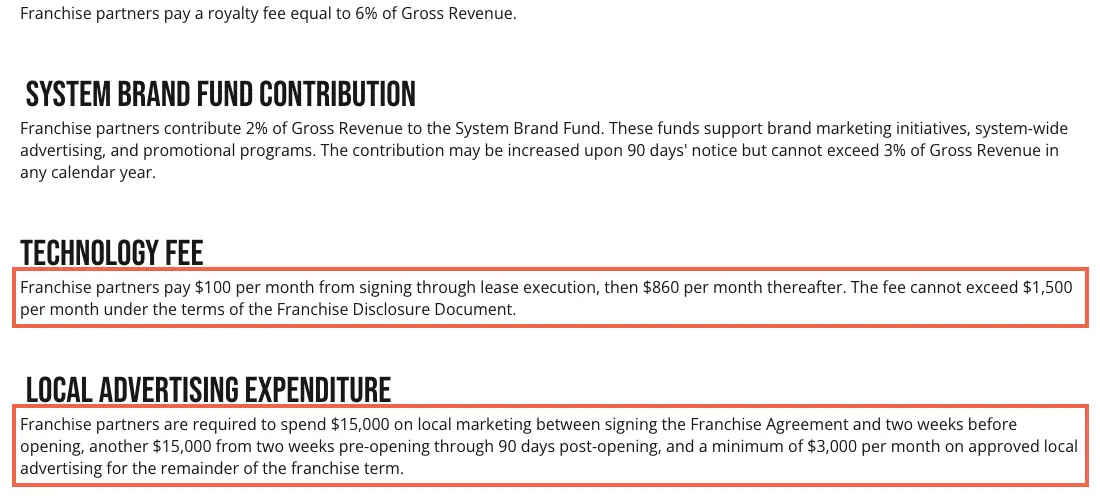
- Ongoing charges are a 6% royalty, a 2% System Brand Fund contribution (capped at 3%), an $860 monthly technology fee (capped at $1,500) and at least $3,000 a month of local advertising, per the franchisor’s financial FAQ.
- Local marketing alone takes $30,000 across two windows that run from signing to 90 days after opening, before the $3,000 monthly floor starts (same FAQ).
- The franchisor’s franchise landing page asks for $200,000 in liquid capital, a $500,000 net worth and a credit score of 700 or higher.
- SBA FOIA records show 138 non-cancelled 7(a) loans under franchise code S0278 from fiscal 2018 to fiscal 2026, totalling $45,178,700 with a median of $243,000 (SBA 7(a) FOIA data, as of September 30, 2026).
- Item 19 of the 2026 FDD exists and covers 307 Reporting Outlets with complete 2025 results; this site does not reproduce its figures.
| Key number | Figure | Source |
|---|---|---|
| Estimated initial investment, single gym | $291,145 to $678,003 | Cost page, citing Item 7 |
| Initial franchise fee | $60,000 ($51,000 for qualifying veterans) | Fee page, citing Item 5 |
| Royalty and brand fund | 6% and 2% of Gross Revenue | Financial FAQ |
| Typical floor area | 3,600 to 7,000 sq ft | Financial FAQ |
| Locations at December 31, 2025 | 395 (388 franchised, 7 company-owned) | Financial FAQ |
| Days allowed from signing to opening | 365 | Financial FAQ |
Why does a Burn Boot Camp gym need $291,145 at the low end and $678,003 at the high end?
The $386,858 gap between the two ends of the Burn Boot Camp range comes mostly from the building: the franchisor says most gyms use about 3,600 to 7,000 square feet, and build-out, equipment and rent deposits scale with that floor. Only $53,500 to $103,248 of the total goes to Kline Franchising or an affiliate; the remaining $237,645 to $574,755 goes to landlords, contractors and suppliers.
The franchisor’s pages list the Item 7 categories but publish dollar amounts for only a few of them. The table below shows which lines carry a published figure and which you will see only in the FDD itself.
| Item 7 category (as listed by the franchisor) | Published amount | Source |
|---|---|---|
| Initial franchise fee | $60,000 standard | Fee page |
| Travel, lodging and meals for initial training | $600 to $6,000 | Fee page, citing Item 7 |
| Local marketing, signing to 2 weeks before opening | $15,000 | Financial FAQ |
| Leasehold improvements and construction | Not published on franchisor pages | Item 7 of the FDD |
| Exercise equipment and training infrastructure | Not published on franchisor pages | Item 7 of the FDD |
| Furniture, fixtures and interior signage | Not published on franchisor pages | Item 7 of the FDD |
| Technology systems and required software | $100 per month until the lease, then $860 per month | Financial FAQ |
| Opening inventory of apparel, supplements and accessories | Not published on franchisor pages | Item 7 of the FDD |
| Professional services, permits and deposits | Not published on franchisor pages | Item 7 of the FDD |
| Working capital | Covers the first 3 months | Cost page |
One detail is worth a direct question to the franchise development team: the low end of the money paid to the franchisor, $53,500, sits below the standard $60,000 fee. The pages do not explain the assumption behind it, so ask which Item 7 footnote produces that number. The FTC rule at 16 CFR 436.5(g) requires Item 7 to appear as a table titled “YOUR ESTIMATED INITIAL INVESTMENT”, and that table is where the line amounts sit.
Which dollars go to Kline Franchising before the doors open?
Burn Boot Camp collects its $60,000 initial fee in one lump sum when the Franchise Agreement is signed, and the fee is nonrefundable, per the fee page citing Item 5. It covers Fundamental Burn U for the owner and up to two team members: 26 classroom hours and 4 on-the-job hours at headquarters in Cornelius, North Carolina, or another designated location.
Two features lower the fee. Under the VetFran program, an owner holding at least 50% who is an honorably discharged or active-duty U.S. service member gets 15% off, which brings the fee to $51,000. Multi-gym buyers sign an Area Development Agreement and pay the full Development Fee at signing, with no further fee per Franchise Agreement. Our veteran franchise discount research compares the VetFran reduction with other franchisors’ terms.
| Gyms committed | Fee per location | Example total fee | Source |
|---|---|---|---|
| 1 to 2 | $60,000 | 2 gyms: $120,000 | Financial FAQ |
| 3 to 5 | $45,000 | 3 gyms: $135,000 | Financial FAQ |
| 6 to 9 | $40,000 | 6 gyms: $240,000 | Financial FAQ |
| 10 or more | $35,000 | 10 gyms: $350,000 | Financial FAQ |
For area developers, the fee page gives a total investment of $326,324 to $1,113,123, depending on how many locations are committed. Our explainer on what a franchise fee pays for sets these tiers against how other brands structure initial fees.
When does each payment fall between signing and day 365?
The Burn Boot Camp agreement gives an owner 365 days from signing to open, and the franchisor says most owners take about six months to sign a lease and another four to six months to open. Cash leaves in a fixed order inside that window, so the timing matters as much as the total when you size a loan draw schedule.
- Day 0, Franchise Agreement signed: $60,000 fee paid in full; technology fee starts at $100 per month; the first $15,000 local marketing window opens.
- About month 6, lease or purchase contract signed: the technology fee rises to $860 per month, with a cap of $1,500.
- Before opening: the owner and up to two team members complete Fundamental Burn U (26 classroom plus 4 on-the-job hours); Item 7 estimates travel and lodging at $600 to $6,000.
- 2 weeks before opening: the second $15,000 local marketing window starts and runs to 90 days after opening.
- Opening, no later than day 365: the 6% royalty and 2% System Brand Fund apply to Gross Revenue.
- Day 90 after opening onward: at least $3,000 per month on approved local advertising for the rest of the term.
What does a Burn gym owe each month once members are training?
After opening, a Burn Boot Camp owner pays two percentage fees and two fixed monthly amounts. The percentage fees total 8% of Gross Revenue (6% royalty plus 2% brand fund), and the brand fund can rise on 90 days’ notice to no more than 3%. The fixed floor is $3,860 a month: the $860 technology fee plus the $3,000 local advertising minimum.
| Ongoing fee | Amount | Ceiling | Source |
|---|---|---|---|
| Royalty | 6% of Gross Revenue | None stated | Financial FAQ |
| System Brand Fund | 2% of Gross Revenue | 3% in any calendar year | Financial FAQ |
| Technology fee | $860 per month after the lease | $1,500 per month | Financial FAQ |
| Local advertising | At least $3,000 per month from day 90 | Minimum, not a cap | Financial FAQ |
| Renewal fee | $10,000 | One 10-year renewal | Financial FAQ |
| Transfer fee | $12,500 per change of control | $2,500 for partial transfers | Resale page, citing Item 6 |
Worked arithmetic: the fixed fees before any revenue is counted
The table multiplies only the published fixed amounts; it uses no sales estimate. Royalty and brand fund dollars depend on Gross Revenue and are left as percentages.
| Line | Monthly | 12 months | Basis |
|---|---|---|---|
| Technology fee at the current rate | $860 | $10,320 | $860 x 12 |
| Local advertising minimum | $3,000 | $36,000 | $3,000 x 12 |
| Fixed floor, current rates | $3,860 | $46,320 | Sum of the two rows |
| Fixed floor if the tech fee reaches its $1,500 cap | $4,500 | $54,000 | $1,500 + $3,000, x 12 |
| Opening marketing windows | n/a | $30,000 | $15,000 + $15,000 |
| Percentage fees | 8% of Gross Revenue | Up to 9% if the fund hits 3% | 6% + 2% (cap 3%) |
How many trainers, managers and ChildWatch staff must be on payroll?
Burn Boot Camp sets a staffing floor for every gym: 1 Lead Trainer, 1 Operations Manager and 3 full-time Burn Ambassadors, plus enough support trainers, ChildWatch staff and extra Ambassadors to deliver the approved services, per the financial FAQ. The owner may fill the Lead Trainer or Operations Manager role only with the franchisor’s prior written consent.
| Role | Required count | Training named by the franchisor |
|---|---|---|
| Lead Trainer | 1 | Trainer Burn U: 24 classroom plus 60 on-the-job hours |
| Operations Manager | 1 | Initial education program before opening |
| Burn Ambassadors, full-time | 3 | Not specified on the pages |
| Support trainers and ChildWatch staff | As needed for approved services | Not specified on the pages |
ChildWatch is part of the member offer: the franchisor’s site index describes memberships as including “complimentary ChildWatch”, and the Burn App lets members book ChildWatch alongside camps. The franchise pages we read give no square footage or room specification for the ChildWatch area, so ask for the design standard in the operations manual summary (Item 11) and check your state’s rules on drop-in child care before you sign a lease.
Floor size is another place to ask. The financial FAQ says most gyms run 3,600 to 7,000 square feet and that dense urban markets may get approval below 3,600, while the landing page says most operate in 4,000 to 6,000 square feet. For how Burn’s footprint compares with big-box and studio gyms, see our gym franchise comparison of seven filings.
What does the protected territory cover, and how long is the contract?
Each Burn Boot Camp gym gets a protected territory tied to its approved address. If fewer than 50,000 people live within a 3-mile radius, the territory is that 3-mile radius; if more than 50,000 do, it is the area containing about 50,000 people, per the financial FAQ. The franchisor will not open or license another Burn inside it while the owner complies with the agreement.
| Term or right | What the franchisor publishes | FDD item |
|---|---|---|
| Territory, under 50,000 people within 3 miles | The 3-mile radius | Item 12 |
| Territory, over 50,000 people within 3 miles | Area holding about 50,000 people | Item 12 |
| Initial term | 10 years | Item 17 |
| Renewal | One 10-year renewal, $10,000 fee, 26-hour Renewal Burn U | Items 6 and 17 |
| Sale of the gym | Franchisor approval, right of first refusal, $12,500 transfer fee | Items 6 and 17 |
| Opening deadline | 365 days from signing | Item 11 |
Our franchise territory rights research shows how population-based territories like this one compare with radius-only and no-protection clauses in other filings.
How have Burn Boot Camp owners financed their gyms through SBA 7(a)?
Burn Boot Camp does not offer direct or indirect financing, and its cost page names ApplePie Capital as an independent preferred lender. SBA’s 7(a) FOIA file, as of September 30, 2026, lists 138 non-cancelled loans under franchise code S0278 (“Burn Boot Camp Fitness”) approved in fiscal 2018 to fiscal 2026, totalling $45,178,700 with a median loan of $243,000.
138 non-cancelled SBA 7(a) loans went to Burn Boot Camp franchisees in FY2018 to FY2026, peaking at 28 in FY2019. Source: SBA 7(a) FOIA data as of September 30, 2026 (CSV: burn-boot-camp-sba-7a-loans-fy2018-fy2026.csv).
| SBA fiscal year | 7(a) loans | Total approved | Median loan |
|---|---|---|---|
| 2018 | 15 | $4,836,400 | $102,000 |
| 2019 | 28 | $6,328,700 | $196,000 |
| 2020 | 12 | $3,049,000 | $194,250 |
| 2021 | 10 | $5,513,600 | $324,200 |
| 2022 | 16 | $4,254,200 | $268,950 |
| 2023 | 19 | $3,870,700 | $200,000 |
| 2024 | 15 | $6,454,400 | $327,000 |
| 2025 | 7 | $2,883,900 | $487,000 |
| 2026 | 16 | $7,987,800 | $334,300 |
| FY2018 to FY2026 | 138 | $45,178,700 | $243,000 |
Of the 138 loans, 92 were coded “Startup, Loan Funds will Open Business” and 15 “Change of Ownership”, and 77 carried a 120-month term. Project states with the most loans were Georgia (14), Texas (13), Florida (12), Minnesota (12) and Pennsylvania (10). The file shows 1 charge-off, but 75 loans carry an “EXEMPT” status that hides repayment, so the record does not measure loan performance. Our SBA Franchise Directory report explains how brand codes such as S0278 work, and you can set the 15 ownership-change loans against other brands in our franchise resale index.
How big is the Burn system, and what will Item 20 tell you?
The franchisor reports 395 Burn Boot Camp locations at December 31, 2025: 388 franchised and 7 company-owned, plus 62 signed franchise agreements for gyms not yet open. A January 21, 2026 International Franchise Association release says 36 gyms opened in 2025, 51 new agreements were signed, and the network is more than 80% female-owned.
Burn Boot Camp had 395 open gyms at December 31, 2025, 98% of them franchised, and 62 more signed. Source: Burn Boot Camp Financial FAQ, citing the 2026 FDD, accessed November 8, 2026.
| Measure | Count | Date | Source |
|---|---|---|---|
| Franchised gyms open | 388 | December 31, 2025 | Financial FAQ |
| Company-owned gyms open | 7 | December 31, 2025 | Financial FAQ |
| Signed, not yet open | 62 | December 31, 2025 | Financial FAQ |
| Gyms opened during 2025 | 36 | Calendar 2025 | IFA release |
| New agreements signed during 2025 | 51 | Calendar 2025 | IFA release |
These counts are the franchisor’s summaries, not the five tables that 16 CFR 436.5(t) requires in Item 20, which include “Status of Franchised Outlets” and “Transfers of Outlets from Franchisees to New Owners”. Those two tables show closures, terminations and resales by state for three years; ask for them and for the former-franchisee contact list before signing.
Does Burn Boot Camp publish EBITDA or profit data in Item 19?
Yes. Item 19 of the 2026 Burn Boot Camp FDD contains a financial performance representation based on 307 Reporting Outlets with complete 2025 results, which the franchisor says is 77.7% of the 395 locations open at year-end 2025. It excludes gyms open less than a year, company-owned gyms and outlets with incomplete data.
According to the financial FAQ, Item 19 reports gross revenue, net operating income and net operating margin as averages, medians, highs and lows, split by outlet age (1-year, 2-year, 3-year and mature outlets) and by membership size, with a separate group of 50 locations above 500 members. This site does not republish those figures. The franchisor notes that net operating income is measured before owner compensation, income taxes and debt service, so loan payments on a median $243,000 SBA loan would come out of it. Our Item 19 research explains how to read a representation like this one.
Which Burn Boot Camp cost figures online are out of date?
At least five figures in circulation differ from the franchisor’s November 2026 pages. Most trace to the 2025 FDD, which a widely read guide still cites; one range appears in search summaries but on none of the four franchisor pages we opened.
| Claim in circulation | Where it appears | Current figure | Source |
|---|---|---|---|
| Total investment $281,899 to $645,344 | A franchise media guide updated in 2025, citing the 2025 FDD | $291,145 to $678,003 | Cost page, 2026 FDD |
| Total investment $221,324 to $823,123 | Search summaries attributed to the franchisor | Not on any franchisor page opened November 8, 2026 | Financial FAQ |
| Liquid capital $150,000, net worth $400,000, credit 680 | The same 2025 guide | $200,000, $500,000, 700 | Landing page |
| 370+ locations | The same 2025 guide | 395 at December 31, 2025 | Financial FAQ |
| 4,000 to 6,000 sq ft | Franchisor landing page | 3,600 to 7,000 sq ft in the FAQ | Financial FAQ |
Which Burn Boot Camp entry path fits your capital?
The path depends on three thresholds the franchisor publishes: $200,000 liquid, $500,000 net worth and a 700 credit score for any applicant, then the number of gyms you commit to, which sets the fee from $60,000 down to $35,000 per location. A purchase of an operating gym swaps the build-out for a negotiated price plus the $12,500 transfer fee.
| If your situation is | Then the published terms point to | Fee you would pay |
|---|---|---|
| Liquid capital under $200,000 or net worth under $500,000 | Below the franchisor’s stated minimums; add an equity partner or revisit later | None yet |
| Veteran owning at least 50%, one new gym | Single Franchise Agreement with the VetFran reduction | $51,000 |
| One or two new gyms | Single unit or a 2-gym Area Development Agreement | $60,000 per gym |
| Three to five gyms in one market | Area Development Agreement, fee paid at signing | $45,000 per gym |
| Six or more gyms | Area Development Agreement | $40,000 (6 to 9) or $35,000 (10+) per gym |
| Buying an operating Burn gym | Request that gym’s actual records under Item 19; seller sets the price | $12,500 transfer fee |
Before you sign anything, the FTC Franchise Rule requires the franchisor to deliver the FDD at least 14 calendar days ahead, per the Item 23 receipt language in 16 CFR 436.5. Our guide to reading a franchise disclosure document lists what to check in Items 7, 12, 19 and 20. This page is general information, not legal, financial or investment advice.
How we compiled this
We opened four Burn Boot Camp franchise pages, the franchisor’s site index and a January 2026 IFA release on November 8, 2026, and compared every repeated figure across them. We tried to open the FDD itself through Minnesota CARDS (no filing), Wisconsin DFI and California DFPI (both blocked automated access) and did not use any workaround, so no FDD page was reviewed. SBA loan counts come from our own tabulation of the 7(a) FOIA file as of September 30, 2026; Item 19 dollar figures were excluded by site policy.
Frequently asked questions
What is the EBITDA of a Burn Boot Camp franchise?
Burn Boot Camp’s 2026 FDD includes an Item 19 representation built on 307 Reporting Outlets with complete 2025 results. It reports gross revenue, net operating income and net operating margin by outlet age and membership size. This site does not republish those figures; read them in Item 19 of the current FDD, which the franchisor must deliver at least 14 calendar days before you sign, per 16 CFR 436.5.
How profitable is a Burn Boot Camp franchise?
Profit for a single gym turns on three published cost drivers: the 8% of Gross Revenue paid as royalty and brand fund, the $3,860 fixed monthly floor for technology and local advertising, and debt service on a build that costs $291,145 to $678,003. Item 19 of the 2026 FDD reports operating results for 307 outlets; compare those with your own lease and payroll quotes.
How much do Burn Boot Camp franchise owners make?
The franchisor does not publish owner pay, and its Item 19 net operating income figure is measured before owner compensation, income taxes and debt service. Your take-home depends on whether you fill the Lead Trainer or Operations Manager seat yourself (allowed only with written consent), your loan size, and the 6% royalty plus 2% brand fund on Gross Revenue.
How much is the Burn Boot Camp franchise fee?
The standard initial franchise fee is $60,000, paid in one lump sum at signing and nonrefundable, per the franchisor fee page citing Item 5 of the April 20, 2026 FDD. Qualifying veterans with at least 50% ownership pay $51,000, and area developers pay $45,000, $40,000 or $35,000 per gym at 3, 6 or 10 committed locations.
How much liquid capital do you need for a Burn Boot Camp franchise?
The franchisor’s franchise page asks applicants for at least $200,000 in liquid capital, a $500,000 minimum net worth and a credit score of 700 or higher. Older guides that cite $150,000 liquid and $400,000 net worth reflect the 2025 figures. SBA records show a median 7(a) loan of $243,000 under the brand’s S0278 code.
Does Burn Boot Camp offer financing?
No. Kline Franchising does not offer direct or indirect financing, according to its financial FAQ. Owners use SBA-backed loans, conventional loans or franchise lenders, and the franchisor names ApplePie Capital as an independent preferred lender. SBA FOIA data lists 138 non-cancelled 7(a) loans for the brand from fiscal 2018 to fiscal 2026.
Where can I find Burn Boot Camp franchise reviews from owners?
The most reliable owner feedback comes from the people listed in Item 20 of the FDD, which names current owners and those who left the system in the last fiscal year. Ask the franchisor for that list and for the Status of Franchised Outlets table, then call owners in several states; Georgia (14) and Texas (13) had the most SBA-financed Burn projects.
Sources
- Burn Boot Camp Franchise Financial FAQ, Kline Franchising, LLC, accessed November 8, 2026.
- How Much Does It Cost to Own a Burn Boot Camp Franchise?, Burn Boot Camp, accessed November 8, 2026.
- What Is the Burn Boot Camp Franchise Fee?, Burn Boot Camp, accessed November 8, 2026.
- Burn Boot Camp franchise landing page, accessed November 8, 2026.
- Exploring the Purchase of an Existing Burn Boot Camp, Burn Boot Camp, accessed November 8, 2026.
- Burn Boot Camp site index (llms.txt), accessed November 8, 2026.
- Burn Boot Camp ends 2025 with double digit growth, International Franchise Association, January 21, 2026, accessed November 8, 2026.
- 7(a) and 504 FOIA loan data, 7(a) FY2010 to present, as of September 30, 2026, U.S. Small Business Administration, accessed November 8, 2026.
- 16 CFR 436.5, Disclosure items, Legal Information Institute, Cornell Law School, accessed November 8, 2026.