The Chick-fil-A franchise cost starts with a $10,000 initial fee, and the 2026 disclosure document puts the total initial investment at $317,521 to $3,463,155, most of it falling due only after the restaurant opens.
Key takeaways
- The initial franchise fee is $10,000, and $5,000 of it is held as a refundable working capital deposit (Chick-fil-A Franchise Disclosure Document, issued March 31, 2026, Item 5).
- Item 7 of the 2026 FDD estimates $317,521 to $3,463,155 to open a traditional restaurant, against $426,735 to $2,339,525 in the 2025 FDD.
- There is no percentage royalty line: a monthly formula takes 15% of Gross Receipts minus equipment rental and a $300 business services fee, then 50% of the remaining Net Profit (2026 FDD, Item 6, Note 2).
- Chick-fil-A has charged 0% for its advertising fund since June 30, 1989, though Item 6 allows up to 3.25% of Gross Receipts.
- Item 20 lists 0 transfers of Operator restaurants to new owners in 2023, 2024 and 2025, and 99 restaurants reacquired by Chick-fil-A in 2025.
- Chick-fil-A’s franchising page asks for $10,000 in non-gifted, non-borrowed funds and 5 or more years of professional work experience; neither it nor the FDD states a net worth minimum.
How much does a Chick-fil-A franchise cost?
A Chick-fil-A franchise costs $10,000 at signing, according to Item 5 of the Chick-fil-A Operator Program FDD issued March 31, 2026. Item 7 estimates the full initial investment at $317,521 to $3,463,155 for a traditional restaurant. Chick-fil-A buys or leases the site and owns the equipment, so the Operator rents both and pays a monthly formula fee instead of a royalty.
The disclosure document is filed with the Minnesota Department of Commerce CARDS database as document 36161-202604-08, file number 7464. It covers the Operator Program only. Airport, campus, hospital and workplace locations run by Licensees are offered under a separate License Program disclosure document; 424 Licensed Units were open at December 31, 2025 (Item 19).
| Cost item | Amount in the 2026 FDD | FDD item |
|---|---|---|
| Initial franchise fee | $10,000 | Item 5 |
| Fee for each additional restaurant | $5,000 | Items 5 and 6 |
| Total initial investment, traditional unit | $317,521 to $3,463,155 | Item 7 |
| Base Operating Service Fee | 15% of Gross Receipts minus equipment rental and business services fee | Item 6, Note 2 |
| Additional Operating Service Fee | 50% of Net Profit | Item 6, Note 2 |
| Advertising fund | 0% to 3.25% of Gross Receipts; 0% charged since 6/30/89 | Item 6 |
| Equipment rental | $750 to $5,000 a month | Items 6 and 8 |
| Premises rent, traditional units | $3,500 to $100,655 a month | Item 6 |
| Time from signing to opening | About 6 to 12 weeks | Item 11 |
For how these items work across franchising in general, our guide to franchise costs and the FDD items behind them covers Items 5, 6 and 7 for any brand.
What does the $10,000 franchise fee cover?
The $10,000 fee buys the Franchise Agreement for one restaurant at a site Chick-fil-A selects. Item 5 splits it in two: $5,000 is fully earned on payment, and $5,000 is kept as a working capital deposit that the Operator must maintain. After termination or non-renewal, the deposit comes back less unpaid costs and losses, currently within two and one-half months.
| Part of the fee | Amount | Refundable? | Source |
|---|---|---|---|
| Non-refundable franchise fee portion | $5,000 | No | Item 5 |
| Working capital deposit | $5,000 | Yes, less amounts owed, after a final reconciliation | Item 5 |
| Additional business fee, per extra restaurant | $5,000 | No | Item 5 |
Item 5 also lists payments that are not part of the fee but come with it. Insurance paid to Chick-fil-A or its program administrator is estimated at about $4,100 to $200,000 a year, and opening inventory bought from the affiliate CFA Supply at about $15,000 to $65,000. Both fall due after the restaurant opens.
What is inside the $317,521 to $3,463,155 Item 7 estimate?
Item 7 of the 2026 FDD has six lines: the $10,000 fee, opening inventory, the first month of equipment rental, the first month of rent, the first month of insurance, and additional funds for the first 3 months of operation. Every line except the fee is marked as not due until after the restaurant opens or as incurred during the first 3 months.
| Item 7 line | Low | High | When due |
|---|---|---|---|
| Initial franchise fee | $10,000 | $10,000 | At signing |
| Opening inventory | $22,950 | $107,000 | After opening |
| First month’s equipment rental | $750 | $5,000 | After opening |
| First month’s lease or sublease | $3,500 | $100,655 | After opening |
| First month’s insurance | $321 | $22,500 | After opening |
| Additional funds, first 3 months | $280,000 | $3,463155 (as printed) | First 3 months |
| Total | $317,521 | $3,463,155 |
The low column adds up exactly to $317,521. The high column does not: the filed Minnesota copy prints the additional funds high as “$3,463155”, the same digits as the total. The five other high figures sum to $245,155, so the total of $3,463,155 reconciles only if additional funds top out at $3,218,000. We report the total as printed and flag the line.
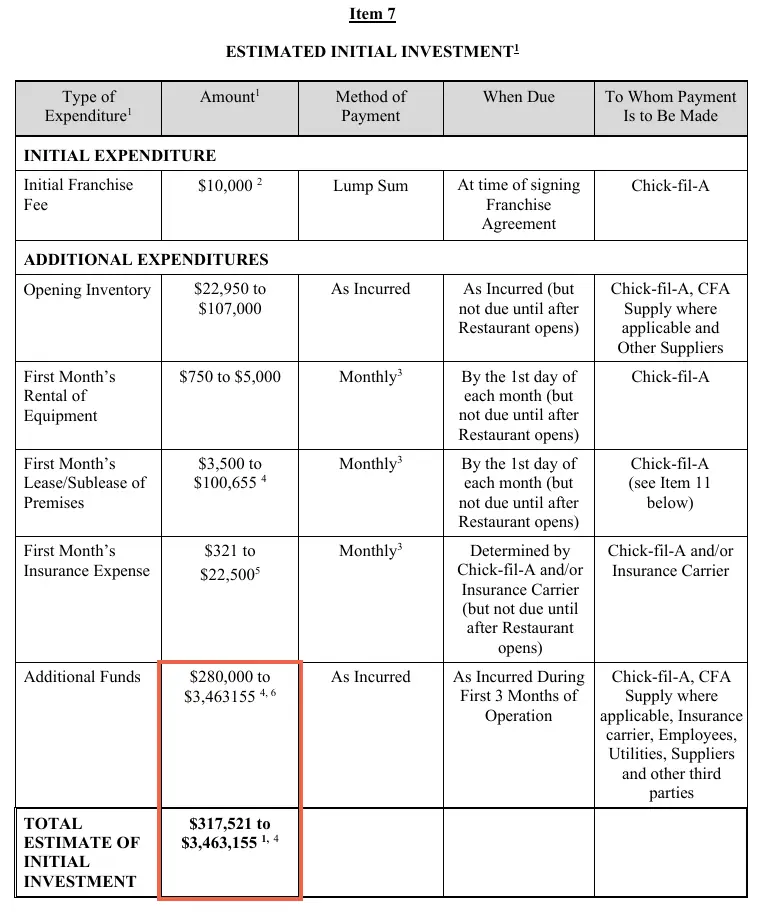
Item 7 Note 2 states that the $10,000 fee “is the only initial out-of-pocket investment you will be required to make to begin operation.” Note 6 says the additional funds figure excludes Operator draws and rests on restaurants opened in the fiscal year ended December 31, 2025. The FTC Franchise Rule at 16 CFR 436.5(g) sets the additional funds period at 3 months or more.
How did the estimate change from 2025 to 2026?
The range widened in both directions between the two most recent filings. Against the 2025 Operator Program FDD issued March 31, 2025, the low estimate fell $109,214 (25.6%) and the high estimate rose $1,123,630 (48.0%), driven mostly by the additional funds line, which covers the first 3 months of operation.
| Item 7 line | 2025 FDD | 2026 FDD |
|---|---|---|
| Opening inventory | $22,000 to $84,000 | $22,950 to $107,000 |
| First month’s equipment rental | $750 to $5,000 | $750 to $5,000 |
| First month’s lease or sublease | $2,725 to $96,285 | $3,500 to $100,655 |
| First month’s insurance | $260 to $10,240 | $321 to $22,500 |
| Additional funds | $391,000 to $2,134,000 | $280,000 to $3,463155 (as printed) |
| Total | $426,735 to $2,339,525 | $317,521 to $3,463,155 |
The 2026 Item 7 low is $109,214 lower and the high $1,123,630 higher than in 2025. Chick-fil-A FDDs issued March 31, 2025 and 2026, Item 7.
Across 259 FDDs filed in Minnesota and issued from 2025 to 2026, the median Item 7 ran $265,372 to $573,000, with the high a median 1.92 times the low; Chick-fil-A’s high is 10.91 times its low. Our franchise initial investment report has the sector medians.
What ongoing fees do Chick-fil-A Operators pay?
Chick-fil-A Operators pay a monthly formula fee, rent, equipment rental, insurance, a $300 business services fee and technology support, all calculated by Chick-fil-A from the restaurant’s Gross Receipts. Item 6 Note 2 of the 2026 FDD defines the formula: a Base Operating Service Fee tied to 15% of Gross Receipts, then a 50% share of Net Profit. There is no separate percentage royalty line.
The formula runs in this order each month, per Item 6 Note 2 and Section 14 of the Franchise Agreement:
- Gross Receipts: all sales for the month, excluding sales tax, including any associated food truck.
- Operating Profit: Gross Receipts minus ordinary and necessary expenses such as rent, equipment rental, the $300 business services fee, insurance and payroll. What the Operator pays to self is not an expense.
- Base Operating Service Fee: the amount by which 15% of Gross Receipts exceeds that month’s equipment rental plus business services fee. Chick-fil-A allocates part of it as a royalty.
- Base Profit: $1,000 a month that the Operator keeps from the first restaurant only, before the profit split.
- Net Profit for Initial Business: Operating Profit minus the Base Operating Service Fee, the Base Profit and any carried offsets.
- Split: 50% to Chick-fil-A as the Additional Operating Service Fee and 50% to the Operator as Additional Profit. An Extra Profit advance of up to $1,500 a month is paid ahead of the Operator’s half.
Because equipment rental and the business services fee are subtracted inside the 15%, they are not charged on top of it. At a free-standing unit, the deduction inside the 15% is the $5,000 monthly equipment rental plus the $300 business services fee (Item 6).
| Fee | Amount | Due | Source |
|---|---|---|---|
| Advertising fund | 0% to 3.25% of Gross Receipts; 0% since 6/30/89 | Monthly | Item 6 |
| Advertising support (optional, in-house agency) | $100 blended hourly rate | As incurred | Item 6 |
| Business services fee | $300 | Monthly | Items 6 and 8 |
| Rent, traditional unit | $3,500 to $100,655 | Monthly | Item 6, Note 6 |
| Occupancy charge, captive venue or delivery kitchen | 4% to 30% of Gross Receipts | Monthly | Item 6, Note 7 |
| Insurance | $321 to $22,500 | Monthly | Item 6 |
| Hardware, software and internet support | $9,500 to $20,000 a year | As incurred | Item 6 |
| Cash handling system services | $85 to $450 | Monthly | Item 6 |
| Food truck usage fee | $2,100 to $7,500 | Monthly | Item 6 |
| Late payment interest | Maximum lawful rate, or 1 1/4% per month | As incurred | Item 6 |
The rent range is the lowest and highest monthly rent any single Operator paid in calendar year 2025. Under an internal Rent Policy in place since January 1, 2015, rent for free-standing, in-line and mall units is held at no more than 6% of annual Gross Receipts, but Item 6 says the policy is not part of the contract and can be revoked. Note 11 caps yearly increases on three Chick-fil-A fees at 35% of the prior year’s amount. The FDD cover page warns that fees may be owed even if the business is losing money, and the FTC’s Consumer’s Guide to Buying a Franchise notes that royalties are often a percentage of gross income.
What does equipment rental cost by restaurant type?
Equipment rental is the one monthly charge Item 6 prices by restaurant format. Item 6 sets it from the fair market rental value of the equipment package under ASC 606, and lists the current monthly amounts below; a food truck is covered under its own agreement.
| Restaurant type | Monthly equipment rental | Source |
|---|---|---|
| Free-standing and in-line | $5,000 | Item 6 |
| Drive-through only | $4,000 | Item 6 |
| Mall | $3,000 | Item 6 |
| Captive venue | $750 to $3,000 | Item 6 |
| Delivery kitchen | $2,500 to $5,000 | Item 6 |
Adding the fixed monthly charges for a free-standing unit shows the floor and ceiling before any formula fee, food or payroll. The rent and insurance ranges span all traditional Operators, so a single site sits somewhere inside them.
| Monthly charge, free-standing unit | Low | High | Source |
|---|---|---|---|
| Equipment rental | $5,000 | $5,000 | Item 6 |
| Business services fee | $300 | $300 | Item 6 |
| Hardware and software support ($9,500 to $20,000 a year divided by 12) | $792 | $1,667 | Item 6 |
| Rent | $3,500 | $100,655 | Item 6 |
| Insurance | $321 | $22,500 | Item 6 |
| Cash handling | $85 | $450 | Item 6 |
| Total fixed charges | $9,998 | $130,572 | FCB arithmetic |
Our franchise royalty rates report puts the median standard royalty at 6% of sales across 239 FDDs, and the advertising fund report puts the median percentage contribution at 2%.
How much cash does a Chick-fil-A Operator need up front?
An Operator needs $10,000 at signing, and Chick-fil-A’s franchising page says it must be non-gifted and non-borrowed. Item 7 Note 2 calls that fee the only initial out-of-pocket investment, and Item 10 says Chick-fil-A leases the premises and equipment and offers extended payment terms on certain pre-opening expenditures. Neither the FDD nor the franchising page states a net worth or liquid capital minimum.
| Line | Amount | Share of Item 7 | Source |
|---|---|---|---|
| Cash due at signing | $10,000 | Item 5 | |
| Of which refundable working capital deposit | $5,000 | Item 5 | |
| Item 7 low estimate | $317,521 | Fee = 3.15% | Item 7 |
| Item 7 high estimate | $3,463,155 | Fee = 0.29% | Item 7 |
| Item 7 lines due before opening | $10,000 | Fee only | Item 7 |
| Stated net worth or liquidity minimum | None stated | FDD; chick-fil-a.com | |
| Second restaurant, if offered | $5,000 | Item 5 |
Item 10 adds that when a restaurant’s Aggregate Operating Profit cannot cover the $1,000 Base Profit and the Extra Profit advance, Chick-fil-A indirectly finances those draws; Item 6 says later profit in the same calendar year covers the shortfall first. Chick-fil-A keeps a security interest in any business equipment the Operator owns, and an Operator who assigns the agreement to an entity must personally guarantee it.
A low entry fee does not mean a low-risk commitment. Ask a franchise attorney to walk through Section 14 of the Franchise Agreement, the one-year term in Item 17 and the personal guarantee in Item 15 before you sign; this page is general information, not legal or financial advice.
What does Chick-fil-A require from an Operator?
Chick-fil-A requires full-time, hands-on operation of one restaurant it selects, with no exclusive territory and a one-year renewable term. Item 15 of the 2026 FDD says the Operator must devote full time and personal best efforts and sign the Franchise Agreement individually. The franchising page adds 5 or more years of professional work experience and divesting all non-passive business interests.
| Requirement or timing | What the source says | Source |
|---|---|---|
| Candidate stage | Operator Candidate Agreement (Exhibit D) once you are considered for a specific restaurant | Item 11 |
| Funds for the fee | $10,000, non-gifted and non-borrowed | chick-fil-a.com/franchising |
| Work experience | 5 or more years of professional work experience | chick-fil-a.com/franchising |
| Other businesses | Divest all non-passive business opportunities | chick-fil-a.com/franchising |
| Disclosure timing | FDD at least 14 calendar days before signing or paying | FDD cover; FTC guide |
| Initial training | About 5 weeks in person: 91 instructor-led hours plus 98 hours in restaurants and at WinShape | Item 11 |
| Signing to opening | About 6 to 12 weeks | Item 11 |
| Site | Chosen by Chick-fil-A; it locates the premises before it seeks an Operator | Item 11 |
| Territory | No exclusive or protected territory | Item 12 |
| Ownership form | Sign individually; an entity only if you are its sole owner, with personal liability | Item 15 |
| Monthly fee report | Prepared by Chick-fil-A between the 1st and 15th day of each month | Item 6, Note 3 |
| Term | Ends December 31 of the signing year (or at lease expiry, if earlier), then renews for one-year periods unless either side gives 30 days notice | Item 17 |
The 2026 training table totals 189 hours, against a median of 76 hours across 259 FDDs in our report on how long it takes to open a franchise, where the median time to open is 5.9 to 9 months. Item 17 also lets Chick-fil-A change the agreement’s terms by written notice at least 45 days before a term ends. On territory, 18.9% of the FDDs in our franchise territory rights report give no protected area; Chick-fil-A’s Item 12 would place it in that group.
How does Chick-fil-A compare with a typical franchise FDD?
Chick-fil-A’s fee is about one fifth of the median initial franchise fee, while its Item 7 high is about six times the median high, based on 259 FDDs registered in Minnesota and issued from 2025 to 2026. The ongoing take is built differently: a formula on Gross Receipts and Net Profit replaces the usual percentage royalty and advertising fund.
| Measure | Chick-fil-A, 2026 FDD | Benchmark, 259 FDDs 2025 to 2026 | Source |
|---|---|---|---|
| Initial franchise fee | $10,000 | Median $49,500 | Item 5; FCB royalty report |
| Item 7 range | $317,521 to $3,463,155 | Median $265,372 to $573,000 | Item 7; FCB investment report |
| High estimate as a multiple of low | 10.91x | Median 1.92x | FCB arithmetic |
| Fee as a share of the Item 7 high | 0.29% | Median 7.6% | FCB arithmetic |
| Royalty | Formula: 15% of Gross Receipts less equipment rental and business services fee, plus 50% of Net Profit | Median 6% of sales (239 FDDs) | Item 6; FCB royalty report |
| Advertising fund | 0% charged since 1989; up to 3.25% allowed | Median 2% where a percentage | Item 6; FCB advertising fund report |
| Signing to opening | 6 to 12 weeks | Median 5.9 to 9 months | Item 11; FCB time-to-open report |
| Protected territory | None | 18.9% give none | Item 12; FCB territory report |
| Item 19 included | Yes, sales figures only | 77.2% include one | Item 19; FCB Item 19 report |
Item 8 shows where else money flows. Chick-fil-A estimates that approved or designated suppliers take 38% to 61% of an Operator’s purchases and leases in operation, and its 2025 revenue from Operator and Licensee purchases and leases was $1,870,222,936, or 18.08% of $10,342,734,669 in total revenue. Warehouse goods are sold at cost plus about 2.5%.
What do Items 19, 20 and 21 show?
Item 20 shows a growing Operator system with no resales: franchised restaurants rose from 2,494 at the end of 2023 to 2,795 at the end of 2025, transfers to new owners were 0 in each year, and Chick-fil-A reacquired 99 restaurants in 2025. Item 19 reports sales only, and Item 21 holds audited statements for Chick-fil-A, Inc.
| Year | Start | Opened | Reacquired by Chick-fil-A | Ceased, other reasons | End | Transfers |
|---|---|---|---|---|---|---|
| 2023 | 2,331 | 255 | 84 | 8 | 2,494 | 0 |
| 2024 | 2,494 | 243 | 102 | 6 | 2,629 | 0 |
| 2025 | 2,624 | 278 | 99 | 8 | 2,795 | 0 |
In 2025, 278 Operator restaurants opened, 99 were reacquired by Chick-fil-A and 8 ceased for other reasons; transfers were 0. Chick-fil-A FDD issued March 31, 2026, Item 20.
Item 20 Note 3 counts as reacquired every case where a restaurant passes from an Operator back to Chick-fil-A, including Operators who leave to take a different restaurant; “Opened” includes company restaurants bought by Operators. The 2025 opening count of 2,624 is 5 below the 2024 closing count of 2,629, which the table does not explain. Terminations and non-renewals were 0 in all three years.
Item 19 exists. It gives annual sales volume (median, average, highest, lowest and thirds) for 2,506 Operator restaurants open all of 2025, split into 201 mall, 2,302 non-mall and 3 delivery kitchen units, and excludes Licensed Units, company-operated units and captive venues. It has no cost or profit lines. We do not republish earnings figures; read Item 19 of the current FDD, and our Item 19 report explains how to read one.
Item 21 and Exhibit C hold consolidated statements audited by PricewaterhouseCoopers LLP. For 2025, Chick-fil-A, Inc. reported total revenue and income of $10,342,734,669, net earnings of $1,054,017,044 and total assets of $18,204,885,749. These describe the franchisor, not any restaurant.
What do other guides get wrong about the Chick-fil-A franchise cost?
Most errors come from older FDDs or from shortening the Item 6 formula into “15% plus 50%”. We opened three pages ranking for this query in October 2026 and checked the four claims below against the FDD issued March 31, 2026, quoting each claim as printed and listing what the primary source says.
| What a guide says | What the primary source says | Source |
|---|---|---|
| A business explainer published June 2024: Chick-fil-A “commands 15% of sales + 50% of any profit” | The 15% is reduced by that month’s equipment rental and business services fee; the 50% applies to Net Profit after a $1,000 Base Profit and any offsets | Item 6, Note 2 |
| A franchise profile page last updated in 2024: “a royalty fee of 15% back to the Chick-fil-A corporation” | No separate percentage royalty line; Chick-fil-A allocates part of the Base Operating Service Fee as a royalty | Item 6, Note 2 |
| The same two pages: total investment of “$343k to $2m” (June 2024) and $518,385 to $2,803,435 (2024) | $317,521 to $3,463,155 in the FDD issued March 31, 2026; $426,735 to $2,339,525 in the FDD issued March 31, 2025 | Item 7 |
| A 2026 FDD review: additional funds of $280,000 to $3,218,000 | The filed Minnesota copy prints “$3,463155”; $3,218,000 is the figure that reconciles to the printed total | Item 7 |
Which situations fit the Operator model?
The Operator model fits a person who wants to run one restaurant full time and can show $10,000 of their own funds, and it fits poorly for investors seeking equity, a territory or a resale. Each row below ties a buyer situation to the FDD item or page that decides it, so you can rule the model in or out before applying.
| If your situation is | Then | Basis |
|---|---|---|
| You cannot document $10,000 of your own non-gifted, non-borrowed funds | You do not meet the stated minimum | chick-fil-a.com/franchising |
| You have fewer than 5 years of professional work experience | You fall below the stated minimum | chick-fil-a.com/franchising |
| You want a semi-absentee or investor role | The model does not allow it: Item 15 requires full-time direct supervision | Item 15 |
| You want equity you can sell later | Item 20 shows 0 transfers in 2023 to 2025, and Chick-fil-A owns or leases the site and equipment | Items 8, 10 and 20 |
| You need a protected trade area | Item 12 grants none | Item 12 |
| You control an airport, campus, hospital or workplace food site | Ask Chick-fil-A for the separate License Program disclosure document | Item 1 |
| You want to own the building, equipment and business yourself | Compare brands whose Item 7 you fund yourself; the median is $265,372 to $573,000 | FCB investment report |
If you fit the last row, a consultant can shortlist brands by Item 7 range and Item 15 involvement; our page on what a franchise consultant does explains how they are paid, and the guide to buying a franchise sets out the steps from first call to signing.
How we compiled this
We read the Chick-fil-A Operator Program FDD issued March 31, 2026 and the prior FDD issued March 31, 2025, both downloaded from Minnesota CARDS, plus Chick-fil-A’s franchising page, the FTC buyer guide and 16 CFR 436.5, in October 2026. Benchmarks come from our analysis of 259 Minnesota-filed FDDs. We excluded Item 19 figures and all owner income estimates by site rule, and did not use applicant counts that rest only on interviews.
Frequently asked questions
How much is a Chick-fil-A franchise?
The initial franchise fee is $10,000, paid when you sign the Franchise Agreement, and $5,000 of it is a refundable working capital deposit. Item 7 of the FDD issued March 31, 2026 estimates the total initial investment for a traditional restaurant at $317,521 to $3,463,155, with every line except the fee due after opening or during the first 3 months.
Is Chick-fil-A a franchise?
Yes. Chick-fil-A, Inc. sells franchises to Operators under its Operator Program FDD, filed in Minnesota as document 36161-202604-08. Unlike most franchises, Chick-fil-A selects and controls the site, owns the equipment and leases both to the Operator. At December 31, 2025, 2,795 restaurants were Operator-run and 68 were company-operated (Item 20).
How much do Chick-fil-A franchise owners make?
We do not publish earnings figures. Item 19 of the 2026 FDD reports annual sales volume for 2,506 Operator restaurants open all of 2025, with no cost or profit lines. What an Operator keeps depends on the Item 6 formula: 15% of Gross Receipts less equipment rental and the business services fee, then a 50% split of Net Profit.
What are the Chick-fil-A franchise requirements?
Chick-fil-A’s franchising page lists $10,000 in non-gifted, non-borrowed funds, 5 or more years of professional work experience, full-time hands-on operation and divesting all non-passive business interests. Item 15 of the FDD requires full time and personal best efforts, and Item 11 requires about 5 weeks of in-person initial training.
Does Chick-fil-A charge a royalty?
Not as a separate percentage line. Item 6 Note 2 of the 2026 FDD defines a Base Operating Service Fee equal to 15% of Gross Receipts minus that month’s equipment rental and $300 business services fee, and says Chick-fil-A allocates part of it as a royalty. A second fee takes 50% of Net Profit after a $1,000 Base Profit.
Can you own more than one Chick-fil-A restaurant?
Only if Chick-fil-A offers it. Item 5 says Chick-fil-A may, but is not obligated to, license additional restaurants under the same Franchise Agreement for $5,000 each, whether a traditional location, a captive venue or a delivery kitchen. Base Profit of $1,000 a month applies to the first restaurant only.
Can you open a Chick-fil-A at an airport or a college?
Not under the Operator Program. Item 1 of the 2026 FDD says Chick-fil-A offers licenses for schools, workplaces, universities, airports, hospitals and similar captive audience sites under a separate disclosure document. There were 424 of these Licensed Units at December 31, 2025, and they are excluded from Item 19.
Sources
- Chick-fil-A, Inc., Chick-fil-A Operator Program Franchise Disclosure Document, issued March 31, 2026, Items 1, 5 to 12, 15, 17, 19 to 21, Minnesota CARDS document 36161-202604-08, accessed October 20, 2026.
- Chick-fil-A, Inc., Chick-fil-A Operator Program Franchise Disclosure Document, issued March 31, 2025, Item 7, Minnesota CARDS document 33525-202504-02, accessed October 20, 2026.
- Chick-fil-A, Franchising: franchisee minimum requirements, accessed October 20, 2026.
- Federal Trade Commission, A Consumer’s Guide to Buying a Franchise, accessed October 20, 2026.
- 16 CFR 436.5, Disclosure items (Legal Information Institute), accessed October 20, 2026.
- Minnesota Department of Commerce, CARDS franchise registrations, accessed October 20, 2026.