Yes, Chicken Salad Chick franchise rights are sold by Simply Southern Restaurant Group, LLC, and its April 20, 2026 disclosure document puts a first restaurant at $777,000 to $998,500, or $802,000 to $1,033,500 with a drive-thru.
Key takeaways
- The Chicken Salad Chick Franchise Disclosure Document, issued April 20, 2026 lists a $50,000 initial franchise fee plus a $10,000 grand opening marketing fee for the first restaurant (Item 5).
- Royalty is the greater of $600 or 5% of Gross Sales each semi-monthly period, so the floor is $14,400 a year before any Brand Fund charge (Item 6 and Franchise Agreement Article IV.A).
- Funds affiliated with Brentwood Associates Private Equity have controlled the franchisor’s parent since November 4, 2019, through BA CSC Holdings, LLC (Exhibit C, note 1).
- Franchised restaurants rose from 159 to 252 between January 1, 2023 and December 31, 2025, while affiliate-owned units ended 2025 at 74 after 12 were sold to franchisees (Item 20).
- The default Protected Area is a 1-mile radius from the front entrance, and an Area Development Agreement grants no exclusive territory (Item 12).
Who sells the franchise, and who stands behind the seller?
Simply Southern Restaurant Group, LLC is the franchisor, a Georgia limited liability company formed on October 4, 2012 and based at 2839 Paces Ferry Road SE in Atlanta. Item 1 of the 2026 document says it has offered Chicken Salad Chick franchises since October 2012 and has never operated a restaurant itself; every affiliate-owned unit belongs to SSRG II, LLC.
The concept dates to January 7, 2008, when the first restaurant opened in Auburn, Alabama, under founders Stacy and Kevin Brown (Item 1). The chain of control above the franchisor is set out in two places: Item 1 names the parents, and note 1 to the audited statements in Exhibit C names the private equity owner.
- Investment funds affiliated with Brentwood Associates Private Equity incorporated BA CSC Holdings, LLC in 2019 (Exhibit C, note 1).
- BA CSC Holdings, LLC acquired SSRG Holdings, LLC through a merger dated November 4, 2019.
- SSRG Holdings, LLC, a Georgia company formed in May 2015, is the direct parent of the franchisor and of three affiliates.
- SSRG II, LLC runs all affiliate restaurants, 74 at the end of 2025 (Item 20).
- CSC Ad Funds, LLC administers the Brand Fund and collects the 2% contribution and the $10,000 grand opening fee (Items 1, 5 and 6).
- SSRG Cake, LLC is the source of the cake and dessert line sold in every restaurant and runs PIECE OF CAKE shops around Atlanta (Item 12).
- Item 1 also names two affiliates under common ownership with no role in Chicken Salad Chick: Hissho International, with 2,650 franchised Hissho Sushi and Oumi Sushi locations, and Blaze Pizza, LLC, with 241 franchised Blaze Pizza restaurants, both as of December 31, 2025.
Private equity control matters for one clause in particular. Item 12 reserves the franchisor’s right to be acquired by, or to buy, a business that runs competing restaurants, including inside your Protected Area. Our study of private equity ownership across franchise disclosure documents tracks how often that kind of clause appears.
What does the first restaurant cost, line by line?
Item 7 of the 2026 document estimates $777,000 to $998,500 for an in-line restaurant and $802,000 to $1,033,500 for a drive-thru site. The $25,000 to $35,000 gap between the two totals is exactly the Drive Thru Package line. Of either total, $60,200 to $60,700 goes to the franchisor or an affiliate, according to the cover page.
| Item 7 line | In-line restaurant | Drive-thru restaurant | Paid to |
|---|---|---|---|
| Initial franchise fee | $50,000 | $50,000 | Franchisor |
| Grand opening marketing fee | $10,000 | $10,000 | CSC Ad Funds, LLC |
| Rent (1 month) and security deposit | $6,000 to $15,000 | $6,000 to $15,000 | Landlord |
| Leasehold improvements | $425,000 to $525,000 | $425,000 to $525,000 | Contractors or landlord |
| Furniture, fixtures and equipment | $175,000 to $225,000 | $175,000 to $225,000 | Approved vendors |
| Decor package | $15,000 to $20,000 | $15,000 to $20,000 | Approved vendors |
| Branded merchandise | $9,000 to $10,000 | $9,000 to $10,000 | Approved vendors |
| Inventory | $12,000 to $13,000 | $12,000 to $13,000 | Approved vendors |
| Signage | $12,000 to $25,000 | $12,000 to $25,000 | Approved vendors |
| Drive Thru Package | Not required | $25,000 to $35,000 | Approved vendors |
| Technology equipment and software | $25,000 to $35,000 | $25,000 to $35,000 | Approved vendors |
| Permits and licenses | $500 to $2,500 | $500 to $2,500 | Cities and counties |
| Insurance (6 months) | $2,500 to $3,500 | $2,500 to $3,500 | Insurance carrier |
| Training travel for 3 people | $5,000 to $9,000 | $5,000 to $9,000 | Hotels, vendors, employees |
| Other deposits and prepaid expenses | $0 to $5,500 | $0 to $5,500 | Vendors, agencies |
| Professional fees | $10,000 to $20,000 | $10,000 to $20,000 | Attorney, architect |
| Additional funds, 3 months | $20,000 to $30,000 | $20,000 to $30,000 | Employees, vendors |
| Total (Item 7) | $777,000 to $998,500 | $802,000 to $1,033,500 | Source: FDD Item 7 |
Leasehold improvements reach $525,000 at the high end, more than twice the $225,000 equipment line. Source: Chicken Salad Chick FDD issued April 20, 2026, Item 7.
What the Item 7 notes add to that table
Note 2 to Item 7 prices leasehold work at $170 to $210 per square foot for a prototype of about 2,500 square feet, which is where the $425,000 to $525,000 line comes from. The same note says landlords paid average tenant improvement funds of approximately $105,000 per prototypical restaurant in 2025, an amount left out of the table because offers differ by lease.
Three items sit outside the totals. Note 4 excludes water tap, sewer tap and impact fees. Note 6 says the 3-month additional funds line includes no draw or salary for you. The total note states the franchisor offers no direct or indirect financing, so lenders set the debt terms; our franchise financing guide covers the SBA and conventional routes.
Which charges come out of Gross Sales twice a month?
Item 6 collects the royalty and the Brand Fund contribution on the 5th and 20th of each month by automatic bank debit. The royalty is 5% of Gross Sales with a $600 minimum per semi-monthly period, and the Brand Fund is currently 2% of Gross Sales, with the contract allowing up to 4%. A local co-op can add up to 1% more.
| Charge | Amount in the 2026 FDD | When due | Source |
|---|---|---|---|
| Continuing royalty | Greater of $600 or 5% of Gross Sales per period | 5th and 20th of each month | Item 6; Franchise Agreement Art. IV.A |
| Brand Fund contribution | 2% now; up to 4% allowed | 5th and 20th of each month | Item 6 |
| Advertising cooperative | Capped at 1% of Gross Sales | Set by the cooperative | Item 6, Note 4 |
| Technology and software fee | Up to $500 per month (not charged today) | As incurred | Item 6 |
| On-site training for a new manager | $5,000 for up to 3 people per 10-day session | After training | Items 6 and 11 |
| Transfer of an open restaurant | $10,000 first; $5,000 each additional | At transfer | Item 6 |
| Renewal | $5,000 | On invoice | Item 6 |
| Late or dishonored payment | $100 plus interest up to 1.5% per month | When invoiced | Item 6 |
| Management fee if the franchisor steps in | Up to 10% of Gross Sales plus expenses | As incurred | Item 6 |
The $600 floor works out to $1,200 a month and $14,400 a year, owed even in a slow period. Item 8 adds two money flows that the fee table does not show: in 2025 approved suppliers paid CSC Ad Funds, LLC $1,409,553 based on franchised and affiliate purchases, all deposited into the Brand Fund, and SSRG Cake received approximately $4,284,000 from dessert sales to a distributor serving franchised restaurants. Our supplier rebate research compares how other franchisors report the same disclosure.
Does Item 19 show what an owner takes home?
Item 19 of the 2026 document is a historical financial performance representation covering 214 franchised and 69 affiliate-owned restaurants open for all of 2025. It reports annual Gross Sales statistics and four partial operating statements for affiliate units, split into thirds of 23 restaurants each. We do not republish those figures; read them in Item 19 itself and see our Item 19 research for how to test them.
How did the store count move between 2023 and 2025?
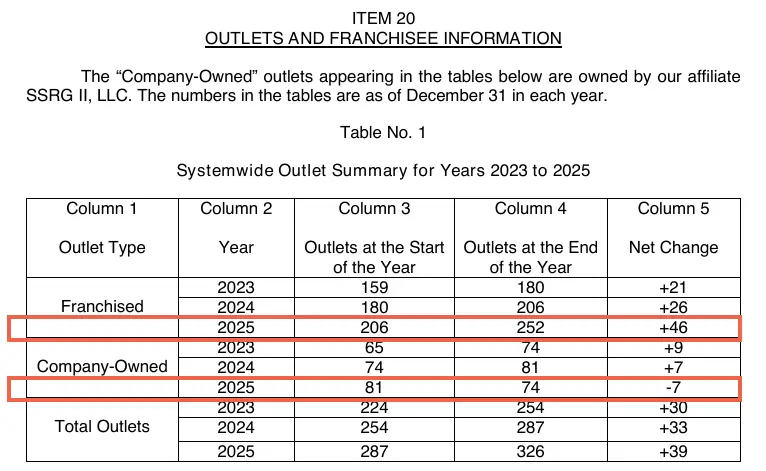
Item 20 Table No. 1 shows the system grew from 224 to 326 outlets over three years. Franchised units rose every year, from 159 at the start of 2023 to 252 at the end of 2025. Affiliate-owned units peaked at 81 at the end of 2024 and fell to 74 in 2025, because SSRG II, LLC sold 12 restaurants to franchisees.
Franchised outlets grew to 252 by December 31, 2025 while affiliate-owned outlets fell back to 74. Source: Chicken Salad Chick FDD issued April 20, 2026, Item 20 Table No. 1; data file chicken-salad-chick-item-20-outlets.csv.
| Year | Franchised, start to end | Affiliate-owned, start to end | System total, end of year | Source |
|---|---|---|---|---|
| 2023 | 159 to 180 (+21) | 65 to 74 (+9) | 254 | Item 20, Table No. 1 |
| 2024 | 180 to 206 (+26) | 74 to 81 (+7) | 287 | Item 20, Table No. 1 |
| 2025 | 206 to 252 (+46) | 81 to 74 (-7) | 326 | Item 20, Table No. 1 |
What sits behind the 2025 numbers
Table No. 3 records 49 franchised openings in 2025, led by Florida with 9, Indiana with 8, Texas with 7 and Oklahoma with 6, against 3 franchised units that ceased operations and no terminations. Table No. 4 shows the 12 affiliate units sold to franchisees came from Indiana (8), Oklahoma (3) and Florida (1). Franchised units made up 77.3% of the system at the end of 2025, against 70.9% two years earlier.
Transfers between franchisees also jumped. Table No. 2 counts 22 transfers in 2025, including 12 in Texas and 5 in Louisiana, after 1 in 2023 and 3 in 2024. For anyone weighing an existing unit, Item 7 says no affiliate resale price in 2025 exceeded the high end of the Item 7 ranges, and the $10,000 transfer fee applies; our transfer fee research sets that against other systems. Table No. 5 lists 47 signed agreements not yet open and 43 projected franchised openings in the following year.
What exactly does the 1-mile Protected Area protect?
Item 12 gives each restaurant a Protected Area that, unless the franchisor sets a smaller one for a dense urban market or a Non-Traditional Venue, equals a 1-mile radius from the front entrance. Inside it, neither the franchisor nor its affiliates will open or license another Chicken Salad Chick restaurant, and the area cannot shrink during the 10-year initial term.
| Activity inside your 1-mile Protected Area | Allowed to the franchisor? | Item 12 basis |
|---|---|---|
| Another Chicken Salad Chick restaurant physically located there | No | Location exclusivity |
| A restaurant just outside or on the boundary line | Yes | Reserved right (1) |
| Selling Chicken Salad Chick products online or through other channels into the area | Yes | Reserved right (2) |
| Competing businesses under other trademarks | Yes | Reserved right (3) |
| Buying, or being bought by, a competing chain with units in the area | Yes | Reserved rights (4) and (5) |
| PIECE OF CAKE dessert shops and shipping by SSRG Cake | Yes | Affiliate disclosure |
Under an Area Development Agreement the rules tighten further. Item 12 says the Development Area carries no exclusive territory, and the franchisor may place restaurants in airports, hospitals, universities, supermarkets, ghost kitchens and other Non-Traditional Venues, or in Restricted Venues whose owners set standards you cannot meet, whenever you decline the site. Units in those venues do not count toward your schedule. Our territory rights research compares radius grants across brands.
What does a three-restaurant development deal cost in fees?
An Area Development Agreement requires at least 2 restaurants. At signing you pay the $50,000 first-unit fee plus a $20,000 deposit for each additional restaurant, and each later unit carries a $45,000 fee, of which $25,000 is due when its own Franchise Agreement is signed (Item 5). The arithmetic below uses only those Item 5 figures.
| Payment point | Calculation | Amount |
|---|---|---|
| ADA signing, development fee | $50,000 + (2 x $20,000) | $90,000 |
| ADA signing, grand opening fee for unit 1 | $10,000 | $10,000 |
| Unit 2 Franchise Agreement | $25,000 balance + $10,000 grand opening fee | $35,000 |
| Unit 3 Franchise Agreement | $25,000 balance + $10,000 grand opening fee | $35,000 |
| Initial fees for 3 restaurants | $50,000 + $45,000 + $45,000 + (3 x $10,000) | $170,000 |
Each restaurant still needs its own Item 7 build-out, and the ADA version of Item 7 shows $797,000 to $1,018,500 for an in-line first unit because the $20,000 deposit is paid up front. The development fee is not refundable, there is no duty to extend the schedule, and each extension request can cost $2,500 (Items 5, 6 and 12). Our area development agreement research explains how schedules are usually written.
What does the contract clock look like from signing to year 10?
The Franchise Agreement runs 10 years with three 10-year renewals (Item 17). Before that, Item 11 sets the opening pace: an accepted site within 120 days if none is named at signing, 2 weeks and 101 hours of training for you and 2 key employees, and an opening generally 8 to 12 months after signing, with a hard deadline of 13 months.
- Day 0: sign the Franchise Agreement and pay the $50,000 fee and $10,000 grand opening fee (Item 5).
- Day 120: have a site accepted if none was named at signing, or the franchisor may terminate without refunding the fee (Item 11).
- Training: at least 2 weeks and 101 hours, with 30 or more hours worked in restaurants, starting 60 days after signing or within 30 days before projected opening (Item 11).
- Opening: generally 8 to 12 months after signing; required within 13 months; owners with fewer than 2 restaurants get an opening team for up to 10 days (Item 11).
- Remodels: at most once every 5 years, starting within 4 months of written notice (Item 8).
- Year 10: renew for a $5,000 fee if you meet the Item 17 conditions, including a full remodel and new technology.
- After exit: an 18-month non-compete within 5 miles of your former site or any Chicken Salad Chick restaurant (Item 17, row r).
Item 15 adds an operating rule worth checking against the brand’s marketing. The franchisor’s franchise opportunity page advertises “Closed on Sundays,” yet Item 15 reserves the right to require the restaurant to open 7 days each week, including Sundays, and requires a dedicated Operating Partner who may not run another business without written approval. Our research on time to open puts the 8 to 12 month window in context.
Which published figures are out of date?
Several pages ranking for this search still quote earlier disclosure documents. The 2024 FDD estimated $747,000 to $964,500 for an in-line restaurant; the 2026 FDD raises that to $777,000 to $998,500, mostly through the leasehold line, which moved from $400,000 to $500,000 up to $425,000 to $525,000. The table compares claims we found on November 8, 2026 with the current filing.
| Claim found in a ranking guide or directory | What the 2026 FDD says | Source |
|---|---|---|
| Total investment $747,000 to $964,500 (review based on the 2024 FDD) | $777,000 to $998,500 in-line; $802,000 to $1,033,500 drive-thru | Item 7 |
| Total investment $742K to $980K (association directory, no FDD year) | $777,000 to $998,500 in-line | Item 7 |
| 2023 affiliate-owned units starting at 66 | 65 at the start of 2023, ending at 74 | Item 20, Table No. 1 |
| Average annual Gross Sales labelled as “ROI” (guide updated September 2026) | Item 19 reports Gross Sales and partial operating statements, not a return on investment | Item 19 |
| Eligibility listed as $250,000 liquid assets and $750,000 net worth | Item 7 and the rest of the FDD set no minimum; the figures match the franchisor’s application form brackets of $250,000+ and $750,000+ | Opportunity page form |
Before you apply: which plan matches the disclosure document?
The decision turns on three FDD facts: the $777,000 floor for an in-line build, the 1-mile radius that can shrink in dense markets, and the Item 15 rule that an Operating Partner be dedicated to the restaurant. The table pairs each common plan with the clause that governs it and the question to put to the franchise development team in writing.
| If your plan is | What the 2026 FDD says | Ask before signing |
|---|---|---|
| One restaurant with under $250,000 in liquid assets | Item 7 starts at $777,000 and the franchisor offers no financing (Item 10) | Which lenders have closed loans for recent openings, and at what equity share? |
| A drive-thru pad site | Add $25,000 to $35,000 for the Drive Thru Package (Item 7) | Does the site meet the minimum traffic count in Item 7 Note 2? |
| A city-center or campus location | The Protected Area may be smaller or none (Item 12) | What radius will be written into the Franchise Agreement? |
| Two or more restaurants | ADA, no exclusive territory, $20,000 deposit per extra unit (Items 5 and 12) | Which Non-Traditional Venues already have pending deals in the Development Area? |
| Running it semi-absentee | A dedicated Operating Partner and a daily General Manager are required (Item 15) | Can your Operating Partner hold other business interests with approval? |
| Buying an existing restaurant | 22 franchisee transfers in 2025; $10,000 transfer fee (Items 6 and 20) | Request the seller’s records, which Item 19 allows the franchisor to share |
Federal rules give you time to check all of this. Under the FTC Franchise Rule, 16 CFR Part 436, you must receive the disclosure document at least 14 calendar days before signing or paying. The FTC’s Consumer’s Guide to Buying a Franchise lists questions for current owners, whose contacts appear in Exhibit F. Our guide to reading a franchise disclosure document walks through the other Items. This page is general information, not legal, financial or investment advice.
How we compiled this
We read the full 276-page Chicken Salad Chick disclosure document filed with the Minnesota Department of Commerce (CARDS document 36114-202604-03, received April 21, 2026), including Items 1 to 23 and note 1 of the Exhibit C audited statements, and the franchisor’s public opportunity page. We compared five ranking pages against the filing in November 2026. We excluded all Item 19 sales and profit figures under our editorial policy and named no franchisees.
Frequently asked questions
Is Chicken Salad Chick a franchise?
Yes. Simply Southern Restaurant Group, LLC has sold Chicken Salad Chick franchises since October 2012, and at the end of 2025 franchisees ran 252 of the 326 restaurants, according to Item 20 of the April 20, 2026 disclosure document. The other 74 belong to the affiliate SSRG II, LLC, which sold 12 restaurants to franchisees during 2025.
How much does a Chicken Salad Chick franchise cost?
Item 7 of the 2026 disclosure document estimates $777,000 to $998,500 for a restaurant without a drive-thru and $802,000 to $1,033,500 with one. Those totals include the $50,000 initial franchise fee, the $10,000 grand opening marketing fee and $425,000 to $525,000 of leasehold improvements, but exclude water tap, sewer tap and impact fees.
How much does a Chicken Salad Chick franchise owner make?
The franchisor publishes historical Gross Sales and partial operating statements in Item 19, covering 214 franchised and 69 affiliate restaurants open all of 2025. We do not republish those figures. Owner income then depends on the 5% royalty, the 2% Brand Fund, rent, labor and debt service, and Item 7 budgets no owner salary in its 3-month reserve.
What are the requirements to own a Chicken Salad Chick?
The disclosure document sets no net worth floor, but the franchisor’s application form uses $750,000+ net worth and $250,000+ liquid asset brackets. Item 15 requires a dedicated Operating Partner, Item 11 requires 2 weeks and 101 hours of training for 3 people, and every owner of 10% or more must sign a personal guaranty.
Who owns Chicken Salad Chick?
Note 1 to the audited financial statements in the 2026 disclosure document says investment funds affiliated with Brentwood Associates Private Equity formed BA CSC Holdings, LLC, which acquired the parent SSRG Holdings, LLC on November 4, 2019. Item 1 names Hissho International and Blaze Pizza, LLC as affiliates under common ownership.
Can a Chicken Salad Chick franchisee be required to open on Sundays?
Yes. The franchisor’s opportunity page markets restaurants as closed on Sundays, but Item 15 of the 2026 disclosure document reserves the right to require each restaurant to open 7 days each week, including Sundays. Ask for the current hours policy in the Operations Manual in writing before signing the 10-year agreement.
Sources
- Chicken Salad Chick Franchise Disclosure Document, issued April 20, 2026, Items 1, 3 to 8, 10 to 12, 15, 17, 19 to 21 and Exhibit C. Minnesota Department of Commerce CARDS. Accessed November 8, 2026.
- Chicken Salad Chick franchise opportunity page, Simply Southern Restaurant Group. Accessed November 8, 2026.
- 16 CFR Part 436, Disclosure Requirements and Prohibitions Concerning Franchising, eCFR. Accessed November 8, 2026.
- A Consumer’s Guide to Buying a Franchise, Federal Trade Commission. Accessed November 8, 2026.