The Crumbl franchise cost is $848,566 to $1,472,533 per store in the FDD issued April 6, 2026, as amended July 1, 2026. Its Item 20 shows yearly openings falling from 288 to 52 while transfers rose from 44 to 82.
Key takeaways
- Growth slowed in every year shown: franchised Crumbl outlets rose from 689 on January 1, 2023 to 1,101 on December 31, 2025, but openings dropped from 288 to 100 to 52 (Crumbl Franchise Disclosure Document, issued April 6, 2026, as amended July 1, 2026, Item 20, Table 3).
- Few exits, many resales: 9 franchised outlets left the system in 2025 (8 terminations, 1 non-renewal), 0.85% of the 1,058 open at the start of the year, while 82 changed owners (7.75%). Across 220 systems in our franchise closure rate index, the medians are 4.7% and 3.0%.
- 207 signed agreements were still unopened at December 31, 2025, equal to 18.8% of open franchised stores; the median system in the same Minnesota filings carried 8.2%. Crumbl projected 98 franchised openings for 2026 (Item 20, Table 5).
- Nine state addenda defer Crumbl’s initial fees until the store opens, and the FDD’s Special Risks page says the franchisor’s financial condition “calls into question” its ability to support franchisees. Item 21 reports a member’s deficit of $16,901,639 at December 31, 2025.
- $50,000 initial fee, 8% royalty, 2% marketing fund (Items 5 and 6), with real estate and build-out alone estimated at $350,000 to $700,000 (Item 7). Crumbl’s franchising page states a minimum liquidity of $200,000.
What does Crumbl’s Item 20 show for 2023 to 2025?
Item 20 of the 2026 Crumbl FDD shows a system that kept growing but slowed each year. Franchised outlets went from 689 to 970 in 2023, to 1,058 in 2024 and to 1,101 in 2025. Openings fell from 288 to 100 to 52, exits stayed between 7 and 12 a year, and transfers to new owners rose from 44 to 62 to 82 (Item 20, Tables 1 to 3).
| Year | Open at start | Opened | Terminated | Not renewed | Reacquired by Crumbl | Ceased, other reasons | Open at end | Transfers to new owners | Source |
|---|---|---|---|---|---|---|---|---|---|
| 2023 | 689 | 288 | 6 | 0 | 1 | 0 | 970 | 44 | Item 20, Tables 2 and 3 |
| 2024 | 970 | 100 | 12 | 0 | 0 | 0 | 1,058 | 62 | Item 20, Tables 2 and 3 |
| 2025 | 1,058 | 52 | 8 | 1 | 0 | 0 | 1,101 | 82 | Item 20, Tables 2 and 3 |
The columns follow the federal template: 16 CFR 436.5(t) requires Table No. 3 to show outlets opened, terminations, non-renewals, outlets reacquired by the franchisor and “ceased operations, other reasons” for each of the last three fiscal years. Each row of the Crumbl table reconciles: 1,058 plus 52 minus 9 equals 1,101.
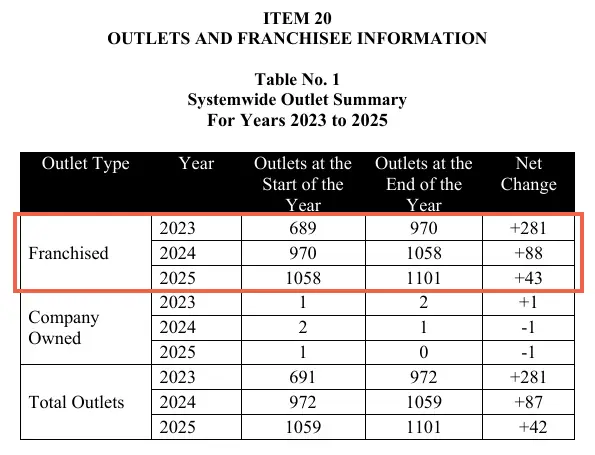
Company-owned stores played almost no part. Table 4 shows Crumbl Franchising, LLC and its affiliates owned 1 store at the start of 2023, 2 at the end of 2023 (one reacquired from a California franchisee) and 0 at the end of 2025, after selling the last one to a franchisee. The FTC’s Consumer’s Guide to Buying a Franchise warns that some franchisors buy back failed outlets and list them as company-owned; Crumbl’s three-year table shows 1 reacquisition.
Openings fell from 288 to 52 a year while transfers rose from 44 to 82; exits were 7, 12 and 9. Source: Crumbl FDD issued April 6, 2026, as amended July 1, 2026, Item 20.
Where did the 2025 exits and transfers happen?
Six states account for all 9 of the 2025 exits, and two states account for 29 of the 82 transfers. California recorded 15 transfers and Texas 14, while Ohio, Illinois and Utah each recorded 2 terminations (Item 20, Tables 2 and 3).
| State | Open Jan 1, 2025 | Opened 2025 | Exits 2025 | Transfers 2025 | Open Dec 31, 2025 |
|---|---|---|---|---|---|
| California | 137 | 8 | 1 termination | 15 | 144 |
| Texas | 105 | 1 | 0 | 14 | 106 |
| Illinois | 41 | 2 | 2 terminations | 5 | 41 |
| Utah | 26 | 1 | 2 terminations | 5 | 25 |
| Ohio | 50 | 0 | 2 terminations | 2 | 48 |
| Oregon | 17 | 1 | 1 non-renewal | 4 | 17 |
| Mississippi | 9 | 0 | 1 termination | 0 | 8 |
Two details in the filing are worth checking against your own copy. The state rows of Table 2 add up to 81 transfers for 2025, while the printed total is 82; this page uses the printed total. Item 19 also says its 2025 data leaves out “8 that closed during 2025”, which matches the 8 terminations in Table 3.
How does Crumbl’s turnover compare with 220 other franchise systems?
Against the 220 systems in our Item 20 closure rate index (mostly fiscal 2025, FDDs filed in Minnesota), Crumbl’s 2025 exit rate of 0.85% sits far below the 4.7% median, and its 7.75% transfer rate sits well above the 3.0% median. Gross churn, exits plus transfers, came to 8.60% against a 9.8% median, so resales did most of the turnover.
| Measure (share of franchised outlets open at start of year) | Crumbl 2025 | Median, 220 systems | Median, systems with 250 or more outlets | Median, 23 food and beverage systems | Source |
|---|---|---|---|---|---|
| Openings | 4.9% | 8.9% | not published | 6.5% | Crumbl FDD Item 20; closure rate index |
| Transfers | 7.75% | 3.0% | not published | 4.8% | Crumbl FDD Item 20; closure rate index |
| Exits (terminations, non-renewals, reacquisitions, ceased) | 0.85% | 4.7% | 4.6% | 5.3% | Crumbl FDD Item 20; closure rate index |
| Gross churn (exits plus transfers) | 8.60% | 9.8% | 11.2% | 10.3% | Crumbl FDD Item 20; closure rate index |
| Net growth | 4.06% | 3.2% | minus 0.6% | 0.0% | Crumbl FDD Item 20; closure rate index |
Crumbl’s 2025 exit rate (0.85%) was below the 4.7% median and its transfer rate (7.75%) above the 3.0% median. Sources: Crumbl FDD Item 20; FDD Item 20 tables of 220 systems (Minnesota CARDS).
How each Crumbl rate is calculated
Every rate uses the 1,058 franchised outlets open on January 1, 2025 as the base, the same method as the index, so the figures can be rebuilt from the FDD with a calculator. The three-year figure pools all three years of Table 3, which smooths the 2023 surge of 288 openings.
| Measure | Inputs from Item 20 | Arithmetic | Result |
|---|---|---|---|
| Exit rate, 2025 | 8 terminations, 1 non-renewal, 0 reacquired, 0 ceased | 9 / 1,058 | 0.85% |
| Transfer rate, 2025 | 82 transfers (Table 2 total) | 82 / 1,058 | 7.75% |
| Gross churn, 2025 | 9 exits plus 82 transfers | 91 / 1,058 | 8.60% |
| Opening rate, 2025 | 52 opened | 52 / 1,058 | 4.91% |
| Net growth, 2025 | 1,101 at end, 1,058 at start | 43 / 1,058 | 4.06% |
| Transfers as share of churn events, 2025 | 82 transfers, 9 exits | 82 / 91 | 90.1% (index pooled share: 43.2%) |
| Pooled exit rate, 2023 to 2025 | 7 + 12 + 9 exits; 689 + 970 + 1,058 starting outlets | 28 / 2,717 | 1.03% (index pooled: 5.8%; 250+ outlets: 5.2%) |
A low exit count says how many agreements ended, not how stores performed. Item 20 does not record why an owner sold, and a transfer can be a planned sale or a sale under pressure. The FTC guide says that if the charts show “more than a few” outlets in your area closed or transferred, the cause may be weak support or unprofitable franchises, and it recommends calling current and former owners.
Why did Crumbl transfers climb while openings fell?
The FDD gives no reason for either trend, but it does show the terms around a sale. Transfers rose 86% in two years, from 44 in 2023 to 82 in 2025, and Item 20 says most franchisees who signed confidentiality clauses in the last three fiscal years were “former franchisees that have transferred their location and have signed our general release agreement.”
| Resale term | Amount or rule | Who pays or signs | Source |
|---|---|---|---|
| Franchise agreement transfer fee | $10,000 | Selling franchisee, before Crumbl signs approval | Item 6 |
| Minority transfer fee | $500 | Existing owners moving 50% or less | Item 6 |
| Transferee training | $8,000 per session, plus travel | Buyer | Item 6 |
| Area development agreement transfer | $20,000 | Selling developer | Item 6 |
| General release | Required on transfer; includes a confidentiality clause | Seller | Items 17 and 20 |
| Guarantees | Guarantors remain liable unless released by Crumbl | Seller’s guarantors | Item 6 |
The $10,000 transfer fee equals the median fixed fee in our franchise transfer fee data from 245 FDDs. SBA lending points the same way as Item 20: of 306 franchise-coded SBA 7(a) loans to Crumbl buyers from fiscal 2020 to June 30, 2026, 31 (10.1%) financed a change of ownership, against 14.9% for all franchise loans (SBA 7(a) FOIA data, compiled in our franchise resale report).
Item 20 also lists one independent franchisee group that asked to be included: the Crumbl Franchise Partner Association, a chapter of the American Association of Franchisees and Dealers, at cfpa@aafdchapters.org. Crumbl states it did not create or sponsor the group.
What has happened since the December 31, 2025 count?
Item 20 stops at December 31, 2025, so 2026 closures will first appear in the 2027 FDD. Press reports since then describe a different year: on October 8, 2026, KUTV, citing Restaurant Business, reported at least 57 Crumbl closures and 20 openings in 2026, and 1,064 stores listed on the company website.
| Indicator | Figure | As of | Source |
|---|---|---|---|
| Franchised outlets open | 1,101 | December 31, 2025 | Item 20, Table 1 |
| Agreements signed, outlet not opened | 207 | December 31, 2025 | Item 20, Table 5 |
| Projected franchised openings, next fiscal year | 98 | December 31, 2025 | Item 20, Table 5 |
| Openings reported in 2026 | 20 | October 2026 | Restaurant Business, via KUTV |
| Closures reported in 2026 | at least 57 | October 2026 | Restaurant Business, via KUTV |
| Stores listed on Crumbl’s website | 1,064 (37 fewer than 1,101) | October 2026 | Restaurant Business, via KUTV |
| Crumbl franchises listed for sale on broker sites | at least 55 | October 2026 | Restaurant Business, via KUTV |
If the 2027 FDD confirms 57 closures, they would equal 5.2% of the 1,101 outlets open on January 1, 2026, against 0.85% in 2025. The press figures are a count of locations, not the Item 20 categories, and some closures may later be reported as transfers or reopenings.
The backlog is the other number to read before you sign. The FDD’s Special Risks page states that Crumbl “has signed a significant number of franchise agreements with franchisees who have not yet opened their outlets.” Table 5 puts that at 207, led by California and New York with 21 each, Florida with 18 and Texas with 16. Our franchise development backlog report found a median of 8.2% across 240 systems; Crumbl’s 207 is 18.8% of its 1,101 open franchised stores.
What do Items 3 and 21 disclose about Crumbl Franchising, LLC?
Item 3 describes one case, a customer class action over how service fees were displayed and charged when ordering, settled for $5,000 plus attorney’s fees and dismissed in February 2026. Item 21’s audited statements show revenues of $155,690,730 for 2025, a member’s deficit of $16,901,639 and a litigation accrual of $6,067,500 at December 31, 2025.
Why Item 3 and the financial statement notes differ
Item 3 lists one case, while Note 5 to the 2025 financial statements refers to several proceedings and a litigation accrual of $6,067,500. The FTC Franchise Rule limits Item 3 to defined categories of litigation, while the accounting notes address proceedings that could affect the company’s financial position.
Under 16 CFR 436.5(c), it reaches pending material actions alleging franchise, antitrust or securities violations or fraud, other material civil actions, and material franchise-relationship cases from the last fiscal year; franchise-relationship cases do “not include actions involving suppliers or other third parties.” Note 5 to the 2025 statements says Crumbl Franchising, LLC “is involved in several legal proceedings,” including alleged copyright infringement and alleged sales and product matters, with a possible impact of $6,067,500 to $17,605,020. Note 1 restates beginning member’s equity by $14,184,760 (unaudited) for misstated litigation accruals. In our franchise litigation disclosure study, 57.1% of 259 FDDs listed at least one Item 3 action.
Item 21 headline figures as stated
Exhibit C holds audited statements for Crumbl Franchising, LLC for 2023, 2024 and 2025. Revenues rose from $122,315,185 in 2023 to $158,265,633 in 2024 and were $155,690,730 in 2025, while total liabilities exceeded total assets at each year end shown, leaving a member’s deficit in all three years.
| Crumbl Franchising, LLC | 2023 | 2024 | 2025 | Source |
|---|---|---|---|---|
| Revenues | $122,315,185 | $158,265,633 | $155,690,730 | Item 21, Exhibit C |
| Total assets (December 31) | $32,232,907 | $39,626,748 | $25,779,187 | Item 21, Exhibit C |
| Total liabilities (December 31) | $46,107,503 | $63,074,098 | $42,680,826 | Item 21, Exhibit C |
| Member’s deficit (December 31) | $13,874,596 | $23,447,350 | $16,901,639 | Item 21, Exhibit C |
| Litigation accrual (December 31) | $16,150,000 | $19,261,000 | $6,067,500 | Item 21, Exhibit C, Note 5 |
The 2025 auditor’s report, dated March 16, 2026, states that the statements “present fairly, in all material respects” the company’s financial position. Exhibit C also carries an unaudited balance sheet at March 31, 2026. For context, 28.6% of 259 FDDs in our franchisor financial health review showed negative equity, and 56.4% disclosed a state fee deferral.
Which states defer Crumbl’s initial fees?
Nine state addenda in the 2026 FDD stop Crumbl from collecting initial fees until it has met its pre-opening obligations, and in most states until the store is open. Four of them, California, Hawaii, Illinois and Maryland, tie the condition to the franchisor’s capitalization or financial condition in the addendum text.
| State | What the state addendum says | What is deferred |
|---|---|---|
| California | The Department found Crumbl had “not demonstrated we are adequately capitalized” | All initial fees until pre-opening obligations are done and you are open |
| Hawaii | Review found “liabilities exceed its assets” | Franchise fee until obligations are met and the business is open |
| Illinois | Attorney General imposed deferral “due to Franchisor’s financial condition” | Initial fee and other initial payments until you commence operations |
| Maryland | Securities Commissioner required a financial assurance | All initial fees; development fees until the first unit opens |
| Minnesota | State addendum | Initial fee and other initial payments until you commence operations |
| North Dakota | State addendum | Initial franchise fees until the franchise is operational |
| South Dakota | State addendum | Initial franchise fees until the franchise is operational |
| Virginia | State Corporation Commission requirement | Initial fee and other initial payments until pre-opening obligations are done |
| Washington | Deferral “in lieu of an impound” | Initial fees until pre-opening and training obligations are met and you are open |
What does the Crumbl franchise cost buy, line by line?
The single-store Item 7 table adds up to $848,566 to $1,472,533, of which $81,000 to $89,000 goes to Crumbl or its affiliates. Real estate and improvements are the largest line at $350,000 to $700,000, or 41.2% of the low total and 47.5% of the high total. The estimate assumes a lease; buying property is excluded.
| Item 7 line | Low | High | Paid to | Note in Item 7 |
|---|---|---|---|---|
| Initial franchise fee | $50,000 | $50,000 | Crumbl | Non-refundable, not financed |
| Opening tech equipment package | $12,000 | $15,000 | Crumbl or affiliates | iPads, televisions, other required tech |
| Opening box and ingredient package | $11,000 | $16,000 | Crumbl or affiliates | Branded boxes, emulsions, specialty packets |
| Training fee, travel and lodging | $25,000 | $35,000 | Crumbl, airlines, hotels | Assumes 4 attendees; $8,000 fee |
| Real estate and improvements | $350,000 | $700,000 | Suppliers, contractors | Excludes any tenant improvement allowance |
| Rent, 3 months | $16,666 | $83,333 | Landlord | 1,600 to 2,000 sq ft; $50,000 to $250,000 a year |
| Professional fees | $10,000 | $50,000 | Architects, engineers, lawyers | Crumbl-approved licensed architect |
| Equipment, furniture, fixtures, decor | $268,000 | $306,000 | Suppliers | Kitchen equipment, warmers, millwork |
| POS, computer hardware, software | $5,500 | $18,000 | Suppliers | Designated POS; QuickBooks Online |
| Signs | $12,000 | $32,000 | Suppliers | At least one exterior sign |
| Miscellaneous opening costs | $15,000 | $45,000 | Suppliers, utilities | Deposits, insurance, licences, grand opening |
| Opening inventory | $12,000 | $22,000 | Suppliers | Flour, sugar, boxes, cups, uniforms |
| Additional funds, 3 months | $61,400 | $100,200 | Suppliers, employees | Labor and operating costs before cash flow |
| Total | $848,566 | $1,472,533 | Excludes royalties and marketing fees |
Real estate and improvements ($350,000 to $700,000) is 41.2% to 47.5% of the $848,566 to $1,472,533 Crumbl total. Source: Crumbl FDD issued April 6, 2026, as amended July 1, 2026, Item 7.
The Crumbl range sits well above the median Item 7 estimate of $265,372 to $573,000 across 259 FDDs in our franchise initial investment study. Two working capital figures appear in the FDD: Item 7 note 14 says the operating account “cannot be less than $10,000,” while Item 6 note 1 requires “at least $30,000 of working capital” in that account at all times. Ask Crumbl which figure governs before you set your reserve.
What does a three-store development add?
The area development table totals $2,545,698 to $4,417,599 for 3 stores, exactly three times the single-store range, with $150,000 due at signing ($50,000 per unit, credited to each unit’s fee). Crumbl may end the agreement early if it decides you are “not well suited” to develop; the refund covers only unsigned units and requires a general release (Items 5 and 7).
What older Crumbl cost guides say against the 2026 FDD
Two of the cost pages ranking for this search in October 2026 cite FDDs from 2022, 2024 and 2025. The figures below set their claims against the April 6, 2026 filing, amended July 1, 2026, so a reader can see which numbers have moved and which never measured cost at all.
| Claim in a ranking guide | What the 2026 FDD states | Where |
|---|---|---|
| A deep-dive guide last updated in January 2023 puts the investment at $347,666 to $691,783 | $848,566 to $1,472,533 per store | Cover page, Item 7 |
| The same guide lists a $65,000 development fee per location | $50,000 per unit up front, credited to each unit’s initial fee | Item 5 |
| The same guide reports “600+” stores | 1,101 franchised stores at December 31, 2025 | Item 20, Table 1 |
| The same guide labels Item 19 revenue as “ROI” | Item 19 shows gross sales only; the FDD says the figures “do not reflect the costs or expenses” of running a store | Item 19 |
| A January 2026 cost article quotes store profit from the 2024 FDD | The 2026 Item 19 reports gross sales for 776 of 1,048 stores open all of 2025, with no cost or profit lines | Item 19 |
What does Crumbl collect from each week’s sales?
Crumbl takes an 8% royalty and a 2% marketing fund contribution from gross sales every week, plus a $650 monthly technology fee and a 2.4% to 4% transaction processing fee on each sale. The royalty is 2 points above the 6% median in our franchise royalty rate data from 239 FDDs.
| Fee | Amount | When | Source |
|---|---|---|---|
| Royalty | 8% of gross sales | Weekly, by Tuesday | Item 6 |
| Marketing fund | 2% of gross sales | Weekly, by Tuesday | Item 6 |
| Advertising cooperative | 1% to 2% of gross sales, if formed | Per co-op rules | Item 6 |
| Local marketing | 0% to 2% of gross sales; currently 0% | Monthly | Item 6, note 2 |
| Technology fee | Currently $650 | Monthly | Item 6 |
| Transaction processing | Currently 2.4% to 4% per transaction; processor’s cost averages about 2.36% | Each transaction | Item 6, note 8 |
| Gift card program fee | 5% to 15% of redemption value | With royalty | Item 6 |
| Third-party store inspections | Cost plus 5% to 15%; two to four a year | As incurred | Item 6 |
| Fines for non-compliance | $250 to $1,000 per violation | As incurred | Item 6 |
| Liquidated damages on early termination | Average royalty of the prior 12 months times the lesser of 36 months or the remaining term | On termination | Item 6, note 3 |
Fees not marked with an asterisk in Item 6 can change through the manuals, capped at a 100% increase during the term. Item 8 estimates that 85% to 95% of purchases come from approved or required sources, including affiliate Crumbl Foods, LLC, and Item 11 allows up to 50% of the marketing fund to be used to solicit new franchisees.
Owner income is not answered by any of these tables. Item 19 holds the only performance data Crumbl publishes, and the site does not reproduce it. Owner income depends on gross sales in Item 19 minus the Item 6 percentages above, rent from your lease and labor from your market.
How long does opening take, and which deadlines can end the agreement?
Crumbl estimates 5 to 6 months from signing to opening, and the franchise agreement makes that schedule binding: a site and lease within 3 months, construction started within 4 and finished within 5, and opening no later than 6 months after signing. Missing those dates can end the agreement without a refund (Item 11).
| Milestone | Deadline or rule | If missed | Source |
|---|---|---|---|
| Receive the FDD | At least 14 calendar days before signing or paying | Sale cannot proceed | FDD cover page |
| Site selected and lease in place | Within 3 months of signing | Agreement may be terminated; initial fee forfeited | Item 11 |
| Construction | Start within 4 months; complete within 5 months | Termination without refund possible | Item 11 |
| Opening | Within 30 days of completion; no later than 6 months after signing | Termination without refund possible | Item 11 |
| Initial training | 18 to 29 days; first two parts finished 1 week before opening | Rescheduling costs charged to you | Item 11 |
| Minimum gross sales | $100,000 a year from the first full calendar year | Sales performance plan or possible termination | Item 12 |
| Term and successor agreement | 10 years; notice 6 to 12 months before expiry; $2,500 fee | No automatic renewal | Items 6 and 17 |
The franchise agreement contains no clause letting the franchisee terminate (Item 17, subject to state law), the territory is generally 1 to 2 miles and not exclusive (Item 12), and disputes go to Utah (Special Risks page).
Which findings should change your next step?
Use the filing itself as the checklist. Each row below pairs a finding in the 2026 FDD with the question it raises and the exhibit that answers it. None of it requires a guess about future sales; every row points to a page you will already hold when the FDD arrives 14 days before signing.
| If you find | Then | Where to check |
|---|---|---|
| Your liquid capital is under $200,000 | You are below Crumbl’s stated minimum; the Item 7 low end is $848,566 before royalties | Crumbl franchising page; Item 7 |
| You live in one of the 9 fee-deferral states | Ask in writing whether the $12,000 to $15,000 tech package and $11,000 to $16,000 box package are also deferred | State addenda; Item 5 |
| You are offered a new territory | Ask how many of the 207 unopened agreements are in your state and how long they have waited | Item 20, Table 5 |
| You are buying one of the stores being resold | Request that outlet’s actual records, the lease and its sales against the $100,000 floor; call former owners | Item 19 (actual records exception); Exhibit D |
| A seller cites the confidentiality clause | Contact the Crumbl Franchise Partner Association and owners who did not sign a release | Item 20 |
| You are offered 3 or more units | Budget $150,000 at signing and note the refund covers only unsigned units | Items 5 and 7 |
| You want to weigh the legal and financial notes | Have a franchise attorney read Note 5 (proceedings) and Note 1 (restatement) with the March 31, 2026 balance sheet | Item 21, Exhibit C |
Our guide to the franchise disclosure document lists all 23 items and the 14-day rule. If you want comparable bakery or dessert FDDs set against Crumbl’s Item 20, the role of a franchise consultant includes pulling them. This page is general information drawn from public filings, not legal, financial or investment advice.
How we compiled this
We read the Crumbl Franchise Disclosure Document issued April 6, 2026, as amended July 1, 2026 (Minnesota CARDS 36632-202605-08) in full for Items 1, 3, 5 to 8, 11, 12, 17, 19 to 21 and the state addenda, and cross-checked Items 7 and 20 against the April 28, 2026 amendment (36463-202604-08). Rates are our arithmetic on the printed Item 20 tables, compared with our 220-system index built the same way. Other inputs: 16 CFR 436.5, FTC guidance, SBA 7(a) loan data, Crumbl’s franchising page and two KUTV reports, accessed October 27, 2026. We left out all Item 19 figures and all press figures on store sales.
Sources
- Crumbl Franchise Disclosure Document, issued April 6, 2026, as amended July 1, 2026, Crumbl Franchising, LLC, Minnesota CARDS document 36632-202605-08, accessed October 27, 2026.
- 16 CFR 436.5, Disclosure items (CFR 2026 edition), U.S. Government Publishing Office, accessed October 27, 2026.
- A Consumer’s Guide to Buying a Franchise, Federal Trade Commission, accessed October 27, 2026.
- Crumbl franchising page, Crumbl, accessed October 27, 2026.
- SBA 7(a) and 504 FOIA loan data, U.S. Small Business Administration, as of June 30, 2026.
- Crumbl closures offer glimpse into pressure on fast-casual, discretionary spending, KUTV, October 8, 2026, accessed October 27, 2026.
- Crumbl Cookies closes dozens of stores amid declining sales, report finds, KUTV, October 8, 2026, accessed October 27, 2026.
Frequently asked questions
Is Crumbl a franchise?
Yes. Crumbl Franchising, LLC, a Utah company organised on February 9, 2018 and based in Provo, sells Crumbl franchises in the United States. At December 31, 2025 the system had 1,101 franchised stores and no company-owned stores, according to Item 20 of the FDD issued April 6, 2026, as amended July 1, 2026.
How much does it cost to open a Crumbl?
The 2026 Crumbl FDD estimates $848,566 to $1,472,533 for one store, including the $50,000 initial fee, $350,000 to $700,000 for real estate and improvements and $61,400 to $100,200 of working funds for the first 3 months. A 3-store development agreement is estimated at $2,545,698 to $4,417,599 (Item 7).
How much liquid capital does Crumbl require?
Crumbl’s franchising page states a minimum liquidity of $200,000. The FDD itself sets operating account floors: Item 7 note 14 says the account cannot fall below $10,000, and Item 6 note 1 requires at least $30,000 of working capital at all times. Ask Crumbl which floor applies to your agreement.
Are Crumbl stores closing?
Item 20 of the 2026 FDD shows 9 franchised exits in 2025 (8 terminations, 1 non-renewal) out of 1,058 stores. Later press coverage differs: KUTV, citing Restaurant Business, reported on October 8, 2026 that at least 57 locations closed in 2026. Those closures will appear in the 2027 FDD.
How much do Crumbl franchise owners make?
The FDD does not report owner income. Item 19 of the 2026 FDD shows gross sales for 776 stores open all of 2025, with no cost or profit lines, and this site does not reproduce those figures. Owner income depends on those sales minus the 8% royalty, 2% marketing fund, rent and labor.
Can you buy an existing Crumbl store?
Yes. Item 20 records 82 transfers of franchised Crumbl stores to new owners in 2025, up from 44 in 2023. The seller pays a $10,000 transfer fee, the buyer pays $8,000 for transferee training, and the FDD allows the franchisor to share an existing outlet’s actual records with a prospective buyer (Items 6 and 19).
What is the Crumbl royalty fee?
Crumbl charges an 8% royalty and a 2% marketing fund contribution on gross sales, both collected weekly, plus a technology fee currently $650 a month and a transaction processing fee of 2.4% to 4% per transaction (Item 6 of the 2026 FDD). The median royalty across 239 FDDs we reviewed is 6%.