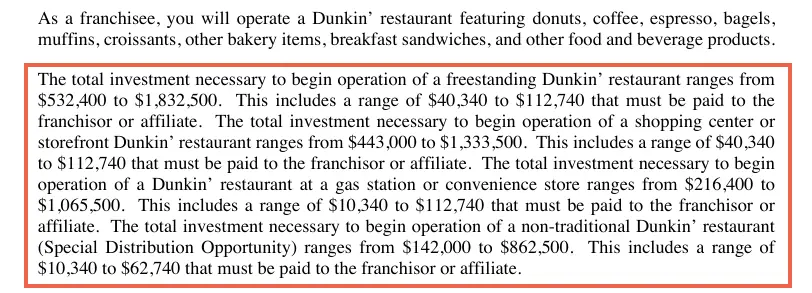
The Dunkin’ Donuts franchise cost is $142,000 to $1,832,500 to open one restaurant under the FDD issued March 26, 2026: $532,400 to $1,832,500 freestanding, $443,000 to $1,333,500 in a shopping center.
Key takeaways
- Four Item 7 tables, not one range: freestanding $532,400 to $1,832,500, shopping center or storefront $443,000 to $1,333,500, gas station or convenience store $216,400 to $1,065,500, and non-traditional (SDO) $142,000 to $862,500, per the Dunkin’ Franchise Disclosure Document, issued March 26, 2026, Item 7.
- The fee follows your TV market: the standard initial franchise fee is $90,000 in Development Area Type 1 markets such as Boston and New York and $40,000 in Type 6, every US market Item 5 does not name, which includes Dallas (Dunkin’ FDD 2026, Item 5).
- 10.9% of Gross Sales every week: a 5.9% Continuing Franchise Fee plus a 5.0% Continuing Advertising Fee, and a separate contribution of up to 1.4% of Loyalty Program Sales through 2026 (Dunkin’ FDD 2026, Item 6).
- Royalty credits replaced reduced royalty rates: the 2026 FDD offers $125,000 (Standard) or $225,000 (Strategic) in royalty credits for agreements signed by March 31, 2027, where the prior FDD, issued March 27, 2025 and amended October 24, 2025, cut the royalty to 1.9% or 2.4% for early years.
- $250,000 liquid, $500,000 net worth: the minimums on Inspire Brands’ Dunkin’ franchising page (October 2026); the FDD sets none, and the Item 7 lines it marks lump sum only reach $351,000 for a freestanding restaurant (our arithmetic).
- 9,999 US restaurants at December 28, 2025: 9,963 franchised and 36 company-owned; standalone Dunkin’ outlets grew by 279 in 2025 while Dunkin’/Baskin-Robbins combos fell by 50 (Dunkin’ FDD 2026, Items 1 and 20).
| Measure | Figure | FDD item |
|---|---|---|
| Total investment, four formats | $142,000 to $1,832,500 | Cover, Item 7 |
| Paid to franchisor or affiliate | $10,340 to $112,740 (format dependent) | Cover |
| Standard initial franchise fee | $40,000 to $90,000 by Development Area Type | Item 5 |
| Combo (with Baskin-Robbins) fee add-on | $10,000 | Item 5 |
| Royalty (CFF) | 5.9% of Gross Sales, weekly | Item 6 |
| Advertising (CAF) | 5.0% of Gross Sales; 2.5% at SDOs | Item 6 |
| Loyalty Program Contribution | Up to 1.4% of Loyalty Program Sales (1.2% from 2027) | Item 6 |
| Typical time to open | 8 to 15 months after signing | Item 11 |
| Term / renewal | 20 years / 20 years | Item 17 |
| Franchisor financing | None offered | Item 10 |
| US restaurants, Dec 28, 2025 | 9,999 (9,963 franchised, 36 company-owned) | Item 1 |
What does each Dunkin’ format cost under Item 7?
Dunkin’ Donuts Franchising LLC prints four separate Item 7 tables in its 2026 FDD, one per site type, and repeats all four totals on the cover page. The freestanding table is the most expensive at $532,400 to $1,832,500. The non-traditional table, used for host venues such as airports, hospitals and college campuses, starts at $142,000. Land is excluded from every table.
Item 7 defines the formats by their walls and host. A freestanding restaurant shares no wall with a third party; a shopping center or storefront restaurant shares at least one, as an endcap, inline unit or urban multi-level space; a Gas & Convenience restaurant sits inside a gas station store and may be self-serve; an SDO (Special Distribution Opportunity) operates inside another venue under the Non-Traditional Rider, Exhibit C-3.
| Item 7 line | Freestanding | Storefront | Gas & convenience | SDO | Source |
|---|---|---|---|---|---|
| Initial franchise fee | $40,000 to $90,000 | $40,000 to $90,000 | $10,000 to $45,000 | $20,000 to $45,000 | Item 7, Tables A to D |
| Building costs | $180,000 to $600,000 | $145,600 to $455,000 | $51,000 to $300,000 | $21,500 to $300,000 | Item 7, Note 1 |
| Site development | $13,000 to $350,000 | $0 to $60,000 | $0 to $65,000 | $0 | Item 7, Note 1 |
| Additional development (architect, engineer, legal) | $12,000 to $90,000 | $5,000 to $50,000 | $5,000 to $50,000 | $2,500 to $25,000 | Item 7, Note 2 |
| Equipment, fixtures and signs | $189,000 to $300,000 | $154,000 to $300,000 | $112,000 to $265,000 | $60,000 to $245,000 | Item 7, Note 3 |
| Restaurant Technology System | $65,000 to $118,000 | $65,000 to $118,000 | $12,000 to $118,000 | $12,000 to $25,000 | Item 7, Note 4 |
| Licenses, permits, fees, deposits | $3,500 to $7,500 | $3,500 to $7,500 | $500 to $7,500 | $500 to $7,500 | Item 7, Note 5 |
| Real estate costs | Variable | Variable | Variable | Variable | Item 7, Note 6 |
| Opening inventory | $8,000 to $20,000 | $8,000 to $20,000 | $4,000 to $10,000 | $4,000 to $10,000 | Item 7, Note 7 |
| Miscellaneous opening costs | $9,500 to $70,000 | $9,500 to $70,000 | $9,500 to $70,000 | $9,500 to $70,000 | Item 7, Note 8 |
| Uniforms | $400 to $3,000 | $400 to $3,000 | $400 to $3,000 | $0 to $3,000 | Item 7 |
| Insurance | $10,000 to $16,000 | $10,000 to $16,000 | $10,000 to $16,000 | $10,000 to $16,000 | Item 7, Note 9 |
| Training travel and related expenses | $2,000 to $50,000 | $2,000 to $50,000 | $2,000 to $50,000 | $2,000 to $50,000 | Item 7, Note 10 |
| Marketing start-up | $0 to $10,000 | $0 to $10,000 | $0 to $10,000 | $0 to $10,000 | Item 7 |
| Additional funds, first 3 months | $0 to $108,000 | $0 to $84,000 | $0 to $56,000 | $0 to $56,000 | Item 7, Note 11 |
| Total | $532,400 to $1,832,500 | $443,000 to $1,333,500 | $216,400 to $1,065,500 | $142,000 to $862,500 | Item 7, Notes 12 to 14 |
A freestanding Dunkin’ tops out at $1,832,500 and a non-traditional unit starts at $142,000. Source: Dunkin’ FDD issued March 26, 2026, Item 7, Tables A to D.
Which Item 7 lines separate a freestanding Dunkin’ from a storefront?
Site development explains the biggest gap: up to $350,000 for a freestanding pad against up to $60,000 in a shopping center, per Item 7 Note 1. Building costs add another $145,000 at the high end ($600,000 against $455,000), and the three-month reserve is $24,000 higher ($108,000 against $84,000). Drive-thru buildings cost more and take longer to permit, Note 1 says.
- Per square foot: $83 to $566 across 750 to 3,100 square feet freestanding, $59 to $378 across 600 to 2,800 square feet in a storefront, and $56 to $340 across 600 to 2,300 square feet for Gas & Convenience (Item 7, Note 1).
- Low end means a landlord build: the bottom of each building range assumes a build-to-suit lease where the landlord pays most development costs, which Note 1 says usually raises rent.
- POS count: the technology line prices 2 to 4 POS terminals and includes drive-thru equipment; without a drive-thru the cost is lower (Item 7, Note 4).
Do the printed Dunkin’ Item 7 totals add up, and what moved since the 2025 FDD?
We re-added every line of the four 2026 Item 7 tables and every subtotal, and each printed total matches. Against the prior Dunkin’ FDD, issued March 27, 2025 and amended October 24, 2025, only one Item 7 line changed: the low end of insurance rose from $4,500 to $10,000. That single change lifts each low-end total by exactly $5,500, while every high-end total stayed the same.
| What changed | 2025 FDD (amended Oct 24, 2025) | 2026 FDD (Mar 26, 2026) | Source |
|---|---|---|---|
| Freestanding total | $526,900 to $1,832,500 | $532,400 to $1,832,500 | Cover, Item 7 Table A |
| Storefront total | $437,500 to $1,333,500 | $443,000 to $1,333,500 | Cover, Item 7 Table B |
| Gas & Convenience total | $210,900 to $1,065,500 | $216,400 to $1,065,500 | Cover, Item 7 Table C |
| Non-traditional (SDO) table | Not printed (Tables A to C only) | $142,000 to $862,500 (new Table D) | Item 7 |
| Insurance line, low end | $4,500 | $10,000 | Item 7, Note 9 |
| Paid to franchisor, freestanding | $45,340 to $102,740 | $40,340 to $112,740 | Cover |
| Paid to franchisor, Gas & Convenience | $30,340 to $102,740 | $10,340 to $112,740 | Cover |
| Trainees included in the fee | First 2 to 4 people | First 2 people, for your first 5 restaurants | Item 5 |
| Top training cancellation charge | $2,000 if 5 days or fewer before class | $2,000 if 7 days or fewer before class | Item 5 |
| Incentive signing deadline | March 31, 2026 | March 31, 2027 | Item 5 |
| Fee tiers, royalty, ad fee | $40,000 to $90,000; 5.9%; 5.0% | Unchanged | Items 5 and 6 |
Three other cross-checks are worth running before you sign. Item 1’s restaurant mix reconciles: 8,744 single-branded, 36 at Multi-Brand Locations and 1,219 combos make 9,999. Item 20’s standalone rows do not: opening counts minus exits fall 16 restaurants short of the printed 2024 year-end and 46 short for 2025, because Item 20 Notes 2 and 3 move restaurants between the standalone and combo tables when a Baskin-Robbins is added or closed. Item 8 describes franchisor total revenue of approximately $944,000,000, while the audited income statement in Exhibit B shows $1,398,356,000, a difference the FDD does not explain.
Which Dunkin’ figures in other cost guides do not match the 2026 FDD?
Three ranking guides we read in October 2026, and the franchisor’s own sales page, repeat figures that the March 26, 2026 FDD does not support, mostly because they rely on the 2024 FDD or on no named document. The table sets each claim beside the governing FDD item.
| What a ranking guide says | What the 2026 FDD says | Source |
|---|---|---|
| A lender guide updated May 2026: total cost $255,000 to $1.7 million | $142,000 to $1,832,500 across four formats | Cover, Item 7 |
| A franchise listing site: $526,900 to $1,832,500 and 8,297 units | Those are 2024 FDD figures; 2026 shows $532,400 low and 8,780 standalone outlets plus 1,219 combos | Item 7, Item 20 |
| A business directory profile: exclusive territories, yes | No exclusive and no non-exclusive territory under the Franchise Agreement | Item 12 |
| The same profile: royalty 2% to 6% for traditional restaurants | 5.9% of Gross Sales; incentives now credit dollars instead | Item 6 |
| The same profile: 20% off the franchise fee for veterans | VetFran: a $10,000 royalty credit per restaurant, up to $100,000 | Item 6, Note 2 |
| Inspire Brands’ own page: initial franchise fee $40,000 | $40,000 to $90,000 for a standard restaurant, set by DMA | Item 5 |
Why does the Dunkin’ fee run from $40,000 in Dallas to $90,000 in Boston?
Item 5 prices the standard initial franchise fee by the Nielsen Designated Market Area (DMA) that holds the restaurant, sorted into six Development Area Types. The fee drops $10,000 per type, from $90,000 in Type 1 markets across New England, New York and Philadelphia to $40,000 in Type 6, which covers every US market Item 5 does not list. Franchisees paid between $0 and $90,000 in 2025.
| Development Area Type | Standard fee | Examples of DMAs named in Item 5 | Source |
|---|---|---|---|
| Type 1 | $90,000 | Boston, New York, Philadelphia, Hartford/New Haven, Providence, Albany, Springfield MA | Item 5 |
| Type 2 | $80,000 | Baltimore, Chicago, Miami/Ft. Lauderdale, Orlando, Tampa, West Palm Beach | Item 5 |
| Type 3 | $70,000 | Cleveland, Jacksonville, Pittsburgh, Greenville NC | Item 5 |
| Type 4 | $60,000 | Atlanta, Charlotte, Nashville, Indianapolis, Las Vegas, Phoenix, Washington DC | Item 5 |
| Type 5 | $50,000 | Denver, Seattle-Tacoma, Portland OR, Salt Lake City, Boise, Spokane | Item 5 |
| Type 6 | $40,000 | All other US areas, including Dallas, Houston and Los Angeles | Item 5 |
The standard Dunkin’ fee falls $10,000 per tier, from $90,000 in Type 1 DMAs such as Boston to $40,000 in Type 6. Source: Dunkin’ FDD issued March 26, 2026, Item 5.
How are Dunkin’ gas station and non-traditional fees prorated?
Gas station, self-serve and SDO fees shrink with a shorter term. Item 5 pro-rates the Gas & Convenience fee by the length of the franchise term, so a 10-year term in a Type 1 market costs $45,000 instead of $90,000. Self-serve gas station units and SDOs pay 50% of the standard fee before that proration, which makes the same Type 1, 10-year example $22,500. Item 7 therefore lists $10,000 to $45,000 and $20,000 to $45,000.
Two add-ons apply on top. A Dunkin’/Baskin-Robbins combo pays the Dunkin’ fee plus a $10,000 Baskin-Robbins initial franchise fee, and a developer signing for 2 or more restaurants pays 25% of each fee at signing and the balance 6 months before each Required Opening Date or at opening, whichever comes first (Item 5).
What do Dunkin’ restaurants pay every week, and what does the POS cost to keep running?
Item 6 takes 10.9% of Gross Sales each week before any incentive: a 5.9% Continuing Franchise Fee and a 5.0% Continuing Advertising Fee, both paid every Thursday for the week that ended twelve days earlier. SDOs pay a 2.5% advertising fee instead. A loyalty contribution, The Center subscription and Item 11 technology upkeep come on top, and most other fees apply only when you train, transfer or relocate.
| Fee | Amount | When | Source |
|---|---|---|---|
| Continuing Franchise Fee (royalty) | 5.9% of Gross Sales | Weekly | Item 6 |
| Continuing Advertising Fee | 5.0% of Gross Sales; 2.5% at SDOs | Weekly with the royalty | Item 6, Note 3 |
| Loyalty Program Contribution | Up to 1.4% of Loyalty Program Sales in 2025 to 2026; 1.2% from 2027 | Weekly | Item 6, Note 4 |
| The Center (online learning) subscription | $340 per restaurant | Annually | Item 6 |
| Additional trainee | $4,000 per person | On registration | Items 5 and 6 |
| Training cancellation | $1,000 (8 to 14 days out) or $2,000 (7 days or fewer) | On demand | Item 6 |
| Late fee and interest | 1.5% per month or the legal maximum, if lower | On demand | Item 6 |
| Transfer fee, first 3 years | $12,500 (Dunkin’) or $20,000 (combo) | On transfer | Item 6, Note 6 |
| Fixed Documentation Fee | $2,000 per transferee | On qualifying transfers | Item 6, Note 7 |
| Development Agreement transfer | $10,000 | On majority transfer | Item 6 |
| Testing a new supplier you propose | Typically $1,000 to $10,000 | On request | Item 6 |
| NDCP purchasing co-op membership | $2,500 one time, plus a personal guarantee | On joining | Item 8 |
The advertising fee funds the Dunkin’ Advertising and Sales Promotion Fund, which may spend up to 20% of contributions on administration. In fiscal 2025 the fund put 35.5% into media placement, 11.5% into production and 17.8% into administrative costs (Item 11). For how these splits compare with other brands, see our study of franchise advertising fund disclosures.
What does Dunkin’ POS hardware cost to buy and maintain?
Item 11 prices the required POS System by operating model, assuming 2 to 4 new terminals. A Dunkin’ with a drive-thru costs $32,340 to $41,580 to install and $3,812 to $3,927 a year to maintain; a combo with a drive-thru costs the most at $39,270 to $46,200. These figures sit inside the Item 7 technology line, but the annual maintenance continues after opening.
| Operating model | Initial hardware, software, installation | Annual maintenance | Source |
|---|---|---|---|
| Dunkin’ with drive-thru | $32,340 to $41,580 | $3,812 to $3,927 | Item 11 |
| Dunkin’ without drive-thru | $24,255 to $31,185 | $3,119 to $3,465 | Item 11 |
| Combo with drive-thru | $39,270 to $46,200 | $4,274 to $4,505 | Item 11 |
| Combo without drive-thru | $28,875 to $35,805 | $3,465 to $3,696 | Item 11 |
| SDO with drive-thru | $24,255 to $31,185 | $3,119 to $3,465 | Item 11 |
| SDO without drive-thru | $17,326 to $24,225 | $2,426 to $2,888 | Item 11 |
How did the 2026 FDD replace Brewed for Growth and Go West with royalty credits?
The 2025 FDD discounted the royalty rate itself in targeted markets: 1.9% for five years under Brewed for Growth, 2.4% under Go West, and a 1.9% to 4.9% ramp under Select Developing Markets. The 2026 FDD keeps the 5.9% rate everywhere and instead credits a fixed $125,000 (Standard) or $225,000 (Strategic) against royalties for each new traditional restaurant. Both versions also lowered the advertising fee for early years.
| Program | 2025 FDD (sign by March 31, 2026) | 2026 FDD (sign by March 31, 2027) | Source |
|---|---|---|---|
| Brewed for Growth (California, Texas, Oklahoma DMAs) | 50% of the fee paid back; royalty 1.9% years 1 to 5, 2.9% years 6 to 8; ad fee 1.9% then 2.9% | Not offered; Los Angeles, Dallas, Houston and the other listed DMAs now sit on the Strategic list | Items 5 and 6, both FDDs |
| Select Developing Markets, now Standard | Royalty 1.9%, 2.9%, 3.9%, 4.9% in years 1 to 4, then 5.9%; ad fee 2%, 3%, 4%, then 5% | Royalty 5.9% with a $125,000 royalty credit; ad fee 2%, 3%, 4%, then 5% | Item 6, Notes 2 and 3 |
| Go West, now Strategic | Royalty 2.4% years 1 to 5, 3.4% years 6 to 8; ad fee 2.4% then 3.4% | Royalty 5.9% with a $225,000 royalty credit; ad fee 2.4% years 1 to 5, 3.4% years 6 to 8 | Item 6, Notes 2 and 3 |
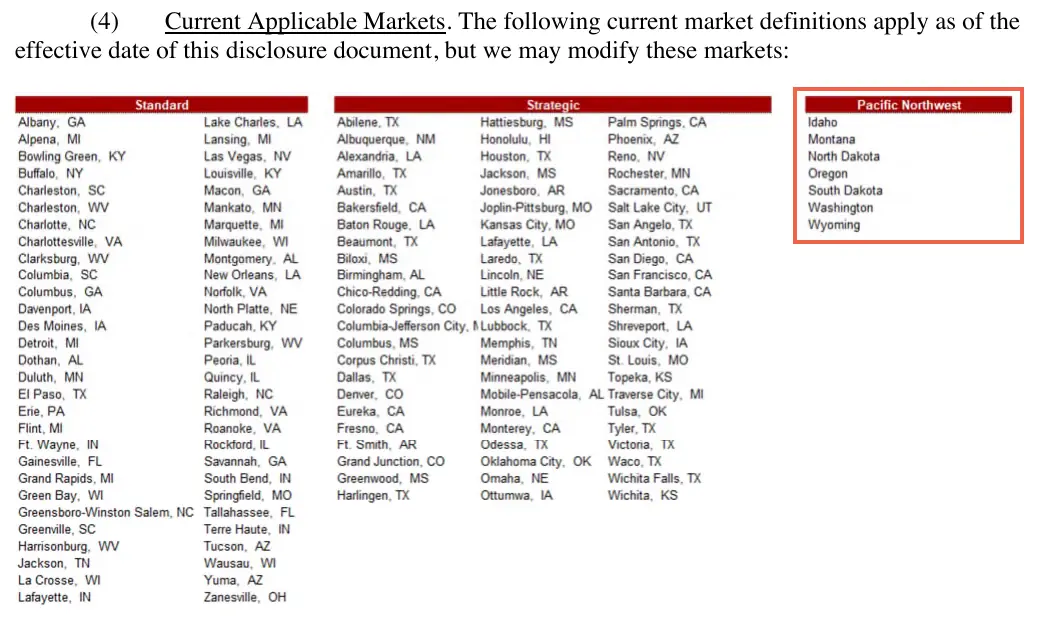
| Pacific Northwest (ID, MT, ND, OR, SD, WA, WY) | 50% of the fee paid back; $50,000 one-time credit; $300,000 per restaurant opened in 2026 or 2027; $250,000 from 2028 | No fee payback listed; adds $25,000 per restaurant; keeps the $50,000, $300,000 and $250,000 credits | Items 5 and 6 |
| Pacific Northwest opening marketing | Up to $20,000 (first) and $10,000 (second) reimbursed | Same | Item 5 |
| Early Opening Incentive | 0% royalty from opening until the required opening date, up to 6 months | Same | Item 6, Note 2 |
| VetFran | $10,000 royalty credit per restaurant | $10,000 per restaurant, up to $100,000 | Item 6, Note 2 |
The credits are not cash. Item 6 says they post within 30 days of opening and are applied to royalty payments during the term without interest. You lose them if you miss the required opening date, fail to file a development cost report within 120 days of opening, or build off the approved design; they never apply to SDOs, renewals, relocations or purchases of an existing restaurant. For how other franchisors structure veteran offers, see our veteran franchise discount study.
Item 6 Note 2 lists the Pacific Northwest $25,000, $50,000 and $300,000 credits as separate lettered items, so ask Dunkin’ in writing whether all three apply to a first restaurant opened in 2026 or 2027 and get the answer into Exhibit C-4, the incentive addendum.
Does $250,000 of liquid capital cover the Dunkin’ lines Item 7 marks lump sum only?
Not at the high end of a freestanding or storefront budget. Inspire Brands asks for $250,000 in liquid assets and $500,000 in net worth; the FDD itself sets no minimum. Item 7’s Method of Payment column marks the fee, inventory, opening costs, uniforms, training travel, marketing and the 3-month reserve as lump sum only, and for a freestanding restaurant those lines reach $351,000.
| Format | Lines marked lump sum only | Lines marked lump sum or financed | Item 7 total | Source |
|---|---|---|---|---|
| Freestanding | $59,900 to $351,000 | $472,500 to $1,481,500 | $532,400 to $1,832,500 | Item 7 Table A; our arithmetic |
| Shopping center or storefront | $59,900 to $327,000 | $383,100 to $1,006,500 | $443,000 to $1,333,500 | Item 7 Table B; our arithmetic |
| Gas & Convenience | $25,900 to $244,000 | $190,500 to $821,500 | $216,400 to $1,065,500 | Item 7 Table C; our arithmetic |
| Non-traditional (SDO) | $35,500 to $244,000 | $106,500 to $618,500 | $142,000 to $862,500 | Item 7 Table D; our arithmetic |
Worked example: an Atlanta storefront against a Boston freestanding drive-thru
Swap the fee range in Item 7 for the exact Item 5 fee and the totals tighten. Atlanta is a Type 4 DMA ($60,000) and Boston is Type 1 ($90,000), so the storefront budget becomes $463,000 to $1,303,500 and the freestanding budget $582,400 to $1,832,500. In both, the lump-sum-only lines can pass the $250,000 liquidity figure before a lender is involved.
| Step | Atlanta storefront (Type 4) | Boston freestanding (Type 1) | Source |
|---|---|---|---|
| Initial franchise fee | $60,000 | $90,000 | Item 5 |
| Item 7 total with that fee | $463,000 to $1,303,500 | $582,400 to $1,832,500 | Item 7 Tables A and B; our arithmetic |
| Lump-sum-only lines (fee + inventory, opening costs, uniforms, training, marketing, reserve) | $79,900 to $297,000 | $109,900 to $351,000 | Item 7; our arithmetic |
| Lines that may be financed (building, site, development, equipment, technology, licenses, insurance) | $383,100 to $1,006,500 | $472,500 to $1,481,500 | Item 7; our arithmetic |
| High-end lump-sum lines minus $250,000 liquid | $47,000 more than $250,000 | $101,000 more than $250,000 | Inspire Brands page; our arithmetic |
| Not in either total | Land $100,000 to $1,200,000 or more if bought; impact fees of $87,000 or more in some markets; a delivery vehicle | Same | Item 7, Notes 5, 6 and 12 |
“Lump sum” describes how Item 7 expects the payment to be made, not whether a lender will treat it as equity, so take the table to your lender. Item 10 states that Dunkin’ does not offer direct or indirect financing. SBA records show 99 7(a) loans and 27 504 loans approved under Dunkin’ franchise code S0529, and 26 and 14 under the Dunkin’ Donut/Baskin-Robbins Co-Brand code S0528, from fiscal 2020 to June 30, 2026, per the SBA Franchise Directory and SBA 7(a) and 504 loan data. Our SBA Franchise Directory tracker lists both codes and their lender notes.
What changes when the Dunkin’ sits beside a Baskin-Robbins or a Jimmy John’s?
A combo restaurant runs Dunkin’ and Baskin-Robbins under one Combo Franchise Agreement (Exhibit C-2); a Multi-Brand Location pairs Dunkin’ with an Arby’s, Buffalo Wild Wings, BWW GO, Jimmy John’s or Sonic run by the same franchisee. The 2026 Dunkin’ FDD prices neither in full: Item 7 Note 13 sends you to the Baskin-Robbins FDD for the ice cream side, and Note 14 sends you to the partner brand’s FDD.
| Cost point | Standalone Dunkin’ | Dunkin’/Baskin-Robbins combo | Multi-Brand Location | Source |
|---|---|---|---|---|
| Initial fee | $40,000 to $90,000 by DMA | Dunkin’ fee plus $10,000 Baskin-Robbins fee | Dunkin’ fee plus the partner brand’s fees | Item 5 |
| Build cost | Item 7 Tables A to D | Similar to a Baskin-Robbins build plus additional equipment; see the Baskin-Robbins FDD | May be less than both totals added, where rent and insurance overlap | Item 7, Notes 13 and 14 |
| POS with drive-thru | $32,340 to $41,580 | $39,270 to $46,200 | Separate POS may be required per brand | Items 1 and 11 |
| Early transfer fee | $12,500 | $20,000 | Per each brand’s agreement | Item 6 |
| Training | Dunkin’ program | Training and certification for both brands before opening | Each brand’s program | Items 5 and 11 |
| US count, Dec 28, 2025 | 8,744 franchised (incl. Multi-Brand) | 1,219 franchised | 36 Dunkin’ restaurants | Items 1 and 20 |
How long from a Dunkin’ Development Agreement to the first weekly royalty?
Item 11 puts the typical gap between signing a Franchise Agreement and opening at 8 to 15 months, and construction cannot start until Dunkin’ accepts the site and you sign. Developers sign a Development Agreement first and pay 25% of every restaurant’s fee up front. The Dunkin’ Training Program takes at least 19 days and runs at least 8 times a year.
- Receive the FDD at least 14 calendar days before you sign or pay anything (cover page; FTC, A Consumer’s Guide to Buying a Franchise).
- Sign a Development Agreement for 2 or more restaurants and pay 25% of the initial franchise fee for every restaurant in the schedule (Item 5).
- Get the site accepted and sign the Franchise Agreement: the full fee of $40,000 to $90,000 for a single unit, plus the $340 Center access fee (Item 5).
- Pay each fee balance 6 months before the Required Opening Date or at opening, whichever is earlier (Item 5).
- Complete the Dunkin’ Training Program (at least 19 days); extra trainees cost $4,000 each and travel and wages are yours (Items 5 and 11).
- Open, typically 8 to 15 months after the Franchise Agreement, and spend at least $10,000 on opening marketing, or $5,000 at an SDO (Items 5 and 11).
- Every week after opening, pay the 5.9% royalty and 5.0% advertising fee (2.5% at an SDO); incentive credits post within 30 days of opening and the cost report is due within 120 days (Items 5 and 6).
What territory and staffing rules come with the Dunkin’ agreement?
A single Franchise Agreement grants no exclusive territory and no non-exclusive territory, per Item 12; only a Development Agreement for 2 or more restaurants gives limited protection inside its Development Area while you meet the schedule. Item 11 requires 2 trained managers, one of them an owner, rising to 3 trainees for 6 to 19 restaurants and 4 for 20 or more. Our report on area development agreements compares these schedules across brands.
Item 15 does not require your personal on-premises supervision, but it says a new franchisee should expect to work a full shift in the restaurant every day early in the 20-year term, and every owner of an entity franchisee signs a personal guaranty. Our franchise territory rights research shows how often other FDDs grant protected areas.
Are standalone Dunkin’ and combo restaurant counts moving the same way?
No. Item 20 shows franchised standalone Dunkin’ outlets rising from 8,087 at the start of 2023 to 8,744 at the end of 2025, while franchised Dunkin’/Baskin-Robbins combos fell from 1,252 to 1,219, including a net loss of 50 in 2025. Combo openings dropped from 52 in 2023 to 12 in 2025 as combo exits rose from 21 to 62.
| Year | Standalone opened | Standalone exits | Standalone franchised, year end | Combo opened | Combo exits | Combo, year end | Transfers (standalone / combo) |
|---|---|---|---|---|---|---|---|
| 2023 | 344 | 166 | 8,265 | 52 | 21 | 1,283 | 224 / 29 |
| 2024 | 312 | 96 | 8,465 | 31 | 45 | 1,269 | 137 / 30 |
| 2025 | 314 | 81 | 8,744 | 12 | 62 | 1,219 | 241 / 65 |
Exits add terminations, non-renewals, reacquisitions and “ceased operations, other reasons” from Item 20 Table 3; most are in the last column (55 of 81 standalone exits and 54 of 62 combo exits in 2025). Dunkin’ reported 0 reacquisitions in each year.
In 2025, 314 standalone Dunkin’ restaurants opened against 81 exits, while combos opened 12 and lost 62. Source: Dunkin’ FDD issued March 26, 2026, Item 20, Table 3.
The pipeline is larger than a year earlier. As of December 28, 2025, 229 standalone franchise agreements were signed but not open, and Dunkin’ projected 406 new franchised and 10 company-owned standalone openings in 2026, against 278 projected for 2025 in the prior FDD; 314 opened. For combos it projected 26 openings with 0 agreements signed but unopened. Item 20 also notes confidentiality agreements with some current and former franchisees, which can limit what they tell you.
What do Items 19 and 21 add to the Dunkin’ cost picture?
Item 19 exists in the 2026 FDD and reports 2025 annual unit volumes, meaning Gross Sales, for 7,010 franchised Dunkin’ restaurants by quartile, site type and drive-thru status; it excludes combos and gives no cost or profit data, and we do not republish its figures. Our Item 19 study explains how to read these tables. Item 21 holds KPMG-audited statements for Dunkin’ Donuts Franchising LLC.
| Franchisor financials (Exhibit B) | FY2025 | FY2024 | Source |
|---|---|---|---|
| Total revenues | $1,398,356,000 | $1,359,143,000 | Item 21, Exhibit B |
| Franchise fees and royalty revenues | $793,158,000 | $756,620,000 | Item 21, Exhibit B |
| Advertising contributions received | $597,779,000 | $596,461,000 | Item 21, Exhibit B |
| Net income of the franchisor | $732,910,000 | $692,944,000 | Item 21, Exhibit B |
| Member’s equity at year end | $1,330,757,000 | $1,411,150,000 | Item 21, Exhibit B |
Which Dunkin’ FDD rule applies to your situation?
Most of the Dunkin’ price is decided before you look at a single line of Item 7: the TV market sets the fee, the site type picks the table, the signing date decides the incentive, and the number of restaurants decides whether you get any territory. Match your situation to the row below, then check the cited item in the March 26, 2026 FDD before you rely on it.
| If your situation is | Then the FDD says | Source |
|---|---|---|
| Your site is in a Type 1 DMA such as Boston or New York | Budget the $90,000 fee and use the high side of Item 7 | Item 5 |
| Your market is not listed in Types 1 to 5 | The fee is $40,000 (Type 6) | Item 5 |
| You want a pad site with a drive-thru | Use Table A, $532,400 to $1,832,500, plus land if you buy it | Item 7, Notes 1 and 6 |
| You will operate inside a gas station store | Use Table C, $216,400 to $1,065,500; the fee is pro-rated by term | Items 5 and 7 |
| You will operate in an airport, hospital or campus | Use Table D, $142,000 to $862,500; ad fee 2.5%; no Standard or Strategic incentives | Items 5, 6 and 7 |
| You can sign a traditional restaurant by March 31, 2027 in a listed market | Ask which list your DMA is on: $125,000 or $225,000 royalty credit, or the Pacific Northwest credits | Items 5 and 6 |
| You want territorial protection | Sign a Development Agreement for 2 or more restaurants; a single Franchise Agreement gives none | Item 12 |
| You plan to buy an existing Dunkin’ | Budget the $12,500 or $20,000 transfer fee; incentives do not apply | Items 5 and 6 |
This page is general information, not legal, financial or investment advice. Ask a franchise attorney to compare the incentive addendum (Exhibit C-4) with Item 6 Note 2 and Item 12, and ask an accountant to test the lump-sum-only lines against your own balance sheet. For the general Item 5 to Item 7 framework behind these numbers, read our guide to franchise costs, and for the order of steps before signing, our guide to buying a franchise.
For how Dunkin’ compares with smaller coffee and snack brands on Item 7, royalties and SBA lending, see our coffee franchise statistics monitor. For what an early sale would cost, see our study of franchise transfer fees.
How we compiled this
We read the Dunkin’ FDD issued March 26, 2026 (675 PDF pages) and the prior FDD, issued March 27, 2025 and amended October 24, 2025, both from Minnesota CARDS, re-added all four 2026 Item 7 tables and compared their Items 5 to 7. Inspire Brands’ Dunkin’ page, 16 CFR 436.5, SBA loan records and a Massachusetts Attorney General release were accessed October 20 to 26, 2026. Item 19 figures are excluded under our site rule.
Frequently asked questions
Is Dunkin' a franchise?
Yes. Of the 9,999 Dunkin’ restaurants in the United States at December 28, 2025, 9,963 were franchised and 36 were company-owned, all 36 in Ohio, per Items 1 and 20 of the FDD issued March 26, 2026. The franchisor is Dunkin’ Donuts Franchising LLC of Atlanta, part of Inspire Brands, and its predecessors have sold Dunkin’ franchises since 1955.
How much does a Dunkin' franchise cost at a gas station?
Item 7 Table C puts a Dunkin’ inside a gas station convenience store at $216,400 to $1,065,500, including a fee of $10,000 to $45,000. Item 5 pro-rates that fee by the length of the term, and a self-serve unit pays 50% of the standard fee before proration. You must still spend at least $10,000 on opening marketing.
What liquid capital and net worth does Dunkin' require?
Inspire Brands’ Dunkin’ franchising page lists $250,000 in liquid assets and $500,000 in net worth (accessed October 2026), and a brochure on its site created in March 2025 says those amounts apply per restaurant and vary by market. The FDD itself states no minimum. The Item 7 lines marked lump sum only run $59,900 to $351,000 for a freestanding restaurant, so lenders may ask for more.
How much do Dunkin' franchise owners make?
The FDD does not say. Item 19 reports 2025 Gross Sales for 7,010 franchised restaurants by quartile, site type and drive-thru status, with no costs or profits, and we do not republish those figures. What an owner keeps depends on the 10.9% weekly royalty and advertising fees, rent under Item 7 Note 6, labor, and how the Item 7 investment was financed.
Can you buy an existing Dunkin' franchise for sale?
Yes. Item 20 records 241 transfers of standalone Dunkin’ restaurants and 65 of combos in 2025. A transfer costs $12,500, or $20,000 for a combo, if the seller has operated under 3 years, plus a Gross Sales based amount after that (Item 6). Dunkin’ holds a right of first refusal, and the Item 5 incentives do not apply to purchases.
Does Dunkin' offer financing, and do SBA loans work?
Item 10 of the 2026 FDD says Dunkin’ offers no direct or indirect financing and guarantees no note or lease. SBA lending is used: 99 7(a) and 27 504 loans were approved under Dunkin’ code S0529 and 26 and 14 under the co-brand code S0528 from fiscal 2020 to June 30, 2026, per SBA Franchise Directory and loan data.
What was the Massachusetts Dunkin' franchise wage fine?
On September 3, 2026 the Massachusetts Attorney General announced $1.46 million in citations against a Boston-area Dunkin’ franchise operator with more than 20 stores and two staffing agencies. The office found misclassified workers, wages paid later than six days after the pay period, and unpaid travel between stores from August 2023 to August 2025, and ordered restitution to 100 employees.
Sources
- Dunkin’ Franchise Disclosure Document, issued March 26, 2026 (Items 1 to 21, Exhibit B), Dunkin’ Donuts Franchising LLC via Minnesota Department of Commerce CARDS, accessed 2026-10-20.
- Dunkin’ Franchise Disclosure Document, issued March 27, 2025, as amended October 24, 2025, Dunkin’ Donuts Franchising LLC via Minnesota Department of Commerce CARDS, accessed 2026-10-26.
- Franchise with Dunkin’ (requirements and fees), Inspire Brands Franchising, accessed 2026-10-20.
- Dunkin’ franchise brochure (PDF, created March 2025), Inspire Brands, accessed 2026-10-20.
- 16 CFR 436.5, Disclosure items, U.S. Government Publishing Office (govinfo), Code of Federal Regulations 2026, accessed 2026-10-20.
- A Consumer’s Guide to Buying a Franchise, Federal Trade Commission, accessed 2026-10-20.
- SBA Franchise Directory, U.S. Small Business Administration, accessed 2026-10-20.
- SBA 7(a) and 504 FOIA loan data, as of June 30, 2026, U.S. Small Business Administration, accessed 2026-10-20.
- AG Campbell Secures $1.46 Million In Citations from Boston-Area Dunkin’ Franchise Operator And Two Staffing Agencies (September 3, 2026), Massachusetts Office of the Attorney General, accessed 2026-10-20.