
A franchise agreement is the contract you sign to run a franchised business: it fixes your term, renewal, territory, transfer, termination, non-compete and dispute rules, and it binds you where the FDD only summarises.
Key takeaways
- The franchise agreement is attached to the FDD as an exhibit because 16 CFR 436.5(v) requires every proposed agreement to be attached under Item 22; in all three filings we read it is Exhibit B.
- All three agreements set a 10-year initial term, but the clock starts at different points: the Effective Date at U.S. Lawns (§4.A), the Agreement Date at Huntington (Table 2), and the day the Camp opens at Camp Bow Wow (§2.1).
- Renewal is never automatic in these contracts. Each requires a written notice inside a fixed window (120 to 180 days, 180 to 240 days, or 6 to 12 months before expiry) and signing the then-current form.
- Item 17 is a summary, not the contract. In two of the three FDDs the Item 17 wording differs from the section it cites: a narrower radius and a different renewal fee at Huntington, a different mediation city at Camp Bow Wow.
- Every owner signs personally: U.S. Lawns requires a guarantee from anyone holding 5% or more (§14.F), and the Camp Bow Wow guaranty binds signers to the non-compete and arbitration terms.
| Key number | U.S. Lawns | Huntington Learning Center | Camp Bow Wow | Where it is written |
|---|---|---|---|---|
| Sector | Landscape maintenance | Tutoring and test prep | Dog daycare, boarding and grooming | USL §9.D; HLC ¶17.3.2; CBW Recital A |
| FDD issuance date | April 1, 2026 | April 16, 2026 | May 1, 2025, amended November 20, 2025 | FDD cover pages |
| Initial term | 10 years from the Effective Date | 10 consecutive years after the Agreement Date | 10 years from the date the Camp opens | USL §4.A; HLC Table 2; CBW §2.1 |
| Renewal terms offered | 2 terms of 10 years | Successive 10-year renewal agreements | 2 terms of 10 years | USL §4.B; HLC ¶3.1; CBW §2.2 |
| Renewal fee | $5,000 now, capped at 20% of the then-current initial fee | $8,000 plus third-party costs (more with a Territory) | 50% of the then-current Initial Franchise Fee | USL §4.B(iii); HLC ¶3.1.8 and Item 5; CBW §2.2(k) |
| Post-term non-compete | 2 years, 50 miles | 2 years, 25 miles | 2 years, 50 miles | USL §9.D; HLC ¶17.3; CBW §11.3(c) |
| Governing law | Florida | Delaware | Texas | Item 17(w) of each FDD |
What is a franchise agreement, and how is it different from the FDD?
A franchise agreement is the license contract between franchisor and franchisee: it grants the right to use the brand and system for a fixed term in exchange for fees and operating duties. The FDD is the disclosure you must receive at least 14 calendar days before signing under 16 CFR 436.2(a). The agreement is what you sign.
The link between the two is Item 17. Under 16 CFR 436.5(q), Item 17 is a table titled “THE FRANCHISE RELATIONSHIP” that cross-references 23 rows, (a) through (w), to the section of the franchise agreement where each provision sits. The table itself tells you to read those provisions in the attached agreements. Our guide to the franchise disclosure document covers the other 22 Items.
Two more timing rules sit in 16 CFR 436.2(b). If the franchisor changes the agreement unilaterally and materially, you get the revised copy 7 calendar days before signing; changes that come out of negotiations you start do not trigger that 7-day wait.
What information is included in a franchise agreement?
A franchise agreement covers the grant and territory, term and renewal, fees and reporting, operating standards, marketing, insurance, transfer, default and termination, post-term duties, restrictive covenants, dispute resolution and a personal guarantee. The three contracts we read run from 14 to 26 numbered sections, and the guarantee sits in an attached form, not in the body.
| Topic | U.S. Lawns section | Huntington paragraph | Camp Bow Wow section | Item 17 row or FDD Item |
|---|---|---|---|---|
| Term | §4.A | ¶1.116 and Table 2 | §2.1 | Item 17(a) |
| Renewal | §4.B | ¶3.1 | §2.2 | Item 17(b), (c) |
| Territory | §2.B | ¶2.1 | §1.1, §1.6 | Item 12 |
| Fees | §8 | ¶6 | §3 | Items 5 and 6 |
| Transfer | §10 | ¶14 | §12.2, §13 | Item 17(k) to (n) |
| Termination | §12 | ¶15 | §14, §15.2 | Item 17(d) to (h) |
| Non-compete | §9.D | ¶17 | §11.3 | Item 17(q), (r) |
| Disputes | §11, §14.H to K | ¶24 | §19, §20.1 | Item 17(u) to (w) |
| Guarantee | Schedule E | Exhibit A | Guaranty form | Item 22 exhibit |
Length is a signal of how much the contract controls. The U.S. Lawns agreement runs from FDD page 59 to page 125, about 67 pages before state addenda. Huntington’s signature page is page 112 of its agreement, followed by nine lettered exhibits from a Guarantee Agreement to an ACH authorization.
How long does the agreement run, and what does renewal take?
Each of the three agreements runs 10 years, then offers renewal only on conditions: written notice inside a set window, no recent defaults, upgrades, a fee, a general release, and a signature on whatever contract the franchisor is offering new buyers at that time. 16 CFR 436.5(q)(3) makes Item 17(c) say so when that is the case.
Clause 1, U.S. Lawns §4.B(ii): “you sign our then-current form of franchise agreement (modified to reflect that the agreement relates to the grant of a renewal), the terms of which may differ from this Agreement, including higher fees”
U.S. Lawns FDD, issued April 1, 2026, Exhibit B. Summarised in Item 17(b) and (c).
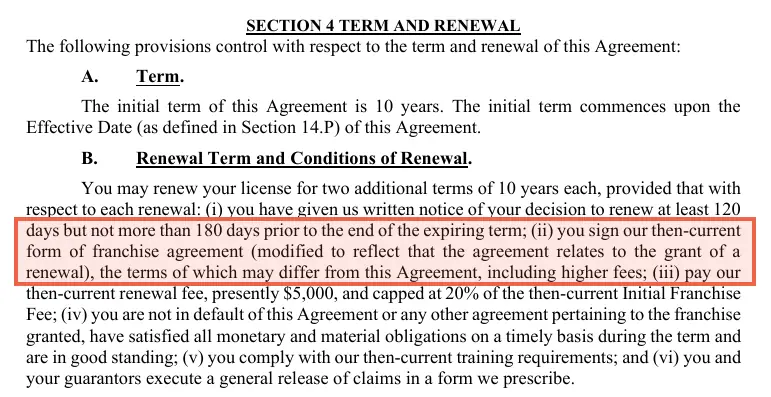
What it means: the second 10 years is a new contract, not a continuation. Before you sign the first one, ask to see the agreement the brand offers today and treat it as the likely renewal text. U.S. Lawns adds a holdover rule in §4.C: if you keep operating after expiry without renewing, the agreement may continue month to month, and “your royalty rate will increase by 5%”.
Clause 2, Huntington ¶3.1.1: the renewal agreement “may contain terms, obligations, royalty, advertising fees, and other fees, costs, and expenses that are significantly different from, in addition to, and less favorable to you than, those in this Agreement, including no or a smaller exclusive area”
Huntington Learning Centers, Inc. FDD, issued April 16, 2026, Exhibit B. Summarised in Item 17(c).
What it means: the protected area you buy is not guaranteed past year 10. Huntington also bars renewal if you received three or more defaults within any 12-month period or four or more written default notices in total, cured or not (¶3.1.3), and asks for 36 months of lease rights into the renewal term.
Clause 3, Camp Bow Wow §2.2(b): notice of intent to renew “at least six (6) but no more than twelve (12) months before expiration” and “FAILURE TO PROVIDE PROPER NOTICE SHALL BE CONSIDERED AN ELECTION NOT TO RENEW”
Camp Bow Wow FDD, issued May 1, 2025, as amended November 20, 2025, Exhibit B. Summarised in Item 17(c).
What it means: a missed date can end the franchise. If you keep operating after a missed renewal deadline, §2.4 lets Camp Bow Wow charge “$1,000 on the day immediately following the missed renewal deadline plus a daily penalty of $100 per day”. Renewal also depends on the franchisor still selling franchises in your state (§2.2).
| Renewal condition | U.S. Lawns §4.B | Huntington ¶3.1 | Camp Bow Wow §2.2 |
|---|---|---|---|
| Notice window before expiry | 180 to 120 days | 240 to 180 days | 12 to 6 months (18 if relocating) |
| Sign then-current agreement | Yes, (ii) | Yes, ¶3.1.1 | Yes, (n) |
| General release of claims | Yes, you and guarantors, (vi) | Yes, per Item 17(c) | Yes, (j) |
| Upgrade or remodel | Training only, (v) | Premises to then-current standards, ¶3.1.3 | Camp Site to then-current standards, (e) |
| Renewal fee | $5,000 now, capped at 20% of the then-current initial fee, (iii) | $8,000 plus third-party costs, ¶3.1.8 | 50% of the then-current Initial Franchise Fee, (k) |
| New personal guarantee | Guarantors sign the release, (vi) | Owners and Guarantors sign the release, ¶3.1.7 | Yes, (i) |
| Missed-deadline consequence | Month-to-month, royalty up 5% (§4.C) | Renewal option terminates (¶3.2) | Election not to renew; $1,000 plus $100 per day if operating (§2.4) |
What territory does the contract actually protect?
The territory clause usually protects you against one thing, a unit under the same brand inside your area, and reserves everything else. When the grant is not exclusive, 16 CFR 436.5(l)(5)(i) makes Item 12 print “You will not receive an exclusive territory”; U.S. Lawns (FDD page 33) and Camp Bow Wow both carry that warning, yet both contracts promise some protection.
Clause 4, U.S. Lawns §2.B: “we will not (i) modify the Territory without your written permission, or (ii) establish either a company-owned or franchised Landscape Maintenance Business within the Territory under the U.S. LAWNS Marks, although we or another franchisee may from time to time service particular customers in the Territory in the event you are unable or unwilling for whatever reason to meet the service needs of those customers”
U.S. Lawns FDD, issued April 1, 2026, Exhibit B. Summarised in Item 12.
What it means: the promise covers U.S. LAWNS-branded units only, and §2.C lets the franchisor sell the same services inside your area under other marks or after a merger. Camp Bow Wow §1.6(f) reserves “Non-Traditional Location(s)” inside the territory, listing stadiums, hotels, hospitals, colleges and airports, with a 30-day right of first negotiation for you. Huntington’s Item 12 defines the Exclusive Area as a circle around the Premises “with a radius between zero and three miles”. Our franchise territory rights study shows how often protected areas carry carve-outs like these.
Can you sell the franchise or leave it to an heir?
You can sell, but only with the franchisor’s approval, after paying a transfer fee, with the buyer signing the franchisor’s current contract, and usually after the franchisor passes on its own right to buy first. Death or disability is handled as a transfer with a deadline, not as an inheritance right.
Clause 5, U.S. Lawns §10.F: “We then have 10 days from our receipt of the statement setting forth the third-party offer and other requested information to accept the offer by delivering written notice of acceptance to you. We will have an additional 45 days to complete the purchase if we elect to exercise our right of first refusal.”
U.S. Lawns FDD, issued April 1, 2026, Exhibit B. Summarised in Item 17(n).
What it means: any buyer you find waits up to 55 days while the franchisor decides and closes, and if it passes you have 60 days to finish the sale on the stated terms. An unapproved sale is void under §10.B, or the franchisor may collect “a transfer fee equal to two times the transfer fee”. Our franchise transfer fee fact sheet compares these fees across brands.
| Transfer term | U.S. Lawns | Huntington | Camp Bow Wow | Source |
|---|---|---|---|---|
| Transfer fee | $15,000 first franchise; $5,000 to an existing majority owner; $2,500 per added agreement | $10,000 Transfer Fee within $53,500 of fees due on transfer | $15,000 plus broker fees; $7,500 Resale Consulting Fee if it helps sell | USL §10.C; HLC Item 5; CBW §12.2(b)(ii)(9) |
| Franchisor’s right to buy first | Right of first refusal, 10 days plus 45 to close | Option on the same terms, cash substitute allowed | First negotiation, refusal and purchase option | USL §10.F; HLC Item 17(n); CBW §§12.2(b), 13 |
| What counts as a transfer | Includes “any 20% or more change in the ownership percentage of the franchisee entity” | Includes any share, membership or partnership interest in you; a company formed for ownership convenience may run no other business | Includes a controlling interest; consent to move into an entity at least 70% owned by you | USL §10.A; HLC Item 17(k), (m); CBW Item 17(k), §12.2(a) |
| Death or incapacity | Heir must meet transfer and training conditions | Transfer within 240 days or the end of term; $1,000 fee | Successor must meet transfer conditions | Item 17(p) of each FDD |
Who can end the agreement early, and how fast?
The franchisor can end all three agreements for cause, with cure periods of 10 to 30 days for most defaults and none for a listed set. Your own exit right is narrower: two contracts let you terminate only after the franchisor fails to cure a breach, and Huntington’s Item 17(d) lists termination by the franchisee as “Not applicable”.
Clause 6, U.S. Lawns §12.B.2(xi): immediate termination with no opportunity to cure for “any default by you that is the second default of any type within any 12-month consecutive period”
U.S. Lawns FDD, issued April 1, 2026, Exhibit B. Summarised in Item 17(h).
What it means: two late reports in a year can count as a non-curable default under the contract text. §12.B.5 adds a cross-default, so a default under one U.S. Lawns agreement is a default under all of yours. State law can override: the Minnesota addendum in the same FDD cites Minn. Stat. 80C.14, which requires 90 days’ written notice and 60 days to cure in most cases.
Clause 7, Camp Bow Wow §15.2: you may terminate “only for ‘Good Cause’” after giving the franchisor “a minimum of 60 days to cure the default”, and “Failure to give timely notice of default shall constitute a waiver of the alleged default.”
Camp Bow Wow FDD, issued May 1, 2025, as amended November 20, 2025, Exhibit B. Summarised in Item 17(d).
What it means: if the franchisor breaches, the clock runs against you too. Send written notice promptly and keep proof, because a late notice waives the claim under this clause. The franchisor’s own cure window for your defaults is 15 days for payment and standards defaults and 30 days for most others (§14.2).
Franchisees get 10 to 15 days to cure a missed payment; the franchisor gets 30 to 60 days to cure its own breach. Exhibit B of the U.S. Lawns, Huntington and Camp Bow Wow FDDs, read November 2, 2026.
| Cure period in days | U.S. Lawns | Huntington | Camp Bow Wow | Source |
|---|---|---|---|---|
| Your missed payment | 10 | 10 (5 from the third in 12 months) | 15 | USL §12.B.1; HLC ¶15.2.4; CBW §14.2 |
| Your other curable defaults | 30 | Up to 30 | 30 | USL §12.B.1; HLC ¶15.2; Item 17(g) CBW |
| Cure you must give the franchisor | 30 | 60 minimum in your claim notice | 60 minimum | USL §12.C; HLC ¶24.2.2; CBW §15.2 |
What does the non-compete stop you doing after you leave?
All three agreements bar you from a competing business for 2 years after the agreement ends, inside your old area and a radius around it, and two extend the bar to areas around other units of the brand. The covenants reach owners and guarantors, and two reach family members.
Clause 8, Huntington ¶17.3.2: no competing business located within or serving students within “(i) the Premises; or (ii) the Exclusive Area; or (iii) a radius of 25 miles from the Exclusive Area; or (iv) a radius of 25 miles from the Premises; or (v) a radius of 25 miles from any HLC”
Huntington Learning Centers, Inc. FDD, issued April 16, 2026, Exhibit B. Summarised in Item 17(r).
What it means: the radius is measured from every Huntington center, so in a metro area with several centers the restricted zone can cover most of the region. The covered business is broad: ¶17.3.2 lists tutoring in reading, phonics, study skills or mathematics, SAT or ACT preparation, and courses “in any academic subject”.
All three covenants last 2 years; the radius is 50 miles at U.S. Lawns and Camp Bow Wow and 25 miles at Huntington, where it runs from every Huntington center. Exhibit B of each FDD, read November 2, 2026.
| Post-term covenant | U.S. Lawns §9.D | Huntington ¶17.3 | Camp Bow Wow §11.3 |
|---|---|---|---|
| Length | 2 years, tolled during breach | 2 years from the latest of transfer, termination or final court order | 2 years, tolled during noncompliance |
| Radius | Territory plus 50 miles from its outer boundary, plus other U.S. LAWNS territories | 25 miles from the Exclusive Area, the Premises or any HLC | Territory plus 50 miles, plus 50 miles of any company or franchisee territory |
| Who is bound | Guarantors, officers, owners; breach if a spouse, parent, sibling or child competes (§9.F) | You and your Owners | Owners, guarantors and “each of their immediate family members”; spouse or significant other signs (§11.3(e)) |
State addenda can cancel these covenants. The Virginia pages in the U.S. Lawns and Huntington FDDs state that subdivision A 4 of §13.1-563 of the Virginia Retail Franchising Act makes it unlawful to offer or enter into an agreement restricting retail business after termination or expiration, with a 2-year exception when you sell the franchise at an agreed price. Our franchise relationship laws tracker lists which states add rules like this.
Where are disputes heard, and who signs personally?
Disputes go first to mediation in all three contracts, at headquarters for U.S. Lawns and Huntington and in Denver for Camp Bow Wow. U.S. Lawns and Camp Bow Wow then send them to American Arbitration Association arbitration, while Huntington uses courts in its home district and sets a strict notice procedure for your claims.
Clause 9, Huntington ¶24.2.3: if you do not submit your claim to mediation “within 30 days after expiration of the time period within which you demand we cure, then you will have evidenced conclusively that you have no claim against any Franchisor Entity”
Huntington Learning Centers, Inc. FDD, issued April 16, 2026, Exhibit B. Summarised in Item 17(u).
What it means: a franchisee claim at Huntington runs on two clocks, a written notice giving at least 60 days to cure (¶24.2.2) and then 30 days to file for mediation. U.S. Lawns §11.A requires in-person mediation in its headquarters city for “a minimum of two (2) consecutive eight (8) hour days”. Item 17(v) puts that headquarters in Orlando, Florida.
Clause 10, U.S. Lawns Schedule E: the guarantors “do jointly, individually and severally hereby become surety and guarantor for the payment of all amounts and the performance of the covenants, terms and conditions in the Franchise Agreement”
U.S. Lawns FDD, issued April 1, 2026, Exhibit B, Schedule E. Required by §14.F for owners of 5% or more.
What it means: forming an LLC does not shield the owners. Schedule E binds guarantors to the §9.D non-compete and the §11 dispute terms, and says liability does not depend on the franchisor first pursuing the franchisee company. Huntington goes further with Exhibit D, a Confession of Judgement for customer refund and complaint amounts, which notes it “is not used where a Confession of Judgment is prohibited or unenforceable”. Our franchise personal guarantee study compares guarantee forms across brands.
Where does the Item 17 summary differ from the contract text?
Item 17 compresses a long contract into short cells, and in the three FDDs we read the summary and the cited section did not always match. Where they differ, the agreement is the document you sign, so the section number in the middle column is the one to read.
| Claim | Where it appears | What the filed text says | Source |
|---|---|---|---|
| Non-compete reaches 25 miles from any HLC “existing on the date this business commences operations” | Huntington Item 17(r) | ¶17.3.2(v) says “a radius of 25 miles from any HLC”, with no date limit | Huntington FDD, April 16, 2026 |
| Disputes “mediated and, if necessary, arbitrated in the State of Texas, City of Dallas” | Camp Bow Wow Item 17(u) | §19.1 holds mediation at the AAA “in Denver, Colorado”; §19.4(a) holds the arbitration hearing in Dallas; §19.3 lets the franchisor sue in Colorado | Camp Bow Wow FDD, amended November 20, 2025 |
| Renewal requires “a nonrefundable fee of $10,000” | Huntington Item 17(c) | ¶3.1.8 sets a Renewal Franchise Fee “of $8,000 plus all Third Party Costs”, and Item 5 also says $8,000 | Huntington FDD, April 16, 2026 |
| Venue applies to claims “not subject to arbitration under Section 12” | U.S. Lawns §14.I | Arbitration is in Section 11; Section 12 is Default and Termination | U.S. Lawns FDD, April 1, 2026 |
| A franchise-consultant guide (2023) ties the term to “the franchise location’s opening date” | Online guide | Only Camp Bow Wow counts from opening (§2.1); U.S. Lawns counts from the Effective Date (§4.A) and Huntington from the Agreement Date (Table 2) | Three FDDs above |
| An encyclopedia entry mentions a “ten-day” federal waiting period | Online reference | 16 CFR 436.2(a) sets 14 calendar days before signing or paying | CFR 2025 edition |
For how these terms compare across 259 FDDs rather than three, our franchise agreement terms study codes Item 17 for every brand in the sample.
Which clause should you read first? A decision table by what the text says
Start with the clauses that cannot be fixed after signing: renewal, the guarantee, the non-compete radius and the claim-notice rules. Use the left column to find the wording in your own agreement, then take the step on the right before you sign. This page explains contract text and is not legal, financial or investment advice.
| If your agreement says | Example in the filings | Then do this before signing |
|---|---|---|
| Renewal means signing the “then-current form” | USL §4.B(ii); HLC ¶3.1.1; CBW §2.2(n) | Get the agreement offered to new buyers today and compare its fees and territory with yours |
| Missing the notice window ends renewal | CBW §2.2(b): 6 to 12 months | Put the window in your calendar on day one, with a reminder at 13 months before expiry |
| Territory protection covers only same-brand units | USL §2.B, §2.C; CBW §1.6(f) | List stadiums, hospitals, colleges and airports in your area and ask which channels are reserved |
| Franchisee termination “Not applicable” | Huntington Item 17(d) | Read the transfer section as your only exit and price the $10,000 Transfer Fee into your plan |
| Second default in 12 months is non-curable | USL §12.B.2(xi) | Ask whether a late report counts, and check your state’s notice and cure statute |
| Non-compete radius runs from every brand unit | HLC ¶17.3.2(v) | Map existing units within 25 miles of your home before signing if you plan to stay in the trade |
| Family members are bound or must sign | USL §9.F; CBW §11.3(b), (e) | Ask whether a spouse’s current job falls inside the covenant |
| A confession of judgment exhibit is attached | HLC Exhibit D | Ask your lawyer whether your state prohibits it; the form says it is not used where prohibited |
| Mediation or arbitration in the franchisor’s city | USL §11.A; CBW §19.1, §19.4 | Check your state addendum; the Minnesota pages in all three FDDs bar required litigation outside Minnesota |
A franchise attorney can mark up this table against your own agreement, and our step-by-step guide to buying a franchise shows where contract review fits between validation calls and signing. For who owes which duty once the contract is signed, see our comparison of franchisee vs franchisor roles.
How we compiled this
We opened three Clean FDDs filed with the Minnesota Department of Commerce on its CARDS franchise registration database on November 2, 2026, one each from home services, education and pet services within our 259-brand FDD sample, and read Exhibit B, the franchise agreement, in each. Every quote is copied from those documents with its section number; brand choice is not an endorsement. Federal rule text comes from the 2025 CFR edition on govinfo because eCFR returned a bot check, and Minnesota law from the Revisor of Statutes. We excluded Item 19 data and franchisee lists.
Frequently asked questions
What is a franchise agreement?
A franchise agreement is the signed contract that licenses you to run a business under a franchisor’s brand and system for a fixed term, usually 10 years in the three filings we read. It sets fees, territory, renewal, transfer, termination, non-compete and dispute rules. The FDD summarises it in Item 17 and attaches the full text under Item 22, which is where you read what you are agreeing to.
What information is included in a franchise agreement?
Expect sections on the grant and territory, term and renewal, initial and ongoing fees, operating standards, marketing, insurance, transfer, default and termination, post-term duties, the non-compete, dispute resolution and governing law, plus an attached personal guarantee. U.S. Lawns fits this into 14 sections; Huntington uses 26 paragraphs and nine exhibits, including a Confession of Judgement form.
How long is a franchise agreement, and does it renew automatically?
All three agreements we read set a 10-year initial term, and none renews automatically. U.S. Lawns needs written notice 180 to 120 days before expiry, Huntington 240 to 180 days, and Camp Bow Wow 12 to 6 months. Each requires signing the franchisor’s then-current agreement, which can carry different fees and a smaller territory.
Where can I read a sample franchise agreement?
Every FDD must attach the proposed franchise agreement under Item 22 (16 CFR 436.5(v)), so the brand’s current FDD is the real sample. Minnesota’s free CARDS database posts filed FDDs; in the U.S. Lawns, Huntington and Camp Bow Wow filings the agreement is Exhibit B. Generic templates online are not the contract a brand will ask you to sign.
Can you negotiate a franchise agreement?
The FTC Rule expects some negotiation: under 16 CFR 436.2(b), changes that come from negotiations you start do not trigger the 7-day waiting period that applies to unilateral changes. Brands often decline to change core terms, so focus requests on items such as the opening deadline, territory boundaries, guarantee scope or a transfer to your own company, and get any change in a signed addendum.
Do I need a franchise agreement lawyer?
A lawyer who reads franchise contracts can check the clauses that are hard to undo, such as the guarantee, the non-compete radius, renewal on the then-current form and claim-notice deadlines, and can tell you which state addendum overrides them. Ask whether your state voids out-of-state venue clauses and whether a confession of judgment form is enforceable where you live.
Sources
- U.S. Lawns Franchise Disclosure Document, issued April 1, 2026, Exhibit B Franchise Agreement, Minnesota CARDS, accessed November 2, 2026
- Huntington Learning Center Franchise Disclosure Document, issued April 16, 2026, Exhibit B Franchise Agreement, Minnesota CARDS, accessed November 2, 2026
- Camp Bow Wow Franchise Disclosure Document, issued May 1, 2025, as amended November 20, 2025, Exhibit B Franchise Agreement, Minnesota CARDS, accessed November 2, 2026
- 16 CFR 436.5, Disclosure items, CFR 2025 edition, govinfo, accessed November 2, 2026
- 16 CFR 436.2, Obligation to furnish documents, CFR 2025 edition, govinfo, accessed November 2, 2026
- Minnesota Statutes 80C.14, Minnesota Office of the Revisor of Statutes, accessed November 2, 2026
- CARDS franchise registrations search, Minnesota Department of Commerce, accessed November 2, 2026