
Franchise opportunities in Florida are sold under the federal FTC Franchise Rule plus one state step: the franchisor files a $100 annual exemption notice with FDACS. Florida does not collect or review the FDD.
Key takeaways
- A franchisor must file a notice with the Florida Department of Agriculture and Consumer Services (FDACS) before offering a franchise located in Florida or sold to a Florida resident; the fee is $100 and the exemption lasts 1 year (Fla. Stat. 559.802; Rule 5J-10.002).
- The FDACS Business Search listed 821 registered franchise exemptions on October 27, 2026, and 210 of them (25.6%) belong to franchisors with a Florida address.
- Without that exemption, a sale with an initial payment above $500 and certain seller promises falls under the Sale of Business Opportunities Act: disclosure 3 working days ahead, a 1-year rescission right and a civil penalty of up to $5,000 per violation (Fla. Stat. 559.813).
- Florida courts presume a post-term noncompete against a former franchisee reasonable at 1 year or less and unreasonable beyond 3 years (Fla. Stat. 542.335(1)(d)2).
- In 2023, 3.7% of Florida’s responding employer firms operated all or partly as a franchise, against 4.7% nationally (Census Annual Business Survey).
- Florida’s sales tax on commercial rent ended for rental periods beginning on or after October 1, 2025, which removes a line from Florida franchise occupancy budgets (Florida DOR TIP 25A01-04).
Florida’s franchise rulebook, section by section
Florida has no franchise investment law that reviews offerings. Four sets of statutes do the work instead: Fla. Stat. 559.802 (the exemption filing), the Sale of Business Opportunities Act at Fla. Stat. 559.80 to 559.815 (which applies when no exemption covers the sale), Fla. Stat. 817.416 (franchise misrepresentation) and Fla. Stat. 542.335 (noncompetes). The table lists what each section requires and what a breach costs, from the 2026 Florida Statutes.
| Section | What it requires | What follows | Source |
|---|---|---|---|
| 559.802(1), (2) | Notice on the FDACS form before offering or selling a franchise located in Florida or to a Florida resident, stating substantial compliance with the FTC Franchise Rule | Sale is exempt from the Sale of Business Opportunities Act for 1 year; renewable each year | Fla. Stat. 559.802 |
| Rule 5J-10.002 | DACS Form 10500, Franchise Exemption Application, with a nonrefundable $100 filing fee | $100 renewal each year | Fla. Admin. Code 5J-10.002 |
| 559.801(1)(a) | Defines a business opportunity: initial fee or sum above $500 plus one of four seller promises (locations, buy-back, income guarantee or refund, sales or marketing program) | Triggers the duties in 559.803 to 559.815 | Fla. Stat. 559.801 |
| 559.803 | Disclosure document at least 3 working days before signing or paying, cover headed DISCLOSURES REQUIRED BY FLORIDA LAW | Missing disclosure supports rescission under 559.813 | Fla. Stat. 559.803 |
| 559.807 | Surety bond, certificate of deposit or letter of credit of at least $50,000 when the seller guarantees income or offers a refund or buy-back | Disclosed on the 559.803 document | Fla. Stat. 559.807 |
| 559.809 | 14 prohibited acts, including misstating the total investment, profits or renewal terms, and assigning one exclusive territory to two buyers | Felony of the third degree under 559.815 | Fla. Stat. 559.809 |
| 559.813 | Buyer may rescind within 1 year; damages plus reasonable attorney fees | Civil penalty up to $5,000 per violation, sought by the Department of Legal Affairs or a state attorney | Fla. Stat. 559.813 |
| 817.416(2) | No intentional misstatement of prospects for success, the known required total investment, or market capacity when selling a franchise or distributorship | Civil judgment for all moneys invested; misdemeanor of the second degree | Fla. Stat. 817.416 |
| 542.335(1)(d)2 | Post-term noncompete against a former franchisee | 1 year or less presumed reasonable; more than 3 years presumed unreasonable | Fla. Stat. 542.335 |
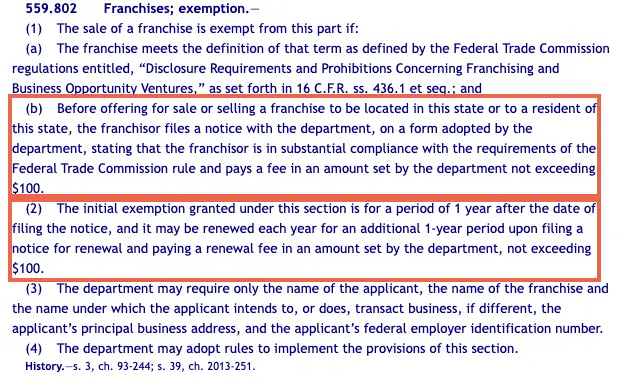
Subsection (3) of Fla. Stat. 559.802 limits what FDACS may ask for to five items: the applicant’s name, the franchise name, any trade name, the principal business address and the federal employer identification number. No disclosure document, financial statement or advertising is filed with the state.
Is Florida a franchise registration state?
No. Florida is a filing state: FDACS states that sellers of business franchises “are no longer required to file registration documents” and that the Franchise Exemption filing remains in place (FDACS, Sellers of Business Franchises). The franchisor certifies compliance with the FTC Franchise Rule, pays $100 and renews every 12 months. The buyer files nothing.
Our comparison of state filing systems places Florida among six states (Connecticut, Florida, Kentucky, Nebraska, Texas and Utah) that require a notice to use the franchise exemption in a business opportunity law, separate from the 14 registration states, in the franchise registration states report.
| Question | Federal FTC Franchise Rule | Florida | Source |
|---|---|---|---|
| What the buyer receives | FDD at least 14 calendar days before signing or paying | Nothing extra when the franchisor holds a current exemption | 16 CFR 436.2(a); Fla. Stat. 559.802 |
| Changed agreement | Copy 7 calendar days before signing a franchisor-made change | No separate Florida period | 16 CFR 436.2(b) |
| State filing | None | Exemption notice with 5 data items, before the first offer | Fla. Stat. 559.802 |
| Fee and term | None | $100, valid 1 year, renewed with another $100 | Rule 5J-10.002 |
| Low-payment threshold | Rule does not apply if required payments in the first 6 months total less than $735 | Business opportunity definition starts at an initial payment above $500 | 16 CFR 436.8(a)(1); Fla. Stat. 559.801 |
| Large-investment exemption | Initial investment of at least $1,469,600, excluding unimproved land and franchisor financing | Florida exemption still requires the FTC franchise definition to be met | 16 CFR 436.8(a)(5); Fla. Stat. 559.802 |
The 23 Items of the federal disclosure document still govern what a Florida buyer reads before signing; the franchise disclosure document guide walks through each one.
How many franchisors have filed a Florida exemption notice?
On October 27, 2026, the FDACS Business Search returned 825 unique license numbers under the license type Franchise Exemption: 821 with status Registered and 4 Expired. Of the 821 registered filers, 210 (25.6%) list a Florida principal address, 78 list California and 71 list Texas. Eighteen list an address outside the United States.
210 of 821 registered Florida franchise exemptions (25.6%) belong to filers with a Florida address. Source: FDACS Business Search, pulled October 27, 2026.
| Filer’s principal address | Registered exemptions | Share of 821 |
|---|---|---|
| Florida | 210 | 25.6% |
| California | 78 | 9.5% |
| Texas | 71 | 8.6% |
| Georgia | 32 | 3.9% |
| New Jersey | 30 | 3.7% |
| North Carolina | 28 | 3.4% |
| Michigan | 24 | 2.9% |
| Pennsylvania | 23 | 2.8% |
| New York | 23 | 2.8% |
| Colorado | 22 | 2.7% |
| Outside the U.S. | 18 | 2.2% |
| 36 other states, DC and Puerto Rico | 262 | 31.9% |
Read the 821 as a floor. Every registered record carries an issue date between June 26, 2026 and November 19, 2026, and 22 are dated after the day we pulled the list. A franchisor whose last notice predates June 26, 2026 may not appear in this search yet, so a missing name is a question to ask, not proof of a violation.
To check a specific brand before you sign:
- Open the FDACS Business Search and set the license type to Franchise Exemption.
- Search the franchisor’s legal entity name as printed on the FDD cover page and in Item 1, not the consumer brand.
- Confirm the status reads Registered and the expiry date falls after your planned signing date; license numbers in this list begin with BF.
- If no record appears, ask the franchisor in writing for its Form 10500 filing date and receipt, since the exemption must be in place before the offer under Fla. Stat. 559.802.
What applies if a seller skips the Florida exemption?
If no exemption covers the sale and the deal fits Fla. Stat. 559.801(1)(a), an initial payment above $500 plus a promise of locations, a buy-back, an income guarantee or a sales or marketing program, the full Sale of Business Opportunities Act applies. The sales-program promise does not count when it comes with a license of a registered trademark the seller requires the buyer to use.
| Duty on a business opportunity seller | Section | Buyer’s position if it is missed |
|---|---|---|
| Disclosure document 3 working days before signing or any payment | Fla. Stat. 559.803 | Rescind within 1 year and recover all sums paid |
| Written contract, copy 3 working days before signing, stating the total financial obligation and a Florida agent for service | Fla. Stat. 559.811 | Rescind within 1 year |
| $50,000 bond, CD or letter of credit when income is guaranteed or a refund or buy-back is offered | Fla. Stat. 559.807 | Damages plus reasonable attorney fees under 559.813(2) |
| Deliver equipment and supplies within 45 days after the contract’s delivery date | Fla. Stat. 559.813 | Rescind within 1 year |
| Avoid the 14 acts in 559.809 | Fla. Stat. 559.809 | Damages; seller faces a third-degree felony |
The state side is heavier. The Department of Legal Affairs or a state attorney may seek a civil penalty of up to $5,000 for each violation (Fla. Stat. 559.813(4)). A prohibited act under 559.809 is a third-degree felony (Fla. Stat. 559.815), punishable by up to 5 years in prison (Fla. Stat. 775.082) and a fine of up to $5,000 (Fla. Stat. 775.083).
| Deadline | What it covers | Section |
|---|---|---|
| 14 calendar days | FDD in hand before you sign or pay anything | 16 CFR 436.2(a) |
| 7 calendar days | Franchisor-made changes to the agreement | 16 CFR 436.2(b) |
| 3 working days | Business opportunity disclosure and contract copy | Fla. Stat. 559.803; Fla. Stat. 559.811 |
| 45 days | Business opportunity goods late past the contract delivery date | Fla. Stat. 559.813(1) |
| 1 year | Business opportunity rescission window; also the term of each FDACS exemption | Fla. Stat. 559.813(1); Fla. Stat. 559.802(2) |
| 5 years | Fictitious name registration term, then renew for $50 | Fla. Stat. 865.09(5), (12) |
| 1 year or less | Former franchisee noncompete presumed reasonable | Fla. Stat. 542.335(1)(d)2 |
| More than 3 years | Former franchisee noncompete presumed unreasonable | Fla. Stat. 542.335(1)(d)2 |
| 30 days | Cancel the fictitious name after you stop trading under it | Fla. Stat. 865.09(4) |
Which Florida statutes cover misrepresentation and termination?
Fla. Stat. 817.416 makes it unlawful, when selling a franchise or distributorship, to intentionally misrepresent the prospects for success, the known required total investment, or plans to sell more units than the market area can sustain. A buyer who proves a violation in civil court may receive a judgment for all moneys invested, with costs, and the court may add attorney fees.
The criminal side is lighter than chapter 559: proven knowledge or intent makes it a misdemeanor of the second degree, carrying up to 60 days (Fla. Stat. 775.082) and a fine of up to $500 (Fla. Stat. 775.083). The statute’s definition requires a franchisee that is “substantially reliant on franchisors for the basic supply of goods” (817.416(1)(b)4), so whether a service brand fits is a question for your lawyer.
Does Florida have a franchise termination law?
Our 50-state screen found no general franchise relationship law in Florida, only sector statutes for motor vehicle dealers (chapter 320), beer distributors (563.022) and parts and agricultural equipment dealers (686.30, 686.40), per the franchise relationship laws report. For most brands, termination, renewal and transfer follow FDD Item 17 and the contract.
Florida law is also a frequent contract choice: 27 of 259 FDDs in our sample of Minnesota CARDS filings name Florida as governing law in Item 17, per the franchise agreement terms analysis. A Florida choice-of-law clause brings 542.335 into play for the noncompete.
How long can a Florida noncompete bind a former franchisee?
Florida courts start from a statutory presumption. Under Fla. Stat. 542.335(1)(d)2, a post-term restraint on a former franchisee, distributor, dealer or trademark licensee is presumed reasonable at 1 year or less and unreasonable at more than 3 years. Both presumptions are rebuttable, and they apply to covenants signed on or after July 1, 1996.
| Person bound after the relationship ends | Presumed reasonable | Presumed unreasonable | Section |
|---|---|---|---|
| Former employee, agent or contractor | 6 months or less | More than 2 years | 542.335(1)(d)1 |
| Former franchisee, distributor, dealer or trademark licensee | 1 year or less | More than 3 years | 542.335(1)(d)2 |
| Seller of all or part of a business | 3 years or less | More than 7 years | 542.335(1)(d)3 |
| Anyone, where the restraint protects trade secrets | 5 years or less | More than 10 years | 542.335(1)(e) |
The same section tilts toward enforcement once a franchisor proves a legitimate business interest, which expressly includes goodwill tied to a trademark, a specific geographic location or a trade area (542.335(1)(b)4). A court “shall not consider any individualized economic or other hardship” to the person bound (1)(g)1, must construe the covenant in favor of reasonable protection (1)(h), and treats a violation as presumed irreparable injury (1)(j), per Fla. Stat. 542.335.
What must a new Florida franchise location register before opening?
The FDACS exemption is the franchisor’s job; opening the unit can put up to four Florida registrations on the franchisee. A unit trading under the brand name needs a fictitious name registration ($50), a Department of Revenue certificate for each place of business that sells taxable goods, any county or city local business tax, and, for food or lodging, a Division of Hotels and Restaurants license under Fla. Stat. 509.241.
- Register the brand as a fictitious name with the Division of Corporations before trading under it; the fee is $50 and the registration runs to December 31 of the 5th calendar year. An unregistered business cannot maintain a lawsuit in a Florida court until it complies (Fla. Stat. 865.09(3), (9), (12)).
- Apply to the Florida Department of Revenue for a certificate of registration for each place of business if you sell taxable items (Fla. Stat. 212.18(3)(a)); the state rate is 6% of the sales price of tangible personal property (Fla. Stat. 212.05), plus any county surtax.
- Check both the county (Fla. Stat. 205.032) and the city (Fla. Stat. 205.042) for a local business tax; each may levy one after 14 days’ public notice.
- For a restaurant or lodging franchise, obtain the Division of Hotels and Restaurants license before opening; it cannot be transferred, and operating without one is a second-degree misdemeanor (Fla. Stat. 509.241(1)).
| Florida cost or tax line | Rule | Amount | Source |
|---|---|---|---|
| Franchise exemption notice (franchisor pays) | Before the first Florida offer, then yearly | $100 | Rule 5J-10.002 |
| Fictitious name | Before trading under the brand name; renew every 5 years | $50 to register, $50 to renew | Fla. Stat. 865.09(12) |
| State sales tax on goods | Collected on taxable retail sales | 6% plus county surtax | Fla. Stat. 212.05 |
| Sales tax on commercial rent | Repealed for rental periods from October 1, 2025 | Was 2% plus surtax; now 0% | DOR TIP 25A01-04 |
| Personal income tax | No state tax on residents’ income beyond the federal credit allowance | None | Fla. Const. art. VII, s. 5(a) |
| Corporate income tax | Applies to corporate taxpayers under chapter 220 | 5.5% of net income | Fla. Stat. 220.11(2)(a) |
The rent change matters most for retail and restaurant brands with a lease. Under TIP 25A01-04, rent for occupancy through September 2025 stays taxable even if paid later, while transient lodging, parking and boat docking remain taxed under section 212.03.
What do Census and SBA data show about franchising in Florida?
Florida has fewer franchise firms per business than the nation but large ones. In the 2023 Annual Business Survey, 3.7% of Florida’s responding employer firms were franchises (U.S. 4.7%), a Franchise Density Index of 79 that ranks 40th, yet those firms held 10.4% of employment among responding firms, per our franchise statistics by state report.
| Florida measure | Value | Comparison | Original source |
|---|---|---|---|
| Franchise share of responding employer firms, 2023 | 3.7% (SE 0.2 pp) | U.S. 4.7%; index 79, rank 40 (90% range 34 to 44) | Census ABS AB2300CSCB01 |
| Same share, 2019 | 4.1% | Change to 2023: -0.4 pp, not significant at 90% | Census ABS |
| Franchise firms’ share of employment, 2023 | 10.4% (SE 1.6 pp) | Size ratio 2.8 (U.S. 2.2) | Census ABS |
| Franchise share in accommodation and food services, 2023 | 21.3% (SE 1.8 pp) | Industry mix predicts a 4.2% statewide share | Census ABS |
| Limited-service restaurants run as franchises, 2017 | 61.5% (8,508 of 13,835) | Full-service restaurants 14.3% | 2017 Economic Census |
| Franchise-coded SBA 7(a) loans, Oct 2021 to Apr 2023 plus FY2026 to Jun 30, 2026 | 1,312 | 2.48 per 100,000 residents a year, rank 10 of 51 | SBA 7(a) and 504 FOIA |
| Median franchise-coded 7(a) loan | $350,000 | 64.0% startups, 10.5% changes of ownership | SBA FOIA |
| Annual pace of franchise 7(a) loans | 654 a year in FY2026 | 521 a year in the earlier window, +25.6% | SBA FOIA |
| Franchise-coded 504 projects | 164 | Hotels and motels 23.2% of projects | SBA FOIA |
| Google Trends index for “buy a franchise”, Oct 2021 to Sep 2026 | 60.5 | Second to Wyoming (100.0) | Google Trends |
The lending figures come from our SBA franchise loans by state analysis, which uses only the windows when the SBA Franchise Directory was in force. Restaurant shares come from the 2017 Economic Census franchise file, which counts establishments, so read them as structure, not a 2026 count.
One widely quoted count, 64,278 franchise locations in Florida from the IFA Franchising by State map, is a model-based estimate with no published method, so we list it here only as context and do not compare it with the Census shares.
Which Florida metros have the highest franchise share?
Among Florida metros with reliable estimates, Gainesville had the highest franchise share of responding employer firms in 2023 at 9.1% (SE 2.6 pp), and the Miami-Fort Lauderdale-West Palm Beach metro the lowest at 2.3% (SE 0.4 pp), against 4.7% for the U.S.
Gainesville had a 9.1% franchise share of responding employer firms in 2023, Miami-Fort Lauderdale-West Palm Beach 2.3%, U.S. 4.7%. Source: Census ABS AB2300CSCB01.
| Metro area | Franchise share 2023 | Std. error | Responding franchise firms |
|---|---|---|---|
| Gainesville | 9.1% | 2.6 pp | 351 |
| Jacksonville | 5.3% | 0.8 pp | 944 |
| Orlando-Kissimmee-Sanford | 4.9% | 0.7 pp | 1,372 |
| Tampa-St. Petersburg-Clearwater | 4.7% | 0.6 pp | 1,593 |
| Cape Coral-Fort Myers | 4.7% | 1.4 pp | 400 |
| Miami-Fort Lauderdale-West Palm Beach | 2.3% | 0.4 pp | 1,697 |
Buying a franchise for sale in Florida: what changes with a resale?
Resales are a smaller slice of Florida franchise lending than elsewhere. From FY2020 to June 2026, 405 of 3,702 franchise-coded SBA 7(a) loans in Florida (10.9%, index 73) financed a change of ownership, the lowest share among 39 states with at least 150 such loans alongside Texas, per our franchise resale index.
- The business opportunity definition excludes the sale of ongoing businesses by an owner who sells no more than five of them (Fla. Stat. 559.801(1)(b)1).
- A seller’s noncompete tied to the sale of business assets or equity runs on the longer scale: 3 years or less presumed reasonable, more than 7 years presumed unreasonable (Fla. Stat. 542.335(1)(d)3).
- A Division of Hotels and Restaurants license “may not be transferred from one place or individual to another”, so a restaurant buyer applies for a new license (Fla. Stat. 509.241(1)).
- The seller must cancel a fictitious name within 30 days after ceasing to trade under it (Fla. Stat. 865.09(4)).
- The franchisor’s transfer conditions and fee sit in FDD Items 6 and 17; get the current FDD even on a resale.
Where do Florida franchise disputes get filed?
The Middle District of Florida is one of the busiest federal courts for franchise cases. It received 22 franchise filings in the 12 months ending June 30, 2026, up from 8 a year earlier, including 10 filed on one day in May 2026, and 51 over five years (4th nationally, 4.7% of U.S. filings), per Federal Judicial Center data in our franchise litigation report.
The Southern District of Florida moved the other way: 26 franchise filings in the five years ending June 30, 2026 (9th nationally, 2.4% of U.S. filings), down from 72 in the prior five years. Same-day groups can be related cases, since the court data does not link them.
Questions worth paying a Florida franchise lawyer to answer, each tied to a statute on this page (the franchise attorney clause checklist covers the federal side):
- Did the franchisor’s FDACS exemption cover the date of my first payment under 559.802?
- Does this system meet the basic-supply-of-goods test in 817.416(1)(b)4?
- How do the noncompete’s length and radius compare with the 1-year and 3-year presumptions in 542.335(1)(d)2?
- Which state’s law and which forum does Item 17 pick, and does that cut off any Florida remedy?
Which Florida rule matters for your deal?
Start with the FDACS record, then the payment size and the seller’s promises. The table gives the rule that controls each common Florida situation and the section behind it; the flowchart under it shows the same logic as a path from the FTC franchise test to the Florida statutes that apply in every branch.
| If | Then | Section |
|---|---|---|
| The franchisor shows as Registered in the FDACS search with an expiry after your signing date | The sale is exempt from Florida’s business opportunity law; rely on the FDD received 14 calendar days before signing or paying | Fla. Stat. 559.802; 16 CFR 436.2(a) |
| No current FDACS exemption, and you pay over $500 with a promise of locations, buy-back, an income guarantee or a sales plan | Sale of Business Opportunities Act: disclosure 3 working days ahead, written contract, 1-year rescission | Fla. Stat. 559.803; Fla. Stat. 559.811; Fla. Stat. 559.813 |
| Not an FTC franchise and no 559.801 promise | No chapter 559 pre-sale duty; ask a lawyer which exemption is claimed | Fla. Stat. 559.801 |
| A seller overstated total investment, success odds or market capacity | Civil judgment for all moneys invested, plus costs | Fla. Stat. 817.416 |
| The post-term noncompete runs more than 3 years | Presumed unreasonable; 1 year or less is presumed reasonable | Fla. Stat. 542.335(1)(d)2 |
| You will trade under the brand name | Register the fictitious name first, $50 | Fla. Stat. 865.09 |
| The unit serves food or offers lodging | Division of Hotels and Restaurants license before opening | Fla. Stat. 509.241 |
How we compiled this
We read 20 sections of the 2026 Florida Statutes and article VII of the Florida Constitution on the Legislature’s Online Sunshine site, Rule 5J-10.002, the FDACS franchise page, Florida DOR TIP 25A01-04 and three sections of the FTC Franchise Rule (16 CFR 436.1, 436.2 and 436.8), all in October 2026. We pulled the full FDACS Franchise Exemption list on October 27, 2026 (875 rows, 825 unique license numbers) and counted it by principal address.
Market figures come from our own analyses of Census, SBA, Federal Judicial Center and Google Trends files, cited to the original datasets. We excluded brand lists, rankings and earnings claims. This page is not legal, financial or investment advice.
Frequently asked questions
Do I need a license to buy a franchise in Florida?
No buyer license exists for the purchase itself. The filing duty sits with the franchisor, which files a $100 exemption notice with FDACS each year under Fla. Stat. 559.802. Your licenses come at the unit level: a $50 fictitious name registration if you trade under the brand, a Department of Revenue certificate if you sell taxable goods, any county or city local business tax and, for restaurants, a Division of Hotels and Restaurants license.
What is the best franchise to own in Florida?
We do not rank brands. Florida data points to where franchising is concentrated: 61.5% of the state’s limited-service restaurants were franchise establishments in the 2017 Economic Census, against 14.3% of full-service restaurants. Compare brands on FDD Items 5 to 7 for cost, Item 19 for whether financial performance data exists, and Item 20 for openings, closures and transfers.
How much does it cost to file a franchise in Florida?
The franchisor files DACS Form 10500, Franchise Exemption Application, with a nonrefundable $100 fee, and renews each year for another $100 under Rule 5J-10.002. The statute caps both fees at $100. Florida asks for five items only: applicant name, franchise name, trade name, principal business address and federal employer identification number.
Can I cancel a franchise agreement in Florida after signing?
Florida gives no general cooling-off period for an exempt franchise sale. The 1-year rescission right in Fla. Stat. 559.813 applies to business opportunity sales that broke the act, for example by skipping the 3-working-day disclosure. Separately, Fla. Stat. 817.416 lets a buyer who proves intentional misrepresentation recover all moneys invested through a civil judgment.
Do franchise brokers have to register in Florida?
Our state-by-state review found no Florida franchise broker registration requirement as of October 2026, and NASAA said in July 2025 that only New York and Washington require one. Florida’s misrepresentation statute, Fla. Stat. 817.416, still reaches “any person” selling or establishing a franchise. The franchise broker registration report lists the rules by state.
Does Florida tax a franchise owner's income?
Florida’s constitution bars a state tax on the income of resident individuals beyond the federal credit allowance (art. VII, s. 5(a)), so profits passed through to you personally carry no Florida income tax. A franchise run as a C corporation pays corporate income tax at 5.5% of net income under Fla. Stat. 220.11(2)(a).
Sources
Florida law, rules and regulators
- The Florida Legislature, Florida Statutes 559.80 to 559.815, Sale of Business Opportunities Act, accessed October 27, 2026.
- The Florida Legislature, Florida Statutes 559.802, Franchises; exemption, accessed October 27, 2026.
- The Florida Legislature, Florida Statutes 559.801, 559.803, 559.807, 559.809, 559.811, 559.813, 559.815, accessed October 27, 2026.
- The Florida Legislature, Florida Statutes 817.416, Franchises and distributorships; misrepresentations, accessed October 27, 2026.
- The Florida Legislature, Florida Statutes 542.335, Valid restraints of trade or commerce, accessed October 27, 2026.
- The Florida Legislature, Florida Statutes 775.082 and 775.083, penalties and fines, accessed October 27, 2026.
- The Florida Legislature, Florida Statutes 865.09, Fictitious name registration, accessed October 27, 2026.
- The Florida Legislature, Florida Statutes 212.05 and 212.18, sales tax and dealer registration, accessed October 27, 2026.
- The Florida Legislature, Florida Statutes 205.032 and 205.042, local business tax, accessed October 27, 2026.
- The Florida Legislature, Florida Statutes 509.241, licenses required, accessed October 27, 2026.
- The Florida Legislature, Florida Statutes 220.11, corporate income tax imposed, accessed October 27, 2026.
- The Florida Legislature, Constitution of the State of Florida, article VII, section 5, accessed October 27, 2026.
- Florida Administrative Code (Florida Department of State), Rule 5J-10.002, Franchises, accessed October 27, 2026.
- Florida Department of Agriculture and Consumer Services, Sellers of Business Franchises, accessed October 27, 2026.
- Florida Department of Agriculture and Consumer Services, Business Search, license type Franchise Exemption (pulled October 27, 2026), accessed October 27, 2026.
- Florida Department of Revenue, TIP 25A01-04, Sales Tax on Commercial Rentals Repealed Effective October 1, 2025, accessed October 27, 2026.
Federal rule and datasets
- eCFR, Federal Trade Commission, 16 CFR 436.1, Definitions, accessed October 27, 2026.
- eCFR, Federal Trade Commission, 16 CFR 436.2, Obligation to furnish documents, accessed October 27, 2026.
- eCFR, Federal Trade Commission, 16 CFR 436.8, Exemptions, accessed October 27, 2026.
- U.S. Census Bureau, 2024 Annual Business Survey, Characteristics of Businesses, AB2300CSCB01, accessed October 27, 2026.
- U.S. Census Bureau, 2017 Economic Census, Franchise Statistics, EC1700FRAN, accessed October 27, 2026.
- Minnesota Department of Commerce, CARDS, Franchise registrations search (FDD Item 17 sample, issued 2025-01-24 to 2026-08-18), accessed October 27, 2026.
- U.S. Small Business Administration, 7(a) and 504 FOIA loan files, as of June 30, 2026, accessed October 27, 2026.
- Federal Judicial Center, Integrated Database, civil cases SY1988 to present, accessed October 27, 2026.
- Google, Google Trends, buy a franchise, interest by U.S. state, Oct 2021 to Sep 2026, accessed October 27, 2026.
- International Franchise Association, Franchising by State map, accessed October 27, 2026.
- North American Securities Administrators Association, Public comment on the proposed Model Franchise Broker Registration Act (July 28, 2025), accessed October 27, 2026.