A handyman business franchise costs $73,050 to $238,736 to open across the four handyman systems with 2026 Minnesota filings: TruBlue, Ace Handyman Services, Mr. Handyman and Handyman Connection, per each brand’s Item 7.
Key takeaways
- Royalties are 6% of gross sales at Ace Handyman Services, Handyman Connection and TruBlue and 7% at Mr. Handyman, each with a 2% brand or marketing fee on top, per Item 6 of the Ace Handyman Services FDD and the other 2026 filings.
- Mr. Handyman requires two vans at opening and puts a purchased, outfitted van at $50,000 to $60,000 (Mr. Handyman FDD, Item 7, note 4); Ace Handyman Services requires no vehicle until you have three full-time craftsmen (Item 7, note 5).
- Every system sets a fee floor for slow years: at its highest tier, $42,000 a year at Handyman Connection for a 100,000-household territory, $40,000 at Ace, $22,100 at Mr. Handyman and $18,000 at TruBlue (Items 6 and 12 of each FDD, including the TruBlue FDD).
- In 2025, outlets that left the system equalled 3.5% of starting franchised outlets at Mr. Handyman, 7.0% at Ace, 9.6% at TruBlue and 15.4% at Handyman Connection (Item 20, Table 3 of the Handyman Connection FDD and the others).
- Ace Handyman Services is the former Handyman Matters: an Ace Hardware subsidiary acquired it on September 5, 2019, and the franchisor took its current name on September 18, 2019 (Ace FDD, Item 1).
How much does a handyman business franchise cost?
Item 7 of the 2026 filings puts the opening investment at $73,050 to $99,400 for TruBlue, $97,200 to $171,000 for an Ace Mini territory, $115,837 to $238,736 for Handyman Connection, $132,200 to $226,000 for a standard Ace Handyman Services territory and $161,900 to $215,000 for Mr. Handyman. The initial franchise fee accounts for $54,900 to $100,000 of each total.
All four franchisors price the fee by territory size. Ace charges $70,000 for up to 70,000 households plus $1.00 per household up to 100,000; Mr. Handyman charges $67,000 for 40,000 to 60,000 target households plus $0.70 per extra target household; Handyman Connection charges $71,000 for about 100,000 households; TruBlue charges $54,900 for a population of 175,000 to 200,000 plus $500 per extra 1,000 people (Item 5 of each FDD, including the TruBlue FDD).
| Brand (FDD issue date) | Initial fee (Item 5) | Paid to franchisor at signing | Total investment (Item 7) | Source |
|---|---|---|---|---|
| TruBlue (April 13, 2026, amended September 1, 2026) | $54,900 | $54,900 | $73,050 to $99,400, excluding real estate | TruBlue FDD, Items 5 and 7 |
| Ace Handyman Services, Mini territory (March 25, 2026, amended June 5, 2026) | $35,000 to $45,000 | $35,000 to $45,000 | $97,200 to $171,000 | Ace FDD, Items 5 and 7 |
| Handyman Connection (March 13, 2026) | $71,000 | $77,000 including the $6,000 software license fee | $115,837 to $238,736 | Handyman Connection FDD, Items 5 and 7 |
| Ace Handyman Services, standard territory | $70,000 to $100,000 | $70,000 to $100,000 | $132,200 to $226,000 | Ace FDD, Items 5 and 7 |
| Mr. Handyman (April 1, 2026) | $67,000 | $72,500 including the $5,500 Initial Package Fee | $161,900 to $215,000 | Mr. Handyman FDD, Items 5 and 7 |
Item 7 ranges run from $73,050 (TruBlue) to $238,736 (Handyman Connection). Source: 2026 FDDs filed in Minnesota, accessed October 2026.
Veteran discounts change the fee by $5,490 to $10,000. Ace takes $7,000 off; Mr. Handyman takes 15% off its $65,000 minimum fee, which is $9,750; Handyman Connection charges veterans and first responders $61,000 instead of $71,000; TruBlue offers up to 10%, which is $5,490 on $54,900 (Item 5 of each FDD).
For context, the median low Item 7 estimate across seven handyman, repair and trades FDDs in our sector study is $107,824, so three of the four systems start above it. The full sector picture is in our home service franchise statistics report. How Item 5 and Item 7 work for any brand is covered in our franchise cost guide.
Why can the Item 7 range understate the cash you need?
Item 7 covers only the first three months, and three lines in these filings move the real cash need: vehicles, opening marketing and working capital. Mr. Handyman’s Item 7 counts three months of vehicle expenses ($7,500 to $15,000), not the purchase of the two vans it requires, and TruBlue’s Item 6 adds a branded truck or van within one year of opening.
| Line item | Ace Handyman Services | Mr. Handyman | Handyman Connection | TruBlue | Source |
|---|---|---|---|---|---|
| Vehicle | $0 to $9,000; none required until three full-time craftsmen | $7,500 to $15,000 for 3 months; two vans required at opening | No vehicle line; one vehicle wrap sits in opening marketing | $0 to $2,000 in Item 7; branded truck or van $2,500 to $40,000 within 1 year (Item 6) | Item 7 notes of each FDD |
| Opening marketing | $11,000 to $20,000 | $6,000 to $10,000 (equipment, uniforms, marketing materials) | $25,685 to $69,700 | $3,000 to $4,000 | Item 7 |
| Additional funds, 3 months | $30,000 to $45,000 | $60,000 to $90,000, not counting any draw for you | $1,730 to $40,830 | $8,000 to $20,000 | Item 7 |
| Office | Small office outside the home required | Real estate and utility deposit $1,000 to $1,500 | No home office; 500 sq ft recommended maximum | Home office allowed | Items 1 and 7 |
| Required staff at opening | Office Manager within 75 days of signing | Operation and customer service payroll in additional funds | A customer service representative in the office | Part-time salesperson after 6 months | Items 7 and 15 |
The van rule is the largest gap. Mr. Handyman’s note 4 says buying and outfitting a van typically costs $50,000 to $60,000, so purchasing the two required vans adds $100,000 to $120,000 that the Item 7 total does not show; leasing keeps the outlay closer to the $7,500 to $15,000 line. Ace’s Item 7 shows the opposite approach in its Truck or Van line.
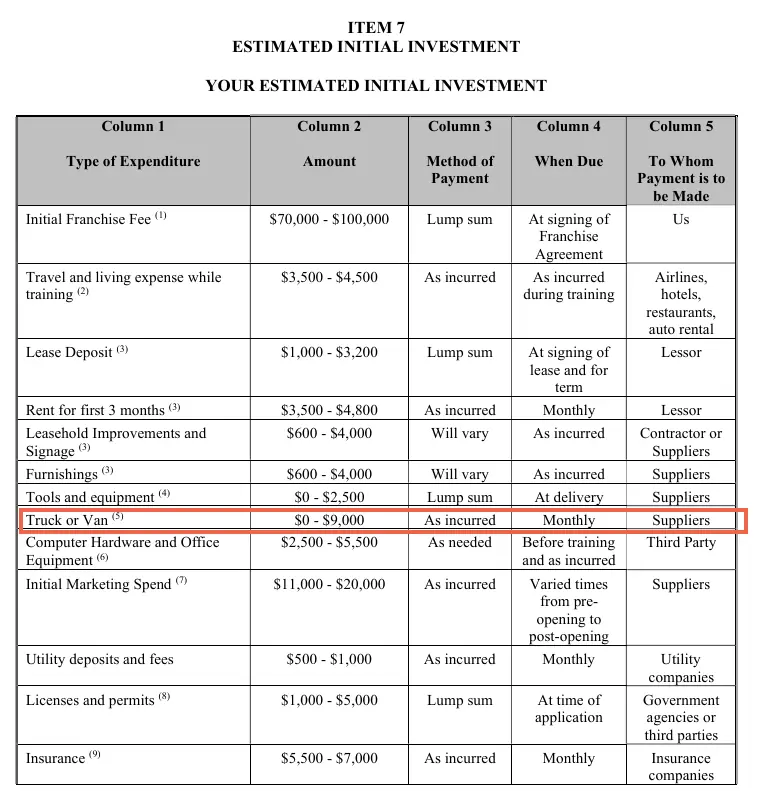
Ace’s working capital line includes a required Office Manager, estimated at $24 to $30 an hour for 40 hours a week over the first 12 weeks. That is $11,520 to $14,400 of the $30,000 to $45,000 additional funds estimate (Ace FDD, Item 7, note 10).
What ongoing fees do handyman franchises charge?
Percentage fees run 8% to 9% of gross sales across the four systems before technology charges: Ace and TruBlue take 6% royalty plus 2% brand fund, Mr. Handyman 7% plus 2%, and Handyman Connection 6% plus 2% plus a 1% technology fee. Local marketing minimums add $30,000 to $75,000 in early years at Ace and Mr. Handyman.
| Fee (Item 6) | Ace Handyman Services | Mr. Handyman | Handyman Connection | TruBlue |
|---|---|---|---|---|
| Royalty | 6% of Gross Revenues, monthly | 7% of Gross Sales weekly; 3.5% on material and subcontractor revenue | 6% of Gross Sales, monthly | 6% of Gross Revenues; $500 monthly minimum for 12 months, then $1,000 |
| Brand or marketing fund | 2% National Brand Fee | 2% MAP Fee | 2% up to $3,000,000 of sales; 1.5% to $5,000,000; 1% above | Greater of 2% or $500 a month |
| Technology | $599 a month, capped at $1,200 | $196.95 a month plus ServiceTitan at $228 to $241 per user a month | $175 per user a month plus 1% of Gross Sales | $195 a month |
| Local marketing minimum | $30,000 in year 1, $40,000 in year 2, $50,000 a year after | $60,000 in year 1, $75,000 in year 2, then 8% of prior year Gross Sales | 10% of Gross Sales in year 1, then 5% to 8% by sales tier | Cooperative up to 3% if one forms |
| Transfer fee | $10,000 ($3,500 to family) | Greater of $9,900 or 5% of price, plus $5,500 | $12,500 | Greater of $15,000 or 10% of price |
| Source | Ace FDD, Item 6 | Mr. Handyman FDD, Item 6 | Handyman Connection FDD, Item 6 | TruBlue FDD, Item 6 |
The worked table below applies each Item 6 rate to every $100,000 of gross sales. It is a unit of arithmetic, not a sales forecast, and it leaves out local marketing, which is set in dollars or by tier.
| Per $100,000 of gross sales | Ace Handyman Services | Mr. Handyman | Handyman Connection | TruBlue |
|---|---|---|---|---|
| Royalty | $6,000 (6%) | $7,000 (7%) | $6,000 (6%) | $6,000 (6%) |
| Brand or marketing fund | $2,000 (2%) | $2,000 (2%) | $2,000 (2%) | $2,000 (2%) |
| Percentage technology fee | $0 | $0 | $1,000 (1%) | $0 |
| Total percentage fees | $8,000 | $9,000 | $9,000 | $8,000 |
| Fixed technology per year | $7,188 ($599 x 12) | $2,363.40 ($196.95 x 12) plus $2,736 to $2,892 per ServiceTitan user | $2,100 per user ($175 x 12) | $2,340 ($195 x 12) |
Across 239 FDDs with a percentage royalty, the median royalty is 6% of sales and royalty plus brand fund is 8%, so Ace and TruBlue sit at both medians and Mr. Handyman and Handyman Connection 1 point above the combined one. The full distribution is in our franchise royalty rates study.
What do you owe if sales come in low?
Each filing sets a minimum that turns the percentage fee into a dollar floor. At Ace, Item 12 bills royalty and brand fee on Minimum Annual Gross Revenues of $200,000, $400,000 and then $500,000; the other three set weekly, monthly or annual minimum fees in Item 6. These minimums are contract terms, not forecasts of what an outlet will sell.
| Brand | Rule | Starts | First floor a year | Highest floor a year | Arithmetic and source |
|---|---|---|---|---|---|
| Ace Handyman Services | 6% royalty plus 2% brand fee charged on the Item 12 minimum | Operating year 1 | $16,000 | $40,000 from year 3 | 8% x $200,000; 8% x $500,000 (Items 6 and 12) |
| Mr. Handyman | Minimum License Fee $200 to $350 a week plus minimum MAP Fee $50 to $75 a week | Week 40 | $13,000 | $22,100 from week 183 | ($200 + $50) x 52; ($350 + $75) x 52 (Item 6 Fees Chart) |
| Handyman Connection | Minimum Royalty $13,500, then $21,000, per 50,000-household group | Calendar year 3 | $27,000 | $42,000 in years 6 to 10 | 2 x $13,500; 2 x $21,000 for a 100,000-household territory (Item 6) |
| TruBlue | Royalty minimum $500, then $1,000 a month; brand fee minimum $500 a month | Month 1 | $12,000 | $18,000 from month 13 | ($500 + $500) x 12; ($1,000 + $500) x 12 (Item 6) |
Highest yearly fee floors: $42,000 Handyman Connection, $40,000 Ace, $22,100 Mr. Handyman, $18,000 TruBlue. Source: Items 6 and 12, 2026 FDDs, accessed October 2026.
Missing the minimum has consequences beyond the fee. Ace may terminate, shrink the territory or add franchisees after two consecutive shortfall years or any three (Item 12). Mr. Handyman requires a performance improvement plan if sales fall into the bottom 10% of the system from the second full calendar year (Item 12). Handyman Connection’s early termination payment equals the current year’s Minimum Royalty plus the next two years’, which reaches $126,000 (3 x $42,000) for a 100,000-household territory in years 6 to 8 (Item 6).
How do territories, owner time and contract terms differ?
Only TruBlue grants an exclusive territory; Ace says its protected territory is “not deemed to be an exclusive Territory”, and Mr. Handyman and Handyman Connection grant no exclusivity. All four sign 10-year terms. Owner time rules range from Ace’s 40 in-person hours a week by you or an approved Franchise Manager to TruBlue, which does not require the owner to work in the business.
| Brand | Territory (Item 12) | Owner role (Item 15) | Term and renewal (Item 17) | Initial training (Item 11) |
|---|---|---|---|---|
| Ace Handyman Services | 70,000 to 100,000 households; Mini up to 45,000; protected, not exclusive | You or an approved Franchise Manager, in person, at least 40 hours a week; Office Manager required | 10 years; successor terms of 10 years for a $5,500 fee | 10 to 12 weeks of onboarding, about 3 business days of training, 18 to 24 hours on site |
| Mr. Handyman | 40,000 to 60,000 target households; not exclusive | You perform or supervise directly unless the franchisor approves a trained manager | 10 years; one 10-year renewal for $5,000 | 5 days in Waco or Dallas, Texas, or virtual |
| Handyman Connection | Generally 75,000 to 100,000 households, typically 100,000 to 105,000; rights to new residential leads, not exclusive | Managed full time by a trained person; the signer works full time unless the franchisor consents | 10 years; one 10-year renewal for the greater of 15% of the fee or $10,000 ($10,650 at $71,000) | Up to 5 weeks: 112 classroom and 54 on-the-job hours |
| TruBlue | Population 175,000 to 200,000 for the base fee; exclusive | An entity with an approved full-time manager; owner participation not required | 10 years; two more 10-year terms | 40 classroom hours |
Handyman Connection also runs a different labor model: its Item 1 says services are performed by independent contractors or employees in your network, customers usually pay a flat fee per job, and jobs are capped at $15,000 per project or $30,000 in total until you complete the Second Calendar Year. Ace recommends that independent contractors stay under 40% of your workforce (Item 15). How exclusivity clauses compare across 259 FDDs is in our franchise territory rights study.
What happened to Handyman Matters?
Handyman Matters is now Ace Handyman Services. Ace’s Item 1 says the franchisor was incorporated in Colorado on August 22, 2000 as Handyman Matters Franchise Corporation and has offered similar franchises since February 2001. Ace Services Holdings LLC, a subsidiary of Ace Hardware Corporation, acquired its parent on September 5, 2019, and the franchisor became Ace Handyman Franchising, Inc. on September 18, 2019.
The other franchisors have their own ownership chains. Mr. Handyman SPV LLC is part of Neighborly, whose parent was bought by funds affiliated with KKR on August 31, 2021; Handyman Connection’s franchisor, Trident Investment Partners, Inc., has franchised since January 31, 2014 after its predecessor franchised from January 1993; TruBlue’s franchisor was incorporated in Ohio on May 2, 2011 (Item 1 of each FDD).
Are these handyman franchise systems growing or losing owners?
All four systems ended 2025 with more franchised outlets than at the end of 2023, but exits differ widely. Exits, meaning terminations, non-renewals, reacquisitions and closures, equalled 3.5% of starting outlets at Mr. Handyman in 2025 and 15.4% at Handyman Connection, whose counts include 16 Canadian outlets at year end (Item 20).
| Brand | Franchised outlets, end 2023 | End 2024 | End 2025 | Opened 2025 | Exits 2025 | Exits as % of start | Transfers 2025 | SBA 7(a) loans, FY2020 to June 30, 2026 |
|---|---|---|---|---|---|---|---|---|
| Ace Handyman Services | 367 | 369 | 383 | 40 | 26 | 7.0% | 19 | 101 |
| Mr. Handyman | 326 | 347 | 357 | 22 | 12 | 3.5% | 35 | 83 |
| Handyman Connection (US and Canada) | 62 | 65 | 65 | 10 | 10 | 15.4% | 7 | 21 |
| TruBlue | 94 | 104 | 135 | 41 | 10 | 9.6% | 14 | 15 |
Outlet columns come from Item 20, Tables 1 to 3 of each FDD; Ace also had 18 affiliate-owned outlets at the end of 2025. Loan counts come from the SBA 7(a) FOIA data matched to codes in the SBA Franchise Directory; the median loan was $150,000 for each brand in our tabulation, and the full list is in our SBA franchise directory report.
Franchised outlets at the end of 2025: Ace 383, Mr. Handyman 357, TruBlue 135, Handyman Connection 65. Source: Item 20, 2026 FDDs, accessed October 2026.
Transfers matter if you search for a handyman franchise for sale: Mr. Handyman recorded 35 in 2025 and Ace 19. Buyers of a resale pay the seller’s price plus the transfer charges in Item 6, compared across brands in our franchise transfer fees study.
What does Item 19 show about handyman franchise owner income?
All four FDDs include an Item 19 financial performance representation for 2025, but they measure different things, and this site does not republish those figures. Ace reports revenue through to an owner discretionary income line; Mr. Handyman and TruBlue report sales only; Handyman Connection adds gross margin on service revenue. Read the figures in Item 19 of each current FDD.
| Brand | What Item 19 reports | Sample | Costs shown? |
|---|---|---|---|
| Ace Handyman Services | Revenue, cost of goods sold, gross profit, expense lines and owner discretionary income, by quartile | 77 single territories and 77 multi-territory groups (309 territories), 2025 | Yes |
| Mr. Handyman | Average and median Gross Sales, grouped by number of units owned | 165 franchisees operating 341 businesses, 2025 | No; the FDD says figures do not reflect costs |
| Handyman Connection | Annual Gross Sales (Part I-A) and gross margin on service revenue (Part II) | 27 of 28 US franchisees; 25 for margin, 2025 | Gross margin only |
| TruBlue | Gross Revenue by quartile and cumulative | 42 owners open a full year with a handyman on staff, 2025 | No |
Owner income depends on what is left after the Item 6 fees and floors above, technician and office payroll, vehicles and the marketing minimums. This is general information, not financial advice: ask each franchisor for its Item 19 substantiation, which Mr. Handyman’s Item 19 says it will provide on written request, and model it with an accountant. How Item 19 disclosures differ across 259 FDDs is in our franchise Item 19 study.
Which licenses and lead-paint rules apply to a handyman franchise?
Two sets of rules apply to every handyman franchise. Federal lead-safe rules under 40 CFR Part 745, Subpart E cover renovation in housing built before 1978, and state contractor licensing applies job by job. Handyman Connection’s Item 1 names 23 states that require special licenses for some home improvement work.
| Rule | What it says | Source |
|---|---|---|
| Target housing | Housing constructed before 1978 falls under the lead Renovation, Repair and Painting rule | 40 CFR 745.103; EPA RRP program |
| Minor repair exemption | 6 square feet or less of painted surface per room inside, or 20 square feet or less outside, with no window replacement or demolition | 40 CFR 745.83 |
| Renovator refresher | Refresher course within 5 years of the initial course | 40 CFR 745.90(a)(4) |
| Ace certification timing | Firm and at least one person certified before initial training | Ace FDD, Item 1 |
| States requiring special licenses | AZ, CA, CO, CT, FL, ID, IL, MD, MI, MN, NE, NJ, NM, NV, NY, OR, PA, SC, TN, VA, WA, WV, WI; AZ, CA, FL, NM, NV and SC also require experience | Handyman Connection FDD, Item 1 |
| Excluded work | Ace excludes advanced plumbing, electrical and HVAC; Handyman Connection bars lead abatement, roofing and HVAC without written permission | Ace Item 1; Handyman Connection Item 16 |
This is general information, not legal advice: ask a licensing attorney in your state which of your planned job types need a license and at what job value, then check that against the services list in Item 16.
Where do other handyman franchise guides go wrong?
The ranking guides we checked quote older FDDs or franchisor marketing pages, so their top-end cost figures trail the 2026 filings by $2,403 to $35,400. The table compares figures from two guides updated in 2026 and from summaries of the 2023 Handyman Connection FDD with the current Minnesota filings.
| What a ranking guide says | What the 2026 FDD says | Source |
|---|---|---|
| A guide updated September 2026: Ace total $131,497 to $223,597, initial marketing $9,000 to $16,000 | $132,200 to $226,000; initial marketing $11,000 to $20,000 | Ace FDD amended June 5, 2026, Item 7 |
| The same guide: TruBlue $70,050 to $96,400, fee $49,900 | $73,050 to $99,400; fee $54,900 | TruBlue FDD amended September 1, 2026, Items 5 and 7 |
| A guide dated January 2026: Mr. Handyman $143,150 to $179,600 including a $65,000 fee | $161,900 to $215,000; $67,000 fee plus $5,500 Initial Package Fee | Mr. Handyman FDD issued April 1, 2026, Items 5 and 7 |
| The same guide: Handyman Connection $110,722 to $231,114 | $115,837 to $238,736 | Handyman Connection FDD issued March 13, 2026, Item 7 |
| Summaries of the 2023 Handyman Connection FDD: 5% royalty | 6% royalty and 2% brand fund since 2025, up from 5% and down from 3% | Handyman Connection FDD, Item 12 |
Which handyman franchise model fits your situation?
The four systems sort cleanly on three questions: total budget, labor model and whether you can buy vehicles before opening. Use the decision table to pick which FDD to read first, then confirm each threshold in the current filing, since Items 5 to 7 change at each annual renewal of the FDD.
| If | Read first | Why (FDD item) |
|---|---|---|
| Your all-in budget is under $100,000 | TruBlue, then the Ace Mini territory | TruBlue Item 7 is $73,050 to $99,400; the Ace Mini range starts at $97,200 |
| You prefer a network of independent contractors | Handyman Connection | Item 1: contractors or employees in your network, flat fee per job |
| You can fund two vans before opening | Mr. Handyman | Item 7, note 4: two vans at opening, $50,000 to $60,000 each to buy |
| You cannot fund vans before opening | Ace Handyman Services | Item 7, note 5: no vehicle until three full-time craftsmen |
| You will not work in the business yourself | TruBlue, or Ace with an approved Franchise Manager | Item 15: TruBlue requires a full-time manager, not the owner; Ace requires 40 in-person hours from you or your manager |
| You want an exclusive territory | TruBlue | Item 12: exclusive territory; the other three are not exclusive |
| Your market is mostly housing built before 1978 | Any of the four, with RRP certification budgeted | 40 CFR 745.103; Ace requires certification before training |
Whichever system you pick, read Items 6, 12 and 20 of the current FDD before signing; every path in the flowchart ends there. A franchise consultant can line these filings up against your budget and territory; what that service includes and how it is paid is explained in our guide to what a franchise consultant does.
How long does it take to open, and what should you check first?
Item 11 of the four filings puts signing-to-opening at 2 to 6 months. Ace says opening typically takes 120 days, Handyman Connection 2 to 4 months with a 120-day deadline, Mr. Handyman training at 1 to 3 months and opening within 45 days after it, with a 6-month deadline, and TruBlue 2 to 6 months, with opening due within 3 months of training.
| Brand | Typical time to open | Contract deadline | Source |
|---|---|---|---|
| Ace Handyman Services | Typically 120 days | Open within 60 days after initial training; site within 90 days of signing | Ace FDD, Item 11 |
| Mr. Handyman | Training 1 to 3 months after signing; open within 45 days after training | Must open within 6 months of signing | Mr. Handyman FDD, Item 11 |
| Handyman Connection | Typically 2 to 4 months | Must open within 120 days of signing | Handyman Connection FDD, Item 11 |
| TruBlue | Typically 2 to 6 months | Must open within 3 months after completing initial training | TruBlue FDD, Item 11 |
- Get the current FDD at least 14 calendar days before you sign or pay, as 16 CFR 436.2(a) requires, and match its issuance date to the filing on Minnesota CARDS.
- Count the households or population in your target zip codes and price the fee: $1.00 per household over 70,000 at Ace, $0.70 per target household over 60,000 at Mr. Handyman, $1 per household at Handyman Connection, $500 per 1,000 people over 200,000 at TruBlue (Item 5).
- Quote vehicles before you sign: two vans at Mr. Handyman, a branded truck or van within 1 year at TruBlue (Items 6 and 7).
- Write out the fee floor for years 1 to 5 from the minimums table above, and compare it with your cash reserve.
- Call former owners listed in Item 20; Ace recorded 26 exits in 2025 and Handyman Connection 10.
- Book RRP renovator training and check your state’s contractor license before training starts (40 CFR 745.90; Ace Item 1).
- Have a franchise attorney review Item 17 renewal and transfer terms, such as Mr. Handyman’s transfer fee of the greater of $9,900 or 5% of the price.
For the full buying sequence from first call to signing, see our guide to buying a franchise.
How we compiled this
We read the four Franchise Disclosure Documents that handyman franchisors filed with the Minnesota Department of Commerce between March and September 2026 (Items 1, 5, 6, 7, 11, 12, 15, 17, 19 and 20), checking key tables against the rendered PDF pages, and added SBA 7(a) loan counts through June 30, 2026 and federal rule text from 16 CFR Part 436 and 40 CFR Part 745, all accessed in October 2026. We excluded every Item 19 figure under our site rule, do not rank brands, and did not cover systems without a current Minnesota filing that we reviewed, such as House Doctors, HandyPro and PatchMaster.
Frequently asked questions
Which handyman franchise has the lowest startup cost?
Among the four handyman systems with 2026 Minnesota filings, TruBlue has the lowest Item 7 range at $73,050 to $99,400, excluding real estate. The Ace Handyman Services Mini territory starts at $97,200, Handyman Connection at $115,837, a standard Ace territory at $132,200 and Mr. Handyman at $161,900. Vehicle rules can change the real cash need, so read Item 7 notes too.
Do I need handyman experience to buy a handyman franchise?
No trade experience is required by these filings. TruBlue’s Item 1 says prior construction experience is not required and that the owner leads the business rather than performing the services. Ace’s cover page says knowledge of the construction trade is not needed. Your job is hiring, scheduling and marketing, while Ace requires at least 40 in-person hours a week from you or a Franchise Manager.
How much do handyman franchise owners make?
This site does not publish earnings figures. Each of the four 2026 FDDs has an Item 19 for 2025: Ace shows revenue through an owner discretionary income line, Mr. Handyman and TruBlue show sales only, and Handyman Connection adds gross margin. Owner income depends on the Item 6 fees and minimums, payroll, vehicles and marketing minimums, so build your estimate from Items 6, 7 and 19.
Can you get an SBA loan for a handyman franchise?
Yes, all four brands carry codes in the SBA Franchise Directory. From FY2020 to June 30, 2026, SBA 7(a) data show 101 loans under Ace Handyman Services, 83 under Mr. Handyman, 21 under Handyman Connection and 15 under TruBlue. Lenders still apply their own credit standards, collateral rules and equity injection requirements.
What is the Handyman Connection franchise fee?
The Handyman Connection FDD issued March 13, 2026 sets the initial franchise fee at $71,000 for about 100,000 households, plus a $6,000 software license fee, so $77,000 goes to the franchisor. Veterans and first responders pay $61,000. Ongoing fees are a 6% royalty, a 2% brand fund and a technology fee of $175 per user a month plus 1% of Gross Sales.
Can I buy an existing handyman franchise for sale?
Yes, resales are common in Item 20: Mr. Handyman recorded 35 transfers in 2025, Ace Handyman Services 19, TruBlue 14 and Handyman Connection 7. You pay the seller’s price plus the franchisor’s transfer charges, such as $10,000 at Ace, $12,500 at Handyman Connection or the greater of $9,900 or 5% of the price plus $5,500 at Mr. Handyman.
Do you need a contractor's license to run a handyman franchise?
It depends on the state and the job. Handyman Connection’s Item 1 lists 23 states, including California, Florida and New York, that require special licenses for some home improvement work. Separately, renovation that disturbs paint in housing built before 1978 falls under the EPA lead rule in 40 CFR Part 745 unless it stays within the minor repair limits of 6 square feet per room inside.
Sources
- Ace Handyman Franchising, Inc., Ace Handyman Services Franchise Disclosure Document, issued March 25, 2026, as amended June 5, 2026 (Minnesota CARDS; accessed October 20, 2026)
- Mr. Handyman SPV LLC, Mr. Handyman Franchise Disclosure Document, issued April 1, 2026 (Minnesota CARDS; accessed October 20, 2026)
- Trident Investment Partners, Inc., Handyman Connection Franchise Disclosure Document, issued March 13, 2026 (Minnesota CARDS; accessed October 20, 2026)
- T.B. Franchising Systems, Inc., TruBlue Franchise Disclosure Document, issued April 13, 2026, as amended September 1, 2026 (Minnesota CARDS; accessed October 20, 2026)
- Minnesota Department of Commerce, CARDS franchise registrations search (accessed October 20, 2026)
- 16 CFR Part 436, FTC Franchise Rule (accessed October 20, 2026)
- 40 CFR Part 745, Subpart E, Residential Property Renovation (accessed October 20, 2026)
- U.S. EPA, Lead Renovation, Repair and Painting Program (accessed October 20, 2026)
- U.S. Small Business Administration, 7(a) and 504 FOIA data, as of June 30, 2026 (accessed October 20, 2026)
- U.S. Small Business Administration, SBA Franchise Directory (accessed October 20, 2026)