Jan-Pro franchise cost depends on which tier you buy: a regional developer territory costs $130,000 to $421,500 under the February 2026 FDD, while unit cleaning plans are priced by each regional office.
Key takeaways
- The only current Jan-Pro filing on Minnesota’s CARDS database is the regional developer offer: $130,000 to $421,500 to open, including a $50,000 to $250,000 fee set by the business count of the territory (Jan-Pro FDD, cover page and Item 5).
- Unit franchises are sold by about 108 regional developer outlets, each of which “annually prepare[s] and furnish[es]” its own unit FDD from a template that leaves the fee blank (Item 1, Item 20 and Exhibit K).
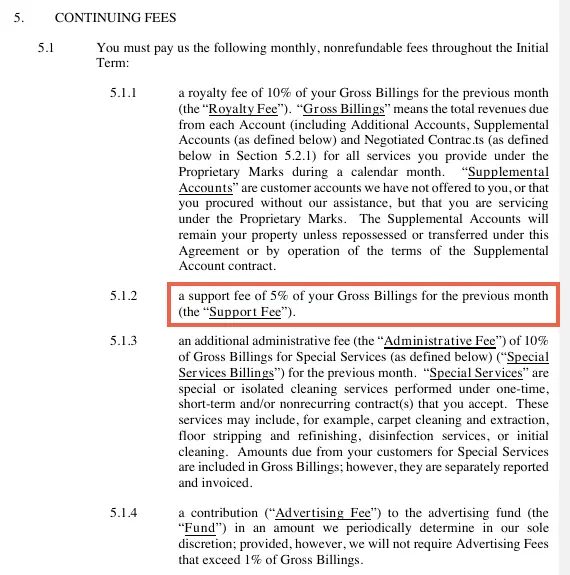
- The 2026 template unit agreement deducts a 10% royalty and a 5% support fee from every month’s Gross Billings, plus up to 1% for advertising, before the unit owner is paid (Exhibit K, sections 5.1.1 to 5.1.4).
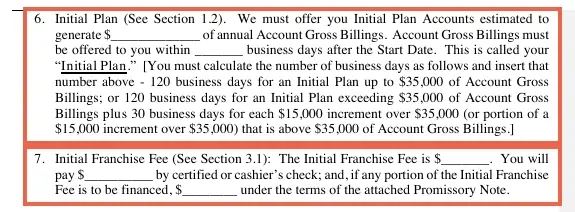
- Initial Plan accounts must be offered within 120 business days of the Start Date, plus 30 business days per $15,000 of annual billing above $35,000, so a $200,000 plan allows 450 business days (Exhibit K, Summary Page item 6).
- A cancelled account is replaced only inside a 12-month window; after one year of service there is no replacement and no refund (Exhibit K, sections 1.4 and 1.5; California DFPI guidance).
Is the Jan-Pro cost you saw for a unit or a regional territory?
Most published Jan-Pro numbers mix two different purchases. Jan-Pro Franchising International, Inc. (JPI), of Alpharetta, Georgia, sells regional developer territories; the regional developers sell the unit cleaning franchises. The Jan-Pro Franchising International FDD, issued February 11, 2026 is the territory offer, and its cover page puts the opening cost at $130,000 to $421,500. Unit prices come from each regional developer’s own disclosure document.
We checked the filing itself. The PDF on Minnesota’s CARDS system is titled “2026 Jan-Pro Regional Developer FDD,” runs 342 pages and was received February 17, 2026. It contains the template Unit Franchise Agreement as Exhibit K and a Services Agreement Pilot version as Exhibit L, but both leave the Initial Franchise Fee and the plan size as blanks for a regional developer to fill in. Jan-Pro’s own franchise cost page says the same thing in plain words: “Investment options vary by Regional Development office.”
The last Jan-Pro unit FDD on file in Minnesota is a 2016 filing by the Minneapolis regional developer. California’s and Wisconsin’s online franchise searches returned 403 errors to our requests in November 2026, so no current unit FDD was available to us; the unit figures below come from the 2026 template and, where labelled, the 2016 filing.
| Cost item | Regional developer (master) | Unit franchisee | Source |
|---|---|---|---|
| Who sells it | Jan-Pro Franchising International | Your local regional developer | Item 1 |
| Initial fee | $50,000 to $250,000 | Blank in the 2026 template; $3,250 to $44,000 in the 2016 Minneapolis filing | Item 5; Exhibit K; 2016 unit FDD, Item 5 |
| Total initial investment | $130,000 to $421,500 | $4,465 to $52,205 in the 2016 Minneapolis filing | Item 7; 2016 unit FDD, cover page |
| Main percentage fees | 4% Contract Services Royalty plus 10% Sales Royalty | 10% royalty plus 5% support fee, up to 1% advertising | Item 6; Exhibit K, s.5.1 |
| Term | 10 years | 5 years, two 5-year renewals | Item 17; Exhibit K, s.2.1 and 2.2 |
| Renewal fee | $20,000 | $750 | Item 6; Exhibit K, s.2.2.6 |
| Transfer fee | 10% of the price up to $1 million, lower above | Greater of $1,500 or 8% of the last 12 months’ Gross Billings | Item 6, note 4; Exhibit K, s.18.4.6 |
Who sets the price, finds the customer and collects the money?
The regional developer does all three for ordinary accounts. Item 11 says its advertising approvals do not affect its “right to determine the prices at which you sell your products or services (e.g., the sales price for Customer contracts sold to Unit Franchisees).” Under the template unit agreement the regional office also invoices the buildings, deducts its fees and pays the unit owner on the last business day of the month (sections 7.2 and 7.3).
National accounts run on a separate track. Jan-Pro Enterprises, LLC, an affiliate, “has the exclusive right to solicit, negotiate and establish the terms and pricing” for national account customers, and “only we or our designated affiliate may invoice and collect fees” from them (Item 12). On that revenue it keeps 25% in the first full month of service and 2% afterwards before paying the regional developer (Item 6), and the unit pays the regional office a further 1% National Account Support Fee (Exhibit K, s.5.2.3).
| Task | Who does it | Where it is written |
|---|---|---|
| Sells regional territories ($50,000 to $250,000 fee) | Jan-Pro Franchising International | Item 5 |
| Writes the template unit agreement and leaves unit fee amounts blank | Jan-Pro Franchising International | Item 1; Exhibit K |
| Sets unit plan prices and account prices | Regional developer | Item 11 |
| Finds customers and sells accounts to units | Regional developer | Item 1; Exhibit K, s.4.1 |
| Bills customers, collects and deducts unit fees | Regional developer | Exhibit K, s.7.2 and 7.3 |
| Issues its own unit FDD every year | Regional developer | Item 1 |
| Cleans the buildings and owns accepted accounts | Unit franchisee | Exhibit K, s.1.3 and 9.1 |
| Sets national account pricing, invoices and collects; keeps 25% first month, then 2% | Jan-Pro Enterprises (affiliate) | Items 6 and 12 |
| Pays invoices to the regional office | Customer building | Exhibit K, s.7.2 |
| Pays royalties to JPI: 4% of Gross Monthly Revenue and 10% of unit fees and note collections, plus the ad fund (lesser of 0.5% or $3,500 a month, minimum $450) | Regional developer | Item 6 |
Insurance money follows a third path. JPI’s captive affiliate, PMA Insurance SPC, received $5,304,103 from regional developer and unit franchisee purchases in the year to September 30, 2025, which was 78% of its revenue (Item 8). Units may buy their bonding and liability cover through the Business Protection Program at a price written on the unit agreement’s Summary Page.
What does a Jan-Pro regional developer territory cost to open?
Item 7 of the 2026 FDD estimates $130,000 to $421,500. The franchise fee is the largest swing at $50,000 to $250,000, followed by $50,000 to $100,000 of working capital for the first three months. A territory “will typically contain a minimum of 300,000 people,” and the office must be a leased space of about 1,500 to 2,000 square feet, because “You may not operate the Franchise from your home” (Items 7 and 12).
| Item 7 line | Low | High | Paid to |
|---|---|---|---|
| Initial franchise fee | $50,000 | $250,000 | JPI |
| Real estate (3 months’ rent and deposit) | $1,500 | $5,000 | Lessor |
| Initial supplies | $1,500 | $2,000 | Suppliers |
| Equipment and office furniture | $10,000 | $25,000 | Suppliers |
| Licenses, permits, deposits, prepaid expenses | $1,000 | $4,000 | Agencies and suppliers |
| Insurance | $1,000 | $3,000 | Insurance carrier |
| Certification travel | $3,000 | $5,000 | Transport, hotels, restaurants |
| Legal fees and registration of your own unit FDD | $1,500 | $10,000 | Attorneys and state agencies |
| Computer hardware and software | $7,500 | $12,500 | Suppliers |
| Initial advertising | $3,000 | $5,000 | Suppliers |
| Additional funds, 3 months | $50,000 | $100,000 | Vendors and employees |
| Total | $130,000 | $421,500 | Item 7 |
The franchise fee and three months of working capital are $350,000 of the $421,500 high estimate. Source: Jan-Pro FDD, Item 7, issued February 11, 2026.
Two lines are specific to the master tier. The equipment line covers a commercial carpet extractor, floor polisher and wet/dry vacuum that the developer keeps as backup gear and “may rent” to its units (Item 7, note 3). The legal line exists because the developer must register and update its own unit FDD; JPI “recommend[s]” a franchise attorney for that work (Item 1).
Financing terms read differently in two places. Item 5 says JPI may finance the part of the fee above $50,000 over 24 to 48 months at 10% a year. Item 10 describes financing for “qualifying existing franchisees” of up to 80% of the fee for up to 24 months at four percentage points over prime. Ask which version your agreement uses. Veterans who own at least 51% of the buyer can take 10% off the first agreement’s fee through the VetFran incentive (Item 5); our veteran franchise discount study compares that offer with other brands.
What the regional office pays JPI every month
Once open, a regional developer owes JPI a share of nearly every dollar its system bills: a 4% royalty on customer revenue, 10% of what it collects from selling unit franchises and accounts, and an advertising contribution with a $450 monthly floor. Item 6 also lists a $20,000 renewal fee after the 10-year term and a 10% transfer fee on a sale up to $1 million.
- Contract Services Royalty: 4% of Gross Monthly Revenue, which counts all billing collected by the developer or its units (Item 6, note 2).
- Sales Royalty: 10% of unit initial franchise fees, upgrade fees, unit transfer fees and note principal and interest collected.
- Advertising Contribution: the lesser of 0.5% of Gross Monthly Revenue or $3,500, with a $450 monthly minimum, plus local advertising of at least 2% with a $250 floor (Item 11).
- Web hosting $80 a month and email $50 a month; customer relationship software $37 per user per month (Items 6 and 11).
- Performance Standard: from the third anniversary, Supported System Sales must sit in the top 90% of comparable developers or grow at least 10% a year, or JPI may shrink the territory or terminate (Item 12).
What does a unit owner pay, and how is a plan priced?
A Jan-Pro unit is priced by its Initial Plan, a promised volume of “Account Gross Billings,” meaning the estimated annual service revenue of the accounts the regional office will offer (Exhibit K, s.1.2.1). The bigger the plan, the larger the Initial Franchise Fee. The 2026 template prints no dollar amounts, so the fee schedule for your city sits in Item 5 of your regional developer’s unit FDD.
The 2016 Minneapolis unit FDD shows how such a schedule is laid out. It listed “19 Franchise plans,” from FP-5 to FP-200, each with a total fee, a down payment, a financed balance at 10% a year and a 10% discount for paying in cash. These are ten-year-old prices from one territory and are shown only for structure; a 2026 schedule from another developer will differ.
| Plan (2016) | Annual Account Gross Billings | Total fee | Down payment | Financed | Full cash price |
|---|---|---|---|---|---|
| FP-5 | $5,000 | $3,250 | $1,250 | $2,000 | $2,925 |
| FP-20 | $20,000 | $9,000 | $5,000 | $4,000 | $8,100 |
| FP-35 | $35,000 | $13,000 | $8,000 | $5,000 | $11,700 |
| FP-50 | $50,000 | $16,000 | $11,000 | $5,000 | $14,400 |
| FP-100 | $100,000 | $26,000 | $21,000 | $5,000 | $23,400 |
| FP-200 | $200,000 | $44,000 | $36,500 | $7,500 | $39,600 |
Source: Jan-Pro Cleaning Systems of Minneapolis unit FDD, received April 12, 2016, Item 5. That filing’s Item 7 put the whole unit start-up at $4,465 to $52,205, including a $950 Initial Equipment Package bought from the regional office.
Which percentage fees come off the unit’s billing?
Section 5 of the 2026 template takes a 10% royalty and a 5% support fee from each month’s Gross Billings, plus an advertising fee the regional developer may set at up to 1%, before net pay is released. The 5% support fee in section 5.1.2 is the line most published cost summaries leave out, and one-time Special Services carry their own 10% charge.
| Unit fee (2026 template) | Amount | Section |
|---|---|---|
| Royalty Fee | 10% of Gross Billings, monthly | 5.1.1 |
| Support Fee | 5% of Gross Billings, monthly | 5.1.2 |
| Administrative Fee on Special Services (one-time jobs such as floor stripping) | 10% of Special Services Billings | 5.1.3 |
| Advertising Fee | Set by the regional developer, capped at 1% of Gross Billings | 5.1.4 |
| Advance Assurance Fee (optional) | 2% of monthly Gross Billings, for the rest of the term | 7.5 |
| National Account Support Fee | 1% of national account billing, on top of the royalty | 5.2.3 |
| Sales and Marketing Fee for each Additional Account | 5 times its monthly billing if your annualized billing is under $20,000; 4 times if $20,000 or more; 10% off if paid upfront | 4.2 and 4.3 |
| Negotiation Fee for a contract you bid with help | The first month’s Gross Billings, in 3 installments | 5.2.1 |
| Resolution Assistance Fee | $50 per unanswered customer complaint, plus 20% on any substitute cleaner’s cost | 5.2.2 |
| Insurance administration | Up to $50 a month; $50 a year to track policies bought outside the group program | 14.2 and 14.4 |
The Services Agreement Pilot version in Exhibit L drops the 5% support fee from the unit agreement, keeps the 10% royalty, and moves billing and sales help into a separate Support Services Agreement whose fees are not printed in the 2026 filing. Its Summary Page also has a box for electing no Initial Plan at all. Ask which template your regional developer uses before comparing fees.
How long can the regional office take to deliver your Initial Plan?
The deadline grows with the plan. The template Summary Page allows 120 business days after the Start Date for a plan of up to $35,000 in annual Account Gross Billings, plus 30 business days for each $15,000, or part of $15,000, above that. The clock starts only after certification, licenses, equipment and insurance are in place (s.1.2.2), and it stops while you are in default.
| Plan size (annual billing) | Amount over $35,000 | $15,000 increments (rounded up) | Deadline, business days | About how many weeks |
|---|---|---|---|---|
| $20,000 | $0 | 0 | 120 | 24 |
| $35,000 | $0 | 0 | 120 | 24 |
| $50,000 | $15,000 | 1 | 150 | 30 |
| $75,000 | $40,000 | 3 | 210 | 42 |
| $100,000 | $65,000 | 5 | 270 | 54 |
| $150,000 | $115,000 | 8 | 360 | 72 |
| $200,000 | $165,000 | 11 | 450 | 90 |
A $200,000 Initial Plan allows 450 business days, about 90 weeks, against 120 for plans up to $35,000. Source: Jan-Pro FDD, Exhibit K Summary Page item 6, issued February 11, 2026; our arithmetic.
Weeks assume 5 business days each and ignore holidays. If the office misses the deadline, section 3.2 reduces the fee by an “Adjustment Amount,” the difference between the fee you paid and the fee for the accounts actually offered, applied first to anything you owe, including a promissory note. The 2016 Minneapolis FDD worked one example: a buyer of the $9,000 FP-20 plan offered only $16,200 of billing would be repriced at $7,733 and refunded $1,267.
The deadline can also stretch. Under section 1.2.3 it is extended if an account cancels because of your “Misconduct,” a term that includes “providing services in a manner reasonably unsatisfactory to one or more of your customers,” or while any default goes uncured.
Which year-one cancellations does the regional office have to replace?
Only cancellations inside a 12-month window, and only with replacement accounts, never cash. Section 1.4 covers an account that ends within the first year for a reason other than your documented Misconduct, or that you stop because the customer will not pay. The office “will not refund the Initial Franchise Fee” but will offer replacement billing; section 1.5 ends that duty one year after service starts.
| What happens | What the template says follows | Section |
|---|---|---|
| You turn down an Initial Plan account | Value is replaced “within a reasonable time,” not necessarily inside the original deadline | 1.3 |
| Customer cancels in year one, not your fault | Replacement accounts; obligation ends 12 months from the cancelled account’s start, or from the replacement’s start if it replaces only remaining value | 1.4 |
| Customer cancels after one year of service | No replacement and no refund “for any reason” | 1.5 |
| Additional Account cancels, fee paid upfront or in 4 installments | Replaced if it ends within 12 months | 4.4.1 |
| Additional Account cancels, fee financed | Replaced only within 6 months | 4.4.1 |
| Contract won through a Negotiation Fee | “we have no obligation to replace” | 5.2.1 |
| Customer asks in writing for a different franchisee, or Misconduct is documented | Account may be “immediately repossessed,” with no refund of fees paid | 9.2 |
| Customer has not paid 90 days after the invoice | You repay the advance, unless you pay the 2% Advance Assurance Fee | 7.4 and 7.5 |
The same clock in order, from the 2026 template:
- Day 0: sign and pay the Initial Franchise Fee; the amount is set by your regional developer, and any financed part needs a promissory note (s.3.1).
- Before the Start Date: certification, licenses, equipment and insurance; certification is free for up to four people (s.7.1), and no accounts are offered until all are done (s.1.2.2).
- Start Date to 120 business days: Initial Plan accounts offered, plus 30 business days per $15,000 of plan billing over $35,000 (Summary Page item 6).
- Each month: invoices, deductions and net pay on the last business day, after the 10% royalty, 5% support fee and up to 1% advertising (s.5.1 and 7.3).
- 90 days after an unpaid invoice: repay the advance, unless you pay the 2% Advance Assurance Fee on monthly Gross Billings (s.7.4 and 7.5).
- 12 months per account: the replacement window closes; after one year of service a cancelled account is not replaced or refunded (s.1.4 and 1.5).
- Year 5: the Initial Term ends; two renewals of five years each, a $750 Renewal Fee and notice 6 to 12 months ahead, and the renewal form may carry a greater Royalty Fee or Support Fee (s.2.1, 2.2 and 2.2.4).
California’s regulator describes the same pattern across janitorial franchising. The California Department of Financial Protection and Innovation warns that “in most cases, the franchisor only promises you accounts for one year” and that “If your customers don’t pay the franchisor, you don’t get paid” (page captured March 10, 2026). Our comparison of six commercial cleaning franchise FDDs sets Jan-Pro’s template next to Coverall, Jani-King, Anago and OpenWorks.
What do Items 3, 19 and 20 add before you sign?
Three items change how to read the cost. Item 3 discloses a $30,000,000 settlement of a California unit franchisee class action and a pending District of Columbia case; Item 19 contains regional developer data only; and Item 20 shows 108 regional developer outlets at September 30, 2025, with several bought back by the parent after year end.
- Litigation. In the Northern District of California case No. 3:16-cv-05961, the court granted class certification and summary judgment on August 2, 2022, including claims over “unlawful deductions of (a) management fees and (b) sales and marketing fees”; JPI agreed on October 31, 2023 to pay $30,000,000 without admitting liability, and final approval came May 23, 2024. The District of Columbia Attorney General’s suit against a Washington-area regional developer and JPI (Case 2022 CA 003128 B), filed July 13, 2022, alleges unit franchisees were misclassified; trial was set for March 30, 2026 (Item 3). Our study of Item 3 litigation disclosures shows how such cases are reported across 259 FDDs.
- Financial performance. Item 19 reports historical revenue and expense tables for regional developers: 115 that operated the full year to September 30, 2025, and 48 of 94 U.S. developers that sent detailed 2024 statements. It has no unit-level owner data; any unit figures would sit in Item 19 of your regional developer’s unit FDD. Our Item 19 research explains what these tables can and cannot show.
- Ownership. JPI is a wholly owned subsidiary of Empower Brands Franchising, LLC, majority owned through holding companies by MidOcean Associates V, LP (Item 1). In October 2025 Empower Brands acquired RBJK Marketing, LLC, a regional developer with 1,528 unit outlets in nine metro regions at September 30, 2025, so the parent now also sells unit franchises in those regions.
| Fiscal year to Sept 30 | Regional developer outlets at start | Opened | Terminated or not renewed | At end |
|---|---|---|---|---|
| 2023 | 104 | 3 | 0 | 107 |
| 2024 | 107 | 1 | 1 | 107 |
| 2025 | 107 | 2 | 1 | 108 |
Source: Jan-Pro FDD, Item 20, Tables 1 and 3. Multi-state territories count once per state. JPI projects 1 new regional outlet, in Virginia, in the year to September 30, 2026, and notes that after year end its parent “reacquired several” developer businesses in Alabama, Arizona, Georgia, Illinois, Kansas, Louisiana, Missouri, Nevada and Oklahoma. Ownership by investment funds is common in franchising; our private equity franchise ownership report counts it across 259 franchisors.
Why do Jan-Pro cost estimates online run from $3,700 to $421,500?
Because sources quote different tiers, years and fee lists without saying which. A unit range belongs to one regional developer’s unit FDD; the $130,000 to $421,500 range belongs to the 2026 master filing. The table sets common claims next to what the primary documents say, as of November 2026.
| Published claim | What the primary source shows | Source |
|---|---|---|
| A lender’s cost guide, updated October 2026, gives a unit total of $3,700 to $57,000 “from the FDD” | No 2026 unit FDD sets one national range; the JPI filing leaves unit fees blank for each regional developer | JPI FDD, Item 1 and Exhibit K |
| The same guide lists a 10% royalty and 1% advertising fee | The standard template adds a 5% Support Fee (s.5.1.2) and a 10% fee on one-time Special Services | Exhibit K, s.5.1 |
| A franchise directory listing gives $4,830 to $58,070 and a $2,520 to $44,000 fee | Plausible as one developer’s unit range, but no issuing developer or year is named; the 2016 Minneapolis filing showed $4,465 to $52,205 | 2016 unit FDD, cover page |
| FDD review blogs report only $130,000 to $421,500 | Correct for a regional territory; it is not the price of a unit cleaning plan | JPI FDD, cover page and Item 7 |
Our list of franchises under $100,000 uses the directory’s unit range; read it as a single regional developer’s figures, not a national price.
Unit plan, regional territory or neither: which fits your capital?
Start with how much cash you can lose and whether you want to clean buildings or sell franchises. A unit buyer pays a plan fee that, in the 2016 example, ran from $3,250 to $44,000; a territory buyer needs at least $130,000 under Item 7, a leased office and its own registered unit FDD. Neither tier comes with a guarantee of income.
| If your situation is | Then | Check first |
|---|---|---|
| Under about $10,000 to spend and you plan to clean yourself | Ask for the smallest Initial Plan and the full cash price | Item 5 plan table of your regional developer’s unit FDD |
| You need the plan delivered within 6 months | Keep the plan at $35,000 or less; larger plans allow 150 to 450 business days | Summary Page item 6 |
| You would finance the plan fee or Additional Accounts | Expect a 6-month replacement window on financed Additional Accounts instead of 12 | s.4.4.1 and the Promissory Note |
| You have $130,000 to $421,500 and want to recruit and support cleaners | Consider the regional developer offer, which makes you a franchisor with your own disclosure document | Items 1, 7, 12 and 19 of the JPI FDD |
| Your territory is in one of the 9 states where the parent reacquired developers | Confirm whether the seller is an Empower Brands affiliate and which template it uses | Item 20 footnote; Item 1 |
| You want customers you can keep if you leave | Read the repossession list before signing; accounts revert on termination | s.9.2 |
Before signing a unit agreement, ask the regional developer for these items in writing:
- Its current unit FDD, at least 14 calendar days before you sign or pay, and the issue date on its cover.
- Its Item 5 plan table with every plan’s fee, down payment and financed balance.
- Which template it uses: the standard agreement with the 5% Support Fee, or the Services Agreement Pilot.
- The Business Protection Program price written on the Summary Page, against a quote for $50,000 bonding and $1,000,000 per occurrence liability cover (s.14.1).
- Its own Item 3 and Item 20, which list its lawsuits and its unit openings and exits.
A franchise consultant can compare those answers across brands, and the FTC’s Consumer’s Guide to Buying a Franchise explains each FDD item. Our guide to reading a franchise disclosure document walks through Items 5 to 7. This page is general information, not legal, financial or investment advice.
How we compiled this
In November 2026 we read the full 342-page Jan-Pro Franchising International FDD issued February 11, 2026, including the template unit agreements in Exhibits K and L, a same-day version of that filing, and the 2016 Minneapolis unit FDD, all from Minnesota’s CARDS database, plus California DFPI and FTC guidance. Deadline weeks are our arithmetic from the Summary Page formula. We excluded all Item 19 figures and did not use unsourced third-party ranges as facts.
Frequently asked questions
How much does a Jan-Pro franchise cost?
It depends on the tier. A regional developer territory costs $130,000 to $421,500, including a $50,000 to $250,000 fee, under the February 11, 2026 FDD. A unit cleaning franchise is priced by your regional developer by plan size; the last unit FDD on file in Minnesota, from 2016, showed $4,465 to $52,205.
What is the Jan-Pro royalty fee for a unit franchise?
The 2026 template unit agreement sets a 10% royalty and a 5% support fee on monthly Gross Billings, plus an advertising fee capped at 1% (Exhibit K, section 5.1). One-time Special Services carry a 10% administrative fee, and an optional Advance Assurance Program adds 2%. Your regional developer’s unit FDD states the rates it actually charges.
Does Jan-Pro guarantee customers to unit franchisees?
The template promises to offer accounts matching your Initial Plan within 120 business days, plus 30 days per $15,000 above $35,000, and to replace accounts lost in their first 12 months for reasons other than your Misconduct. It states it does not guarantee that accounts will be profitable or that estimated billings will be received (section 1.2).
How much does a Jan-Pro franchise owner make?
The 2026 Jan-Pro FDD has no unit owner income data. Its Item 19 covers regional developers only. Unit owner income depends on billing kept after the 10% royalty, 5% support fee and other Item 6 charges, minus labor and supplies. Check Item 19 of your regional developer’s unit FDD for any figures it chooses to disclose.
Does Jan-Pro finance the franchise fee?
For a territory, Item 5 says JPI may finance the part of the fee above $50,000 over 24 to 48 months at 10% a year, while Item 10 describes up to 80% for existing franchisees over 24 months at prime plus 4 points. Unit plans can be partly financed by the regional developer under a promissory note and owner guaranty.
Is there a Jan-Pro veteran discount?
Yes, for regional developers. The VetFran incentive takes 10% off the initial franchise fee on the first Franchise Agreement if the buyer is at least 51% owned by honorably discharged veterans and supplies a DD 214 (Item 5). It cannot be combined with other incentives. Unit discounts, if any, are set by each regional developer.
Sources
- Jan-Pro Franchising International, Inc. Franchise Disclosure Document (regional developer), issued February 11, 2026, Minnesota Department of Commerce CARDS, document 35379-202602-08, accessed November 3, 2026.
- Jan-Pro Cleaning Systems of Minneapolis unit Franchise Disclosure Document, received April 12, 2016, Minnesota Department of Commerce CARDS, document 1607-201604-02, accessed November 3, 2026.
- Janitorial Service Franchises, California Department of Financial Protection and Innovation, Internet Archive capture of March 10, 2026 (live page returned 403), accessed November 3, 2026.
- A Consumer’s Guide to Buying a Franchise, Federal Trade Commission, accessed November 3, 2026.
- Franchise Cost and Initial Investment, Jan-Pro Franchising International, accessed November 3, 2026.