A Paris Baguette franchise costs $727,515 to $1,860,550 to open, by Item 7 of the FDD issued March 30, 2026, and the franchisor or its affiliates are the only approved source of the dough you bake.
Key takeaways
- The franchisor is also the bakery supplier: dough, pastry, dairy, proteins, cake sheets and packaging must come from Paris Baguette Family Inc. or an affiliate, and required purchases make up an estimated 95% of what a cafe buys (Paris Baguette Franchise Disclosure Document, issued March 30, 2026, Item 8).
- Supply sales outweigh royalties: the franchisor reported $97,661,024 of 2025 revenue from required products and services sold to franchisees, 72.8% of its $134,118,474 total (Item 8).
- Two lines carry most of the cost: building costs of $325,000 to $1,000,000 and equipment of $167,956 to $350,000 make up 67.8% of the low Item 7 total and 72.6% of the high one (Item 7; our arithmetic).
- Training is long: each track for operators, bakers and cake decorators runs 240 hours (160 classroom, 80 on the job), against a median of 76 hours in 252 FDDs filed in Minnesota (Item 11; our training-hours study).
- Six states protect your fee: California, Hawaii, Illinois, Maryland, North Dakota and Virginia hold initial fees in escrow or defer them until the cafe opens (Exhibit J, state addenda).
| Key number | Value | Source |
|---|---|---|
| Total initial investment, one cafe | $727,515 to $1,860,550 | FDD cover; Item 7 |
| Paid to the franchisor or an affiliate before opening | $117,200 to $154,000 | FDD cover; Item 5 |
| Initial Franchise Fee | $50,000 first cafe; $40,000 each later cafe | Item 5 |
| Royalty Fee | 5% of weekly Gross Sales (4% for 12 months if open within 9 months of signing) | Item 6 |
| Marketing Fund plus local marketing | 2% plus 1% of Gross Sales; combined cap 4% | Items 6 and 11 |
| Typical time to open | About 12 months; 365-day deadline | Item 11 |
| Franchised cafes, end of 2025 | 261 (up from 186) | Item 20, Table 1 |
| Signed but not yet open, end of 2025 | 284 | Item 20, Table 5 |
Is Paris Baguette a franchise, and who signs the contract?
Yes. Paris Baguette Family Inc., a Delaware corporation based at 137 West Commercial Avenue in Moonachie, New Jersey, has sold Paris Baguette Cafe franchises since March 1, 2015, after two affiliate cafes were converted to franchises on October 27, 2014 (Item 1). The franchisor itself runs no cafes; its affiliate Paris Baguette America, Inc. operated 8 company cafes in the United States at December 31, 2025.
The trademark sits one level up. Item 1 says Paris Croissant Co., Ltd., formed January 2, 2026 in a corporate restructure and based in Seongnam-si, Korea, owns the “Paris Baguette” mark and the patents used to make the proprietary dough. It licenses the mark to Paris Baguette Bon Doux, Inc., which sub-licenses it to the franchisor. Item 3 groups Paris Croissant with related Korean companies as the “SPC Affiliates” in a Korea Fair Trade Commission matter, and also discloses a labor-law charge filed in Seoul on April 21, 2024 against the franchisor’s Chairman, who denies it.
Two formats are offered. A Traditional Cafe is about 3,000 square feet or more with dine-in seating, in a free-standing building or strip mall; a Non-Traditional Cafe sits in a grocery store, airport, hospital or stadium and “may have a smaller format” (Item 1). Buyers committing to 4 or more cafes can sign an Area Development Agreement. The franchise system is described in full in the 23-item disclosure document every buyer must receive 14 calendar days before signing.
Where does the bread come from: shipped dough or baked from scratch?
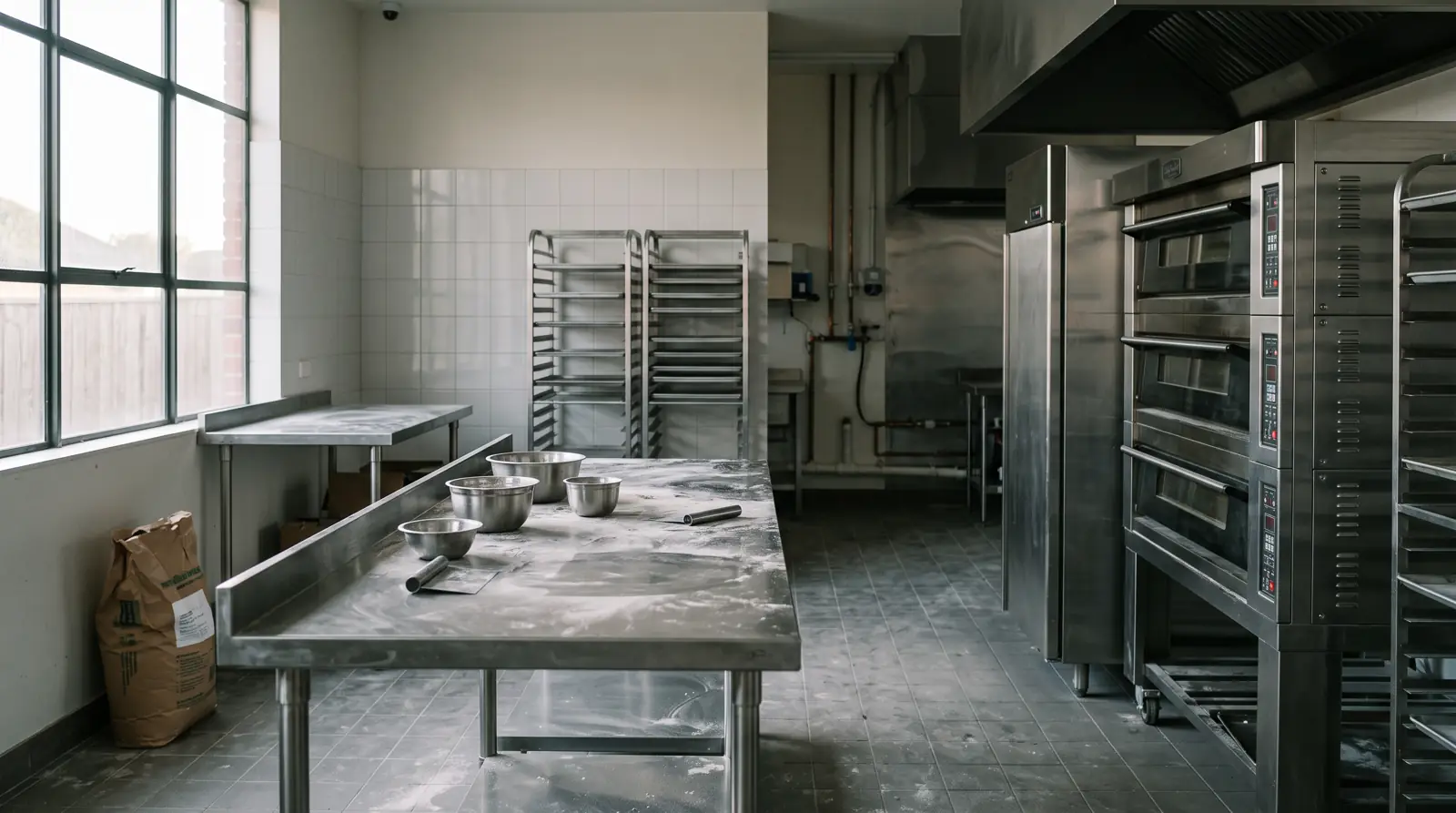
Paris Baguette cafes bake on site from dough the franchisor’s side of the business makes and sells. Item 14 says Paris Croissant uses four process patents “in making its proprietary dough that is sold by it to the Cafes”, Item 8 makes the franchisor or an affiliate the only approved supplier of that dough, and Item 7 prices a dough conditioner, oven and deck oven for every kitchen.
Two bread patents carry the process: US 8,383,173 (issued February 26, 2013) and US 8,512,773 (issued August 20, 2013), both titled “Method of making bread” and described in Item 14 as improving the activity and fermenting power of yeast. A third, US 9,883,686, covers a glazing agent for layered pastry. The FDD does not use the words “frozen” or “par-baked”. A June 2017 QSR Magazine profile (read through a Wayback Machine capture) described “flash-frozen dough that is distributed to each location and baked there”; the 2026 FDD is the binding description and says only “proprietary dough”.
The supply path in the diagram, step by step, as the FDD lays it out:
- Paris Croissant Co., Ltd.: owns the mark and the bread process patents; makes the proprietary dough (Items 1 and 14).
- Franchisor or affiliates: only approved supplier of dough, pastry, dairy, proteins, cake sheets and packaging (Item 8).
- Delivery to your cafe: required Sysco distribution; a delivery charge may apply by distance from the warehouse (Item 8).
- Baked in your cafe kitchen: dough conditioner, oven and deck oven (Item 7, Note 4); bakers and cake decorators: 240 training hours each (Item 11).
- Fallback if dough cannot be delivered: bake from Paris Baguette recipes with alternative approved supplies and special equipment (Item 8).
The fallback matters for cafes far from a warehouse. Item 8 warns that “not all supplies, including dough, may be available for delivery to your Cafe”, and that the franchisor may then “permit and or require you to create Paris Baguette bakery products at your Cafe using our recipes.” That would change both the equipment list and the skill level the kitchen needs, so ask in writing which delivery zone your proposed site falls in before you sign the 90-day site clock.
| What you buy | Who must sell it | FDD reference |
|---|---|---|
| Dough, pastry, produce, dairy, proteins, cake sheets, dry groceries, dry goods | Franchisor or affiliate (currently the only approved supplier) | Items 6 and 8 |
| Paper products bearing the mark; packaging | Franchisor or affiliate | Item 8 |
| 35 to 40 dining chairs and bar stools | Franchisor or affiliate, $7,000 to $8,000 | Item 5 |
| Smallwares (initial set) | Franchisor or affiliate, $15,000 to $18,000 | Item 5 |
| Approved bakery equipment, and replacements later | Franchisor, affiliate or designated supplier | Items 6 and 8 |
| Point of sale (at least 3 systems) | Approved vendor; Toast is the current required POS vendor | Items 7 and 11 |
| Test fit drawings, surveys, permit expediter | Vendor approved by the franchisor | Item 8 |
| Distribution | Required arrangement with Sysco | Item 8 |
What does the kitchen package cost, and who sells it?
Item 7 prices equipment and fixtures at $167,956 to $350,000 and smallwares at $25,000 to $30,000, both payable to the franchisor or approved suppliers before opening. Note 4 lists what the equipment line covers: coolers, freezers, the dough conditioner, oven and deck oven, racks, sinks, dishwashing, shelving, counters, lighting, seating and digital menu boards. No equipment financing is offered (Item 10).
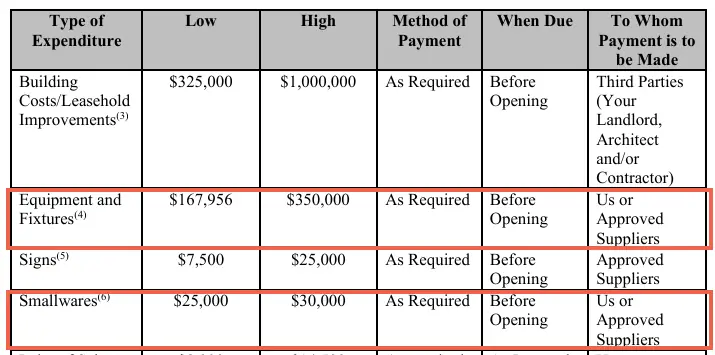
The smallwares line is wider than what the franchisor itself sells. Item 5 puts the franchisor’s share of initial smallwares at $15,000 to $18,000, so roughly $10,000 to $12,000 of the $25,000 to $30,000 Item 7 line goes to other approved suppliers for mixers, pans, dishes and food storage (our arithmetic from Items 5 and 7). Replacement bakery equipment, smallwares and chairs must also come from the franchisor, an affiliate or a designated supplier for the life of the agreement (Item 6).
| Kitchen and tech line | Low | High | Paid to | Source |
|---|---|---|---|---|
| Equipment and fixtures (incl. dough conditioner, deck oven) | $167,956 | $350,000 | Franchisor or approved suppliers | Item 7, Note 4 |
| Smallwares | $25,000 | $30,000 | Franchisor or approved suppliers | Item 7, Note 6 |
| POS, hardware, software, surveillance | $8,000 | $14,500 | Franchisor or approved suppliers | Item 7, Note 7 |
| Three POS systems, installed | $2,500 | $4,000 | Approved vendor | Item 11 |
| Security system with CCTV | $3,500 | $7,000 | Approved vendor | Item 11 |
| Office computer, printer, software | $800 | $2,000 | Approved vendor | Item 11 |
| Signs (exterior) | $7,500 | $25,000 | Approved suppliers | Item 7, Note 5 |
How much is a Paris Baguette franchise by format: Traditional, Non-Traditional or a four-cafe deal?
The FDD prints one single-cafe Item 7 table totaling $727,515 to $1,860,550, plus a 4-cafe area development table totaling $777,515 to $1,910,550 for the first cafe. Note 2 says the low end of the rent line is “typically only possible for a Non-Traditional Cafe”, while the building line assumes a Traditional premises of 3,000 to 4,000 square feet, so each format sits at a different end of the same table.
| Item 7 line | Low | High | Spread | Source |
|---|---|---|---|---|
| Initial Franchise Fee | $50,000 | $50,000 | $0 | Item 7, Note 1 |
| Rent, security deposit, prepaid costs | $10,000 | $90,000 | $80,000 | Item 7, Note 2 |
| Building costs and leasehold improvements | $325,000 | $1,000,000 | $675,000 | Item 7, Note 3 |
| Equipment and fixtures | $167,956 | $350,000 | $182,044 | Item 7, Note 4 |
| Signs | $7,500 | $25,000 | $17,500 | Item 7, Note 5 |
| Smallwares | $25,000 | $30,000 | $5,000 | Item 7, Note 6 |
| POS, hardware, software, surveillance | $8,000 | $14,500 | $6,500 | Item 7, Note 7 |
| Opening inventory | $40,000 | $60,000 | $20,000 | Item 7, Note 8 |
| Grand opening promotion | $12,500 | $12,500 | $0 | Item 7, Note 9 |
| Licenses, permits, fees, deposits | $4,510 | $18,710 | $14,200 | Item 7, Note 10 |
| Miscellaneous (pre-opening payroll, uniforms, utility deposits) | $11,109 | $16,450 | $5,341 | Item 7, Note 11 |
| Insurance, annual premium | $3,405 | $4,890 | $1,485 | Item 7, Note 12 |
| Attorneys and business consultants | $6,535 | $12,500 | $5,965 | Item 7, Note 13 |
| Travel and living while training | $20,000 | $65,000 | $45,000 | Item 7, Note 14 |
| Cost of goods during training | $4,000 | $4,000 | $0 | Item 7, Note 15 |
| Test fit drawings and survey | $2,000 | $7,000 | $5,000 | Item 7, Note 16 |
| Additional funds, first 3 months | $30,000 | $100,000 | $70,000 | Item 7, Note 17 |
| Total | $727,515 | $1,860,550 | $1,133,035 | Item 7; lines re-added by us |
Building costs of $325,000 to $1,000,000 and equipment of $167,956 to $350,000 are the two largest Item 7 lines, 67.8% of the low total and 72.6% of the high. Source: Paris Baguette FDD issued March 30, 2026, Item 7, accessed November 3, 2026.
Three exclusions sit outside every row. The estimates assume you rent rather than buy the property; building costs exclude purchasing and renovating an existing building, new construction, utility connection charges and government “impact fees” (Note 3); and the licenses line excludes an optional liquor license (Note 10). Note 13 adds that you “must hire a permit expediter”, a cost carried inside the $6,535 to $12,500 professional-fees line.
| Format | Space | Where it lands in Item 7 | Source |
|---|---|---|---|
| Traditional Cafe | About 3,000 sq ft or more; free-standing or strip mall | Upper part of the $727,515 to $1,860,550 range; building line assumes 3,000 to 4,000 sq ft | Item 1; Item 7, Notes 2 and 3 |
| Non-Traditional Cafe | About 1,000 sq ft or more; grocery, airport, hospital, stadium | Low end of the rent line; no separate table, offered “occasionally” | Item 1; Item 7, Note 2 |
| First cafe under a 4-cafe Area Development Agreement | Traditional site inside the Development Area | $777,515 to $1,910,550, including the $80,000 Area Development Fee | Item 7, ADA table |
Which checks go to Paris Baguette Family before opening day?
The FDD cover puts the money paid to the franchisor or an affiliate before opening at $117,200 to $154,000 for one cafe. Item 5 lists every piece: the $50,000 fee, opening inventory, chairs, smallwares, software setup and about $4,000 of training goods, plus the $12,500 grand opening budget if the franchisor requires it to be paid over. All of it is nonrefundable.
| Payment to franchisor or affiliate | Low | High | Source |
|---|---|---|---|
| Initial Franchise Fee | $50,000 | $50,000 | Item 5 |
| Opening inventory | $40,000 | $60,000 | Item 5 |
| 35 to 40 chairs and stools | $7,000 | $8,000 | Item 5 |
| Initial smallwares | $15,000 | $18,000 | Item 5 |
| Software setup | $1,200 | $1,500 | Item 5 |
| Goods used in on-site training | $4,000 | $4,000 | Item 5 |
| Grand opening, if paid to the franchisor | $0 | $12,500 | Item 5 |
| Sum (matches the cover) | $117,200 | $154,000 | FDD cover; our arithmetic |
The fee itself has two discounts. A cafe majority-owned by a current or honorably discharged U.S. military member gets 15% off the first fee, so $50,000 becomes $42,500. Every later cafe costs $40,000, whether you sign one at a time or under an Area Development Agreement, and the area development route changes when you pay more than how much (Item 5).
| Cafes committed | Area Development Fee at signing | All fees if on schedule | All fees if off schedule | Fees signing one cafe at a time |
|---|---|---|---|---|
| 4 | $80,000 | $160,000 | $240,000 | $170,000 |
| 5 | $100,000 | $200,000 | $300,000 | $210,000 |
| 6 | $120,000 | $240,000 | $360,000 | $250,000 |
The arithmetic follows Item 5: the Area Development Fee is $20,000 times the cafes in the schedule, credited $20,000 against each $40,000 fee only while you are “in full compliance with the Development Schedule at all times”; otherwise each Franchise Agreement costs the full $40,000 on top. Signing singly costs $50,000 plus $40,000 per later cafe. On schedule, the four-cafe deal saves $10,000 but moves $80,000 to day one; off schedule it costs $70,000 more. Our area development study compares that structure across brands.
What comes out of the weekly sales, and what does Item 19 cover?
Item 6 takes 5% of weekly Gross Sales as royalty and 2% for the Marketing Fund, drafted by EFT each Tuesday, and requires another 1% spent on local marketing. The royalty drops to 4% for the first 12 months if you open within 9 months of signing. The Marketing Fund can rise to 3%, but the fund and local spend together cannot pass 4% of quarterly Gross Sales.
| Recurring charge | Amount | Source |
|---|---|---|
| Royalty Fee | 5% of weekly Gross Sales; 4% for 12 months if open within 9 months | Item 6 |
| Marketing Fund Fee | 2% of weekly Gross Sales; may rise to 3% | Items 6 and 11 |
| Local Marketing Requirement | 1% of Gross Sales; fund plus local capped at 4% | Items 6 and 11 |
| Software Costs (pass-through) | $250 to $500 per month in Item 6; $500 to $700 per month in Item 11 | Items 6 and 11 |
| Technology Fee | Not charged now; up to $200 per month if introduced, maximum $300 | Item 6 |
| Computer and security maintenance | About $600 per year for each system | Item 11 |
| Management Fee if the franchisor steps in | 10% of weekly Gross Sales, $3,000 minimum, $15,000 maximum, plus expenses | Item 6 |
Two internal conflicts are worth a written question before signing: Item 6 quotes software at $250 to $500 a month while Item 11 says required software licensing runs $500 to $700, and Item 8 reports total 2025 revenue of $134,118,474 while the audited income statement in Exhibit A shows net revenue of $133,858,474, a $260,000 difference the text we read does not explain.
| Measure | Paris Baguette | Crumbl | Median across Minnesota-filed FDDs | Source |
|---|---|---|---|---|
| Item 7 total | $727,515 to $1,860,550 | $848,566 to $1,472,533 | $265,372 to $573,000 (259 FDDs) | Paris Baguette FDD Item 7; Crumbl FDD issued April 6, 2026, as amended, Item 7; our Item 7 study |
| Royalty | 5% | 8% | 6% (239 FDDs) | Item 6 of each FDD; our royalty study |
| Initial training | 240 hours per track | 18 to 29 days | 76 hours (252 brands) | Item 11 of each FDD; training study |
| Typical time to open | About 12 months | Not compared | 5.9 to 9 months (223 brands) | Item 11; our time-to-open study |
Item 19 exists. It reports 2025 average, median, highest and lowest annual sales for franchised and affiliate-owned cafes that operated all year, tier tables, a comparable-cafe count for 2021 to 2025 and year-over-year sales and guest-count changes. Nothing is deducted from those figures, and the document reports no costs or profit. Site policy keeps those numbers off this page; read them in Item 19 of the current FDD and our guide to Item 19 disclosures. Owner income is then driven by the 8% current fee load on sales, food bought at the franchisor’s prices, rent and labor.
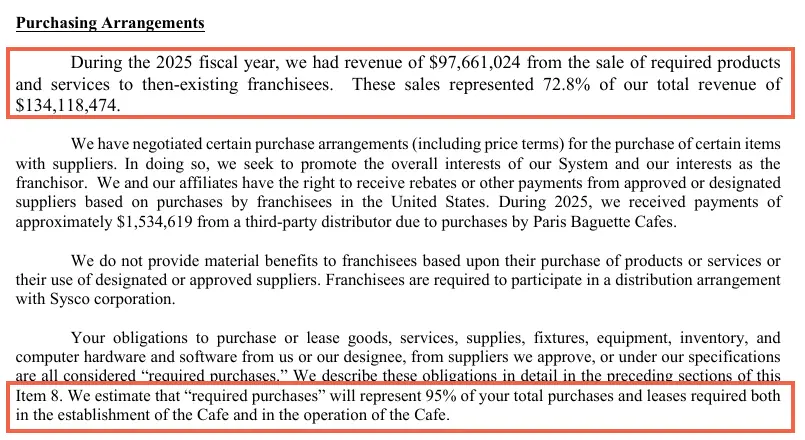
That supply relationship is why Item 8 deserves more attention here than at most brands. The franchisor also received about $1,534,619 in 2025 from a third-party distributor because of cafe purchases, and states that it may profit from franchisee purchases from approved suppliers (Item 8). 16 CFR 436.5(h)(6) and (h)(7) require both disclosures; our study of supplier revenue in 259 FDDs found 77.2% report franchisor or affiliate revenue from required purchases.
How long is training, and how long until the cafe opens?
Before opening, the Operating Principal, General Manager, any District Manager and 8 to 10 food production employees must finish initial training (Item 11). Each track is 240 hours, 160 classroom and 80 on the job, at the Moonachie, New Jersey or Costa Mesa, California training centers, online, or at your cafe. Item 7 Note 14 calls it an eight-week program, with travel budgeted at $20,000 to $65,000.
| Track | Classroom hours | On-the-job hours | Total | Source |
|---|---|---|---|---|
| Operators and managers (orientation, BOH theory, BOH production, FOH, management) | 160 | 80 | 240 | Item 11 |
| Bakers (food safety, principles of baking and cakes, real-time application) | 160 | 80 | 240 | Item 11 |
| Cake decorators (cake principles and decoration, real-time application) | 160 | 80 | 240 | Item 11 |
Instructors and materials are free for the listed trainees; wages, travel and lodging are yours, and extra trainees cost $300 per day per trainer (Item 5). If the cafe opens more than one month after training ends, the franchisor may require more on-the-job training. At opening, it sends 2 cafe operations staff and 3 food production staff to help before opening, on opening day and for 3 days after (Item 11).
The deadlines on the timeline, in order (Item 11 and the Site Addendum):
- Day 0: sign; pay the $50,000 fee.
- Day 90: submit a site that meets the site selection guidelines.
- +30 days: site accepted or not.
- +60 days after acceptance: lease signed; copy due in 3 days.
- 8-week training that ends no more than 1 month before opening.
- Grand opening: 1 month before to 2 months after; $12,500 minimum.
- Day 365: opening deadline. Typical time to open: about 12 months; the 10-year term starts at opening.
Why do six states hold your initial fees in escrow or defer them?
The FDD’s own “Special Risks” page flags the franchisor’s financial condition, and state regulators have attached conditions to the initial fees. Exhibit A shows audited stockholders’ deficiency of $(731,015) at December 31, 2025, narrowed from $(6,851,678) a year earlier, on total liabilities of $25,213,927 against total assets of $24,482,912 (Item 21).
| State | Condition on your initial fees | Source |
|---|---|---|
| California | Impound: all initial fees into escrow with Zions Bancorporation until initial obligations are complete and you are open | Exhibit J, California addendum |
| Hawaii | “Based upon our financial condition”, payment of all initial fees deferred until the cafe opens | Exhibit J, Hawaii addendum |
| Illinois | “Due to the Franchisor’s financial condition”, escrow until pre-opening obligations are met and the business is open | Exhibit J, Illinois addendum |
| Maryland | Escrow with Eagle Bank until pre-opening obligations are fulfilled and the business opens | Exhibit J, Maryland addendum |
| North Dakota | Escrow at Eagle Bank before the business opens | Exhibit J, North Dakota addendum |
| Virginia | Initial Franchise Fee and other initial payments escrowed with Eagle Bank until pre-opening obligations are done | Exhibit J, Virginia addendum |
Negative equity is common in franchising: our review of franchisor financial statements found it in 74 of 259 FDDs (28.6%). What sets this filing apart is the supply dependency. Because Item 8 makes the franchisor and its affiliates the only approved source of dough and core ingredients, a supply interruption reaches the oven, not just the support desk. Ask whether the escrow or deferral in your state also covers the $40,000 to $60,000 inventory and other Item 5 payments, not only the fee.
Is buying an existing cafe a shortcut?
Resales exist but are a small share of the system. Item 20 counts 12 transfers of franchised cafes to new owners in 2025, up from 6 in 2023 and 10 in 2024, against 261 franchised cafes at the end of 2025. SBA records show 15 change-of-ownership loans among 122 SBA 7(a) loans to Paris Baguette businesses from fiscal 2020 to June 30, 2026 (SBA 7(a) and 504 FOIA files).
| Year | Franchised at start | Opened | Terminated or ceased | Franchised at end | Company cafes at end | Transfers |
|---|---|---|---|---|---|---|
| 2023 | 98 | 39 | 0 | 137 | 18 | 6 |
| 2024 | 137 | 51 | 2 | 186 | 11 | 10 |
| 2025 | 186 | 77 | 2 | 261 | 8 | 12 |
Franchised cafes rose from 137 to 261 between the ends of 2023 and 2025, while 284 signed agreements were still unopened at December 31, 2025. Source: Paris Baguette FDD issued March 30, 2026, Item 20, accessed November 3, 2026.
Item 20 also lists 284 signed franchise agreements for cafes not yet open at December 31, 2025, more than the 261 cafes operating, with 90 openings projected for 2026; the FDD flags this as the “Unopened Franchises” special risk. Sellers face Item 17 conditions: they must have owned and operated the cafe for at least 24 months, the franchisor has a 60-day right of first refusal, the transfer fee is $40,000, and the franchisor charges 3% of the price if it found the buyer (Item 6). Our franchise resale index sets the SBA share against other brands.
Which way into Paris Baguette fits your money and your state?
The route depends on liquid capital, the site you can control and how many cafes you can staff. The brand’s franchise site asks applicants for at least $500,000 in liquid capital and a $1.5 million net worth; the FDD sets no such figure but requires the same Operating Principal, holding at least 10%, across every cafe (Item 15).
| If your situation is | Then the FDD points to | Threshold or figure to check |
|---|---|---|
| Under $500,000 liquid capital | Below the brand’s application screen; a resale buyer still needs approval of its financial qualifications | $500,000 liquid, $1.5 million net worth (brand site); Item 17(m) |
| One 3,000 to 4,000 sq ft site in a strip mall or free-standing building | Single Traditional cafe | $727,515 to $1,860,550; budget the rent line near its $90,000 high |
| Access to a grocery, airport, hospital or stadium venue | Non-Traditional cafe, offered occasionally | About 1,000 sq ft; ask for a written estimate, since there is no separate Item 7 table |
| Capital and managers for 4 or more cafes in one metro | Area Development Agreement | $80,000 at signing; $777,515 to $1,910,550 for cafe one; District Manager required at 4 cafes (Item 15) |
| Want an open cafe and cash flow history now | Resale | Seller owned it 24 months; 60-day right of first refusal; $40,000 transfer fee; no opening support owed |
| Site far from a distribution warehouse | Ask about the recipe fallback before signing | Item 8: dough may not be delivered; special equipment may be required |
| Buying in California, Hawaii, Illinois, Maryland, North Dakota or Virginia | State escrow, impound or deferral protects the fee | Exhibit J addendum for your state |
| Cannot release 10 to 13 people for eight weeks | Plan hiring and training travel first | $20,000 to $65,000 travel line; 240 hours per track |
| What several guides say | What the March 30, 2026 FDD says | Source |
|---|---|---|
| Total investment of $727,440 to $1,825,100 (also printed on the brand’s franchise site, attributed to “their 2026 FDD”) | $727,515 to $1,860,550 | FDD cover and Item 7 |
| Equipment and fixtures up to $315,000 | $167,956 to $350,000 | Item 7 |
| Miscellaneous expenses of $11,034 to $16,000 | $11,109 to $16,450 | Item 7 |
| $500,000 liquidity and $1.5 million net worth are FDD requirements | No liquidity or net worth figure appears in the FDD; the figures come from the brand’s application form | Brand franchise site; FDD Items 5 to 7 and 15 |
| Cafes bake from flash-frozen dough (2017 trade profile) | “Proprietary dough” made under affiliate patents and sold to cafes; no temperature state stated | Items 8 and 14 |
This page is general information drawn from public filings, not legal, financial or investment advice. Before signing, ask a franchise attorney to check the Exhibit J addendum for your state and the Site Addendum dates, and ask an accountant to model the 8% current fee load against food bought at the franchisor’s prices, using the FTC’s Consumer’s Guide to Buying a Franchise as a checklist.
How we compiled this
We read the Paris Baguette Franchise Disclosure Document issued March 30, 2026 (Minnesota CARDS document 35764-202604-03, 323 pages), re-added its Item 7 lines and Item 5 payments, and cropped two pages for the screenshots. We also opened the brand’s franchise site, 16 CFR 436.5, a 2017 trade profile through the Wayback Machine, and our own studies of 252 to 259 Minnesota-filed FDDs and SBA loan files, all in November 2026. Item 19 sales figures were excluded under site policy.
Frequently asked questions
Is Paris Baguette a franchise?
Yes. Paris Baguette Family Inc. of Moonachie, New Jersey has offered franchises since March 1, 2015. Item 20 of its FDD issued March 30, 2026 counts 261 franchised cafes and 8 company cafes at the end of 2025, plus 284 signed agreements for cafes not yet open. Company cafes are run by an affiliate, Paris Baguette America, Inc. (Item 1).
How much is the Paris Baguette franchise fee?
The Initial Franchise Fee is $50,000 for a first cafe and $40,000 for each later cafe, nonrefundable and due at signing (Item 5). Area developers pay $20,000 per scheduled cafe up front, credited against each $40,000 fee while they stay on schedule. A cafe majority-owned by a current or honorably discharged service member gets 15% off the first fee, or $42,500.
How much does it cost to open a Paris Baguette?
Item 7 of the FDD issued March 30, 2026 totals $727,515 to $1,860,550 for one cafe, including the $50,000 fee and three months of operating funds. Building costs of $325,000 to $1,000,000 and equipment of $167,956 to $350,000 drive the range. The first cafe under a four-cafe development deal totals $777,515 to $1,910,550.
What are the requirements to own a Paris Baguette franchise?
The brand’s franchise site asks for at least $500,000 in liquid capital and a $1.5 million net worth. The FDD adds an Operating Principal owning at least 10%, ServSafe certification for that person and the cafe manager, a spouse guaranty, 240 hours of training per track, and a cafe open within 365 days of signing (Items 1, 11 and 15).
How much profit does a Paris Baguette franchise make?
The FDD does not report profit. Its Item 19 gives 2025 gross sales averages, medians and ranges for cafes open all year, with nothing deducted, and our site policy keeps those figures off this page. Profit then depends on the 5% royalty, 2% fund and 1% local marketing, ingredient prices set by the franchisor, rent and labor (Items 6, 8 and 19).
Can I buy a Paris Baguette franchise for sale instead of building one?
Yes, with franchisor approval. Item 20 counts 12 transfers to new owners in 2025. The seller must have owned and operated the cafe for at least 24 months, the franchisor holds a 60-day right of first refusal, and a $40,000 transfer fee applies (Items 6 and 17). The franchisor is not obliged to provide opening assistance to a buyer of an existing cafe (Item 11).
Does Paris Baguette bake bread in the store?
Yes. Cafes bake from proprietary dough that the affiliate Paris Croissant Co., Ltd. makes under bread process patents and sells to them (Item 14). Item 7 budgets a dough conditioner, oven and deck oven, and bakers train for 240 hours. If dough cannot be delivered, the franchisor may require baking from its recipes with alternative approved supplies (Item 8).
Sources
- Paris Baguette Franchise Disclosure Document, issued March 30, 2026, Paris Baguette Family Inc., via Minnesota Department of Commerce CARDS (accessed November 3, 2026)
- Crumbl Franchise Disclosure Document, issued April 6, 2026, as amended July 1, 2026, via Minnesota CARDS (accessed November 2026)
- 16 CFR 436.5, Disclosure items (2026 edition), U.S. Government Publishing Office (accessed November 3, 2026)
- Own a Paris Baguette franchise site, Paris Baguette (accessed November 3, 2026)
- Global Brand Paris Baguette Targets Major U.S. Expansion, QSR Magazine, June 2017, Wayback Machine capture of May 29, 2023 (accessed November 3, 2026)
- SBA 7(a) and 504 FOIA loan files, as of June 30, 2026, U.S. Small Business Administration (via our resale index)
- A Consumer’s Guide to Buying a Franchise, Federal Trade Commission (accessed November 3, 2026)