The Planet Fitness franchise cost runs $1,282,500 to $5,386,000 per club in the May 2026 FDD, and yes, it is a franchise: 2,432 of 2,709 U.S. clubs (89.8%) were franchised at the end of 2025.
Key takeaways
- The Planet Fitness Franchising LLC disclosure document issued May 22, 2026 puts one club at $1,282,500 to $3,769,000 with financed equipment and $2,385,000 to $5,386,000 with purchased equipment, excluding real estate (FDD cover page and Item 7).
- The $40,000 initial franchise fee is currently waived for clubs signed under an Area Development Agreement, which charges $10,000 per club committed instead (FDD Item 5).
- Required fitness equipment is sold by the franchisor’s affiliate PF Equipment, which took in about $333,000,000 from franchise equipment sales and placement in 2025, plus a volume rebate of about $22,000,000 (FDD Item 8).
- Item 6 lets Planet Fitness require a $333,000 to $995,000 re-equip every 5 to 9 years and a $250,000 to $1,200,000 remodel as often as every 12 years.
- Planet Fitness, Inc. counted 86 franchisee groups at December 31, 2025, and about 98% of franchise clubs sat in groups owning 3 or more clubs (2025 Form 10-K).
Is Planet Fitness a franchise, and who owns the clubs?
Yes. Planet Fitness Franchising LLC of Hampton, New Hampshire has sold franchises since August 2018, after its predecessor Pla-Fit Franchise, LLC sold them from February 2003. At December 31, 2025, Item 20 of the May 2026 FDD counted 2,432 franchised and 277 company-owned clubs in the U.S., so 89.8% of the U.S. system was franchised.
The publicly traded parent, Planet Fitness, Inc., reports a slightly larger footprint because its 2025 Form 10-K includes Canada, Panama, Mexico, Australia and Spain: 2,896 clubs, of which 2,604 were franchisee-owned and 292 corporate-owned, a franchised share of 89.9%. The U.S. company-owned clubs are run by the affiliate Planet Fitness Assetco LLC, per Item 1.
| Measure (December 31, 2025) | Figure | Source |
|---|---|---|
| U.S. franchised clubs | 2,432 | FDD Item 20, Table 1 |
| U.S. company-owned clubs, including affiliates | 277 | FDD Item 20, Table 1 |
| U.S. franchised share | 89.8% (2,432 of 2,709) | Our calculation from Item 20 |
| Worldwide clubs: franchisee-owned and corporate-owned | 2,604 and 292 | Form 10-K, Item 1 |
| Worldwide franchised share | 89.9% (2,604 of 2,896) | Our calculation from the 10-K |
| Franchisee groups operating the franchise clubs | 86 | Form 10-K, Item 1 |
| Franchise clubs held by groups owning 3 or more clubs | About 98% | Form 10-K, Item 1 |
| Clubs owned by the largest franchisee | 208 | Form 10-K, Item 1 |
| Franchisee groups owning 10 or more clubs | 44% | Form 10-K, Item 1 |
| U.S. franchise agreements signed, club not yet open | 86 | FDD Item 20, Table 5 |
| Clubs franchisees are contractually obliged to open, worldwide | About 750 | Form 10-K, Item 1 |
Franchised clubs were 2,432 of 2,709 U.S. clubs (89.8%) at December 31, 2025. Source: Planet Fitness FDD issued May 22, 2026, Item 20, Table 1; accessed October 27, 2026.
The franchised share barely moves from year to year because the parent opens and sells clubs at the same time. In 2025, franchisees opened 141 U.S. clubs and lost 7 to terminations, while the company side opened 15 and sold 8 to franchisees (Item 20, Tables 3 and 4). The 10-K calls those 8 sales “refranchised” clubs.
Two franchisee groups each held about 7% of all Planet Fitness clubs at the end of 2025, according to the 10-K’s risk factors. A buyer is joining a system shaped by large operators, which matters for the next question.
Can one buyer still get a single Planet Fitness club?
On paper, yes: each Franchise Agreement grants one club at one approved location, and conversion of an existing gym is allowed under a Conversion Amendment. In practice, the 10-K says about 98% of franchise clubs belong to groups owning at least 3, and Planet Fitness weighs prior multi-unit experience, profit and loss history, financial history and available capital before approving anyone.
Who has to run the club?
Item 15 requires a Responsible Owner who holds equity and has completed initial training. Unless Planet Fitness approves an Approved Operator, that owner must manage the club “as your primary occupation,” and someone from management must log in to the Designated Franchise Portal at least once a week. Every owner of a franchisee entity signs a personal guaranty (Item 1).
How much of the cost can be borrowed?
Item 10 says Planet Fitness offers no direct or indirect financing and guarantees no note or lease. Item 7, Note 11 adds a hard ceiling: franchisees may not borrow more than 80% of the initial investment. That implies owner equity of at least $256,500 against the lowest financed-route estimate of $1,282,500, and $1,077,200 against the $5,386,000 high.
Planet Fitness posts its minimum net worth and liquidity thresholds on its franchising website, not in the FDD. That page refused our automated requests in October 2026, so we do not quote it; ask the franchise development team for the current figures in writing before your first call with a lender.
Can you buy an existing club instead?
Item 20, Table 2 lists 100 franchise transfers in 2023, 270 in 2024 and 71 in 2025, so existing clubs do change hands, usually in batches. A buyer signs an Acquisition Amendment for the remainder of the seller’s term, and the seller pays a $10,000 transfer fee plus up to $10,000 of costs (Item 6).
Company-owned clubs can also be sold on negotiated terms, and Item 7 says that price may be higher or lower than a new build. Our franchise resale research covers how transfer activity is reported across brands.
What does it cost to open one club under the May 2026 FDD?
Item 7 of the FDD issued May 22, 2026 totals $1,282,500 to $5,386,000 for one club, excluding the cost of buying or leasing real estate. The cover page splits that into two routes: $1,282,500 to $3,769,000 if you finance equipment, and $2,385,000 to $5,386,000 if you buy it outright. Leasehold improvements alone run $1,000,000 to $2,167,000 for a 15,000 to 25,000 square foot building.
| Item 7 expense | Low | High | Paid to (as listed in Item 7) |
|---|---|---|---|
| Initial franchise fee | $0 | $40,000 | Planet Fitness Franchising LLC |
| Site selection costs | $0 | $10,000 | Planet Fitness Franchising LLC |
| Construction Development Plan review fee | $0 | $5,000 | Planet Fitness Franchising LLC |
| Design resubmission fee | $0 | $5,000 | Planet Fitness Franchising LLC |
| Leasehold improvements | $1,000,000 | $2,167,000 | Approved suppliers |
| Fitness equipment | $33,300 | $995,000 | Lender, approved suppliers, affiliate |
| Non-fitness equipment | $89,200 | $1,315,000 | Lender, approved suppliers, affiliate |
| Pre-sale and grand opening marketing | $40,000 | $120,000 | Media companies and other third parties |
| Exterior signs | $12,000 | $40,000 | Approved suppliers |
| Computer, point of sale system and supplies | $1,000 | $7,000 | Approved suppliers |
| Insurance, first-year premium | $25,000 | $45,000 | Insurance companies |
| Real estate lease deposits | $0 | $95,000 | Landlord |
| Other deposits | $0 | $23,000 | Utilities, banks, card processors, vendors |
| Professional fees | $2,000 | $25,000 | Accountants, lawyers |
| Out-of-pocket initial training expenses | $2,000 | $10,000 | Airfare, lodging, meals |
| Licenses and bonds | $10,000 | $25,000 | Government agencies, bonding companies |
| Additional funds, first 3 months | $68,000 | $459,000 | Payroll, debt service, marketing, cash |
| Total | $1,282,500 | $5,386,000 | Excludes buying or leasing real estate |
Leasehold improvements and the two equipment lines make up $4,477,000 of the $5,386,000 high estimate. Source: Planet Fitness FDD issued May 22, 2026, Item 7; accessed October 27, 2026.
We re-added all 17 lines: the low column sums to $1,282,500 and the high column to $5,386,000, matching the printed total. The high column uses full purchase prices for both equipment lines. Swapping in the maximum down payments of $298,500 and $394,500 produces the $3,769,000 financed-route ceiling on the cover page.
The cover page says $33,300 to $353,500 goes to the franchisor or its affiliate on the financed route, and $333,000 to $1,050,000 on the purchase route. Those totals equal the franchise fee, site costs, plan review fee and fitness equipment. They leave out the $5,000 design resubmission fee that Item 7 lists as payable to Planet Fitness, and the non-fitness equipment for which Item 7 names the affiliate as a possible payee.
Three Item 7 notes push costs past the table. Note 3 says building your own building “may increase the cost significantly,” as can dense urban sites. Note 5 sets pre-sale marketing at $20,000 to $30,000 for every 30 days, starting at least 60 days before opening. Note 10 covers only 3 months of operating cash after opening.
For scale, the 18 fitness franchise disclosure documents in our fitness franchise statistics report show a median Item 7 range of $319,510 to $746,562. The Planet Fitness low estimate of $1,282,500 is about 4 times that median low.
Who sells the equipment, and why does it swing the budget so much?
Equipment is the one large Item 7 line where the buyer picks the payment method, and Planet Fitness’s own affiliate is the seller. Bought outright, fitness equipment costs $333,000 to $995,000 and non-fitness equipment such as lockers, televisions, trusses, flooring and tanning beds costs $892,000 to $1,315,000, a combined $1,225,000 to $2,310,000 before opening day.
| Equipment | Down payment if financed | Purchase price | Source |
|---|---|---|---|
| Fitness equipment (from PF Equipment) | $33,300 to $298,500 (10% to 30% of the amount financed) | $333,000 to $995,000 | FDD Item 5; Item 7, Note 4 |
| Non-fitness equipment (through the approved supplier) | $89,200 to $394,500 | $892,000 to $1,315,000 | FDD Item 7, Note 4 |
| Combined | $122,500 to $693,000 | $1,225,000 to $2,310,000 | Our sum of the two rows |
Item 8 names Planet Fitness Distribution LLC, called PF Equipment, as the sole U.S. supplier of required fitness equipment. Its Equipment Terms (Exhibit K-1, section 2) make payment due when you accept the quote, or on delivery if PF Equipment approves your financing. Section 6 says all warranties come from the manufacturer, not PF Equipment. Used equipment can only be resold or donated through approved suppliers.
Item 8 also reports what the channel earns. In 2025, PF Equipment had about $333,000,000 of gross revenue from equipment bought or leased by franchise locations and related placement services, plus a volume-based rebate of about $22,000,000. The franchisor itself earned about $60,000 in supplier commissions, under 1% of its $385,100,000 total 2025 revenue.
Item 8 estimates that purchases made to Planet Fitness specifications are about 97% of what you spend to open and 11% to 40% of ongoing operating costs. Across 259 recent disclosure documents, the median was 70% of startup and 50% of ongoing purchases, per our franchise supplier rebates research.
The parent’s 10-K describes the same flow from the other side. Equipment segment revenue was $310.1 million in 2025, 23.4% of Planet Fitness, Inc. revenue, and the filing says the “equip” and “re-equip” requirements “create a predictable and growing revenue stream.” Because the 7% royalty is in place, Item 8 limits other vendor revenue, but the sale and placement of fitness equipment is a permitted category.
What does a multi-club development deal cost before club one opens?
An Area Development Agreement costs $10,000 per club you commit to, fully earned and non-refundable at signing, or $30,000 per club if you take rights in a territory where an earlier agreement with you or an affiliate was terminated early. Planet Fitness is currently waiving the $40,000 initial franchise fee on each Franchise Agreement signed under an ADA, a policy Item 5 says may end at any time.
| Clubs committed | Development fee at $10,000 per club | Franchise fees if the waiver ends | Item 7 total, equipment financed | Item 7 total, equipment purchased |
|---|---|---|---|---|
| 3 | $30,000 | $120,000 | $3,847,500 to $11,307,000 | $7,155,000 to $16,158,000 |
| 5 | $50,000 | $200,000 | $6,412,500 to $18,845,000 | $11,925,000 to $26,930,000 |
| 10 | $100,000 | $400,000 | $12,825,000 to $37,690,000 | $23,850,000 to $53,860,000 |
The multiplication is ours, using Item 7’s statement that its ranges “also apply to each facility” developed under an ADA. Item 7 warns that later clubs may cost more because of inflation over the development period, so the 10-club row understates a schedule stretched over several years.
The ADA in Exhibit G turns that commitment into dated obligations. The steps below come from section 2.1 of the agreement and the fee table in Item 6.
- Sign the first Franchise Agreement at or soon after the ADA, through an entity at least 51% owned by your ownership group.
- Lease, sublease or buy an accepted site at least 4 months before each club’s due date.
- Start construction at least 3 months before that due date.
- Open at least 1 new club in every 730-day period while the ADA runs.
- Miss an opening date and pay a Late Development Fee of $5,000 for every 30 days; the cap equal to the franchise fee applies only under a Franchise Agreement, not under the ADA.
- Open a club early while fully compliant and pay no royalty on it until the sooner of its required opening date or 180 days after opening (the Royalty Incentive Period). National Advertising Fund fees start on opening day.
Territory is the trade for that schedule. A single Franchise Agreement grants no protected area at all, and on request you must sublease up to 10% of the club’s square footage to Planet Fitness at fair market rent (Item 12). An ADA protects the Development Area while you meet the schedule, with carve-outs for existing clubs, airports, military bases, universities and multi-territory acquisitions, where you get a 30-day option. The ADA has no renewal; Item 12 gives a one-year limited right of first refusal after it ends.
Insurance minimums in Item 8 also step up with club count, which adds cost as a group grows:
| Clubs owned | Cyber liability minimum | Employment practices minimum | Umbrella minimum |
|---|---|---|---|
| 1 to 2 | $1,000,000 | $1,000,000 | $2,000,000 |
| 3 to 5 | $1,000,000 | $1,000,000 | $5,000,000 |
| 6 to 10 | $2,000,000 | $2,000,000 | $5,000,000 |
| 11 to 24 | $3,000,000 | $3,000,000 | $10,000,000 |
| 25 to 50 | $3,000,000 | $5,000,000 | $10,000,000 |
About 126 of 259 recent disclosure documents offer an area development route, most often with a 2-unit minimum, according to our area development agreement research. Planet Fitness differs in the 730-day opening floor and the uncapped ADA late fee.
When do the re-equip and remodel bills arrive?
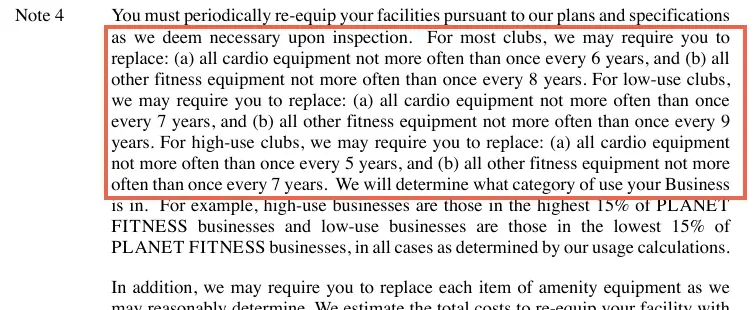
Item 6, Note 4 lets Planet Fitness require new cardio equipment every 5, 6 or 7 years and new strength and other fitness equipment every 7, 8 or 9 years, depending on whether your club ranks in the top 15%, the middle or the bottom 15% of clubs by usage. Each full re-equip is estimated at $333,000 to $995,000, payable to the franchisor’s affiliate.
| Obligation | Most clubs | High-use clubs (top 15%) | Low-use clubs (bottom 15%) | Estimated cost |
|---|---|---|---|---|
| Replace all cardio equipment | Every 6 years | Every 5 years | Every 7 years | $333,000 to $995,000 for a full re-equip |
| Replace all other fitness equipment | Every 8 years | Every 7 years | Every 9 years | |
| Substantial remodel (signage excepted) | Not more often than every 12 years | Same | Same | $250,000 to $1,200,000 |
| Notice before either | About 6 months | Same | Same | Not applicable |
Two clauses can change that calendar. Note 6 lets Planet Fitness accelerate a remodel or equipment change if 66% of all U.S. clubs or 51% of U.S. franchised clubs vote for it. Note 4 works in your favour near the end: re-equip or remodel in the last 2 years of the term as required, and no further substantial work is demanded as a condition of a successor agreement, unless the marks change.
The term runs 12 years from opening, with up to a 1-year extension or a 2-year reduction to match your lease (Item 17). Adding the capital items the FDD names for one club across that term gives the following range.
| Capital item, one club, one 12-year term | Low | High | Source |
|---|---|---|---|
| Item 7 initial investment, equipment purchased | $2,385,000 | $5,386,000 | FDD cover page, Item 7 |
| One full re-equip | $333,000 | $995,000 | Item 6, Note 4 |
| One remodel, required for a successor term | $250,000 | $1,200,000 | Item 6, Note 5; Item 17(c) |
| Successor franchise fee | $20,000 | $20,000 | Item 6; Item 17(c) |
| Named capital before rent and debt service | $2,988,000 | $7,601,000 | Our sum |
The sum leaves out rent, real estate, loan interest and price increases, and Item 6 labels both re-equip and remodel ranges as “currently.” A high-use club could replace cardio twice in 12 years, at years 5 and 10. If you decide not to renew, Item 17 requires notice at least 180 days before the term ends, or a $25,000 late non-renewal fee.
What does the franchisor collect once members are paying dues?
Planet Fitness bills ongoing fees against the EFT Dues Draft, meaning the monthly and annual membership fees due from members by electronic draft, “regardless of the amount of membership fees you actually collect.” The core charges are a 7% royalty, a join fee of 20% of the regular monthly fee for each new membership, and a National Advertising Fund fee of 2% that can rise to 3%.
| Fee | Amount in the May 2026 FDD | Timing |
|---|---|---|
| Royalty | 7% of total gross monthly and annual membership fees in the EFT Dues Draft | Monthly and annually |
| Join fee | 20% of the regular monthly fee, or 5% of a prepaid membership | Monthly, once per new membership |
| National Advertising Fund | 2%, capped at 3%; in 2026 only, 2% of the EFT Dues Draft plus 1% of Monthly EFT | With the royalty |
| Local advertising (you spend it) | Greater of $60,000 or 7% of cumulative Monthly EFT a year; in 2026, greater of $50,000 or 6% | Through an approved agency |
| Local advertising floors | First quarter: greater of $24,000 or 10%; later quarters: greater of $4,000 or 3% each month | Quarterly and monthly |
| Combined local and national cap | 9% of the EFT Dues Draft | Annual |
| Special marketing programs | Up to 7% of Monthly EFT in a single month, credited to local spend | On demand |
| Software licensing | $100 per year | On demand |
| Refresher training | $500 to $1,500 | As agreed |
| Late payment interest | 10% a year or the legal maximum, whichever is lower | As incurred |
| Early termination | Average monthly royalty multiplied by the lesser of 36 or the months left | On default or unpermitted closure |
Planet Fitness can switch the royalty base to Total Net Membership Revenues on 60 days’ notice (Item 6, Note 2). Older agreements pay less: the 10-K says about 63% of clubs paid the current rate at December 31, 2025, and the system-wide average royalty rate was 6.7%.
Item 19 of the May 2026 FDD reports 2025 Annual EFT Revenue for U.S. clubs open all 12 months of 2025, split into thirds for franchised and corporate clubs, plus an operating statement for corporate-owned clubs. Our site does not republish those figures; read them in Item 19 itself, and see our Item 19 research for how such tables are built.
Item 20 lists 18 former franchisees and notes that some current and former owners signed confidentiality clauses. It also names the PF Independent Franchisee Council as an independent association. Our franchisee associations report explains how these groups appear in disclosure documents.
Which published Planet Fitness numbers are out of date?
Several pages that rank for this keyword still print figures from Planet Fitness disclosure documents filed before 2026. The table sets each claim beside what the May 22, 2026 FDD says, with the Item number. The gaps are large: the initial fee is twice the widely repeated $20,000, and the remodel ceiling is twice an older $600,000 estimate.
| Claim found in ranking guides | Where it appears | May 22, 2026 FDD | Item |
|---|---|---|---|
| Initial franchise fee of $20,000 | A cost guide last modified in 2022; a directory profile built on the 2024 FDD | $40,000 per Franchise Agreement; currently waived under an ADA | Item 5 |
| Total investment of $1,084,600 to $4,178,500 | Cost guide modified in 2022 | $1,282,500 to $5,386,000 | Item 7 |
| Re-equip costs of $312,000 to $857,000, no timing given | Cost guide modified in 2022 | $333,000 to $995,000 every 5 to 9 years | Item 6, Note 4 |
| Remodel costs of $70,000 to $600,000 | Cost guide modified in 2022 | $250,000 to $1,200,000, at most every 12 years | Item 6, Note 5 |
| Local advertising of the greater of $15,000 a month or 7% | Cost guide modified in 2022 | Greater of $60,000 a year or 7% of cumulative Monthly EFT | Item 6, Note 7 |
| Successor fee of 50% of the then-current fee, capped at $40,000 | Cost guide modified in 2022 | $20,000 | Item 17(c) |
| Late payment interest of 18% | Cost guide modified in 2022 | 10% or the legal maximum, whichever is lower | Item 6 |
| Financing “can reduce cash-at-close by 80 to 90%” | Directory profile built on the 2024 FDD | No more than 80% of the initial investment may be borrowed; no franchisor financing | Item 7, Note 11; Item 10 |
Which entry route matches your capital and experience?
The route depends on three facts you can check before a first call: whether you can fund at least 20% of the Item 7 range yourself, whether you can commit to more than one club on a dated schedule, and whether you can hold a reserve for a re-equip within 5 to 9 years. The table maps each situation to the clause that governs it.
| If your situation is | Then the FDD points you to | Governing clause |
|---|---|---|
| Equity below $256,500 | No new-build route fits the 80% borrowing cap; look at other fitness brands | Item 7, Note 11 |
| Equity of $256,500 or more, 1 club, no multi-unit history | Buy an existing club through a transfer, or ask whether a single Franchise Agreement is available to you | Item 20, Table 2; Item 6 transfer fee |
| Plans for 3 or more clubs on a schedule | Area Development Agreement at $10,000 per club, with the franchise fee waived while the policy lasts | Item 5; Exhibit G, section 2.1 |
| You want cash kept for build-out | Finance equipment: $122,500 to $693,000 down instead of $1,225,000 to $2,310,000 | Item 7, Note 4 |
| Your site is a ground-up building | Plan on the 480-day opening deadline, not 360 days | Item 11 |
| You own a gym and want to convert it | Conversion Amendment; same initial fees; site may still fail on parking | Item 1; Item 5 |
| You cannot work in the business full time | Get an Approved Operator approved before signing | Item 15 |
| You cannot reserve $333,000 to $995,000 by year 5 to 9 | Do not sign; the re-equip can be required on that schedule | Item 6, Note 4 |
Timing is the other constraint. Item 11 estimates 8 to 18 months from signing to opening, yet the Franchise Agreement requires an open club within 360 days of signing, or 480 days for a ground-up build, so the top of that estimate would breach the contract. Our research on how long franchises take to open compares those windows across brands.
- Request the current FDD and keep it at least 14 calendar days before you sign or pay anything, as the FDD cover and the FTC’s Consumer’s Guide to Buying a Franchise both state.
- Ask Planet Fitness franchise development for its written net worth and liquidity minimums and for the clubs it will accept on a single Franchise Agreement in your market.
- Get a PF Equipment quote and price both routes: the financed down payment of $33,300 to $298,500 against the $333,000 to $995,000 purchase price.
- Ask the landlord for a tenant improvement allowance against the $1,000,000 to $2,167,000 leasehold line.
- For an ADA, map every due date against the 4-month lease and 3-month construction milestones and the 730-day floor.
- Have a franchise lawyer read Exhibit G (ADA) and Exhibit K-1 (Equipment Terms), and read our guide to the franchise disclosure document for the other Items to check.
A franchise consultant can shortlist other fitness concepts if the equity or multi-unit hurdles rule Planet Fitness out; our page on what a franchise consultant does explains how they are paid. This page is general information, not legal, financial or investment advice.
How we compiled this
We read the 550-page Planet Fitness Franchising LLC disclosure document issued May 22, 2026 (Minnesota file 10843) with Exhibits G and K-1, the Planet Fitness, Inc. 2025 Form 10-K and 16 CFR 436.5 in October 2026. We re-added the Item 7 columns and did the per-club, 12-year and multi-club arithmetic ourselves. We excluded every Item 19 revenue and cost figure under our site rule and used no third-party profit estimates.
Frequently asked questions
Is Planet Fitness a franchise or corporate owned?
Both, but mostly franchised. Item 20 of the May 22, 2026 FDD counted 2,432 franchised and 277 company-owned U.S. clubs at December 31, 2025, so 89.8% were franchised. Worldwide, the Planet Fitness, Inc. 2025 Form 10-K reports 2,604 franchisee-owned and 292 corporate-owned clubs, run by 86 franchisee groups.
How much is the Planet Fitness franchise fee?
The initial franchise fee is $40,000 per Franchise Agreement, due at signing and non-refundable (Item 5). Clubs signed under an Area Development Agreement currently have that fee waived, but the ADA itself costs $10,000 per club committed, or $30,000 per club in a territory where an earlier agreement with you was terminated.
How much money do you need to open a Planet Fitness?
Item 7 puts one club at $1,282,500 to $5,386,000, excluding real estate. Because Item 7, Note 11 bars borrowing more than 80% of the initial investment, a buyer needs equity of at least 20%, which is $256,500 on the lowest estimate. Planet Fitness also sets net worth and liquidity minimums outside the FDD.
Are Planet Fitness franchises for sale?
New franchises are offered under the May 2026 FDD, mostly to multi-club groups through Area Development Agreements. Existing clubs also change hands: Item 20 lists 100 franchise transfers in 2023, 270 in 2024 and 71 in 2025, and the company sold 8 corporate clubs to franchisees in 2025. Transfers carry a $10,000 fee.
Does Planet Fitness offer financing?
No. Item 10 says Planet Fitness offers no direct or indirect financing and guarantees no note, lease or obligation. You may finance equipment through your own lender, with down payments of $33,300 to $298,500 on fitness equipment and $89,200 to $394,500 on non-fitness equipment, per Item 7, Note 4.
How long does it take to open a Planet Fitness?
Item 11 estimates 8 to 18 months from signing the Franchise Agreement to opening. The contract is stricter: you must secure a site within 6 months, start construction within 120 days of the lease, finish within 120 days, and open within 360 days of signing, or 480 days for a ground-up building.
How much do Planet Fitness owners make?
Our site does not publish earnings figures. Owner income depends on membership dues collected, the 7% royalty, the join fee and advertising fees in Item 6, rent, payroll and the re-equip schedule. Item 19 of the May 22, 2026 FDD reports 2025 Annual EFT Revenue by thirds; read it there and confirm it with current franchisees.
Sources
- Planet Fitness Franchising LLC, Franchise Disclosure Document, issued May 22, 2026, Items 1, 5 to 8, 10 to 12, 15, 17, 19, 20, Exhibits G and K-1, Minnesota Department of Commerce CARDS, accessed October 27, 2026.
- Planet Fitness, Inc., Form 10-K for the fiscal year ended December 31, 2025, U.S. Securities and Exchange Commission EDGAR, accessed October 27, 2026.
- 16 CFR 436.5, Disclosure items (FTC Franchise Rule), Legal Information Institute, Cornell Law School, accessed October 27, 2026.
- A Consumer’s Guide to Buying a Franchise, Federal Trade Commission, accessed October 27, 2026.