
A property management franchise is a licensed brokerage first: Texas, Florida and California treat collecting rent for owners as broker work, and four 2025 to 2026 FDDs price entry at $85,950 to $244,400.
Key takeaways
- Texas defines a broker to include anyone paid to control the acceptance or deposit of rent from a single-family rental tenant (Tex. Occ. Code §1101.002(1)(A)(x)); California does the same for anyone who collects rents for others (Bus. & Prof. Code §10131(b)).
- Rent and security deposits are trust money: Texas wants them deposited by the close of business on the second working day (22 TAC §535.146), California and Florida within three business days.
- Real Property Management will not admit a new owner to initial training until that owner holds a real estate license and has a sponsoring broker (Real Property Management FDD, April 2, 2026, as amended August 11, 2026, Item 11).
- Item 7 totals run from $85,950 (All County, standard franchise) to $244,400 (Keyrenter single unit), and every one of the four brands sets a royalty floor that rises with months in business.
- Keyrenter requires a real estate license even in states that do not require one for property management, and credits $5,000 to buyers licensed before signing (Keyrenter FDD, April 24, 2026, Items 1 and 5).
Who has to hold the broker license when you manage rentals for others?
In all three states opened for this page, managing rentals for a fee is broker activity, so either you hold a broker license or the business runs under someone who does. Texas names rent control in §1101.002, California names rent collection in §10131(b), and Florida names renting and advertising rental property in §475.01(1)(a). The owner who leases only property it owns is exempt in Texas and Florida, and so are on-site apartment managers. Unlicensed brokerage is a crime in each of the 3 states.
Texas goes one step further for companies. Under §1101.351(a-1) a business entity may not act as a broker unless the entity itself holds a license, and §1101.355 requires the entity to designate a licensed managing officer as its broker, with errors and omissions cover of at least $1 million per occurrence if that broker owns under 10% of the company. California runs corporate brokers through a designated officer under §10159.2.
| State | What makes rental management broker work | Main exemptions | Penalty for unlicensed activity | Source |
|---|---|---|---|---|
| California | Leasing, renting, soliciting tenants or collecting rents for others for compensation | Resident manager of an apartment building and that manager’s employees (§10131.01) | Fine up to $20,000 and up to six months in county jail; corporations up to $60,000 (§10139) | DRE Real Estate Law, in effect January 1, 2026 |
| Florida | Renting or leasing real property for another for compensation, procuring lessees, advertising rental property information or lists | Owner leasing its own property; salaried onsite apartment leasing staff; salaried condo or co-op manager on rentals of 1 year or less (§475.011) | Felony of the third degree (§475.42(1)(a)) | 2026 Florida Statutes, Chapter 475 |
| Texas | Leasing real estate for another; controlling the acceptance or deposit of rent from a single-family rental resident | On-site manager of an apartment complex; owner or owner’s employee leasing the owner’s real estate (§1101.005) | Class A misdemeanor (§1101.758) | Tex. Occ. Code Ch. 1101, Wayback capture of January 13, 2025 |
A franchise agreement does not replace any of this. The Real Property Management FDD says in Item 1 that local laws may require “real estate brokerage licensing” and in Item 15 that you may need to engage a licensed broker, after which you, the franchisor and the broker sign the Brokerage Agreement attached as Schedule H. All County’s Item 1 cites California §10131 as an example of a state that needs a broker of record supervising the managers.
How fast must rent and security deposits reach a trust account?
Two or three business days. Texas sets the close of business on the second working day after receipt, California sets three business days under 10 CCR §2832(a), and Florida reads its statutory word “immediately” as the end of the third business day under Fla. Admin. Code 61J2-14.008(3). All three require a monthly check of the trust records, and all three bar mixing client money with the broker’s own beyond small allowances.
| Rule | California | Florida | Texas |
|---|---|---|---|
| Deposit deadline | 3 business days after receipt (10 CCR §2832(a)) | End of the third business day; weekends and legal holidays excluded (FAC 61J2-14.008(3)) | Close of business, second working day (22 TAC §535.146) |
| Monthly duty | Reconcile beneficiary records with the trust account at least once a month, except months with no activity (10 CCR §2831.2) | Written monthly statement comparing trust liability with reconciled bank balances, signed and dated by the broker (FAC 61J2-14.012(2)) | Accounting to each beneficiary at least monthly if the account had activity (22 TAC §535.146) |
| Broker money allowed in the account | Up to $200 for bank charges (10 CCR §2835(a)) | Up to $5,000 in a property management escrow account; $1,000 in a sales escrow account (§475.25(1)(k)) | A reasonable amount for bank service fees, with records (22 TAC §535.146) |
| Where the account sits | A bank or recognized depository in California (§10145(a)(1)) | A bank, credit union or savings and loan located and doing business in Florida (§475.25(1)(k)) | A banking institution authorized to do business in Texas (22 TAC §535.146) |
Texas names “rent” and “security deposits” in its definition of trust money and lets a broker keep a separate trust account for security deposits from managed rentals. Once fees become the broker’s own money, the broker must move them out of the trust account by the 30th day. Florida’s $5,000 cushion for property management escrow accounts is five times its $1,000 limit for sales escrow, set in §475.25(1)(k).
What the four franchise agreements say about licenses and trust money
Each of the 4 FDDs leaves state compliance with the franchisee, but they differ on whether you must be licensed personally and what they charge to help keep trust books straight. Keyrenter requires a license everywhere; Real Property Management requires one before training; All County requires a broker of record where state law does; Property Management Inc. requires licenses before you perform licensed work. The franchise disclosure document items cited below are the place to confirm each rule in the current filing, and our guide to reading a franchise disclosure document shows where each item sits.
| Brand (FDD issue date) | License rule for the owner | Trust account clause | Trust or bookkeeping fee in Item 6 | Source |
|---|---|---|---|---|
| All County (January 28, 2025) | Designated broker of record at all times if state law requires; NARPM and National Association of Realtors membership required (Item 7 note 9) | Comply with state law; mandatory Reconciliation Assistance Program | $425 per month for up to 3 total accounts; $45 per hour for rework | All County FDD, Items 1, 6, 7 |
| Keyrenter (April 24, 2026) | Real estate license required even where the state does not require one; property management license where required; both before opening | Complete state certified trust account training; “reconcile your trust accounts according to state guidelines at all times” | No reconciliation fee; audit costs of about $1,500 to $5,000 if you mismanaged trust accounts | Keyrenter FDD, Items 1, 6, 8 |
| Property Management Inc. (March 30, 2026) | Secure all real estate licenses before performing services that require them; franchisor has no duty to help | Reconcile customer trust accounts at all times under the law of the Territory’s state (FA 2.4.2) | $5.00 per Door if out of compliance or on request; PMiBOOKS greater of $15 per Door or $100 | PMI FDD, Items 6, 11 and Franchise Agreement 2.4.2 |
| Real Property Management (April 2, 2026, as amended August 11, 2026) | Real estate license and sponsoring broker before initial training in Texas; Brokerage Agreement if a broker is engaged | Maintain the Trust Account that law requires (FA definition S) | BackOffice bookkeeping $17.00 per property unit, $400 minimum; optional Quarterly Bank Review $350, then $250 | Real Property Management FDD, Items 6, 11, 15 |
The license cost also shows up in Item 7. Keyrenter budgets $5,000 to $10,000 for real estate broker fees and $800 to $2,000 for licensure or property management training; All County budgets $1,500 to $2,000 for licenses and bonds covering the entity, the Managing Owner and the broker of record; Real Property Management’s $750 to $2,000 line for licenses, permits and subscriptions includes real estate and brokerage license fees (note 8).
How much does a property management franchise cost to open?
The four Item 7 totals for a new standard unit run from $85,950 to $244,400. The initial franchise fee ranges from $50,000 at Keyrenter to $69,900 at Property Management Inc. and Real Property Management, and the high ends are driven by working capital: Real Property Management allows up to $100,000 for the first 12 months, while Keyrenter’s three-month reserve runs $33,200 to $60,200.
| Brand | Initial franchise fee (Item 5) | Other payments to franchisor before opening | Item 7 total, new unit | Working capital line in Item 7 | Source |
|---|---|---|---|---|---|
| All County | $58,500 standard; $85,000 E-2 visa franchise | E-2 only: $36,000 marketing and $3,000 software | $85,950 to $117,900 | $15,000 to $30,000, 3 months | All County FDD, Items 5, 7 |
| Keyrenter | $50,000 (territory of 100,000+ people) | $5,000 training; $10,000 initial marketing; $600 software implementation | $118,750 to $244,400 | $33,200 to $60,200, 3 months | Keyrenter FDD, Items 5, 7 |
| Property Management Inc. | $69,900; $69,900 to $90,000 for E-2 buyers | $24,000 local advertising prepayment; $675 to $2,975 hardware and software | $102,439 to $165,975 | $3,864 to $25,000, 3 months | PMI FDD, Items 5, 7 |
| Real Property Management | $69,900; 2025 average paid approx. $46,908, range $27,500 to $89,850 | Software System and task software, $663 to $2,652 in Item 7 | $99,341 to $244,302 | $2,500 to $100,000, 12 months | Real Property Management FDD, Items 5, 7 |
Item 7 totals run from $85,950 (All County) to $244,400 (Keyrenter); Real Property Management’s high end, $244,302, carries $100,000 of 12-month working capital. Source: FDDs on Minnesota CARDS, accessed November 3, 2026.
Item 7 leaves out the office lease beyond its first months, personal living costs and the cost of buying an existing portfolio. Real Property Management’s rent line covers only lease entry and three months on 500 to 1,000 square feet ($2,250 to $9,000), and All County’s total says it “does not include real estate acquisition costs”.
What is the royalty charged on, and what drops out of the base?
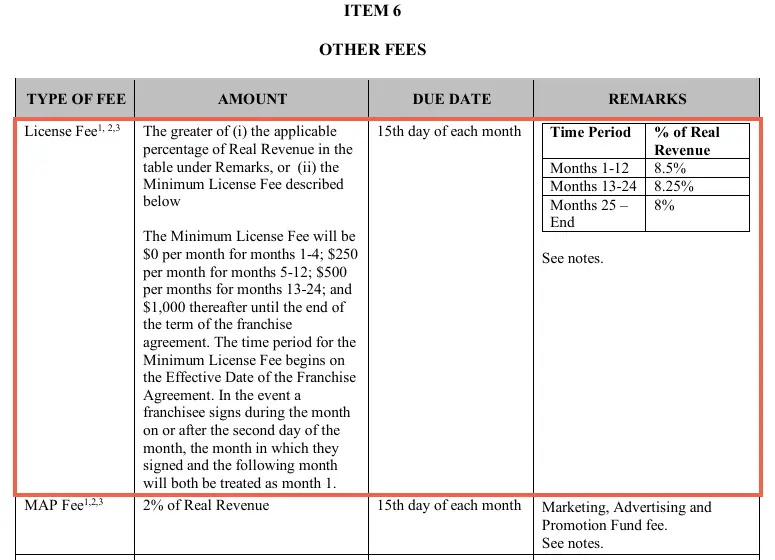
Management fees, leasing fees and similar charges carry the royalty at all four brands, while maintenance money is treated three ways. Real Property Management deducts “Pass-Through Expenses” for repairs before applying 8.5%, 8.25% or 8%; All County charges 7% on non-maintenance revenue and 3% on maintenance revenue; Property Management Inc. counts maintenance services in Gross Revenue. The royalty rates across the sector are compared in our franchise royalty rates report.
| Brand | Royalty (Item 6) | Base and what is excluded | Marketing fund | Source |
|---|---|---|---|---|
| All County | 7% of Gross Revenue less Maintenance Revenue, plus 3% Maintenance Royalty | Includes all rental management and sales commission revenue; Maintenance Revenue (painting, lawn care, cleaning, plumbing, repairs) carries the 3% rate instead | Greater of 1% of Gross Revenue or $195 per month | All County FDD, Item 6 |
| Keyrenter | 7% of monthly Gross Revenue or the Minimum Royalty Fee, whichever is greater | All revenue from products and services, including Real Estate Sales Commissions and Referral Fees; sales taxes and good faith refunds deducted | $925 per month Keyrenter Marketing Fee plus local spend of the greater of $1,425 or 3% | Keyrenter FDD, Item 6 and note 1 |
| Property Management Inc. | 5% of Brokerage Revenue plus 7% of Gross Revenue up to $35,000, 6% from $35,001 to $75,000, 5% above $75,001 (monthly) | Gross Revenue includes management, maintenance, leasing, booking and guest fees; excludes Brokerage and sales taxes | 2.0% of Gross Revenue to the National Marketing Fund; local quota $2,000 per month | PMI FDD, Item 6 notes 1 and 4 |
| Real Property Management | 8.5% of Real Revenue in months 1 to 12, 8.25% in months 13 to 24, 8% from month 25 | Real Revenue minus Pass-Through Expenses (outside repair vendors and in-house maintenance payroll); management fees and markups stay in | MAP Fee 2% of Real Revenue; local spend the greater of $32,000 a year or 5% | Real Property Management FDD, Item 6 and notes |
Rent you collect for owners is trust money under the state rules, not franchise revenue, and none of the four Item 6 definitions treats owners’ rent as the royalty base. Ask each franchisor to show, in writing, how a security deposit forfeited to an owner and a tenant-paid late fee are coded in its royalty report, because both pass through the trust account first.
What do minimum royalties add up to before the portfolio grows?
Each brand charges a monthly floor that applies when the percentage royalty comes in lower, and the floors climb on a fixed schedule regardless of how many doors you manage. By month 60 the floor is $200 at All County, $1,000 at Real Property Management, $1,050 at Property Management Inc. and $3,000 at Keyrenter, which also charges $15 per Unit managed when that is higher.
| Brand | Minimum monthly royalty schedule (Item 6) | When the clock starts |
|---|---|---|
| All County | $200 per month | 90 days after signing, or after E-2 visa approval |
| Keyrenter | Months 1 to 4: $15 per Unit; 5 to 12: $250; 13 to 24: $500; 25 to 35: $1,000; 36 to 47: $1,500; 48 to 55: $2,250; 56 on: $3,000 (or $15 per Unit if greater) | Royalty begins 120 days after signing or when you begin using the System, whichever is sooner |
| Property Management Inc. | Through month 23: $350; months 24 to 35: $700; month 36 on: $1,050 | Months of operation |
| Real Property Management | Months 1 to 4: $0; 5 to 12: $250; 13 to 24: $500; month 25 to end of term: $1,000 | Effective Date of the Franchise Agreement |
By month 60 the flat royalty floor is $200 (All County), $1,000 (Real Property Management), $1,050 (Property Management Inc.) and $3,000 (Keyrenter). Source: Item 6 of each FDD, accessed November 3, 2026.
The arithmetic below adds up the flat floors only, month by month, using each FDD’s own month bands from Item 6. It assumes no per-Unit minimum applies and no percentage royalty exceeds the floor, so it shows the least each contract can cost in royalty over 60 months, not a forecast.
| Brand | Calculation, months 1 to 60 | Floor total, 60 months | Floor in months 49 to 60 |
|---|---|---|---|
| All County | 57 months x $200 (from month 4) | $11,400 | $2,400 |
| Keyrenter | 8 x $250 + 12 x $500 + 11 x $1,000 + 12 x $1,500 + 8 x $2,250 + 5 x $3,000 | $70,000 | $30,750 |
| Property Management Inc. | 23 x $350 + 12 x $700 + 25 x $1,050 | $42,700 | $12,600 |
| Real Property Management | 8 x $250 + 12 x $500 + 36 x $1,000 | $44,000 | $12,000 |
Fixed monthly charges sit on top of the floor. At Real Property Management they include the $121 Software System fee, $100 for task and lead software up to 90 units, and bookkeeping at $17.00 per unit with a $400 minimum; at Property Management Inc. the Digital Essentials Package is $729 per month; at Keyrenter the Technology Fee is $150 per month.
How are property management territories drawn?
None of the four grants an exclusive territory, and each measures the area by population, with one brand adding a rental count. Real Property Management’s typical territory has more than 100,000 people and more than 10,000 single family rentals; Keyrenter sets a 100,000 minimum; All County sets 50,000 to 250,000; Property Management Inc. negotiates boundaries by city, county and ZIP code. How these clauses compare across franchising is covered in our franchise territory rights research.
| Brand | Territory size (Item 12) | Protection offered | Service and marketing reach | Source |
|---|---|---|---|---|
| All County | Population of at least 50,000 and not over 250,000 | No other All County office located in the Territory; no other franchisee’s grass-roots marketing there | Accounts up to 50 miles from the principal business address | All County FDD, Item 12 |
| Keyrenter | Minimum population of 100,000, from Census or similar data | No same-mark outlet within a five-mile radius of the Approved Location if performance minimums are met | Focus on a 45-mile radius; no solicitation outside the Territory | Keyrenter FDD, Item 12 |
| Property Management Inc. | Negotiated; city, county, state, ZIP code, streets or highways | None beyond the Territory map; may be reduced for breach or missed sales quota | Unsolicited outside leads may be served; outside portfolios require buying that territory | PMI FDD, Items 6 and 12 |
| Real Property Management | More than 100,000 people and more than 10,000 single family rentals (typical) | No more than one additional Real Property Management business per 100,000 persons in the Territory | Relocation within 3 miles of the Franchise Location with approval | Real Property Management FDD, Item 12 |
Property Management Inc. ties the map to a revenue quota: its Item 6 note 3 requires minimum Gross Revenue of $5,000 in month 12, $10,000 in month 24 and $15,000 in month 36 after opening, failing which it may shrink the Territory, sell a franchise inside it or terminate. That is a contract condition, not a statement of what a location earns.
Can an existing management company convert, or a buyer take over a resale?
Yes at all four, with fee cuts tied to the size of the book you bring. Real Property Management discounts its fee 20% to 50% for 20 to 150+ rolled-in properties, Keyrenter charges a flat $30,000 Brand Conversion fee for companies with 20+ residential units, and Property Management Inc. sets $0 to $69,900 for companies billing more than $5,000 a month in third-party management. Our conversion franchising report compares these programs with other sectors.
| Brand | Conversion terms (Item 5) | Transfer fee for a resale (Item 6 or 7) | Veteran discount (Item 5) | Source |
|---|---|---|---|---|
| All County | No conversion schedule in Item 5; $5,000 off a subsequent franchise | $10,000 plus transferor costs; $2,500 paid by transferee | $3,000 | All County FDD, Items 5, 6 |
| Keyrenter | $30,000 Brand Conversion fee; 20+ residential units; total investment $97,250 to $174,800 | 50% of the then-current initial fee plus 10% of the agreed price | 20% off the first unit | Keyrenter FDD, cover, Items 5, 6 |
| Property Management Inc. | $0 to $69,900; existing third-party management revenue above $5,000 a month | See Item 6 of the current FDD | Not stated in Item 5 | PMI FDD, Item 5 |
| Real Property Management | Roll-In Discount: 20 to 50 properties 20%; 51 to 100 30%; 101 to 150 40%; 150+ 50% | $10,000 transfer fee instead of an initial fee | 15% off $69,900 (VetFran) | Real Property Management FDD, Items 5, 7 |
A converting broker keeps the license and trust accounts it already has, which removes the Item 11 licensing gate at Real Property Management and earns the $5,000 credit at Keyrenter. Transfer fees across franchising are tabulated in our franchise transfer fees research.
Where are owner income and outlet counts disclosed?
All four FDDs include an Item 19 financial performance representation, so revenue data exists in each filing; this page does not reproduce it. Real Property Management’s Item 19 reports annual revenue for 421 businesses open all of 2025 and takes no costs into account. Item 20 outlet counts, which are not earnings data, show all four systems adding franchised outlets in their latest reported year. Our Item 19 research explains how to read revenue-only tables.
| Brand | Item 19 present | What Item 19 covers | Franchised outlets, end of latest year (Item 20) | Prior year | Source |
|---|---|---|---|---|---|
| All County | Yes | Data reported by franchisees; excludes the company location | 78 (2024), plus 10 company-owned | 68 (2023) | All County FDD, Items 19, 20 |
| Keyrenter | Yes | Subsets of franchised and affiliate locations, 2023 to 2025 | 76 (2025) | 59 (2024) | Keyrenter FDD, Items 19, 20 |
| Property Management Inc. | Yes | 2025 calendar year figures from franchisee reports and PMI’s accounting software | 406 (2025); 408 total incl. international | 402 (2024) | PMI FDD, Items 19, 20 |
| Real Property Management | Yes | Annual Revenue only, 421 businesses, no costs | 450 (2025) | 447 (2024) | Real Property Management FDD, Items 19, 20 |
Owner income in this model depends on doors under management, the management fee percentage your market accepts and the Item 6 charges above. Revenue tables do not show the bookkeeping, broker and payroll costs a manager carries, so ask current owners listed in Item 20 what share of revenue those three lines take.
Where do published property management franchise numbers differ from the filings?
Several pages ranking for this keyword print fees that do not match the 2026 filings, and none cites an item number. The table sets each claim against the FDD on Minnesota CARDS. A disclosure document must reach you at least 14 calendar days before you sign or pay under 16 CFR §436.2(a), so the current issue date matters more than any blog figure; our FTC Franchise Rule explainer sets out that timing.
| What a published page says | What the primary source says | Source |
|---|---|---|
| A cost guide ranking on page one: Real Property Management franchise fee $64,900 | $69,900 Minimum Initial Franchise Fee for a standard franchise | Real Property Management FDD, Item 5 |
| Same guide: initial investment $91,796 to $244,302 | $99,341 to $244,302 | Real Property Management FDD, Item 7 |
| Same guide: royalty 5% to 7% of gross revenue | 8.5%, then 8.25%, then 8% of Real Revenue, with a Minimum License Fee up to $1,000 a month | Real Property Management FDD, Item 6 |
| A franchisor’s California addendum: property managers need a real estate license and a property management license | The DRE Real Estate Law book in effect January 1, 2026 defines no separate property management license; §10131(b) puts rent collection under the broker license | California Bus. & Prof. Code §10131(b) |
| A brand roundup published by a franchisor ranks six property management brands | No ranking appears in any FDD; Items 5, 6, 7 and 12 are the comparable facts | Four FDDs, Items 5 to 12 |
Which path fits your license status and portfolio?
Start with the license you hold today, then the book of business you could bring (20 doors is the conversion threshold at two brands), then cash. The table carries the same logic as the license flowchart above, with the dollar thresholds from each FDD.
| If | Then | Source |
|---|---|---|
| The business will only lease property you own | Owner leasing own property: exempt in Texas and Florida; a franchise license is not the issue | TX §1101.005(8); FL §475.011(2) |
| You hold an individual broker license in the state | License the business entity with you as designated broker or officer; at Keyrenter claim the $5,000 Real Estate License Credit before signing | TX §1101.355; CA §10159.2; Keyrenter Item 5 |
| You hold only a sales agent or salesperson license | Work under a sponsoring or supervising broker until you qualify; Keyrenter budgets $5,000 to $10,000 for broker fees | RPM Item 11; Keyrenter Items 7, 8 |
| You hold no license | Engage a licensed broker of record and sign the brokerage agreement before managing, or finish licensing first; Real Property Management will not start training until you do | RPM Schedule H and Item 11; All County Item 1 |
| You already manage 20 or more properties for others | Price the conversion: 20% to 50% off at Real Property Management, $30,000 at Keyrenter, $0 to $69,900 at Property Management Inc. | Item 5 of each FDD |
| Your cash for the whole Item 7 range is under $120,000 | Only the All County standard range ($85,950 to $117,900) sits fully below that line; the other three high ends exceed $165,000 | Item 7 of each FDD |
| You want association, commercial or short-term rental pillars | Property Management Inc. offers them; each Additional Pillar costs $5,000 plus certification | PMI Item 7 note 3 |
For background on brokerage franchises that sell homes rather than manage them, see our real estate franchise statistics. Real Property Management (SBA code S1407) and Keyrenter (S0940) also appear in the SBA Franchise Directory, which our SBA franchise directory report tracks.
This page is general information, not legal, financial or investment advice; confirm license and trust account rules with your state real estate commission and have a franchise attorney read the current FDD, including Items 5 to 12.
How we compiled this
We read four Clean FDDs filed in Minnesota (Real Property Management, Property Management Inc., Keyrenter, All County) and the state texts that govern rental management in Texas, Florida and California: Texas Occupations Code Chapter 1101 and 22 TAC §535.146, Florida Chapter 475 and rules 61J2-14.008 and 14.012, and the California DRE law and regulations, all opened in November 2026. Texas statute text came from a January 13, 2025 Wayback Machine capture because the live site served no text to our client. We excluded Item 19 figures, brand rankings and franchisee names.
Frequently asked questions
Do you need a real estate license to own a property management franchise?
Usually someone in the business must hold a broker license. Texas, Florida and California all treat renting or collecting rent for owners as broker work. Real Property Management requires a license and sponsoring broker before training, and Keyrenter requires a real estate license even in states that do not demand one (Keyrenter FDD, April 24, 2026, Item 1).
How much does a Real Property Management franchise cost?
The Real Property Management FDD issued April 2, 2026, as amended August 11, 2026, lists a $69,900 initial franchise fee and a total initial investment of $99,341 to $244,302 in Item 7. The high end includes up to $100,000 of additional funds for the first 12 months. Discounts include 15% for veterans and 20% to 50% for rolled-in portfolios.
What royalty does a property management franchise charge?
In the four FDDs read, the top royalty rate is 7% to 8.5% of a defined revenue base. Real Property Management charges 8.5% falling to 8% of Real Revenue, All County 7% plus 3% on maintenance, Keyrenter 7%, and Property Management Inc. a tiered 7%, 6% and 5%. Each also sets a monthly minimum.
Is rent collected for owners counted as franchise revenue?
Rent and security deposits collected for owners are trust money under Texas 22 TAC §535.146 and must sit in a trust account, not the operating account. None of the four Item 6 royalty definitions names owners’ rent as the base. Ask the franchisor in writing how forfeited deposits and tenant late fees are reported.
Can I convert my existing property management company into a franchise?
Yes. Real Property Management cuts its fee 20% to 50% for 20 to 150+ rolled-in properties, Keyrenter charges a $30,000 Brand Conversion fee for companies with at least 20 residential units, and Property Management Inc. sets $0 to $69,900 when third-party management revenue tops $5,000 a month (Item 5 of each FDD).
How big is a property management franchise territory?
Item 12 sets a typical Real Property Management territory at more than 100,000 people and 10,000 single family rentals, Keyrenter at a 100,000 minimum, All County at 50,000 to 250,000 people, and Property Management Inc. by negotiated city, county or ZIP code lines. None of the four is exclusive.
How much do property management franchise owners make?
All four FDDs include an Item 19, so check Item 19 of the brand’s current FDD for its revenue data. This site does not publish those figures. What drives the result is doors under management, local management fee rates, the Item 6 royalty and minimums, and bookkeeping and broker costs that revenue-only tables leave out.
Sources
- Real Property Management Franchise Disclosure Document, issued April 2, 2026, as amended August 11, 2026, Real Property Management SPV LLC (Minnesota CARDS). Accessed November 3, 2026.
- Property Management Incorporated Franchise Disclosure Document, issued March 30, 2026, Property Management Incorporated Franchise, LLC (Minnesota CARDS). Accessed November 3, 2026.
- Keyrenter Property Management Franchise Disclosure Document, issued April 24, 2026, Keyrenter Franchise LLC (Minnesota CARDS). Accessed November 3, 2026.
- All County Franchise Disclosure Document, issued January 28, 2025, All County Property Management Franchise Corp. (Minnesota CARDS). Accessed November 3, 2026.
- Texas Occupations Code Chapter 1101, Real Estate Brokers and Sales Agents (Wayback capture January 13, 2025), Texas Legislature. Accessed November 3, 2026.
- 22 TAC §535.146, Maintaining Trust Money, Texas Real Estate Commission. Accessed November 3, 2026.
- Florida Statutes Chapter 475 (2026), Florida Legislature. Accessed November 3, 2026.
- Fla. Admin. Code 61J2-14.008, Definitions, Florida Real Estate Commission. Accessed November 3, 2026.
- Fla. Admin. Code 61J2-14.012, Broker’s Records, Florida Real Estate Commission. Accessed November 3, 2026.
- Real Estate Law, as amended and in effect January 1, 2026, California Department of Real Estate. Accessed November 3, 2026.
- Regulations of the Real Estate Commissioner, 10 CCR, California Department of Real Estate. Accessed November 3, 2026.
- Bus. & Prof. Code §10131 (Wayback capture April 13, 2025), California Legislative Information. Accessed November 3, 2026.
- 16 CFR §436.2, Obligation to furnish documents, eCFR, Federal Trade Commission rule. Accessed November 3, 2026.
- Franchise registrations search, Minnesota Department of Commerce CARDS. Accessed November 3, 2026.