
A senior care franchise opportunity is only as open as the state license behind it: of 9 states checked, Pennsylvania, Georgia and Washington license even companion care, Florida registers it, and Texas licenses personal assistance services.
Key takeaways
- Pennsylvania bars any home care agency from operating without a Department of Health license, and its definition of home care services includes companionship (28 Pa. Code ch. 611).
- Florida exempts companion and homemaker providers from licensure but requires them to register with the Agency for Health Care Administration for $50 per two-year period (Fla. Stat. s. 400.509).
- Comfort Keepers’ December 2025 disclosure document counts about 32 states that required licensure or registration for personal care as of May 1, 2025, and budgets $3,000 to $6,000 for licensure in Item 7.
- Item 7 estimates for six home care systems span $69,401.20 (HomeWell Care Services, low end) to $239,000 (Interim HealthCare, non-certified high end); Interim’s certified home health and hospice path runs $422,150 to $628,000.
- Four of the six systems size territories by residents aged 65 and older, from at least 10,000 (Nurse Next Door) to 38,000 to 40,000 (Homewatch CareGivers).
- Medicare does not pay for bathing or dressing help when that is the only care a person needs (Medicare.gov), so non-medical franchises bill families, long-term care insurers or state programs instead.
| Key number | Value | Source |
|---|---|---|
| States checked at the statute or regulator page | 9 | State codes and health department pages, accessed October 27, 2026 |
| Home care FDDs compared | 6, issued December 5, 2025 to May 20, 2026 | Minnesota CARDS filings |
| Texas HCSSA initial license, parent agency | $2,625 for three years | Texas Health and Human Services |
| Florida companion and homemaker registration | $50 per two years | Fla. Stat. s. 400.509(3) |
| Medicare reserve for a new home health agency | 3 months of operating funds | 42 CFR 489.28 |
| Home health ownership lock after Medicare enrollment | 36 months | 42 CFR 424.550(b) |
Which states license a non-medical senior care franchise?
Of the nine states whose statute or regulator page we opened in October 2026, California, Pennsylvania, Georgia and Washington license agencies whose services include companionship, Florida requires a $50 registration for companion and homemaker providers, and Texas, Illinois, Virginia and New York license non-medical agencies at least once caregivers give hands-on personal care. Skilled nursing always sits under a separate home health license. The table names the section to read.
States whose rules reach companion-only care
California, Georgia, Pennsylvania and Washington write companionship or homemaker help into the licensed service definition, and Florida requires a $50 registration instead of a license. A franchise that only sends companions still files with the state in these 5 states.
| State | Rule and regulator | Companion or homemaker only | Hands-on personal care | Skilled home health | Source |
|---|---|---|---|---|---|
| California | Home Care Organization license, Department of Social Services (Health and Safety Code 1796.10 to 1796.70) | Licensed: “home care services” in s. 1796.12 list companionship, housekeeping and transportation | Licensed; affiliated aides must be listed on the home care aide registry | Separate home health agency license under s. 1725; excluded from the home care organization definition by s. 1796.17(b)(1) | Cal. HSC 1796.12, 1796.17 |
| Georgia | Private home care provider license, Department of Community Health (Rule 111-8-65) | Licensed: provider definition covers employees doing “companion or sitter tasks” (Rule .03(o)) | Licensed: “personal care tasks” (Rule .03(n)) | Nursing services also fall in the same provider definition; Medicare billing needs certification on top | Ga. Comp. R. & Regs. 111-8-65 |
| Pennsylvania | Home care agency or registry license, Department of Health (28 Pa. Code 611.2) | Licensed: “home care services” include companionship services (s. 611.5) | Licensed; each physical location licensed separately | Separate home health rules in 28 Pa. Code ch. 601, with a plan of treatment set by the attending physician (s. 601.31) | 28 Pa. Code 611.5 |
| Washington | In-home services agency license, Department of Health (RCW 70.127.020) | Licensed: “home care services” include homemaker assistance and respite care (RCW 70.127.010(6)) | Licensed: personal care is in the same definition | Separate home health category in the same license | RCW 70.127.010 |
| Florida | Agency for Health Care Administration (Fla. Stat. ch. 400, part III) | Registration, not licensure: $50 for two years (s. 400.509) | A companion “may not provide hands-on personal care” (s. 400.462(8)), so hands-on care needs an AHCA license under part III rather than the companion registration | License or registration required to operate a home health agency (s. 400.464(1)) | Fla. Stat. s. 400.462, s. 400.464 |
States where hands-on care is the clear trigger
In Illinois, New York, Texas and Virginia, the pages we opened license non-medical or personal care agencies but do not settle whether a companion-only agency is covered. New York adds a public need review under PHL 3605 before any license issues.
| State | Rule and regulator | Companion or homemaker only | Hands-on personal care | Skilled home health | Source |
|---|---|---|---|---|---|
| Illinois | Home services agency license, Department of Public Health (210 ILCS 55) | IDPH says home services “are not medical”; read the act’s definitions for companion-only work | Licensed as a home services agency | Separate home health and home nursing agency categories under the same act | Illinois IDPH |
| New York | Licensed home care services agency, Department of Health (Public Health Law 3605) | The 3605(1) trigger names nursing, home health aide and personal care services; homemaker-only is not in that list | Licensed; approval requires a finding of “public need” | Certified home health agency is a separate certificate (PHL 3602(3)) | N.Y. PHL 3605 |
| Texas | Home and community support services agency (HCSSA), Health and Human Services | Not addressed on the HHSC page we opened; ask HHSC before opening | Licensed: “Personal Assistance Services” category; $2,625 initial three-year license | Licensed Home Health, or Licensed and Certified Home Health for Medicare | Texas HHS |
| Virginia | Home care organization license (Code of Virginia 32.1-162.9) | Definition lists home health, personal care and pharmaceutical services; companion-only work is not among the three | Licensed: “personal care services” (s. 32.1-162.7) | Licensed under the same article as home health services | Va. Code 32.1-162.7 |
The franchisor’s own read lines up with most of this. Comfort Keepers’ Exhibit F names 23 jurisdictions with homemaker or companionship licensing or registration and 9 more for personal care as of May 1, 2025, and warns that New York “does limit the amount of licenses that it issues” (Comfort Keepers Franchise Disclosure Document, issued December 19, 2025, Exhibit F).
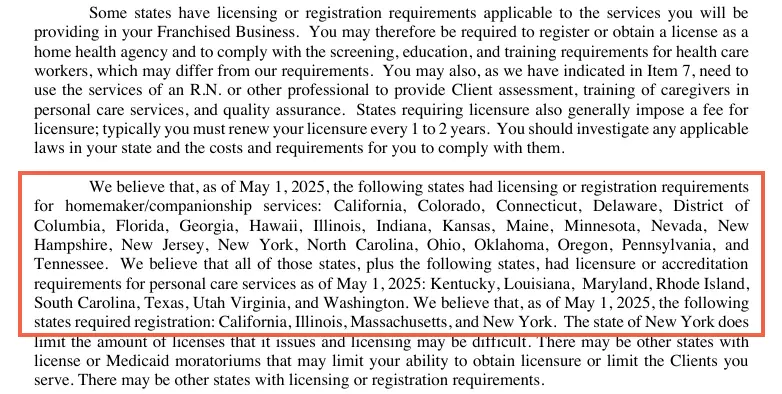
Two rows differ from that list. Washington’s statute puts homemaker assistance inside licensed home care services (RCW 70.127.010(6)), yet Exhibit F lists Washington only for personal care. New York appears on the companion list, while Public Health Law 3605(1) ties licensure to nursing, home health aide or personal care services. Ask the Washington Department of Health and the New York Department of Health how they treat a companion-only agency before you sign.
Does companion care, personal care or skilled nursing change the license?
Yes. In the 9 states we checked, the license tier follows the most hands-on task your caregivers perform. Companion work (meals, errands, housekeeping) is licensed in California, Pennsylvania, Georgia and Washington and registered in Florida. Bathing, dressing and toileting trigger an agency license in all 9. Skilled nursing adds a home health license, and billing Medicare adds federal certification with its own capital and ownership rules.
| Service model | Typical tasks | Who usually pays | License layer | Systems in our sample built around it |
|---|---|---|---|---|
| Companion and homemaker | Meals, errands, transportation, housekeeping, company | Private pay; Medicare excludes homemaker services unrelated to a care plan | State-specific: licensed in CA, PA, GA, WA; registered in FL | Part of every non-medical system; Comfort Keepers Item 16 also requires personal care |
| Non-medical personal care | Bathing, dressing, toileting, transfers, medication reminders | Private pay, long-term care insurance, some Medicaid waiver programs | Agency license in all nine states checked | Visiting Angels, Comfort Keepers, HomeWell Care Services |
| Skilled home health | RN or LPN visits, therapy, wound care | Medicare if homebound and the agency is Medicare-certified | Home health license, Medicare enrollment, survey or accreditation | Interim HealthCare (optional certified lines); Nurse Next Door (license application required within two years); Homewatch CareGivers’ Item 1 lists licensed practical nurses and registered nurses among caregivers |
Wage law follows the same split. Since the Department of Labor’s rule at 29 CFR 552.109(a), a third-party employer such as a franchised agency cannot use the companionship exemption from minimum wage and overtime, even when the family is a joint employer. Paragraph (c) applies the same rule to live-in domestic workers while letting the family itself keep the exemption, so a live-in schedule that works for a family employer does not carry the same pay terms when an agency employs the caregiver.
What do six home care FDDs charge before the first client?
The six disclosure documents put the initial franchise fee between $49,500 and $75,000 for a standard start-up, with HomeWell’s reduced-fee option at $15,000 and Visiting Angels scaling its fee to territory population. Item 7 totals run from $69,401.20 to $239,000 for non-medical or primary service lines. Licensing appears as its own Item 7 line in four of the six, from $3,000 to $18,000 where a figure is printed.
| System (FDD issued) | Item 5 initial fee | Item 7 total | Licensing line in Item 7 | Source |
|---|---|---|---|---|
| Visiting Angels (April 20, 2026) | $51,950 to $89,950, set by Protected Territory population | $125,460 to $171,150 | Licenses folded into a deposits, insurance and lease line | Visiting Angels FDD, Items 5 and 7 |
| Comfort Keepers (December 19, 2025) | $55,000 | $119,560 to $190,700 | Licensure $3,000 to $6,000; a licensure consultant or attorney is required | Comfort Keepers FDD, Items 5 and 7 |
| HomeWell Care Services (April 20, 2026) | $49,500 (Option 1) or $15,000 (Option 2) | $69,401.20 to $233,912 | Licenses and Permits line; state registration fees vary (note 20) | HomeWell FDD, Items 5 and 7 |
| Homewatch CareGivers (April 30, 2026) | $50,000 base plus $1.85 per senior above 40,000 | $142,890 to $194,080 | Licenses, Permits, and Professional $8,000 to $18,000 | Homewatch CareGivers FDD, Items 5 and 7 |
| Nurse Next Door (December 5, 2025) | $72,000 (no more than $90,000) plus $8,000 Technology Start-up Fee | $119,286 to $217,210 | No separate license line; Legal and Accounting $5,150 to $10,300 | Nurse Next Door FDD, Items 5 and 7 |
| Interim HealthCare (May 20, 2026) | $75,000; $60,000 for each optional certified home health or hospice line | $156,000 to $239,000 (primary services) | Business license line; accreditation $8,000 to $12,000 for both certified lines | Interim HealthCare FDD, Items 5 and 7 |
Item 7 estimates run from $69,401.20 (HomeWell Care Services low end) to $239,000 (Interim HealthCare high end, primary services). Source: FDDs filed in Minnesota, accessed October 27, 2026.
Two fee formulas move with the territory you choose, so the fee can be computed before you negotiate. The table applies each brand’s own Item 5 formula; no sales or profit assumptions are involved. For the sector-wide spread of Item 7 estimates, see our franchise initial investment report.
| Worked example | Inputs from Item 5 | Arithmetic | Initial fee |
|---|---|---|---|
| Homewatch CareGivers, 45,000 seniors | $50,000 base for up to 40,000 seniors; $1.85 per added senior | $50,000 + (5,000 x $1.85) | $59,250 |
| Homewatch CareGivers, 50,000 seniors | Same formula | $50,000 + (10,000 x $1.85) | $68,500 |
| Visiting Angels, 325,000 population vs 200,000 | $89,950 vs $64,950 | $89,950 minus $64,950 | $25,000 more for the larger tier |
| Interim HealthCare, adding certified lines | Cover page: $156,000 to $239,000 vs $422,150 to $628,000 | $422,150 minus $156,000; $628,000 minus $239,000 | $266,150 to $389,000 added to Item 7 |
Which ongoing fees rise with billings, and which have floors?
On standard terms the six systems charge a royalty on gross billings between 3.0% and 6% before marketing funds, all six set a dollar floor, and four raise that floor as the agency ages. Nurse Next Door adds a Care Services Center fee of the greater of 7% of gross sales or $300 a month, so its percentage load sits well above the headline 5% royalty. Interim prices royalty by payer type.
| System | Royalty (Item 6) | Minimum or floor | Brand or ad fund | Other fixed fees named |
|---|---|---|---|---|
| Visiting Angels | 3.5% of gross revenues; 3.25% in months above $125,000; 3.0% above $225,000 | $495 a month, rising to $650 (month 24), $875 (month 48), $1,095 (month 60) | Cooperative advertising: greater of $425 a month or 2.5%, stepping down to 2.25% and 2.0% | Minimums are higher in 325,000-population territories |
| Comfort Keepers | 5% of gross revenue | $500 a month in the first 24 months; a Minimum Performance Standard applies from month 25 | Greater of $1,000 a month or 2% | POSH yearly subscription for state-specific compliance materials (Item 8) |
| HomeWell Care Services | 6% (Option 1) or 10% on the first $1.5 million of gross revenues (Option 2) | From month 7 after signing: $500 a month, rising by $500 about every 12 months per Note 3 | 1%, with floors of $250, $500 and $1,000 a month by month 7, 13 and 19 | Training fee $5,000 (Item 7) |
| Homewatch CareGivers | 5% of gross revenue | None in months 0 to 6; $500 in months 7 to 12, up to $2,500 a month from month 61 | 2% of the first $500,000 a year, then 1.5%, 1% and 0.5% bands | Care+ software: $595 setup, then a monthly fee currently at least $495 |
| Nurse Next Door | 5% of gross sales | Annual minimums from $6,250 (year 1) to $51,153.82 (years 12 to 15) | General Brand Fund 1% | Care Services Center: greater of 7% or $300 a month; technology maintenance $600 a month |
| Interim HealthCare | Weekly: 3.5% palliative care, 4.5% Medicare, Medicare Advantage and Medicaid sales, 5.5% all other | $100 a week | National Marketing Fee 1% of weekly sales | Technology fee $485 a month |
The start date of the minimum royalty matters when a state license is still pending. HomeWell counts its minimum from the franchise agreement’s effective date, so an owner still waiting on a license in month 8 after signing owes at least $500 a month under Item 6; Homewatch CareGivers counts from the original opening date instead. Our franchise royalty rate study shows how these floors compare with other sectors.
How do home care franchisors count seniors in a territory?
Four of the six FDDs measure the territory by residents aged 65 or older; Visiting Angels and Comfort Keepers use total population by zip code. The senior counts run from at least 10,000 (Nurse Next Door) to 38,000 to 40,000 (Homewatch CareGivers). Visiting Angels, Comfort Keepers and Nurse Next Door each print the Item 12 sentence “You will not receive an exclusive territory.”
| System | Item 12 territory measure | How it is drawn | Source |
|---|---|---|---|
| Visiting Angels | Total population: up to 100,000, 200,000 standard, or 325,000 | Zip codes; offices generally 7 to 10 miles apart; one office per 400,000 population | Visiting Angels FDD, Item 12 |
| Comfort Keepers | At least 200,000 total population (may exceed 220,000) | U.S. Postal Service zip codes; office in commercial or retail space | Comfort Keepers FDD, Item 12 |
| HomeWell Care Services | 30,000 to 40,000 seniors aged 65 and over, total population not above 350,000 | Contiguous zip codes using purchased third-party data | HomeWell FDD, Item 12 |
| Homewatch CareGivers | Typically 38,000 to 40,000 seniors (65 or older) | Zip codes; added zip codes cost $1.85 per senior | Homewatch CareGivers FDD, Items 5 and 12 |
| Nurse Next Door | At least 10,000 resident senior citizens | U.S. census data through Atlas Mapping software | Nurse Next Door FDD, Item 12 |
| Interim HealthCare | 175,000 to 200,000 population, about 25,000 over age 65 | Zip codes or counties, GbBIS demographic data | Interim HealthCare FDD, Item 12 |
Senior counts per territory run from at least 10,000 (Nurse Next Door) to 38,000 (Homewatch CareGivers, low end of 38,000 to 40,000); Interim’s figure is approximate. Source: FDD Item 12, accessed October 27, 2026.
A senior count only helps if the state lets you serve those seniors. In New York, where licensure turns on public need under PHL 3605, a territory full of residents aged 65 and older is still closed until the Public Health and Health Planning Council approves the agency. Our franchise territory rights research covers how protected and exclusive territories differ across 259 FDDs.
Can someone else run the agency for you?
Only partly. Item 15 in all six FDDs keeps a named owner responsible, and three set personal duties: Visiting Angels requires a 25% owner full-time for the first four years, Interim HealthCare requires the majority owner full-time unless it consents in writing, and Nurse Next Door’s principal owner must participate personally. HomeWell and Comfort Keepers allow a trained manager with no equity.
| System | Item 15 owner rule | Manager allowed? | Staffing rule named in the FDD |
|---|---|---|---|
| Visiting Angels | An owner with at least 25% of the stock full-time for the first 4 years | After year 4, if trained | Owner supervises directly on premises |
| Comfort Keepers | Owner provides overall supervision; owners with 10% or more guarantee | Yes, a Designated Manager with no equity needed | At least two full-time employees to open |
| HomeWell Care Services | Managing Owner full-time unless a qualified manager is hired | Yes, after training and a Brand Protection Agreement | A full-time Care Manager; the Managing Owner cannot fill that role |
| Homewatch CareGivers | A Key Person with at least 5% equity, trained, may be required on premises | Key Person may hold as little as 5% of the equity | Owners with 5% or more sign a personal guarantee |
| Nurse Next Door | Principal owner participates personally | Only in limited circumstances | Item 1: a supervising registered nurse where the state requires one |
| Interim HealthCare | Majority owner full-time unless the franchisor consents in writing | Yes, a full-time manager with no equity needed | Competent and fully trained staff (Item 15) |
State law can add a second layer that the FDD only mentions. HomeWell’s Item 1 warns that certain states require a nurse or administrator on staff, and Nurse Next Door’s Item 1 says a supervising registered nurse may be needed even for non-medical care. Our semi-absentee franchise analysis shows how Item 15 wording differs across 259 systems.
What does adding Medicare home health do to cost and timing?
It moves the project into federal rules. A new home health agency must show 3 months of initial reserve operating funds, excluding Medicare receivables (42 CFR 489.28), pass a state survey or accreditation, and live with a 36-month lock: a majority sale within 36 months of enrollment does not transfer Medicare billing privileges (42 CFR 424.550(b)). Interim’s certified path adds $266,150 to $389,000 to Item 7.
| Skilled-path requirement | What it says | Source |
|---|---|---|
| Medicare coverage condition | Homebound patient, part-time or intermittent skilled need, Medicare-certified agency | Medicare.gov |
| Initial reserve operating funds | Funds for the 3 months after billing privileges begin, based on the cost per visit of 3 or more comparable new agencies | 42 CFR 489.28 |
| 36-month ownership rule | Buyer enrolls as a new agency and needs a new survey or accreditation; exception after 2 consecutive years of full cost reports | 42 CFR 424.550 |
| Accreditation budget at Interim | $8,000 to $12,000 for both certified home health and hospice | Interim HealthCare FDD, Item 7 |
| Certificate of Need | Interim’s Item 1: “In some states, providing health care services may require a Certificate of Need” | Interim HealthCare FDD, Item 1 |
| Nurse Next Door deadline | Non-medical only “for a period of up to two years,” then a skilled nursing license application | Nurse Next Door FDD, Item 1 |
Interim HealthCare’s Item 1 adds that it does not expect franchisees to seek Medicare certification “until the Franchise Business has been firmly established,” so its fee table treats certified home health and hospice as later add-ons at $60,000 each. Nurse Next Door is the reverse: non-medical-only operation is allowed for up to two years, the owner must apply for a home health license before that period ends, and Item 16 allows Medicare, Medicare Advantage and Medicaid participation once requirements are met.
Where do senior care franchise guides oversimplify licensing?
Several top-ranking guides describe licensing in one line, or skip it. The primary documents show 3 gaps: the license count depends on the service tier, companion-only care is licensed in some states and not addressed in others, and the skilled path carries federal capital and ownership rules no guide we read mentioned. The table sets each claim against the source.
| What a guide says | What the primary source says | Source |
|---|---|---|
| A franchise sales guide published February 2026 mentions “regulatory awareness” and names no state, statute or agency | Nine states checked use nine different rules, from a $50 Florida registration to New York’s public need review | State codes in the license table |
| A 2025 senior care franchise guide lists brand cost ranges with no FDD issue dates and does not mention licensing | Comfort Keepers counts about 32 states for personal care as of May 1, 2025, with 23 jurisdictions also covering companion services, and budgets $3,000 to $6,000 for licensure | Comfort Keepers FDD, Item 7 note 10 and Exhibit F |
| The February 2026 guide presents “Manager-Run and Semi-Passive Models” as a senior care option without naming brands | Visiting Angels requires a 25% owner full-time for 4 years; Nurse Next Door’s principal owner must participate personally | Visiting Angels and Nurse Next Door FDDs, Item 15 |
Which license path matches your plan?
Start from the most hands-on task you intend to sell, then read the state rule for that tier and the FDD clause that matches it. Companion-only plans depend most on the state; personal care plans need an agency license in all 9 states we checked; skilled plans add Medicare rules and, at 2 of the 6 systems, a franchisor timetable or add-on fee. This is not legal advice.
| If your plan is | State rule to read first | FDD clause to check first | Then ask |
|---|---|---|---|
| Companion only (errands, meals, housekeeping, company) | License: CA, PA, GA, WA; registration: FL ($50, 2 years); trigger is hands-on care: NY PHL 3605, VA 32.1-162.7 | Item 16: must you offer personal care? Comfort Keepers requires it | The state regulator whether companion-only needs a license; confirm with the agency |
| Hands-on personal care, private pay | Agency license in all 9 states in our table; TX: Personal Assistance Services, $2,625 for 3 years; FL: home health agency license, s. 400.464 | Item 7 license line and Item 1 state law notes ($3,000 to $18,000 lines) | How long the state takes to license, and which Item 6 minimum royalty starts before you can bill |
| Skilled nursing or Medicare billing | Home health license plus Medicare enrollment; 3 months reserve funds (42 CFR 489.28); NY: public need review; some states: CON | Item 1 skilled mandate: Nurse Next Door, 2 years; Interim, $60,000 per line | Whether you can fund 3 months of reserves and hold the agency 36 months |
| Semi-absentee ownership | Nurse or administrator staffing rules in the state | Item 15: Visiting Angels full-time 4 years; HomeWell Care Manager | A franchise attorney to read Item 15 against the franchise agreement |
For income questions, owner-level data, where a brand publishes it, sits in Item 19 of the current FDD; our Item 19 research explains what those tables can and cannot show. Market size and SBA lending for the sector are in our senior care franchise statistics report, and the franchise disclosure document guide explains all 23 items. A consultant’s role in shortlisting brands is set out in what a franchise consultant does.
How we compiled this
We read Items 1, 5, 6, 7, 12, 15 and 16 of six home care Franchise Disclosure Documents filed with the Minnesota Department of Commerce (issued December 5, 2025 to May 20, 2026) and opened the statute, regulation or regulator page for nine states plus four federal rules in October 2026. We excluded brands not in our FDD corpus, competitor figures we could not confirm, and every Item 19 number. North Carolina was left out because its statute pages blocked access.
Frequently asked questions
Do you need a license to open a senior care franchise?
Usually, and the tier depends on the service. Pennsylvania licenses any home care agency, companion work included (28 Pa. Code 611.2), Florida asks companion providers to register for $50 every two years (s. 400.509), and Texas licenses Personal Assistance Services agencies at $2,625 for a three-year license. Skilled nursing needs a home health license in every state we checked. This is not legal advice.
What is the difference between a non-medical and a medical home care franchise?
A non-medical franchise sends caregivers for companionship and hands-on help such as bathing and dressing; a medical one adds nurses and therapists under a home health license. Medicare pays only for part-time skilled care from a Medicare-certified agency for homebound patients, and not for personal care alone (Medicare.gov), so the two models bill different payers.
How much does a home care franchise cost to open?
Item 7 estimates in six FDDs issued December 2025 to May 2026 run from $69,401.20 (HomeWell Care Services, low end) to $239,000 (Interim HealthCare, primary services). Interim’s path with certified home health and hospice runs $422,150 to $628,000. Licensing lines inside Item 7 range from $3,000 to $6,000 (Comfort Keepers) to $8,000 to $18,000 (Homewatch CareGivers).
Can a home care franchise be run semi-absentee?
Partly, and it depends on Item 15. Visiting Angels requires an owner holding at least 25% to work full-time for the first four years, Nurse Next Door’s principal owner must take part personally, and Interim HealthCare’s majority owner works full-time unless the franchisor consents. HomeWell and Comfort Keepers allow a trained manager without equity, but HomeWell also requires a full-time Care Manager.
Can a non-medical senior care franchise bill Medicare?
Not for non-medical services. Medicare.gov says Medicare does not pay for custodial or personal care when that is the only care a person needs. To bill Medicare home health, an agency needs a state home health license, Medicare enrollment with a survey or accreditation, and 3 months of reserve operating funds under 42 CFR 489.28. Interim HealthCare prices that step at $60,000 per certified line in Item 5.
Is buying an existing home health agency faster than opening one?
Not always. Under 42 CFR 424.550(b), if majority ownership of a Medicare home health agency or hospice changes within 36 months of its enrollment or its last majority change, billing privileges do not transfer; the buyer enrolls as a new agency and needs a new survey or accreditation. The exception requires 2 consecutive years of full cost reports. Ask the seller for the enrollment date first.
Sources
- Living Assistance Services, Inc., Visiting Angels Franchise Disclosure Document, issued April 20, 2026 (Minnesota CARDS; accessed October 27, 2026)
- CK Franchising, Inc., Comfort Keepers Franchise Disclosure Document, issued December 19, 2025 (Minnesota CARDS; accessed October 27, 2026)
- HomeWell Franchising LLC, HomeWell Care Services Franchise Disclosure Document, issued April 20, 2026 (Minnesota CARDS; accessed October 27, 2026)
- Homewatch CareGivers Franchising SPE LLC, Homewatch CareGivers Franchise Disclosure Document, issued April 30, 2026 (Minnesota CARDS; accessed October 27, 2026)
- Nurse Next Door Home Healthcare Services (USA) Inc., Nurse Next Door Franchise Disclosure Document, issued December 5, 2025 (Minnesota CARDS; accessed October 27, 2026)
- Interim Healthcare, Inc., Interim HealthCare Franchise Disclosure Document, issued May 20, 2026 (Minnesota CARDS; accessed October 27, 2026)
- California Health and Safety Code 1796.12 and 1796.17, Home Care Services (accessed October 27, 2026)
- Florida Statutes 400.462, 400.464 and 400.509 (accessed October 27, 2026)
- Georgia Rules 111-8-65, Private Home Care Providers (accessed October 27, 2026)
- Illinois Department of Public Health, Home Services Agencies (accessed October 27, 2026)
- New York Public Health Law 3602 and 3605 (accessed October 27, 2026)
- 28 Pa. Code Chapter 611, Home Care Agencies and Home Care Registries (accessed October 27, 2026)
- Texas Health and Human Services, How to Become a Licensed HCSSA Provider (accessed October 27, 2026)
- Code of Virginia 32.1-162.7 and 32.1-162.9 (accessed October 27, 2026)
- Revised Code of Washington 70.127.010 and 70.127.020 (accessed October 27, 2026)
- Medicare.gov, Home health services (accessed October 27, 2026)
- 42 CFR 489.28, Special capitalization requirements for HHAs (accessed October 27, 2026)
- 42 CFR 424.550, Prohibitions on the sale or transfer of billing privileges (accessed October 27, 2026)
- 29 CFR 552.109, Third party employment (accessed October 27, 2026)
- 16 CFR 436.5, FTC Franchise Rule disclosure items (accessed October 27, 2026)