A Shake Shack franchise is not sold in the United States: Shake Shack’s 10-Q for the quarter ended September 30, 2026 counts 427 Company-operated and 311 licensed Shacks, and Minnesota’s franchise registry holds no Shake Shack FDD.
Key takeaways
- Shake Shack Inc. describes itself as a company that “operates and licenses” Shacks; its Form 10-K for fiscal 2025 never calls its own model franchising.
- At December 31, 2025 there were 659 Shacks: 373 Company-operated, all in the U.S., and 286 licensed, of which 239 were outside the U.S. and 47 inside it (FY2025 10-K, Item 2).
- Licensing revenue was $54,140 thousand in fiscal 2025, or 3.7% of total revenue, made up of territory fees, opening fees, percentage-of-sales license fees and termination fees (FY2025 10-K, MD&A).
- Only 11 licensees ran every U.S. licensed Shack and 10 ran every international one at the end of 2025, and one licensee held 30% of each group (FY2025 10-K, risk factors).
- A search of Minnesota CARDS for “Shake Shack” on November 8, 2026 returned no Clean FDD rows, so no Item 5, 6, 7 or 19 exists to quote.
What do Shake Shack’s own filings call the business model?
Shake Shack’s filings describe two kinds of restaurant and no franchise program. Note 1 of the FY2025 Form 10-K, filed February 26, 2026, says the company “operates and licenses Shake Shack restaurants (“Shacks”)”. Company-operated Shacks are leased and run by Shake Shack itself; licensed Shacks are run by partner companies under license agreements, and Shake Shack owns or leases no property for them.
The distinction shows up in the accounting. The 10-K states that “The Company does not recognize the sales from licensed Shacks as revenue.” What Shake Shack books from a licensed Shack is a fee stream, reported on its own line called Licensing revenue. A franchisor would usually label the same stream franchise or royalty revenue; Shake Shack’s statements use the word license throughout, from the 2019 annual report to the 10-Q filed November 5, 2026.
The 10-K also says the company was founded in 2001 by Danny Meyer’s Union Square Hospitality Group, starting as a hot dog cart in New York City’s Madison Square Park. The filings name no U.S. program through which an individual can apply to own a Shack.
How has the split between licensed and Company-operated Shacks moved since 2019?
Licensed Shacks have stayed between about 40% and 44% of the system for seven years. The count rose from 112 licensed Shacks at the end of fiscal 2019 to 286 at the end of fiscal 2025 and 311 at September 30, 2026, while Company-operated Shacks rose from 163 to 373 and then 427, according to eight annual and quarterly SEC filings.
| Period end | Company-operated | U.S. licensed | International licensed | Licensed total | System-wide | Source |
|---|---|---|---|---|---|---|
| Dec 25, 2019 | 163 | 22 | 90 | 112 | 275 | FY2019 10-K |
| Dec 30, 2020 | 183 | 22 | 106 | 128 | 311 | FY2020 10-K |
| Dec 29, 2021 | 218 | 25 | 126 | 151 | 369 | FY2021 10-K |
| Dec 28, 2022 | 254 | 33 | 149 | 182 | 436 | FY2022 10-K |
| Dec 27, 2023 | 295 | 39 | 184 | 223 | 518 | FY2023 10-K |
| Dec 25, 2024 | 329 | 44 (250 minus 206 abroad) | 206 | 250 | 579 | FY2024 10-K |
| Dec 31, 2025 | 373 | 47 | 239 | 286 | 659 | FY2025 10-K |
| Sep 30, 2026 | 427 | not split | not split | 311 | 738 | Q3 2026 10-Q |
Licensed Shacks rose from 112 to 311 between fiscal 2019 and September 30, 2026, holding roughly 40% to 44% of the system. Source: Shake Shack 10-K and 10-Q filings, SEC EDGAR, accessed November 8, 2026.
The 2026 movement is visible in the 10-Q roll-forward: Shake Shack opened 54 Company-operated and 32 licensed Shacks in the 39 weeks to September 30, 2026, and permanently closed 7 licensed Shacks and no Company-operated ones. Every closure in that period sat on the licensed side.
Where do the 47 U.S. licensed Shacks operate?
The 47 domestic licensed Shacks at December 31, 2025 sat in 20 states and Washington, D.C., with New York (12) and New Jersey (8) holding 20 of them, per Item 2 of the FY2025 10-K. The filings tie U.S. licensing to captive venues: “major airports, travel plazas, and high-traffic entertainment venues” in 2025, and airport sites since at least 2019.
| State or district | Licensed Shacks | Company-operated Shacks |
|---|---|---|
| New York | 12 | 55 |
| New Jersey | 8 | 20 |
| Missouri | 3 | 7 |
| Pennsylvania | 3 | 17 |
| Florida | 2 | 25 |
| Nevada | 2 | 6 |
| North Carolina | 2 | 8 |
| Texas | 2 | 27 |
| Arizona, Colorado, D.C., Georgia, Indiana, Louisiana, Maryland, Massachusetts, Minnesota, Ohio, Tennessee, Utah, Virginia | 1 each (13 total) | See 10-K Item 2 |
| Total U.S. | 47 | 373 |
The venue history comes from the annual reports. The FY2019 10-K reports 10 domestic licensed openings that year, “of which eight were in airports,” plus the first roadside Shack in New Jersey. The FY2023 10-K lists one opening at Newark Liberty International Airport and five in New Jersey and New York travel plazas. The FY2025 10-K adds signed agreements to bring Shake Shack to Hawaii and to 10 U.S. casino properties.
What does a Shake Shack licensee pay, and what does Shake Shack book?
The FY2025 10-K names four fee types: an initial territory fee paid when the license agreement is signed, a Shack opening fee paid before or upon each opening, ongoing license fees “calculated as a percentage of sales,” and termination fees. It states no dollar amount or percentage for any of them, and says most license terms run “from ten to twenty years” per Shack.
- Initial territory fee: paid on signing, for “the exclusive right to develop Shacks in a specific geographic area.”
- Shack opening fee: paid “either in advance of or upon opening the related Shack.”
- License fees: a percentage of each licensed Shack’s sales, recognized as those sales occur.
- Termination fees: recognized for certain licensed Shacks when a contract ends; fiscal 2025 included one such termination.
Upfront fees are deferred and spread across the license term. At December 31, 2025, Shake Shack carried $27,308 thousand of license consideration not yet recognized, and $25,673 thousand at September 30, 2026, per the revenue notes in the 10-K and Q3 2026 10-Q.
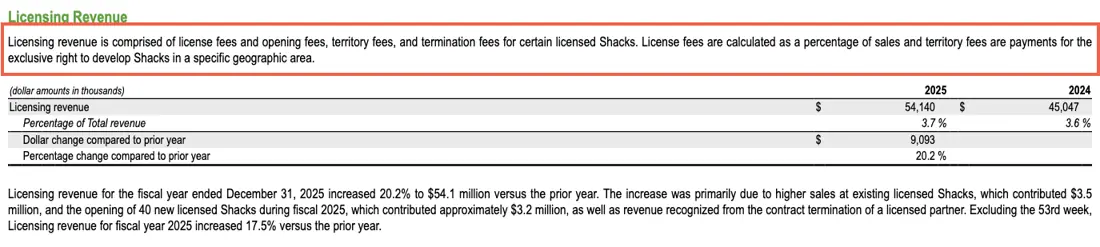
Licensing revenue nearly tripled in six years, from $19,894 thousand in fiscal 2019 to $54,140 thousand in fiscal 2025, while staying between 3.2% and 3.7% of total revenue. The FY2025 increase of 20.2% included $3.5 million from existing licensed Shacks, about $3.2 million from 40 new ones, and a contract termination payment.
Licensing revenue grew from $19,894 thousand in fiscal 2019 to $54,140 thousand in fiscal 2025, between 3.2% and 3.7% of total revenue each year. Source: Shake Shack 10-K filings, accessed November 8, 2026.
| Calculation | Inputs (SEC filing) | Result |
|---|---|---|
| Licensed share of all Shacks, FY2025 | 286 licensed / 659 system-wide | 43.4% |
| Licensed share of all Shacks, FY2019 | 112 / 275 | 40.7% |
| Growth in licensed Shacks, FY2019 to FY2025 | (286 minus 112) / 112 | +155.4% |
| Growth in Company-operated Shacks, same years | (373 minus 163) / 163 | +128.8% |
| Growth in Licensing revenue, same years | ($54,140k minus $19,894k) / $19,894k | +172.1% |
| Licensing revenue share of total revenue, FY2025 | Printed in the 10-K | 3.7% |
The gap between 43.4% of units and 3.7% of revenue is structural: Shake Shack books a licensed Shack’s fees, not its sales. A comparable split for franchisors that do file FDDs is in our report on how franchisors make money from royalties and fees.
Who holds the licenses, and how is a partner chosen?
Shake Shack licenses to a short list of operating companies, not to individuals. At December 31, 2025, 11 licensees ran all 47 U.S. licensed Shacks and 10 ran all 239 international ones; one licensee operated 30% of each group, per the FY2025 10-K. Two years earlier the counts were 10 and 6, with top shares of 28% and 36%.
The same risk factor describes the selection process only in general terms: Shake Shack has “developed criteria to evaluate and screen prospective developers and licensees,” requires them to follow its operating guidelines, and provides training, but has no “day-to-day control” over their Shacks. It also advises international partners to hold at least 3 months of inventory because proprietary ingredients such as beef patties are imported (Item 1A).
- FY2019: 112 licensed; 10 U.S. licensed openings, 8 in airports; first roadside Shack in New Jersey (10-K).
- FY2020: 128 licensed; 17 licensed Shacks temporarily closed at year end, mainly due to COVID-19 (10-K).
- FY2023: 223 licensed; U.S. openings at Newark Liberty airport and 5 New Jersey and New York travel plazas (10-K).
- FY2025: 286 licensed; 40 licensed openings, 36 abroad in 12 countries and 4 in the U.S.; agreements for Hawaii and 10 U.S. casino properties; development deals for 15 Shacks in Vietnam and 12 in Panama (10-K).
- Q3 2026: 311 licensed; Brazil entry announced; Panama, Vietnam and U.S. regional casinos slated for Q4 2026; 2026 licensed openings expected at the high end of a 40 to 45 range (Q3 2026 shareholder letter).
Why is there no Shake Shack FDD, and where does the FTC Rule fit?
The filings do not say why Shake Shack issues no Franchise Disclosure Document, and this page does not guess. They do say its licensed operations “are subject to laws enacted by a number of states, rules and regulations promulgated by the U.S. Federal Trade Commission.” Minnesota CARDS, a common public source for FDDs, returned no Shake Shack filing on November 8, 2026.
Under 16 CFR 436.1(h), a franchise is any arrangement, “whatever it may be called,” with three elements: the right to use the trademark, significant control or assistance, and a required payment. Where the rule applies, 16 CFR 436.2(a) requires the disclosure document at least 14 calendar-days before signing or paying. Our guide to the FTC Franchise Rule covers the full timeline.
The rule also lists exemptions in 16 CFR 436.8 that are relevant to large operators: an initial investment of at least $1,469,600, excluding unimproved land and franchisor financing, with a signed acknowledgment, or a buyer entity in business at least five years with a net worth of at least $7,348,000. The FTC adjusts these thresholds every fourth year. Whether any Shake Shack license relies on them is not disclosed; this is general information, not legal advice.
Which burger FDDs set rules for airports and stadiums?
Five burger franchisors with FDDs issued in 2024 to 2026 and filed on Minnesota CARDS spell out how airports, arenas and stadiums are handled, which is the venue type where U.S. licensed Shacks cluster. Two reserve those venues to the franchisor, one sells a separate nontraditional agreement at a lower fee, and two print a separate cost range or fee rule for them.
| Brand (FDD issued) | Airport, stadium and captive-venue rule | Venue fee or cost rule | Standard initial fee (Item 5) | Source |
|---|---|---|---|---|
| Five Guys (June 30, 2026) | Item 1: “train stations, sports arenas, airports, university campuses” considered “on a case-by-case basis”; Item 12: airports, arenas and stadiums are a “Reserved Area,” open to a franchisee who secures permits in its own area | Same terms as other sites once approved (Item 12) | $25,000 franchise fee plus $50,000 Development Fee per restaurant | Five Guys FDD, Items 1, 5, 12 |
| Freddy’s Frozen Custard & Steakburgers (April 30, 2026) | Item 12: franchisor may operate or license others in “airports, train stations, bus stations, service plazas, stadiums, arenas” and casinos inside or outside your territory | Item 6 note 1: non-traditional franchisees pay a reduced Marketing and Advertising Fund contribution | $35,000 License Fee | Freddy’s FDD, Items 5, 6, 12 |
| Jack in the Box (March 13, 2026) | Item 1: separate Nontraditional License Agreement covering airports, stadia, arenas, casinos and similar sites | Item 5: $25,000 fee per nontraditional unit; Item 6: typical Marketing Fee 1% of Gross Sales; Item 7: $990,000 to $2,300,000 | Typically $50,000 | Jack in the Box FDD, Items 1, 5, 6, 7 |
| Smashburger (April 17, 2026, amended May 28, 2026) | Item 1: “Special Venue Restaurant” (airports, sports facilities, convention centers) offered case by case based on your experience at special venues; Item 12: franchisor may place them anywhere, including your Development Area | Item 7 notes: Special Venue Restaurants are often smaller, which changes leasehold and equipment costs | $40,000 | Smashburger FDD, Items 1, 5, 7, 12 |
| Steak n Shake (March 28, 2024) | Item 1: non-traditional sites of 400 SF to 2,400 SF “such as food courts, universities, airports, and arenas” | Item 5: may charge a different fee for Captive Facilities; Item 7: non-traditional $316,000 to $715,000 | $25,000 | Steak n Shake FDD, Items 1, 5, 7 |
For the full building-cost side of these systems, our page on the In-N-Out franchise question compares burger Items 5 to 7, and the Steak n Shake franchise page breaks down that brand’s formats. Royalty rates across sectors are in our franchise royalty rates report.
Shake Shack franchise claims online, checked against the filings
Pages ranking for this search in November 2026 print investment, fee and net-worth figures for Shake Shack. None of the five we opened cites a Shake Shack document, and the figures below have no support in the 10-K, the 10-Q or any state registry.
| Claim in circulation | What the primary record shows | Source |
|---|---|---|
| A franchise-directory guide (published August 2026) lists startup costs of $1,135,000 to $2,940,000 and a net worth of $2.5 million to $5 million | No Shake Shack filing states any investment, net worth or liquidity requirement | FY2025 10-K; CARDS |
| A food-service trade profile (January 2024) counts 339 Shacks: 200 company, 23 U.S. licensed, 116 international | 659 at December 31, 2025 (373 and 286); 738 at September 30, 2026 (427 and 311) | Q3 2026 10-Q |
| The same profile uses a Five Guys investment of $256,200 to $591,250 as a stand-in | Five Guys Item 7 prints $927,850 to $1,375,750 | Five Guys FDD, June 30, 2026, Item 7 |
| A franchise marketplace article (August 2025) cites “5 to 7%” fees and a $3 million to $6 million investment from “industry insiders” | License fees are “a percentage of sales”; no rate or investment is disclosed | FY2025 10-K, MD&A |
| A startup blog (last modified 2022) lists a $9,250 franchise fee and a 6% royalty | No Shake Shack document states either figure | FY2025 10-K |
Decision table: five reader situations and the documented route
The route depends on what you hold now: a concession business, building capital, or only an interest in the brand. Each row below points to a document you can read before spending money, and the thresholds come from the FTC Rule or a filed FDD rather than from Shake Shack, which publishes none; the exemption figures are from 16 CFR 436.8 as amended July 12, 2024.
| If you are… | Then the documented route is… | Threshold or figure to check |
|---|---|---|
| An individual hoping to own a Shake Shack in the U.S. | No application path exists in the filings; licenses went to 11 operating companies for 47 U.S. Shacks | FY2025 10-K risk factors |
| An airport, travel-plaza or casino concession operator | A negotiated license, the channel the 10-K describes for U.S. venues; ask for the territory fee, opening fee, percentage-of-sales fee and term in writing | Most license terms run 10 to 20 years per Shack |
| A large entity told no disclosure document is required | Ask which 16 CFR 436.8 exemption is claimed and get the signed acknowledgment language reviewed by a franchise attorney | $1,469,600 investment, or 5 years in business and $7,348,000 net worth |
| A buyer with about $0.9 million to $1.4 million for a burger restaurant | A franchised burger system with a current FDD, such as Five Guys | $927,850 to $1,375,750 (Item 7), plus a $50,000 Development Fee |
| A buyer who wants a small venue or food-court unit | A nontraditional format in a filed FDD | Steak n Shake non-traditional $316,000 to $715,000 (2024 FDD); Jack in the Box nontraditional $990,000 to $2,300,000 |
Before signing any burger agreement, read the full disclosure document; our explainer on the Franchise Disclosure Document lists the 23 items. Other quick-service systems that do sell U.S. franchises are compared in our fast food franchise guide, and the role of a broker is set out in what a franchise consultant does. This page is general information, not legal, financial or investment advice.
Shake Shack, with 311 licensed Shacks at September 30, 2026, is one of several restaurant chains that grow through licensing instead of franchising; Panda Express licenses are the closest parallel, though Panda Express files an FDD for them. Public franchisors’ unit growth, which excludes Shake Shack for this reason, is tracked in our public franchisor unit growth report.
How we compiled this
We read nine Shake Shack SEC filings on EDGAR (seven 10-Ks for fiscal 2019 to 2025, the Q3 2026 10-Q and the Q3 2026 shareholder letter filed as an 8-K exhibit), five burger FDDs from Minnesota CARDS, one CARDS search and three sections of 16 CFR Part 436, all in November 2026. We excluded system-wide sales, unit sales volumes, margins, Item 19 data and the names of licensees and franchisees.
Frequently asked questions
Is Shake Shack a franchise?
No. Shake Shack Inc. describes itself in its fiscal 2025 Form 10-K as a company that operates and licenses Shacks. At December 31, 2025 it ran 373 Company-operated Shacks in the U.S. and had 286 licensed Shacks run by partner companies, 239 of them abroad. Minnesota’s CARDS registry showed no Shake Shack Franchise Disclosure Document on November 8, 2026.
How much does a Shake Shack franchise cost?
There is no published cost, because Shake Shack files no Franchise Disclosure Document and so has no Item 7 investment table. Its 10-K lists the fee types a licensee pays (territory fee, opening fee, percentage-of-sales license fee, termination fee) without amounts. For a filed comparison, the June 30, 2026 Five Guys FDD prints $927,850 to $1,375,750 in Item 7.
What is the Shake Shack franchise fee?
Shake Shack does not disclose one. Its fiscal 2025 10-K says licensees pay an initial territory fee on signing, a Shack opening fee before or at each opening, and license fees calculated as a percentage of sales, with most license terms running 10 to 20 years. No dollar amount or rate appears in any filing we read through November 5, 2026.
How much does a Shake Shack franchise owner make?
No individual owns a Shake Shack franchise in the U.S., and Shake Shack publishes no Item 19 for licensed Shacks. At December 31, 2025, 11 companies ran the U.S. licensed Shacks and 10 ran the international ones. Income at any burger franchise depends on the Item 6 fees, the Item 7 costs and the sales history in that brand’s Item 19, which you read in its current FDD.
What are the Shake Shack franchise requirements?
No published requirements exist. The 10-K says Shake Shack has criteria to screen prospective developers and licensees, requires them to follow its operating guidelines, provides training and advises international partners to carry three months of inventory. In practice U.S. licenses sit with operating companies in airports, travel plazas, entertainment venues and casinos: 47 U.S. licensed Shacks were run by 11 companies at the end of 2025.
Is Shake Shack planning to franchise in the United States?
Not according to its filings. The Q3 2026 10-Q and shareholder letter, filed November 5, 2026, describe growth through Company-operated Shacks (54 opened in 39 weeks) and licensing (32 opened), including entry into Brazil and U.S. regional casinos. Neither document mentions a domestic franchise program. Check the next 10-K, due early 2027, for any change.
Sources
- Shake Shack Inc., Form 10-K for fiscal 2025, filed February 26, 2026, SEC EDGAR, accessed November 8, 2026.
- Shake Shack Inc., Form 10-K for fiscal 2024, filed February 21, 2025, SEC EDGAR, accessed November 8, 2026.
- Shake Shack Inc., Form 10-K for fiscal 2023, filed February 29, 2024, SEC EDGAR, accessed November 8, 2026.
- Shake Shack Inc., Form 10-K for fiscal 2022, filed February 23, 2023, SEC EDGAR, accessed November 8, 2026.
- Shake Shack Inc., Form 10-K for fiscal 2021, filed February 18, 2022, SEC EDGAR, accessed November 8, 2026.
- Shake Shack Inc., Form 10-K for fiscal 2020, filed February 26, 2021, SEC EDGAR, accessed November 8, 2026.
- Shake Shack Inc., Form 10-K for fiscal 2019, filed February 24, 2020, SEC EDGAR, accessed November 8, 2026.
- Shake Shack Inc., Form 10-Q for the quarter ended September 30, 2026, filed November 5, 2026, SEC EDGAR, accessed November 8, 2026.
- Shake Shack Inc., Q3 2026 shareholder letter, Form 8-K exhibit, filed November 5, 2026, SEC EDGAR, accessed November 8, 2026.
- Minnesota Department of Commerce, CARDS franchise registrations search (“Shake Shack”, Clean FDD), accessed November 8, 2026.
- Five Guys Franchisor, LLC, Franchise Disclosure Document, issued June 30, 2026, Minnesota CARDS, accessed November 8, 2026.
- Freddy’s, L.L.C., Franchise Disclosure Document, issued April 30, 2026, Minnesota CARDS, accessed November 8, 2026.
- Different Rules, LLC (Jack in the Box), Franchise Disclosure Document, issued March 13, 2026, Minnesota CARDS, accessed November 8, 2026.
- Smashburger Franchising LLC, Franchise Disclosure Document, issued April 17, 2026, as amended May 28, 2026, Minnesota CARDS, accessed November 8, 2026.
- Steak n Shake Enterprises, Inc., Franchise Disclosure Document, issued March 28, 2024, Minnesota CARDS, accessed November 8, 2026.
- 16 CFR 436.1, Definitions, Legal Information Institute, accessed November 8, 2026.
- 16 CFR 436.2, Obligation to furnish documents, Legal Information Institute, accessed November 8, 2026.
- 16 CFR 436.8, Exemptions, eCFR, accessed November 8, 2026.