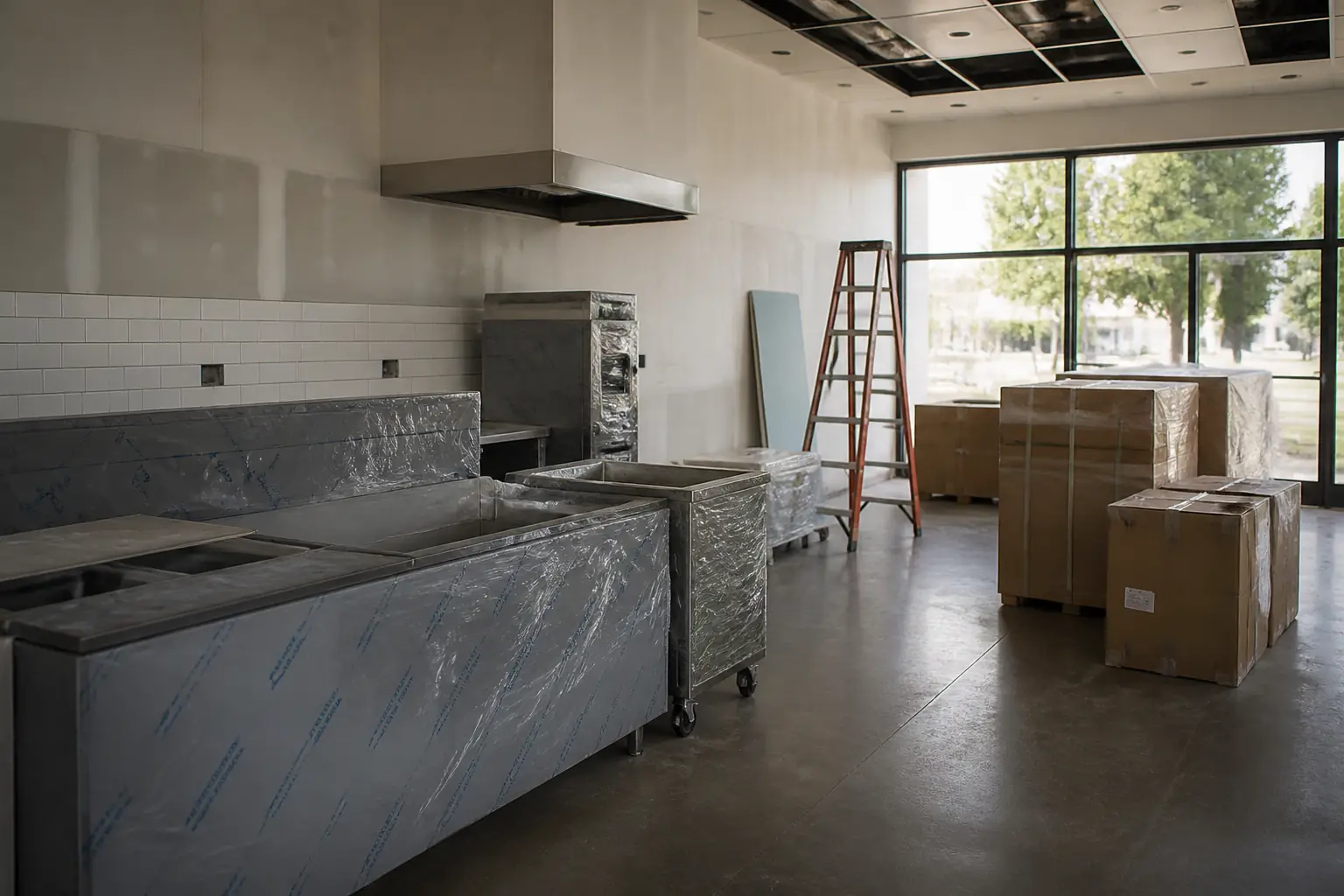
The Subway franchise cost for a new traditional restaurant is $263,000 to $630,000 under Item 7 of Subway’s 2026 disclosure document, including a $15,000 franchise fee; non-traditional sites run $227,000 to $458,000.
Key takeaways
- Subway’s Item 7 estimate for one traditional restaurant is $263,000 to $630,000, with a mid estimate of $430,000, per the Subway Franchise Disclosure Document, issued April 30, 2026 (amended June 15, 2026).
- The high end rose $93,255 from the 2025 FDD’s $536,745, led by a $50,000 increase in leasehold improvements, per the 2025 Subway FDD.
- Ongoing fees are an 8% royalty plus a 4.5% advertising fee on gross sales, paid weekly, against a 6% median royalty in 239 FDDs filed in Minnesota CARDS.
- Subway’s FDD has no Item 19 financial performance representation, so it publishes no sales or profit figures for its restaurants (Item 19).
- U.S. outlets fell from 20,576 at the start of 2023 to 18,773 at the end of 2025, and 792 were temporarily closed on December 31, 2025 (Item 20).
| Key number | Value | Source |
|---|---|---|
| Item 7 total, traditional | $263,000 to $630,000 (mid $430,000) | FDD 2026, Item 7 |
| Item 7 total, non-traditional | $227,000 to $458,000 (mid $325,000) | FDD 2026, Item 7 |
| Paid to Subway or affiliate before opening | $18,000 to $27,000 | FDD 2026, cover page |
| Royalty plus advertising | 8% + 4.5% = 12.5% of gross sales, weekly | FDD 2026, Item 6 |
| Term and renewal | 20 years, renewable for 20 years at $3,750 | FDD 2026, Items 6 and 17 |
| U.S. outlets, end of 2025 | 18,773, all franchised | FDD 2026, Item 20 |
How much does a Subway franchise cost in 2026?
A new traditional Subway restaurant costs $263,000 to $630,000 to open and run for three months, according to Item 7 of the FDD issued April 30, 2026. The mid estimate is $430,000. Build-out and equipment drive the range: leasehold improvements of $75,000 to $250,000 and equipment, furniture and decor of $110,000 to $210,000 make up 70.3% of the low total and 73.0% of the high total.
The table copies every line of the Item 7 table as printed. Item 7 is the estimated initial investment section that the FTC Franchise Rule, 16 CFR 436.5(g), requires in every franchise disclosure document.
| Item 7 line | Lower | Mid | Higher | Non-traditional (where different) | Source |
|---|---|---|---|---|---|
| Initial franchise fee | $15,000 | $15,000 | $15,000 | Same row | FDD 2026, Item 7 |
| Real property (2 months of rent) | $3,000 | $6,000 | $12,000 | Same row | FDD 2026, Item 7 |
| Leasehold improvements | $75,000 | $150,000 | $250,000 | $42,000 / $46,000 / $80,000 | FDD 2026, Item 7 |
| Equipment, furniture and decor | $110,000 | $160,000 | $210,000 | Same row | FDD 2026, Item 7 |
| Optional security system | $2,500 | $3,000 | $4,000 | Same row | FDD 2026, Item 7 |
| Freight | $8,000 | $11,000 | $15,000 | $5,000 / $8,000 / $11,000 | FDD 2026, Item 7 |
| Exterior signage | $5,000 | $6,000 | $12,000 | $2,000 / $5,000 / $10,000 | FDD 2026, Item 7 |
| Opening inventory | $7,500 | $10,000 | $15,000 | Same row | FDD 2026, Item 7 |
| Insurance | $1,500 | $3,500 | $7,500 | Same row | FDD 2026, Item 7 |
| Supplies and smallwares | $5,000 | $7,500 | $9,000 | Same row | FDD 2026, Item 7 |
| Training expenses | $4,500 | $5,500 | $6,500 | Same row | FDD 2026, Item 7 |
| Legal and accounting | $1,000 | $3,500 | $6,000 | Same row | FDD 2026, Item 7 |
| Grand opening advertising | $2,500 | $3,500 | $4,500 | Same row | FDD 2026, Item 7 |
| Miscellaneous | $8,000 | $16,000 | $20,000 | Same row | FDD 2026, Item 7 |
| Additional funds (3 months) | $15,000 | $30,000 | $45,000 | Same row | FDD 2026, Item 7 |
| Printed total | $263,000 | $430,000 | $630,000 | $227,000 / $325,000 / $458,000 | FDD 2026, Item 7 |
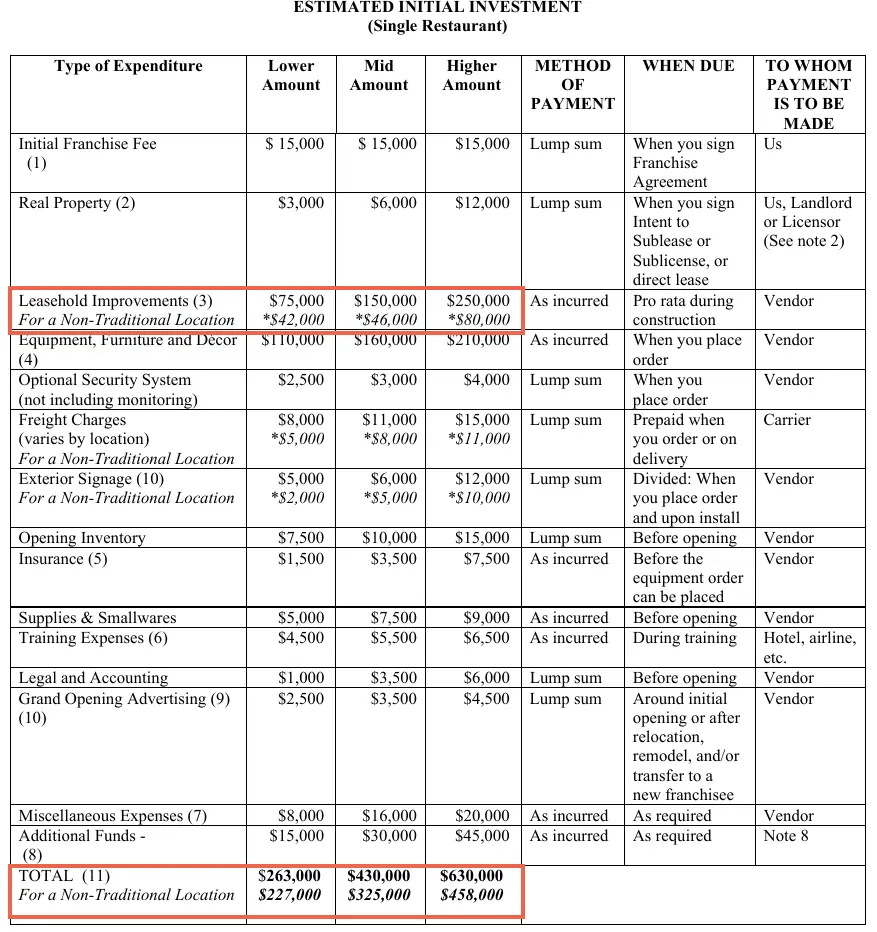
Subway says the typical restaurant measures about 1,375 square feet, with some as small as 300 and others as large as 2,000 square feet (Item 7, Note 2). The new Fresh Forward 2.0 decor and equipment package is required for every new restaurant and relocation (Item 7, Note 3), which is why the decor line cannot be trimmed by choosing an older design.
Leasehold improvements ($75,000 to $250,000) and equipment ($110,000 to $210,000) make up 70.3% to 73.0% of the total. Subway FDD issued April 30, 2026, Item 7.
How does a non-traditional Subway cost less?
Non-traditional locations cost $227,000 to $458,000 because three Item 7 lines shrink: leasehold improvements fall to $42,000 to $80,000, freight to $5,000 to $11,000 and signage to $2,000 to $10,000. Subway lists convenience stores, gas stations, hospitals, universities, airports, military bases and travel plazas as examples (Item 1). Qualified operators of these sites may also pay the $7,500 reduced franchise fee (Item 5).
The 2026 FDD adds a warning: Subway has not yet costed a non-traditional build to the Fresh Forward 2.0 standard and expects it to run higher than the chart shows (Item 7, Note 3). Ask for a site-specific estimate before signing a host-site lease.
Do the Item 7 rows add up to the printed totals?
Not exactly. The 15 traditional rows add to $263,500, $430,500 and $631,500, which is $500 to $1,500 above the printed totals. The non-traditional totals run $2,500 above what the rows produce once the three starred lines are swapped in. The FDD does not explain either gap; the differences are small, but ask Subway which figure its lenders and development staff use.
| Check | Lower | Mid | Higher | Source |
|---|---|---|---|---|
| Sum of the 15 printed traditional rows | $263,500 | $430,500 | $631,500 | Our arithmetic, FDD 2026 Item 7 |
| Printed traditional total | $263,000 | $430,000 | $630,000 | FDD 2026, Item 7 |
| Gap (rows minus total) | $500 | $500 | $1,500 | Our arithmetic |
| Sum of rows with the 3 non-traditional substitutions | $224,500 | $322,500 | $455,500 | Our arithmetic, FDD 2026 Item 7 |
| Printed non-traditional total | $227,000 | $325,000 | $458,000 | FDD 2026, Item 7 |
| Gap (total minus rows) | $2,500 | $2,500 | $2,500 | Our arithmetic |
What changed from the 2025 Subway FDD?
The 2026 estimate is higher at every point. The traditional low rose from $238,625 to $263,000 (+$24,375) and the high from $536,745 to $630,000 (+$93,255), comparing the April 25, 2025 and April 30, 2026 FDDs. Leasehold improvements added $50,000 at the high end. Supplies, opening inventory and miscellaneous lines more than doubled at the top of their ranges.
| Item 7 line | 2025 FDD (low to high) | 2026 FDD (low to high) | Change at the high end | Source |
|---|---|---|---|---|
| Leasehold improvements | $75,000 to $200,000 | $75,000 to $250,000 | +$50,000 | FDD 2025 and 2026, Item 7 |
| Miscellaneous | $4,000 to $8,000 | $8,000 to $20,000 | +$12,000 | FDD 2025 and 2026, Item 7 |
| Opening inventory | $4,400 to $6,050 | $7,500 to $15,000 | +$8,950 | FDD 2025 and 2026, Item 7 |
| Supplies | $500 to $1,300 | $5,000 to $9,000 | +$7,700 | FDD 2025 and 2026, Item 7 |
| Exterior signage | $2,000 to $8,000 | $5,000 to $12,000 | +$4,000 | FDD 2025 and 2026, Item 7 |
| Additional funds (3 months) | $12,000 to $42,000 | $15,000 to $45,000 | +$3,000 | FDD 2025 and 2026, Item 7 |
| Legal and accounting | $1,000 to $3,500 | $1,000 to $6,000 | +$2,500 | FDD 2025 and 2026, Item 7 |
| Training expenses | $2,500 to $4,500 | $4,500 to $6,500 | +$2,000 | FDD 2025 and 2026, Item 7 |
| Equipment, furniture and decor | $106,785 to $208,845 | $110,000 to $210,000 | +$1,155 | FDD 2025 and 2026, Item 7 |
| Total, traditional | $238,625 to $536,745 | $263,000 to $630,000 | +$93,255 | FDD 2025 and 2026, Item 7 |
| Total, non-traditional | $199,135 to $403,745 | $227,000 to $458,000 | +$54,255 | FDD 2025 and 2026, Item 7 |
The traditional estimate rose from $238,625 to $536,745 (2025 FDD) to $263,000 to $630,000 (2026 FDD); the mid estimate from $394,657 to $430,000.
One part of the 2026 FDD was not updated. The multi-unit development totals, $246,123 to $604,245 per restaurant ($206,635 to $471,245 non-traditional), are identical to the 2025 FDD. In 2025 they equalled the single-restaurant estimate minus the $15,000 fee plus the $22,500 to $82,500 development fee. Rebuilt on the 2026 rows, the same formula gives $270,500 to $697,500. A developer should ask Subway in writing which figure applies.
Stale numbers also circulate online. The corrections below compare common claims with the filed documents.
| What some guides say | What the primary source says | Source |
|---|---|---|
| A guide updated in August 2026 says the FDD sets a $65,000 minimum liquid capital | The 2026 FDD states no net worth or liquidity minimum for a standard buyer in Items 5, 7 or 15 | FDD 2026, Items 5, 7, 15 |
| A cost guide titled 2022 (dated November 2024) prints a total of $100,050 to $342,400 | The current total is $263,000 to $630,000 for a traditional restaurant | FDD 2026, Item 7 |
| Several pages quote $199,135 to $536,745 | That pairs the 2025 FDD’s non-traditional low with its traditional high; the 2026 ranges are $227,000 to $458,000 and $263,000 to $630,000 | FDD 2025 and 2026, Item 7 |
| Some pages call the 12.5% a royalty | The royalty is 8%; the other 4.5% is the advertising fee paid into the advertising fund | FDD 2026, Item 6 |
What is the Subway franchise fee, and who pays less?
The standard Subway franchise fee is $15,000, paid in full when you sign the Franchise Agreement and not refundable except in narrow site-approval cases (Item 5). A $7,500 reduced fee applies to existing owners in good standing, honorably discharged U.S. veterans buying a first franchise and qualified non-traditional operators. Buying an existing restaurant by transfer carries no initial fee at all.
| Fee (Item 5) | Amount | Who it applies to | Source |
|---|---|---|---|
| Standard franchise fee | $15,000 | First-time franchisees | FDD 2026, Item 5 |
| Reduced fee | $7,500 | Existing owners in substantial compliance; owners in affiliated Subway systems; honorably discharged U.S. veterans buying a first franchise; qualified non-traditional operators | FDD 2026, Item 5 |
| Add-on owner fee | $3,750 | Adding a new individual owner to a reduced-fee deal (waived for parent, child or spouse) | FDD 2026, Item 5 |
| Satellite franchise fee | $5,000 | Satellite unit tied to a base restaurant; waived in the same facility | FDD 2026, Item 5 |
| Short-term satellite fee | $1,000 | Satellite operating 1 year or less | FDD 2026, Item 5 |
| No initial fee | $0 | School Lunch and Community Development programs; buying an existing restaurant by transfer | FDD 2026, Item 5 |
| Extension fee | $1,000 | One extra year to open after the 12-month deadline | FDD 2026, Item 5 |
Two refund rules matter for timing. If Subway does not approve your location within 90 days of signing, it may cancel the agreement and refund the fee, or refund one half of it in the direct-lease and test-site cases (Item 5). If you miss the 12-month opening deadline, an extension costs $1,000 and requires signing the then-current Franchise Agreement.
What does Subway charge after you open?
After opening, Subway drafts an 8% royalty and a 4.5% advertising fee from gross sales every week, a combined 12.5% (Item 6). Fixed technology charges add about $244.30 to $254.30 a month, or $2,931.60 to $3,051.60 a year, from the $75 technology fee, the $57 POS fee, $90 to $100 in other digital fees and $22.30 in terminal charges. Rent is estimated at $1,000 to $6,000 a month.
| Ongoing fee (Item 6) | Amount | Per $1,000 of gross sales | Source |
|---|---|---|---|
| Royalty | 8% of gross sales, weekly | $80 | FDD 2026, Item 6 |
| Advertising fee | 4.5% of gross sales, weekly | $45 | FDD 2026, Item 6 |
| Sub Club loyalty fee | 1.9% of sales to loyalty members | Up to $19 if every sale is a member sale | FDD 2026, Item 6, Note 15 |
| Restaurant Technology Fee | $75 per month (up to 10% yearly increases) | Fixed | FDD 2026, Item 6 |
| POS hardware as a service (HP) | About $57 per month | Fixed | FDD 2026, Item 6 |
| Other technology and digital initiatives | About $90 to $100 per month, plus one-time $9,300 to $15,750 | Fixed | FDD 2026, Item 6 |
| Payment terminal lease, switching, software | $10 + $10 + $2.30 per month | Fixed | FDD 2026, Item 6 |
| Rent (estimate) | $1,000 to $6,000 per month | Fixed | FDD 2026, Item 6 |
| Insurance (estimate) | $1,000 to $6,000 per year | Fixed | FDD 2026, Item 6 |
| Renewal fee | $3,750 (25% of the fee) | One-time | FDD 2026, Item 6 |
| Transfer fee | $7,500 (50% of the fee) | One-time | FDD 2026, Item 6 |
The percentage fees can be lower in specific cases. Airport, train station and captive travel plaza sites may pay a royalty of 6.5% to 8%, Development Agreement signers 7.5% to 8% royalty and 2% to 3.5% advertising, and some satellites 0.5% to 2% advertising (Item 6, Notes 1 and 2). The fee benchmarks below come from our franchise royalty rate study of 259 FDDs.
| Measure | Subway (2026 FDD) | Median, Minnesota-filed FDDs issued 2025 to 2026 | Source |
|---|---|---|---|
| Initial franchise fee | $15,000 | $49,500 | Minnesota CARDS filings; Subway FDD Item 5 |
| Royalty | 8% | 6% (239 FDDs) | Minnesota CARDS filings; Subway FDD Item 6 |
| Advertising or brand fund | 4.5% | 2% | Minnesota CARDS filings; Subway FDD Item 6 |
| Item 7 total | $263,000 to $630,000 | $265,372 to $573,000 (259 FDDs) | Minnesota CARDS filings; Subway FDD Item 7 |
| Time from signing to opening | 2 to 12 months | 5.9 to 9 months | Minnesota CARDS filings; Subway FDD Item 11 |
| Transfer fee | $7,500 | $10,000 (245 FDDs) | Minnesota CARDS filings; Subway FDD Item 6 |
| Renewal fee | $3,750 | $8,750 | Minnesota CARDS filings; Subway FDD Item 6 |
| Item 19 earnings data | None | Included in 77.2% of 259 FDDs | Minnesota CARDS filings; Subway FDD Item 19 |
| Outlets that left in one year | 6.3% (2025) | 4.7% (220 systems) | Minnesota CARDS filings; Subway FDD Item 20 |
Subway’s 8% royalty sits at the top of the 4% to 8% band that holds 86.2% of percentage royalties in that sample. Its $15,000 fee and $7,500 transfer fee sit below the medians, so the brand front-loads less and collects more weekly.
What costs sit outside the Item 7 total?
At least five costs named in Subway’s own Item 7 notes are not in the $263,000 to $630,000 total. Digital menu boards cost $8,000 to $14,000 to buy, a grease trap can add $10,000 to $15,000 and municipal impact fees run $5,000 to $25,000. Payment terminals add about $731. Key money and extensive exterior renovation are excluded without an estimate (Item 7, Notes 3, 4, 7 and 11).
| Cost outside the Item 7 total | Amount | Where the FDD says so |
|---|---|---|
| Digital menu boards, if bought instead of leased | $8,000 to $14,000 (or $155 per month leased) | FDD 2026, Item 7, Note 4 |
| P400 payment terminal, kit and barcode reader | $237.70 + $323.30 + $170 ($180 with a drive thru) | FDD 2026, Item 7, Note 4 |
| Grease trap, if local law requires one | $10,000 to $15,000 added to leasehold | FDD 2026, Item 7, Note 3 |
| Municipal impact fees | $5,000 to $25,000 | FDD 2026, Item 7, Note 7 |
| Nevada licensed architect | $1,500 to $3,000 | FDD 2026, Item 7, Note 7 |
| Key money to a landlord and extensive exterior work | Not estimated | FDD 2026, Item 7, Note 11 |
| Drive-thru or non-traditional Fresh Forward 2.0 build | Not estimated yet; drive thru may be substantially higher | FDD 2026, Item 7, Note 3 |
| Royalty, advertising, food cost and owner’s draw in the first 3 months | Excluded from Additional Funds | FDD 2026, Item 7, Note 8 |
Item 8 explains where much of the operating spend goes. Required purchases from approved suppliers make up about 66.5% to 100% of what you buy to open and 29.5% to 37.5% of annual operating costs. In 2025, supplier contributions to Subway totalled $136,510,121, about 14.75% of the franchisor’s $925,217,000 revenue (Item 8).
How much cash do you need to open a Subway?
For a financed new build, plan on at least $26,373 to $68,474 in cash equity once out-of-table costs are added. That is 10% of an adjusted project cost of $263,731 to $684,741, the floor SBA SOP 50 10 8.1 sets for start-up 7(a) loans from October 1, 2026. Subway itself collects $18,000 to $27,000 before opening (cover page).
| Line | Low-cost traditional | High-cost traditional | Source |
|---|---|---|---|
| Item 7 printed total | $263,000 | $630,000 | FDD 2026, Item 7 |
| Payment terminal, kit and barcode reader | $731 | $741 | FDD 2026, Item 7, Note 4 |
| Digital menu boards bought outright | $0 (leased) | $14,000 | FDD 2026, Item 7, Note 4 |
| Grease trap | $0 (not required) | $15,000 | FDD 2026, Item 7, Note 3 |
| Impact fees | $0 (none assessed) | $25,000 | FDD 2026, Item 7, Note 7 |
| Adjusted project cost | $263,731 | $684,741 | Our arithmetic |
| Minimum 10% equity injection for a start-up SBA 7(a) loan | $26,373 | $68,474 | SBA SOP 50 10 8.1 |
| Paid to Subway or its affiliate before opening | $18,000 | $27,000 | FDD 2026, cover page |
The 2026 FDD sets no liquid-capital or net-worth minimum for a standard buyer in Items 5, 7 or 15. Ask Subway’s Franchise Development Team (800-888-4848) in writing for its current financial qualification criteria before you sign or pay the $15,000 fee. Our guide to franchise costs explains how net worth and liquidity tests usually work.
The three-month Additional Funds line of $15,000 to $45,000 covers payroll but excludes royalty, advertising, food cost and any owner’s draw (Item 7, Note 8). A lender reviewing your plan will usually test those separately.
Does Subway finance franchisees?
Subway offers limited direct financing. Item 10 lists negotiable loans from Doctor’s Associates LLC, a 1% fee on any third-party loan Subway guarantees, a 3-year oven lease through Huntington Technology Finance and the $57 monthly HP POS program. Most buyers use bank or SBA loans: the SBA 7(a) FOIA file shows 376 Subway-coded 7(a) approvals from fiscal 2020 to June 30, 2026.
Of those 376 approvals, 54 were later cancelled. The other 322 had a median gross approval of $212,500; 113 financed a change of ownership and 31 a start-up (SBA FOIA, data as of June 30, 2026). Our SBA franchise loan report compares Subway with other brands.
Can you buy an existing Subway for less?
Yes, and many buyers do. Subway restaurants changed hands 1,307 times in 2025, 1,416 times in 2024 and 1,764 times in 2023 (Item 20, Table 2). In 2025 Subway itself sold 148 restaurants at prices from $1 to $56,500, and its affiliates sold 32 for $1 to $160,000 (Item 5, Note 4). A resale carries no initial franchise fee, but the transfer fee is $7,500.
A low purchase price is not the full cost. Subway’s Note 4 says those prices may cover only existing physical assets, that you may need to buy required equipment and bring the store up to the Operations Manual, and that some incentives went to restaurants Subway considered below-average performers. Budget the Fresh Forward 2.0 remodel, which existing restaurants must complete on Subway’s timetable (Item 7, Note 3). Our franchise resale index compares the share of SBA loans that financed a change of ownership across franchise brands.
How fast is the Subway system shrinking?
Subway’s U.S. system lost 1,803 outlets in three years, from 20,576 at the start of 2023 to 18,773 at the end of 2025 (Item 20, Table 1). In 2025, 1,224 outlets left through termination, non-renewal, reacquisition or closure, 6.3% of the 19,502 open at the start of the year. Subway notes that 148 reacquired outlets were resold within one or two days.
| Year | Outlets at start | Opened | Terminated | Not renewed | Reacquired | Ceased, other reasons | Outlets at end | Transfers | Source |
|---|---|---|---|---|---|---|---|---|---|
| 2023 | 20,576 | 455 | 3 | 19 | 98 | 733 | 20,133 | 1,764 | FDD 2026, Item 20 |
| 2024 | 20,133 | 453 | 4 | 30 | 90 | 881 | 19,502 | 1,416 | FDD 2026, Item 20 |
| 2025 | 19,502 | 499 | 4 | 46 | 148 | 1,026 | 18,773 | 1,307 | FDD 2026, Item 20 |
Subway’s U.S. outlet count fell by 443, 631 and 729 in 2023, 2024 and 2025, to 18,773. Subway FDD issued April 30, 2026, Item 20, Table 1.
Our franchise closure rate index puts the median one-year exit rate at 4.7% across 220 systems. Of the 499 Subway openings reported for 2025, about 56% were reopenings of previously closed stores, and 93 signed agreements had not yet opened at year end (Item 20, Tables 3 and 5). Franchisor royalties fell from $847,962,000 in 2023 to $760,610,000 in 2025, down 10.3% (Item 21, Exhibit C).
What do the other FDD items add to the cost picture?
Five other items change what the money buys. The term is 20 years with a 20-year renewal at $3,750 (Item 17). There is no exclusive territory and no radius restriction (Item 12). Opening typically takes 2 to 12 months (Item 11). An owner or trained full-time manager must supervise on site (Item 15), and Item 19 contains no earnings data.
- Sign the Franchise Agreement: pay the $15,000 fee in full (Item 5).
- Sign the Intent to Sublease: pay 2 months of rent as deposit, $3,000 to $12,000; under a sublease, a Subway leasing affiliate holds the master lease and each owner guarantees the sublease (Items 7 and 10).
- Bind insurance before the equipment order: $1,500 to $7,500, including $2,000,000 per occurrence general liability (Item 7, Note 5).
- Attend training: no fee for 2 people, $1,500 for each additional person, plus $4,500 to $6,500 in travel and wages (Items 6 and 7).
- Build out and order equipment: leasehold $75,000 to $250,000 plus equipment $110,000 to $210,000 (Item 7).
- Open: typically 2 to 12 months after signing, and within 12 months unless you buy a $1,000 extension (Items 5 and 11).
- Grand opening sale 4 to 8 weeks after opening: $2,500 to $4,500 budgeted; Subway recommends at least $2,000 (Item 7, Note 9).
- Every week from opening: royalty 8% plus advertising 4.5% of gross sales, drafted weekly (Item 6).
Subway’s 2 to 12 month window compares with a 5.9 to 9 month median in our study of franchise opening times. Because Item 19 is empty, ask current and former franchisees listed in Exhibit B about sales and costs; Item 20 warns that some signed confidentiality clauses. Our Item 19 analysis explains what that section normally contains.
Which Subway route fits your situation?
Match the route to the asset you already control. A host site points to a non-traditional unit at $227,000 to $458,000; an operating store points to a resale with no initial fee and a $7,500 transfer fee; 2 to 10 planned units point to a Development Agreement with a $22,500 to $82,500 fee. Everyone else is pricing a traditional unit at $263,000 to $630,000.
| If your situation is | Then the likely Subway route is | Budget line to test first | Source |
|---|---|---|---|
| You control a convenience store, campus, hospital or travel plaza site | Non-traditional franchise; ask whether you qualify for the $7,500 fee | $227,000 to $458,000 Item 7 range | FDD 2026, Items 5 and 7 |
| You have about $26,000 to $69,000 in cash for equity and want a new build | Traditional single restaurant with SBA 7(a) financing | Leasehold $75,000 to $250,000; get 3 contractor bids | FDD 2026, Item 7; SBA SOP 50 10 8.1 |
| You want an operating store and its existing staff | Resale through a transfer; no initial fee | $7,500 transfer fee plus any Fresh Forward 2.0 remodel | FDD 2026, Items 5, 6 and 7 |
| You plan 2 to 10 restaurants | Development Agreement | Development fee $22,500 to $82,500; ask for 2026 per-unit totals | FDD 2026, Items 5, 6 and 7 |
| You are an honorably discharged U.S. veteran buying a first franchise | Any new-unit route at the reduced fee | $7,500 instead of $15,000 | FDD 2026, Item 5 |
| You need a protected trade area | Subway grants none; check nearby units in Exhibit B first | No radius restriction | FDD 2026, Item 12 |
If you are comparing Subway with other sandwich or quick-service brands at the same $263,000 to $630,000 budget, a franchise consultant can line up several FDDs and their 23 items side by side; our page on what a franchise consultant does explains how they are paid. This page is general information from public filings, not legal, financial or investment advice; have a franchise lawyer and an accountant review the FDD and your lease.
How we compiled this
We read 2 Subway FDDs filed in Minnesota (issued April 25, 2025 and April 30, 2026), copied the figures in Items 5 to 21 as printed and recomputed the Item 7 sums. We added the SBA 7(a) FOIA file (data as of June 30, 2026) and medians from our study of 259 Minnesota-filed FDDs, all accessed in October 2026. We excluded every sales and profit estimate by design.
Frequently asked questions
Is Subway a franchise?
Yes. Subway restaurants in the United States are operated by franchisees under agreements with Doctor’s Associates LLC. Item 20 of the 2026 FDD lists 18,773 U.S. outlets at the end of 2025 and zero company-owned outlets. Since April 30, 2024, the franchisor’s parent has been owned by funds managed by Roark Capital, according to Item 1 of the same FDD.
How much does a Subway franchise owner make?
Subway does not say. Its 2026 FDD has no Item 19 financial performance representation, so there are no official sales or profit figures. Owner income depends on sales minus the 8% royalty, the 4.5% advertising fee, rent of an estimated $1,000 to $6,000 a month, labor and food cost. Ask current and former franchisees listed in Exhibit B for their numbers.
How much is the Subway franchise fee?
The standard fee is $15,000, paid in full when you sign the Franchise Agreement (Item 5, 2026 FDD). Existing owners in good standing, honorably discharged U.S. veterans buying a first franchise and qualified non-traditional operators pay $7,500. Satellite units cost $5,000, and buying an existing restaurant by transfer carries no initial fee, though the transfer fee is $7,500.
Can you buy a Subway franchise for sale for less than a new build?
Often, yes. In 2025 Subway sold 148 restaurants for $1 to $56,500 and its affiliates sold 32 for $1 to $160,000 (Item 5, Note 4). Independent resales also happen: 1,307 transfers were recorded in 2025. Add the $7,500 transfer fee, any required equipment, and the cost of a Fresh Forward 2.0 remodel before comparing with the $263,000 new-build low.
What are the Subway franchise requirements?
The 2026 FDD requires you or a trained full-time Designated Manager to supervise on site, completion of the New Franchisee Onboard Training Program, a personal guaranty from principal owners and opening within 12 months (Items 5, 11 and 15). It sets no liquid-capital or net-worth minimum, so ask Subway in writing for its current financial qualification criteria.
How long does it take to open a Subway restaurant?
Subway estimates 2 to 12 months from signing the Franchise Agreement to opening (Item 11, 2026 FDD). Site approval, lease and permit timing, equipment delivery and weather drive the spread. The standard agreement gives you 12 months to open; a single one-year extension costs $1,000 and requires signing the then-current Franchise Agreement (Item 5).
Sources
- Subway Franchise Disclosure Document, issued April 30, 2026 (amended June 15, 2026), Doctor’s Associates LLC, Minnesota CARDS document 36389-202604-19. Accessed 2026-10-20.
- Subway Franchise Disclosure Document, issued April 25, 2025, Minnesota CARDS document 34006-202504-06. Accessed 2026-10-20.
- 16 CFR 436.5, Franchise Rule disclosure items, eCFR. Accessed 2026-10-20.
- SBA 7(a) and 504 FOIA loan data, U.S. Small Business Administration, data as of June 30, 2026. Accessed 2026-10-20.
- SOP 50 10: Lender and Development Company Loan Programs, U.S. Small Business Administration. Accessed 2026-10-20.
- Minnesota CARDS franchise registrations, Minnesota Department of Commerce. Accessed 2026-10-20.