A Taco Bell franchise cost runs $1,859,750 to $4,312,200 for a new freestanding Traditional Unit and $934,750 to $1,817,200 for an In-Line or End-Cap, per Item 7 of the FDD issued March 26, 2026.
Key takeaways
- The initial franchise fee is $45,000 for a Traditional Unit and $25,000 for an In-Line or End-Cap; fees actually paid in fiscal 2025 ranged from $0 to $45,000 per Unit (Item 5, Taco Bell Franchise Disclosure Document, issued March 26, 2026).
- Two Item 7 lines carry most of the Traditional range: building and site construction at $1,000,000 to $2,000,000 and owned land at $250,000 to $1,400,000. The build lines are priced for the Dallas, Texas market (Item 7, notes ** and F).
- The Traditional estimate rose $275,000 at the low end and $332,000 at the high end between the 2024 Taco Bell FDD (issued March 26, 2024) and the 2026 filing.
- Ongoing charges start at a 5.5% period franchise fee plus a 4.25% period marketing fee on Gross Sales, plus up to $6,000 a year in franchisor technology fees and up to $15,500 a year to third-party tech vendors (Items 6 and 11).
- The 2026 FDD prints no franchisee net worth or liquid-capital minimum; the only net worth figure in it is the franchisor’s own $15 million covenant (Exhibit J).
- Taco Bell reacquired 144 franchised restaurants in 2025, and franchised units fell from 7,341 to 7,335 while company-owned units rose from 498 to 663 (Item 20, Table Nos. 1 and 3).
Why does a freestanding Taco Bell cost about twice an In-Line one?
A freestanding Traditional Unit needs land and a full building, while an In-Line or End-Cap sits in leased space. The 2026 FDD therefore prints three separate cost tables: $1,859,750 to $4,312,200 for a Traditional Unit, $934,750 to $1,817,200 for an In-Line or End-Cap, and $175,000 to $1,800,000 or more, excluding real property, for an existing Unit bought from Taco Bell or an affiliate.
| Format | Item 7 total | Initial fee | Franchise term | Real property basis |
|---|---|---|---|---|
| Traditional Unit (freestanding, often drive-thru) | $1,859,750 to $4,312,200 | $45,000 | 25 years | Purchased site, $250,000 to $1,400,000 |
| In-Line (End-Cap if it has a drive-thru) | $934,750 to $1,817,200 | $25,000 | 10 years | Leased site, $45,000 to $150,000 |
| Existing Unit from Taco Bell or an affiliate | $175,000 to $1,800,000 or more | $45,000 Traditional, $25,000 In-Line | Lease length, a shorter term, or the standard term | Excluded; leasehold priced separately |
Terms and fees come from Items 1, 5 and 7 of the Taco Bell Franchise Disclosure Document, issued March 26, 2026. Taco Bell Express Units are licensed under a separate disclosure document, so their costs do not appear in these three tables. Before signing, the FTC Franchise Rule requires delivery of the FDD at least 14 calendar days ahead, as the FTC Consumer’s Guide to Buying a Franchise explains.
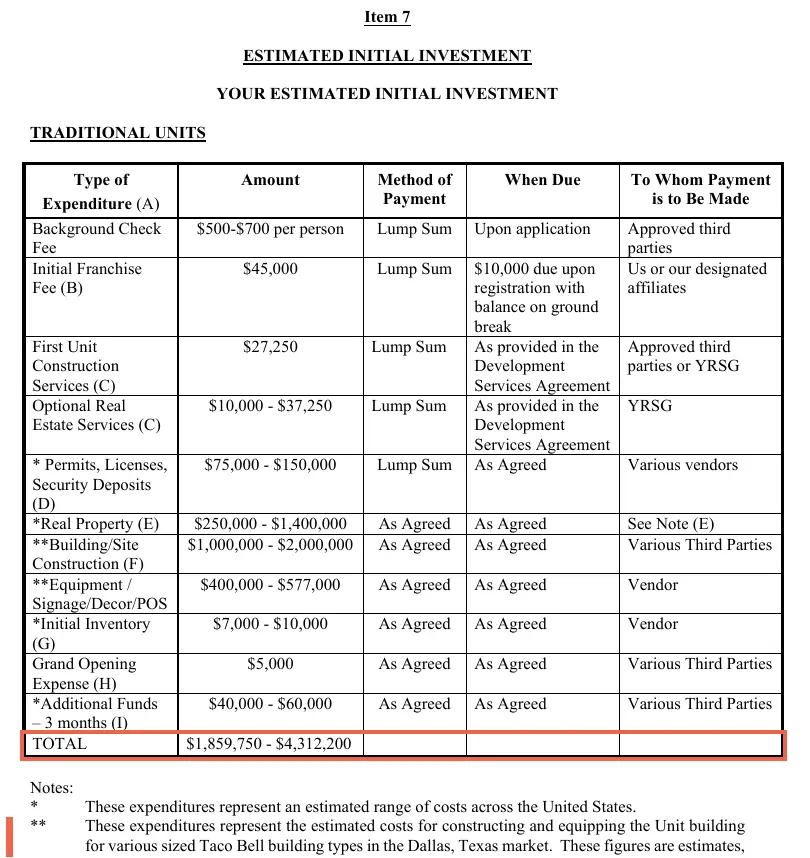
Which Item 7 lines drive the Traditional range, and do the totals add up?
Building and site construction ($1,000,000 to $2,000,000) and equipment, signage, decor and POS ($400,000 to $577,000) make up 75.3% of the Traditional low estimate and 59.8% of the high estimate. Both lines are estimated for the Dallas, Texas market, so a buyer in a higher-cost metro should price them locally rather than read the Dallas range as national.
| Item 7 line (Traditional) | Low | High | Paid to | Source |
|---|---|---|---|---|
| Background check | $500 per person | $700 per person | Approved third parties | Item 7 |
| Initial franchise fee | $45,000 | $45,000 | Taco Bell or designated affiliates | Items 5, 7 |
| First Unit construction services | $27,250 | $27,250 | Approved third parties or YRSG | Item 7 note C |
| Optional real estate services | $10,000 | $37,250 | YRSG | Item 7 note C |
| Permits, licenses, security deposits | $75,000 | $150,000 | Various vendors | Item 7 note D |
| Real property (purchased site) | $250,000 | $1,400,000 | See note E | Item 7 note E |
| Building/site construction (Dallas basis) | $1,000,000 | $2,000,000 | Various third parties | Item 7 note F |
| Equipment, signage, decor, POS (Dallas basis) | $400,000 | $577,000 | Vendor | Item 7 |
| Initial inventory (first week) | $7,000 | $10,000 | Vendor | Item 7 note G |
| Grand opening expense | $5,000 | $5,000 | Various third parties | Item 7 note H |
| Additional funds, 3 months | $40,000 | $60,000 | Various third parties | Item 7 note I |
| Printed total | $1,859,750 | $4,312,200 | Item 7 |
Building and site construction ($1,000,000 to $2,000,000) and owned land ($250,000 to $1,400,000) are the widest Traditional Unit lines. Taco Bell FDD issued March 26, 2026, Item 7.
Arithmetic checks of the printed totals
We added every Item 7 line in the 2024, 2025 and 2026 Traditional and In-Line tables, counting the background check once at $500 and $700. Eleven of the twelve printed low and high totals match their lines; the 2024 Traditional low does not.
| Check | What the FDD prints | What the lines add to | Result |
|---|---|---|---|
| 2026 Traditional, low and high | $1,859,750 to $4,312,200 | $1,859,750 to $4,312,200 | Matches |
| 2026 In-Line or End-Cap | $934,750 to $1,817,200 | $934,750 to $1,817,200 | Matches |
| 2025 Traditional and In-Line | $1,859,750 to $4,310,200; $934,750 to $1,815,200 | Same | Matches |
| 2024 Traditional, low | $1,584,750 | $1,583,750 | $1,000 above its lines |
| 2024 In-Line, low and high | $610,750 to $1,440,200 | $610,750 to $1,440,200 | Matches |
| 2026 optional real estate services | Note C: services cost $10,000 | Table range $10,000 to $37,250 | No printed reason for the $37,250 top |
| 2026 Item 7 note B | Refers to the National Incentive Program in “Exhibit D” | Exhibit D is the Release; the program is in Exhibit O | Cross-reference error |
Two subtractions help compare formats. Without the real property line, the 2026 Traditional estimate is $1,609,750 to $2,912,200 and the In-Line estimate is $889,750 to $1,667,200. A Traditional site can also be ground-leased instead of bought: note E puts base rent at $45,000 to $200,000 or more per year, before taxes, insurance and percentage rent.
How did Taco Bell’s Item 7 move across the 2024, 2025 and 2026 filings?
Most of the increase arrived in one step. Between the 2024 Taco Bell FDD (issued March 26, 2024) and the 2025 Taco Bell FDD (issued March 26, 2025), the Traditional building and site line rose from $750,000 to $1,700,000 to $1,000,000 to $2,000,000, and the In-Line building line rose from $177,000 to $650,000 to $450,000 to $900,000. The 2026 filing changed only the equipment line, by $2,000 at the top.
| Filing | Traditional total | In-Line or End-Cap total | Lines that changed vs prior year |
|---|---|---|---|
| 2024 (March 26, 2024) | $1,584,750 to $3,980,200 | $610,750 to $1,440,200 | Baseline |
| 2025 (March 26, 2025) | $1,859,750 to $4,310,200 | $934,750 to $1,815,200 | Permits to $75,000 to $150,000; Traditional equipment to $400,000 to $575,000; In-Line equipment to $250,000 to $450,000; In-Line real property to $45,000 to $150,000 |
| 2026 (March 26, 2026) | $1,859,750 to $4,312,200 | $934,750 to $1,817,200 | Equipment tops: $577,000 Traditional, $452,000 In-Line |
| Change 2024 to 2026 | +$275,000 low, +$332,000 high | +$324,000 low, +$377,000 high | Fee, inventory, opening and 3-month funds unchanged |
The Traditional estimate moved from $1,584,750 to $3,980,200 (2024 FDD) to $1,859,750 to $4,312,200 (2026 FDD); nearly all of the change came in the 2025 filing. Taco Bell FDDs, Item 7, accessed October 20, 2026.
Who can register a Taco Bell site, and what is paid before ground break?
Item 5 says site registration happens on MYTACOBELL, a website made available after Taco Bell approves you as eligible to become a franchisee, with a $10,000 deposit toward the fee. Item 1 adds growth-eligibility policies that look at development history, operating history and financial health, and limits purchases from Taco Bell or a selling franchisee to no more than 250 Units per franchisee and related parties, excluding restaurants they built themselves.
| Stage | What is due | Amount | FDD reference |
|---|---|---|---|
| Application | Background check | $500 to $700 per person | Item 7 |
| Eligibility approval | MYTACOBELL site registration opens to you | None printed | Item 5 III |
| Site registration | Fee deposit; 18 to 24 month clock starts | $10,000 | Items 5, 11 |
| Before site submission (first Unit, if required) | Development Services Agreement with YRSG, plus ADA inspection | $25,000 plus $2,250 | Item 5 V |
| Site decision | Approval or rejection | 30 to 60 days after a complete site package | Item 11 |
| 6+ months before ground break | Site sketch, plans and elevations to brand designer | Included in permits line | Item 11 |
| Ground break | Fee balance | $35,000 Traditional, $15,000 In-Line | Item 5 III |
| Training | You and one manager; 7 to 8 weeks, ending 4 to 6 weeks before opening | $350 per extra trainee | Item 11 |
| Opening | About 18 to 24 months after the deposit | 3-month funds $40,000 to $60,000 | Items 7, 11 |
| First 6 months open | Grand opening spend; proofs within 9 months | $5,000, reimbursed up to $5,000 | Item 6 |
The 18 to 24 month estimate in Item 11 is roughly double the 5.9 to 9 month median across 259 recent FDDs that we read for our franchise opening-time study. A grand opening reimbursement is not paid when the initial fee was waived under an incentive, although the $5,000 spend is still required (Item 6, note B(i)).
What Item 15 asks of the owner
Item 15 requires full time, best efforts and constant personal attention from you, or from an employee supervisor Taco Bell authorizes who has finished the 7 to 8 week training. You or a qualified manager must live within approximately one hour’s drive of the Unit, and every equity holder signs a personal guaranty, except a spouse whose interest arises only from marriage.
What do the 5.5% period franchise fee and 4.25% NAFA fee sit beside?
Taco Bell calls its royalty the period franchise fee, 5.5% of Gross Sales, and its ad fund charge the period marketing fee, 4.25% of Gross Sales paid to the Taco Bell National Advertising Fund Administration (NAFA). Together they are 9.75% of Gross Sales before the fixed charges below, which Items 6 and 11 print as flat amounts or caps.
| Charge | Amount as printed | When | Source |
|---|---|---|---|
| Period franchise fee | 5.5% of the Unit’s Gross Sales | 5th business day after each accounting period | Item 6 |
| Period marketing fee (NAFA) | 4.25% of the Unit’s Gross Sales | 5th business day after each accounting period | Items 6, 11 |
| All Access Fee | $750/year | As billed | Item 6 |
| Digital transaction fee (mobile, web, kiosk, voice AI, delivery) | $0.19 per digital transaction | As billed | Item 6 |
| Gift card transaction fee | $.19 per gift card transaction | As billed | Item 6 |
| System-One Merchandising Program | $729.25 to $744 per quarter per restaurant | As billed | Item 6 |
| Technology fees to Taco Bell or affiliates | Up to $6,000 per restaurant per year | As billed | Item 11 |
| Technology fees to third-party vendors | Up to $15,500 per year; up to $83,000 one-time | As billed | Item 11 |
| Successor fee (Traditional) | Greater of $22,500 or half the then-current initial fee, plus an offset, scrape/rebuild or major remodel | On successor agreement | Item 6 |
| Liquidated damages on certain terminations | Greater of 11% of Gross Sales for the last 12 months or $100,000 | On termination | Item 6 |
Four quarters of the System-One program come to $2,917 to $2,976 a year. Item 8 adds that required purchases are about 40% to 70% of the cost to establish a Unit and about 40% of operating expenses, and Pepsi products are required, subject to certain exceptions, while Coca-Cola beverages are not approved. Mid-term upgrades are required, but Item 6 says “We do not estimate the costs of these upgrades.”
Taco Bell next to 259 other FDDs
Against medians from 259 franchise disclosure documents filed with the Minnesota Department of Commerce in 2025 and 2026, Taco Bell’s 5.5% royalty sits below the 6% midpoint while its 4.25% ad fund is about twice the 2% median. Taco Bell is not in that sample, so each row places one filing beside a cross-brand midpoint rather than ranking it.
| Measure | Taco Bell (2026 FDD) | Median in 259 Minnesota-filed FDDs, 2025 to 2026 | Source |
|---|---|---|---|
| Initial franchise fee | $45,000 (Traditional) | $49,500 | Item 5; our royalty and fee study |
| Royalty | 5.5% of Gross Sales | 6% of sales (239 FDDs) | Item 6; royalty and fee study |
| Brand or ad fund | 4.25% of Gross Sales | 2% | Item 6; royalty and fee study |
| Item 7 high estimate | $4,312,200 | $573,000 | Item 7; our initial investment study |
| Time to open | About 18 to 24 months | 5.9 to 9 months | Item 11; opening-time study |
| Transfer fee | $7,500 per transfer (1 to 5 units) | $10,000 (245 FDDs) | Item 6; our transfer fee study |
| Technology, one-time | Up to $83,000 | $3,100 to $5,925 | Item 11; our technology study |
The medians come from the Item 5, 6, 7 and 11 tables of those 259 filings. How each fee category works across brands is explained in our guide to franchise costs.
What does buying existing Taco Bells add through the Market Build Out Agreement?
Existing restaurants sold by Taco Bell or an affiliate cost $175,000 to $1,800,000 or more, excluding real property, are priced on a multiple of cash flow, and multi-unit sales are priced as a group rather than per restaurant. Item 5 sets the Asset Purchase Agreement deposit at generally 2% of the purchase price, and Item 12 says the buyer may also have to sign a Market Build Out Agreement to build new Units.
| Obligation | Amount or term as printed | Source |
|---|---|---|
| Asset Purchase Agreement deposit | Generally 2% of the purchase price; refundable only in situations the APA lists | Items 5, 7; Exhibit L |
| Market Build Out development fee | $45,000 per new Unit, $10,000 at registration and the balance at groundbreak | Item 12 |
| Missed opening date | $45,000 within 5 days, then $4,231 per four or five week accounting period until opening or 10 years | Items 6, 12 |
| Market Build Out term | Standard term of five (5) years | Item 12 |
| Impact protection | Buyer may have to waive it for the full term | Item 12 |
| Relationship Agreement legal fees | Taco Bell’s estimate: $20,000 to $100,000, possibly higher | Item 6 |
| Real estate sublease from Taco Bell | $1,331.00 to $20,833.00 per month, one to thirty years | Item 10 |
| Transfer between franchisees | $7,500 per transfer for 1 to 5 units; $1,500 per unit for 6 or more | Item 6 |
Item 12 grants no exclusive territory. Existing franchisees accepted into the 10K Trade Areas program pay a $10,000 Trade Area Fee that is applied to the initial fee for a Unit they commit to open there (Item 5 I). Across 259 filings, protected areas are far more common than at Taco Bell, as our territory rights study shows. Multi-unit commitment terms elsewhere are compared in our area development agreement study.
Is there a Taco Bell net worth requirement?
The 2026 FDD prints no net worth or liquid-capital minimum for franchisees. Its only net worth figure is a $15 million minimum the franchisor itself keeps to qualify for the large franchisor exemption in certain state registration laws, against $59.7 million of member’s equity (Exhibit J). Item 1 instead describes eligibility policies on development history, operations and financial health that Taco Bell may change.
| What a published guide says | What the 2026 FDD prints | FDD item |
|---|---|---|
| A franchise publication’s guide (November 2021): net worth of about $1.5 million and liquidity of about $750,000 | No franchisee net worth or liquidity figure | Items 1, 5; Exhibit J |
| A food-industry blog (updated February 2024): $5 million net worth and $2,000,000 liquid capital | No franchisee net worth or liquidity figure | Items 1, 5; Exhibit J |
| Same 2021 guide: standalone cost of $1.2 million to $2.6 million aside from land | $1,609,750 to $2,912,200 for a Traditional Unit without the real property line | Item 7 |
| Same 2021 guide: franchise fees of $25,000 to $50,000 | $25,000 or $45,000; no $50,000 fee | Item 5 |
| Same 2024 blog: mid-term upgrade of $168,000 | “We do not estimate the costs of these upgrades” | Item 6 note B(iii) |
| A franchise listing site using the 2024 FDD: $1,584,750 to $3,980,200 | $1,859,750 to $4,312,200 in the current filing | Item 7 |
Lenders set their own cash tests. Item 10 names one: Yum! Brands arranged lending through LS BDC Adviser, LLC, an affiliate of Lafayette Square, and YUM may guaranty up to 33% of a referred franchisee’s loan, capped at $5,000,000. This page is information, not legal, tax or financial advice.
What did 144 reacquired restaurants do to Taco Bell’s 2025 unit count?
Franchised Units fell from 7,341 to 7,335 in 2025 even though franchisees opened 168, because Taco Bell reacquired 144, 21 ceased operations, 8 were not renewed and 1 was terminated. Company-owned Units rose from 498 to 663, and 125 of the 144 reacquisitions were in Florida (102) and Georgia (23), per Item 20, Table No. 3.
| Item 20 measure | 2023 | 2024 | 2025 |
|---|---|---|---|
| Franchised Units at year end | 7,198 | 7,341 | 7,335 |
| Company-owned Units at year end | 483 | 498 | 663 |
| Franchised Units opened | 164 | 183 | 168 |
| Reacquired by franchisor | 0 | 7 | 144 |
| Ceased operations | 13 | 27 | 21 |
| Transfers between owners | 197 | 39 | 134 |
In 2025, 168 franchised Taco Bell Units opened while 144 were reacquired by the franchisor, 21 ceased operations, 8 were not renewed and 1 was terminated. Taco Bell FDD issued March 26, 2026, Item 20, Table No. 3.
Table No. 1 prints a system total of 7,847 at the end of 2024 but 7,839 at the start of 2025; the franchised and company-owned rows sum to 7,839. Table No. 5 projects 184 new franchised and 25 new company-owned Units in the next fiscal year, with 0 signed agreements for unopened Units.
Item 19 does not publish historical unit results. It describes three site forecast tools, Bell Point, Kalibrate and SiteZeus, with their back-tested error, and says written substantiation is available on reasonable request. Under 16 CFR 436.5(s), franchisors choose whether to include such data, and our Item 19 study shows how other filings use it. Item 21 holds KPMG LLP-audited statements for Taco Bell Franchisor, LLC showing $793,350 thousand of total revenues in fiscal 2025, mostly franchise and license fees.
Which Taco Bell format or incentive matches your position?
The decision turns on three FDD facts: whether Taco Bell has approved you as eligible, whether you can fund an Item 7 low estimate of $934,750 or $1,859,750 before financing, and whether a site qualifies for an Exhibit O incentive that opens by December 29, 2026. Each row below points to the item that governs it.
| If | Then | FDD basis |
|---|---|---|
| You are not yet approved as eligible | You cannot register a site on MYTACOBELL; the first step is the eligibility review | Item 5 III; Item 1 |
| Cash plus committed financing is below $934,750 | A new In-Line falls short of its Item 7 low estimate; an existing Unit starts at $175,000 excluding real property | Item 7 |
| You will build a freestanding drive-thru Unit that opens by December 29, 2026 | The National Incentive Program may waive the $45,000 fee and 1 to 4 years of marketing fees, by portfolio tier | Exhibit O |
| Your In-Line site has at least 20,000 people within 0.5 mile | The Urban Test Incentive may waive the $25,000 fee, cut the 5.5% fee to 2.75% for year one and waive marketing fees for 2 years | Exhibit O; Item 6 note B(ii) |
| You are buying existing Units | Budget the 2% APA deposit and check whether a Market Build Out Agreement adds $45,000 per new Unit | Items 5, 12 |
| You want a protected trade area | The franchise agreement grants none; ask about the Integrated Expansion Policy and 10K Trade Areas | Item 12; Exhibit P |
| You plan to own without managing | Item 15 requires you or an approved, trained supervisor full time, living within about one hour | Item 15 |
A consultant who works with multi-unit restaurant buyers can help assemble the Item 7 budget and lender package; what that role covers is set out in our guide to buying a franchise.
How we compiled this
We read the Taco Bell Traditional Unit FDDs issued March 26 of 2024, 2025 and 2026 from Minnesota CARDS, retyped every Item 7 line and re-added each printed total. Fees, timing and unit counts come from 12 items plus Exhibits J and O of the 2026 filing. We excluded all Item 19 figures under this site’s no-earnings rule, checked three ranking third-party guides, and accessed everything on October 20, 2026.
Frequently asked questions
Is Taco Bell a franchise?
Yes. Taco Bell Franchisor, LLC, a Yum! Brands subsidiary, franchises the brand in the United States. Item 20 of the March 26, 2026 FDD counts 7,335 franchised and 663 company-owned Units at the end of 2025, so about 91.7% of the 7,998 Units in that offering’s Item 20 tables were franchised.
How much is the Taco Bell franchise fee?
Item 5 of the 2026 FDD sets the initial franchise fee at $45,000 for a new Traditional Unit and $25,000 for an In-Line or End-Cap. You pay a $10,000 deposit when you register the site and the balance at ground break. Fees actually paid in fiscal 2025 ranged from $0 to $45,000 per Unit because of incentive waivers.
How much does it cost to buy an existing Taco Bell?
Item 7 prices an existing Unit bought from Taco Bell or an affiliate at $175,000 to $1,800,000 or more, excluding real property, including the $45,000 or $25,000 fee. Prices follow a multiple of cash flow, the deposit is generally 2%, and the buyer may have to sign a Market Build Out Agreement to develop new Units.
How much does a Taco Bell owner make?
This site does not publish earnings figures. What an owner keeps depends on sales against the 5.5% period franchise fee and 4.25% marketing fee, rent, labor and technology charges in Items 6 and 11. Item 19 of the 2026 FDD describes site forecast tools rather than historical results, so ask Taco Bell for its written substantiation and call owners listed in Exhibit I.
How long does it take to open a Taco Bell?
Item 11 of the 2026 FDD estimates approximately 18 to 24 months from paying the $10,000 deposit at site registration to opening. Site approval takes 30 to 60 days after a complete package, plans go to the brand designer at least six months before ground break, and training of 7 to 8 weeks should end 4 to 6 weeks before opening.
Does Taco Bell help with financing?
Item 10 says Taco Bell does not finance the initial investment directly. Yum! Brands refers qualified applicants to LS BDC Adviser, LLC, a Lafayette Square affiliate, which underwrites its own loans, and YUM may guaranty up to 33% of the loan principal, capped at $5,000,000. Taco Bell may also lease or sublease existing restaurants at $1,331.00 to $20,833.00 per month.
Sources
- Taco Bell Franchise Disclosure Document, issued March 26, 2026, Items 1 to 21 and Exhibits J and O. Minnesota Department of Commerce CARDS. Accessed October 20, 2026.
- 2025 Taco Bell FDD (issued March 26, 2025), Item 7. Minnesota CARDS. Accessed October 20, 2026.
- 2024 Taco Bell FDD (issued March 26, 2024), Item 7. Minnesota CARDS. Accessed October 20, 2026.
- 16 CFR 436.5, Disclosure items. eCFR. Accessed October 20, 2026.
- A Consumer’s Guide to Buying a Franchise. Federal Trade Commission. Accessed October 20, 2026.
- Cross-brand medians: 259 FDDs filed with the Minnesota Department of Commerce, compiled in our royalty, initial investment, opening-time, transfer fee and technology studies linked above.