Wingstop franchise cost, per Wingstop’s FY2025 Form 10-K, is a $20,000 franchise fee plus a $10,000 development fee per restaurant, then 6.0% royalty and 5.5% Ad Fund on weekly sales: 11.5% in total.
Key takeaways
- The U.S. franchise fee is $20,000 for each restaurant opened, and the development fee is $10,000 per restaurant, paid when the area development agreement is signed and not refundable (Wingstop FY2025 Form 10-K, Item 1).
- Every week a franchised Wingstop pays a 6.0% royalty plus a 5.5% Ad Fund contribution on gross sales net of discounts, 11.5% combined, up from 10% under the FY2021 10-K.
- The median food and beverage franchise in 27 Minnesota-filed FDDs charges a 5.5% royalty and a 2% ad fund, an 8% load, so Wingstop’s Ad Fund is the outlier, not its royalty (our franchise royalty rate study).
- Wingstop’s 10-K “average initial investment” rose from approximately $400,000 in FY2021 to approximately $580,000 in FY2025, and it excludes real estate and pre-opening expenses, so it is not an Item 7 total (FY2025 10-K).
- The newest Wingstop document in Minnesota CARDS is a brochure received May 16, 2012; we could not open a current FDD in any public registry, so this page prints no Item 7 range.
- Existing franchisees opened more than 90% of new franchised Wingstops in 2024 and in 2025, and 186 domestic franchisees averaged about 14 restaurants each on December 27, 2025 (FY2025 10-K).
Which Wingstop charges come out of sales every week?
Two charges come out of a franchised Wingstop’s sales every week: a 6.0% royalty to Wingstop and a 5.5% contribution to the Wingstop Restaurants Advertising Fund, both figured on gross sales net of discounts. The FY2025 Form 10-K states both rates, and Wingstop’s franchisee reporting system collects them against weekly sales reports.
| Charge | Rate or amount | Charged on | How often | Paid to | Source |
|---|---|---|---|---|---|
| Royalty | 6.0% | Gross sales net of discounts | Weekly | Wingstop | FY2025 10-K, Item 1; Q3 2026 10-Q |
| Ad Fund contribution | 5.5% since the first day of fiscal 2025 | Gross sales net of discounts | Weekly | Wingstop Restaurants Advertising Fund, a consolidated not-for-profit fund | FY2025 10-K, Items 1 and 1A |
| Development fee | $10,000 per restaurant to be developed | Each restaurant in the area development agreement | Once, at signing; not refundable | Wingstop | FY2025 10-K, Item 1 |
| Franchise fee | $20,000 | Each restaurant opened | Once per restaurant | Wingstop | FY2025 10-K, Item 1 |
| Technology, POS, software, delivery or digital fees | No amount stated in the 10-K | Check FDD Item 6 | Check FDD Item 6 | Wingstop or named vendors | FY2025 10-K (POS must meet PCI standards; Smart Kitchen in all domestic restaurants) |
| Renewal and transfer fees | No amount stated in the 10-K | Check FDD Item 6 | At renewal or sale | Wingstop | FY2025 10-K (10-year initial term) |
| Required purchases (not a fee) | Supplier prices | Chicken, groceries, produce, beverages, equipment, signage, furniture, fixtures, logo paper goods, cleaning supplies | Ongoing | Designated or approved suppliers | FY2025 10-K, Suppliers and Distribution |
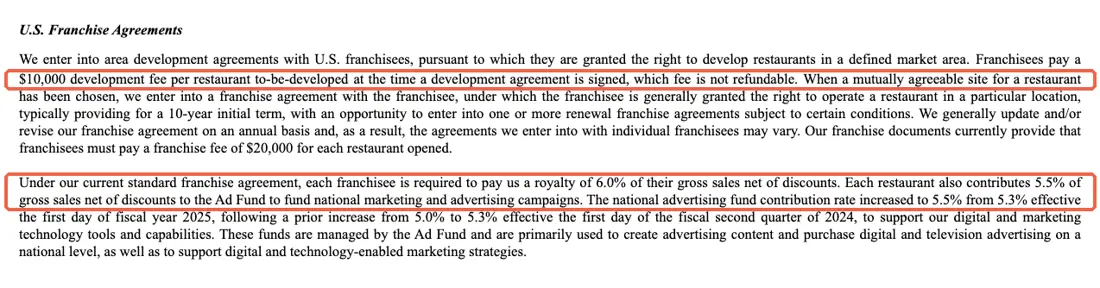
The 10-K ties the 5.5% rate to technology, not only to television time: Wingstop says the step from 5.3% to 5.5% was made “to support our digital and marketing technology tools and capabilities.” Read the Ad Fund line as part marketing budget and part digital platform cost, then ask in 16 CFR 436.5(f) terms whether Item 6 lists any separate technology charge on top.
That question matters because 87.3% of 259 FDDs in our Minnesota sample list a recurring technology, software or POS charge, per our study of franchise royalty rates and fees. Wingstop’s 10-K names no such fee, which means neither that one exists nor that it does not; under 16 CFR 436.5(f) every fee paid to the franchisor or an affiliate, with its formula, belongs in the Item 6 table titled “OTHER FEES”.
How did the Ad Fund climb from 4% to 5.5% of sales?
Wingstop raised its Ad Fund rate three times in under three years: from 4% to 5% on the first day of fiscal Q2 2022, to 5.3% on the first day of fiscal Q2 2024, and to 5.5% on the first day of fiscal 2025, according to the FY2022, FY2024 and FY2025 10-Ks. The 6% royalty did not change across those filings.
| Rate in effect from | Royalty | Ad Fund | Combined weekly charge | Filing that states it |
|---|---|---|---|---|
| May 2012 (brochure, history only) | 5% of sales | 2% of sales | 7% | Minnesota CARDS document 92299 |
| Fiscal 2021 | 6% | 4% | 10% | FY2021 10-K |
| First day of fiscal Q2 2022 | 6% | 5% | 11% | FY2022 10-K |
| First day of fiscal Q2 2024 | 6% | 5.3% | 11.3% | FY2024 10-K |
| First day of fiscal 2025 | 6.0% | 5.5% | 11.5% | FY2025 10-K |
Put in per-dollar terms, the weekly charge on each $100 of gross sales net of discounts went from $10.00 under the FY2021 rates to $11.50 under the fiscal 2025 rates. The Q3 2026 Form 10-Q, filed October 28, 2026, does not restate either rate, so 5.5% is the latest figure in a Wingstop filing as of November 2026.
The FY2025 10-K also says Wingstop updates its franchise agreement “on an annual basis” and that agreements “may vary”. Federal rules require Item 6 to show the formula or maximum for any fee that can rise (16 CFR 436.5(f), footnote 3), so the Item 6 and Item 11 pages should tell you whether the Ad Fund can pass 5.5% without your consent. Our franchise advertising fund research shows how other systems word that cap.
How does 11.5% in weekly fees compare with other food franchise FDDs?
Wingstop’s royalty is close to the food sector norm, and its Ad Fund is not. In 27 food and beverage FDDs filed in Minnesota and issued between January 2025 and August 2026, the median royalty was 5.5% and the median ad fund 2%, for a median percentage fee load of 8%. Wingstop’s 11.5% sits 3.5 points above that median.
| Measure | Wingstop (FY2025 10-K) | Food and beverage median, 27 Minnesota FDDs | Food middle half | All 239 FDDs with a % royalty | Source |
|---|---|---|---|---|---|
| Royalty | 6.0% | 5.5% | 5% to 6% | Median 6% (middle half 5% to 7%) | 10-K; royalty study |
| Ad fund | 5.5% | 2% | 1.65% to 2.75% | Not in this table | 10-K; royalty study |
| Royalty plus ad fund plus other % fees | 11.5% (other % fees, if any, not in the 10-K) | 8% | 6.69% to 8.31% | Median 8%, 90th percentile 10% | 10-K; royalty study |
| Initial franchise fee | $20,000 | $35,000 | $30,000 to $40,000 | Not in this table | 10-K; royalty study |
Wingstop’s 5.5% Ad Fund is 3.5 points above the 2% food median; royalties differ by 0.5 points. Sources: Wingstop FY2025 10-K; 27 Minnesota-filed food FDDs, accessed November 2026.
Two limits apply. Wingstop is not in the Minnesota sample, because it has no current Minnesota filing, and its numbers come from a 10-K rather than an Item 6 table. Treat 11.5% as a floor: if Item 6 adds a percentage-of-sales technology or delivery fee, the gap to the 8% food median widens. The $20,000 fee is $15,000 below the food median, which shifts more of the cost from signing day to every week of the 10-year term.
What is due before a Wingstop opens, per restaurant?
Before a U.S. Wingstop opens, the 10-K names two payments to Wingstop: a $10,000 development fee for each restaurant in the area development agreement, due at signing and not refundable, and a $20,000 franchise fee for each restaurant opened. That is $30,000 per restaurant in initial fees to Wingstop, before any build-out, equipment or lease cost.
- Sign an area development agreement for a defined market area and pay $10,000 for each restaurant to be developed.
- Agree a site with Wingstop, then sign a franchise agreement for that location, typically for a 10-year initial term.
- Pay the $20,000 franchise fee for the restaurant; the exact due date sits in Item 5 of the current FDD.
- Complete the four-week training program with your managers before opening.
- Open, report sales weekly and pay 6.0% royalty plus 5.5% Ad Fund on gross sales net of discounts.
| Restaurants in the agreement | Development fees at signing ($10,000 each) | Franchise fees as each opens ($20,000 each) | Initial fees to Wingstop |
|---|---|---|---|
| 1 | $10,000 | $20,000 | $30,000 |
| 3 | $30,000 | $60,000 | $90,000 |
| 5 | $50,000 | $100,000 | $150,000 |
| 10 | $100,000 | $200,000 | $300,000 |
The arithmetic assumes the 10-K terms apply unchanged and that the development fee is not credited against the franchise fee; the 10-K is silent on any credit, so Item 5 decides it. Because the $10,000 is not refundable, a developer who signs for 5 restaurants and opens 3 would, on the 10-K description, leave $20,000 with Wingstop for the 2 unopened sites. Our area development agreement research covers how other FDDs handle missed schedules.
Why can’t you find a current Wingstop Item 7 range online?
Because the current Wingstop FDD is not posted in the public state registries we could open. Minnesota CARDS holds no Wingstop document newer than a brochure received May 16, 2012, and Wingstop’s 10-K says it operates “under exemptions from registration (though not disclosure) in several states.” The FTC still requires delivery of the FDD 14 calendar days before you sign or pay.
| Where we looked (November 2, 2026) | What we found | Usable for current fees? |
|---|---|---|
| Minnesota CARDS | File number 5434; newest document 92299, typed “Clean FDD”, received 05/16/2012, is a 32-page franchise brochure | History only |
| Wisconsin DFI franchise search | Security block page (HTTP 403); not bypassed | No |
| California DFPI DOCQNET portal | Sign-in portal; no open franchise document search | No |
| NASAA Electronic Filing Depository | HTTP 403 | No |
| wingstop.com/own-a-wingstop | Redirects to Wingstop’s investor site; archived copies from 2025 and 2026 load page titles only, no fee text | No |
| SEC EDGAR | FY2021 to FY2025 Form 10-Ks and the Form 10-Q for the quarter ended September 26, 2026 | Yes: fees, average investment, unit counts |
Exemption from state registration does not remove the federal duty: 16 CFR 436.2(a) requires the current disclosure document at least 14 calendar days before a binding agreement or payment. One federal exemption to read for: under 16 CFR 436.8(a)(5)(i), a sale where the initial investment is at least $1,469,600, excluding unimproved land and franchisor financing, can be exempt if you sign an acknowledgment, which a multi-restaurant agreement could reach. Our franchise registration states report lists which 14 states review filings.
Minnesota’s statute lists its own exemptions in Minn. Stat. 80C.03, including any the commissioner grants by rule or order under clause (g). Our guide to reading a Franchise Disclosure Document explains Items 5, 6 and 7 once you hold the document.
Is Wingstop’s $580,000 average the same as the Item 7 total?
No. The FY2025 10-K describes an average initial investment of approximately $580,000 that excludes real estate purchase or lease costs and pre-opening expenses. An Item 7 table under 16 CFR 436.5(g) must list real property, training, deposits and an “Additional funds” line for at least the first three months, so a current Item 7 adds lines the 10-K average leaves out.
| 10-K for fiscal year | Average initial investment stated (approx.) | Change from prior 10-K | Filed |
|---|---|---|---|
| FY2021 | $400,000 | Base year | February 16, 2022 |
| FY2022 | $440,000 | +$40,000 | February 22, 2023 |
| FY2023 | $480,000 | +$40,000 | February 21, 2024 |
| FY2024 | $535,000 | +$55,000 | February 19, 2025 |
| FY2025 | $580,000 | +$45,000 | February 18, 2026 |
Wingstop’s 10-K average initial investment rose $180,000 (45%) from FY2021 to FY2025, excluding real estate and pre-opening costs. Source: Wingstop Form 10-Ks, accessed November 2, 2026.
Across the five filings the stated average rose $180,000, or 45%, between FY2021 and FY2025, while each filing kept the same exclusions. Use that slope to judge any Item 7 range you are shown: a range labelled with an older FDD year probably understates current build-out cost.
| Cost driver | What the Wingstop filings say | What to check in Item 7 |
|---|---|---|
| Real estate | Excluded from the $580,000; restaurants generally occupy approximately 1,700 square feet of leased retail space (FY2025 10-K, Item 2) | Rent, deposits and how many months of rent the range covers |
| Pre-opening expenses | Excluded from the $580,000 | Travel and wages for the four-week training program, opening payroll |
| Equipment, signage, furniture, fixtures | Must come from suppliers Wingstop designates and approves | Whether the range uses current supplier quotes |
| Technology | POS systems must meet Payment Card Industry standards; Wingstop Smart Kitchen runs in all domestic restaurants | Hardware, software and installation lines |
| Initial fees | $20,000 franchise fee plus $10,000 development fee per restaurant | Whether the total counts the development fee |
| Additional funds | Not stated in the 10-K | The initial period used (16 CFR 436.5(g) asks for at least three months or a reasonable industry period) |
Food costs sit outside Item 7 once you open, but they shape working capital: chicken was approximately 57.2% of all purchases in fiscal 2025, per the FY2025 10-K, so wing price swings hit cash needs in the first months. For cross-brand context on what Item 7 ranges contain, see our franchise initial investment research.
What did Wingstop charge in its last Minnesota filing, 2012?
Wingstop’s May 2012 Minnesota brochure listed a $30,000 franchise fee, $22,500 for later stores in a multi-unit agreement, a 5% royalty and a 2% national advertising contribution. Against the FY2025 10-K, the up-front franchise fee is $10,000 lower and the weekly percentage is 4.5 points higher, 11.5% against 7%.
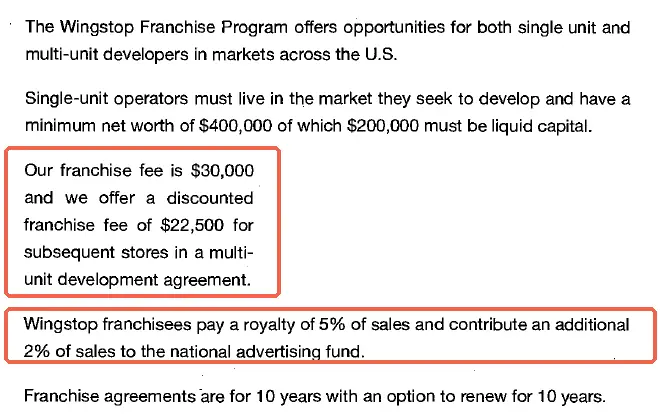
| Term | 2012 Minnesota brochure (history only) | FY2025 Form 10-K |
|---|---|---|
| Franchise fee | $30,000 | $20,000 per restaurant opened |
| Later restaurants under a multi-unit agreement | $22,500 discounted franchise fee | $20,000 franchise fee plus $10,000 development fee each |
| Royalty | 5% of sales | 6.0% of gross sales net of discounts |
| Advertising | 2% of sales | 5.5% of gross sales net of discounts |
| Agreement term | 10 years, option to renew for 10 years | Typically 10-year initial term, renewal subject to conditions |
| Single-unit net worth and liquidity | $400,000 net worth, $200,000 liquid | Not stated |
| Multi-unit liquidity | $200,000 per store plus restaurant operations or development experience | Not stated |
| Training | Four-week orientation in Dallas | Four-week training program before opening |
| System size | Over 500 locations in 30 or more states | 3,056 restaurants worldwide on December 27, 2025 |
The 2012 net worth and liquidity floors are 14 years old and should not be read as today’s rule. Wingstop’s archived franchise site had a page titled “Determine Your Franchising Eligibility”, but the copies we could open in 2025 and 2026 carry no figures, so ask Wingstop’s development team for the current written criteria.
Who is opening the new Wingstop restaurants?
Mostly people who already own Wingstops. The FY2025 10-K says existing franchisees accounted for more than 90% of franchised restaurants opened in 2024 and in 2025, and its 186 domestic franchisees averaged about 14 restaurants each with 16 years of average tenure. Domestic franchised restaurants rose from 1,877 at the end of 2023 to 2,716 on September 26, 2026.
| Period end | Domestic franchised | Domestic company-owned | International franchised | System-wide | Source |
|---|---|---|---|---|---|
| December 30, 2023 | 1,877 | 49 | 288 | 2,214 | FY2025 10-K |
| December 28, 2024 | 2,154 | 50 | 359 | 2,563 | FY2025 10-K |
| December 27, 2025 | 2,529 | 57 | 470 | 3,056 | FY2025 10-K |
| September 26, 2026 | 2,716 | 71 | 544 | 3,331 | Q3 2026 10-Q |
Domestic franchised openings were 274 in fiscal 2024 with no closures and 384 in fiscal 2025 with 4 closures; the first 39 weeks of 2026 brought 202 openings, 2 closures and 13 franchised restaurants bought back by Wingstop. Over the same span the domestic franchisee count fell from 216 (FY2023 10-K) to 186, so fewer, larger operators hold the growth. Our public franchisor unit growth report sets those numbers beside other listed brands.
The 10-K also reports unit-level sales measures. This site does not reproduce earnings or sales-per-unit figures; whether Wingstop makes a financial performance representation, and on what basis, is answered in Item 19 of its current FDD (16 CFR 436.5(s)). Our Item 19 research explains how to read one, and our study of how franchisors make money shows Wingstop’s royalty revenue of $292.5 million against $6.5 million of franchise fees in fiscal 2025.
Which cost figures in other Wingstop guides do not match the filings?
Pages that rank for Wingstop franchise cost often carry rates that have since moved. A widely read cost guide last updated March 2024 lists a 5% ad fee and, in its FAQ, a $30,000 franchise fee; Wingstop’s FY2025 10-K states 5.5% and $20,000. The $30,000 figure matches the 2012 Minnesota brochure, not any 10-K from FY2021 to FY2025.
| Claim in a cost guide updated March 2024 | What the primary filing says | Filing |
|---|---|---|
| Ad fee of 5% of gross sales | 5.3% from the first day of fiscal Q2 2024; 5.5% from the first day of fiscal 2025 | FY2024 10-K; FY2025 10-K |
| $30,000 franchise fee (FAQ; the body says $20,000) | $20,000 per restaurant in every 10-K from FY2021 to FY2025; $30,000 appears in the 2012 brochure | FY2021 10-K; CARDS document 92299 |
| Royalty of 2% in year one, 4% in year two, 6% from year three | “a royalty of 6.0%” under the current standard franchise agreement; no ramp described | FY2025 10-K |
| Total investment of $315,310 to $948,080 from a May 17, 2022 FDD | We could not open that FDD; the 10-K average rose from $440,000 (FY2022) to $580,000 (FY2025), excluding real estate and pre-opening | FY2022 10-K; FY2025 10-K |
| $1.2 million net worth, $600,000 liquid, three-restaurant minimum | No net worth, liquidity or unit minimum in any 10-K; U.S. franchisees sign area development agreements | FY2025 10-K |
A royalty ramp could still exist as a development incentive inside a specific FDD; the 10-K describes the standard agreement only. Ask for the incentive terms in writing, with the Item 5 or Item 6 page that states them, before you rely on a lower early-year royalty in any budget.
Which Wingstop path fits your starting point?
Your path depends on how many restaurants you can fund and whether you already operate in the system. The 10-K describes U.S. growth through area development agreements, and more than 90% of new franchised units in 2024 and 2025 went to existing franchisees, so a first-time buyer should confirm early that Wingstop grants new agreements in the target market.
| If you | Then | Number or rule to check |
|---|---|---|
| Have not received the FDD yet | Request it and do not sign or pay until 14 calendar days after receipt | 16 CFR 436.2(a) |
| Are a first-time buyer wanting one restaurant | Ask whether a single-restaurant development agreement is offered in your market | More than 90% of 2024 and 2025 openings by existing franchisees |
| Plan a 3 to 5 restaurant agreement | Budget $30,000 to $50,000 in non-refundable development fees at signing, then $20,000 per opening | $10,000 x restaurants, FY2025 10-K |
| Expect a total investment of $1,469,600 or more | Read any exemption acknowledgment before signing; it can remove FTC disclosure protection | 16 CFR 436.8(a)(5)(i) |
| Compare Wingstop with other food brands on ongoing fees | Line up 11.5% against the 8% food median, then add each brand’s fixed Item 6 fees | 27 Minnesota food FDDs |
| Want to buy an existing Wingstop | Ask for the transfer fee in Item 6 and the years left on the franchise agreement | Typically a 10-year initial term |
| Need outside financing | Line up a lender early; Wingstop does not lend to franchisees directly | FY2025 10-K, Item 1A |
Before paying the first $10,000 development fee, ask for these pages of the current FDD:
- The cover page and issuance date, plus any state addendum for your state.
- Item 5: when the $20,000 franchise fee is due and whether the $10,000 development fee is credited against it.
- Item 6: every fee beyond the 6.0% royalty and 5.5% Ad Fund, including technology, renewal and transfer fees, and any cap on the Ad Fund rate.
- Item 7: each line, the real estate assumption and the “Additional funds” period.
- Item 11: how the Wingstop Restaurants Advertising Fund is spent and whether it is audited.
- Item 12: the development area, any exclusivity and what happens if the schedule slips.
- Items 19, 20 and 21: any financial performance representation, outlet openings, transfers and closures by state, and Wingstop’s audited financial statements.
For the wider budget, including how the 14-day rule and Items 5 to 7 fit together across brands, read our franchise cost guide. This page is general information, not legal, financial or investment advice.
How we compiled this
We read five Wingstop Form 10-K filings (fiscal 2021 to fiscal 2025), the Form 10-Q for the quarter ended September 26, 2026, the 2012 Minnesota CARDS filing, 16 CFR Part 436 and Minn. Stat. 80C.03, all accessed in November 2026: 9 primary documents. We tried four public registries and Wingstop’s archived franchise pages for a current FDD and could not open one, so no Item 7, net worth or technology-fee amount appears here. We excluded the sales, same store sales and return figures the 10-K reports, under this site’s no-earnings rule; food benchmarks come from our Minnesota FDD fee study.
Frequently asked questions
Is Wingstop a franchise?
Yes. Wingstop’s FY2025 Form 10-K says approximately 98% of its restaurants are owned and operated by independent franchisees. On December 27, 2025 that meant 2,999 franchised restaurants (2,529 in the U.S. and 470 abroad) against 57 company-owned, out of 3,056 worldwide. Outside the U.S., master franchisees hold rights for whole regions or countries (FY2025 10-K).
How much is the Wingstop franchise fee?
The FY2025 Form 10-K puts the U.S. franchise fee at $20,000 for each restaurant opened. A separate $10,000 development fee is due for each restaurant when the area development agreement is signed and is not refundable, so initial fees to Wingstop total $30,000 per restaurant before build-out, equipment, rent or pre-opening costs.
What are the Wingstop franchise requirements?
The 10-K names operating requirements: an area development agreement, a four-week training program before opening, purchases from designated suppliers and POS systems that meet Payment Card Industry standards. It states no net worth or liquidity minimum. The last Minnesota filing, from 2012, asked single-unit operators for $400,000 net worth and $200,000 liquid, which is history, not today’s rule.
How much does a Wingstop franchise owner make?
This site does not publish earnings figures. Owner income depends on the 11.5% weekly royalty and Ad Fund charge, rent on roughly 1,700 square feet of leased space, chicken costs (about 57.2% of Wingstop’s fiscal 2025 purchases) and debt service. Any financial performance representation Wingstop makes must sit in Item 19 of its current FDD (16 CFR 436.5(s)).
Does Wingstop offer financing to franchisees?
No direct financing. The FY2025 Form 10-K risk factors state: “We do not provide our franchisees with direct financing,” and add that new restaurant growth depends on franchisees getting independent financing at commercially reasonable rates. Plan for a bank or SBA lender, and check Item 10 of the FDD for any third-party financing arrangements Wingstop discloses.
Can you buy an existing Wingstop instead of building one?
Restaurants do change hands: Wingstop itself bought 5 restaurants from franchisees in fiscal 2025 and 13 in the quarter ended September 26, 2026, per its 10-K and 10-Q. A buyer of a franchised unit takes over an agreement with a typical 10-year initial term, so ask for the remaining term and the transfer fee listed in Item 6.
Sources
- Wingstop Inc., Form 10-K for the fiscal year ended December 27, 2025 (filed February 18, 2026), SEC EDGAR, accessed November 2, 2026.
- Wingstop Inc., Form 10-K for the fiscal year ended December 28, 2024 (filed February 19, 2025), SEC EDGAR, accessed November 2, 2026.
- Wingstop Inc., Form 10-K for the fiscal year ended December 30, 2023 (filed February 21, 2024), SEC EDGAR, accessed November 2, 2026.
- Wingstop Inc., Form 10-K for the fiscal year ended December 31, 2022 (filed February 22, 2023), SEC EDGAR, accessed November 2, 2026.
- Wingstop Inc., Form 10-K for the fiscal year ended December 25, 2021 (filed February 16, 2022), SEC EDGAR, accessed November 2, 2026.
- Wingstop Inc., Form 10-Q for the quarter ended September 26, 2026 (filed October 28, 2026), SEC EDGAR, accessed November 2, 2026.
- Wingstop Restaurants Inc., Minnesota franchise filing, file 5434, document 92299, received May 16, 2012, Minnesota Department of Commerce CARDS, accessed November 2, 2026.
- 16 CFR Part 436, Disclosure Requirements and Prohibitions Concerning Franchising, eCFR, accessed November 2, 2026.
- Minnesota Statutes 80C.03, Exemptions, Office of the Revisor of Statutes, accessed November 2, 2026.
- Franchise Consultants and Brokers, Franchise Royalty Rates (analysis of Minnesota CARDS FDDs issued January 2025 to August 2026), accessed November 2, 2026.