
An Ace Hardware franchise is a membership in a retailer-owned cooperative: you pay a $5,000 affiliation fee, buy $5,000 of Ace stock, and the 2026 FDD puts a new store at $611,928 to $2,018,550.
Key takeaways
- Ace Hardware Corporation says it “became a retailer-owned cooperative in 1976” and admits members under three agreements: a Membership Agreement (Nonbranded), an Ace Brand Agreement and a Subscription for Capital Stock Agreement (Ace Hardware FDD, issued March 25, 2026, as amended June 5, 2026, Items 1 and 5).
- Item 7 estimates $611,928 to $2,018,550 for a new leased store of 3,000 to 12,000 square feet and $139,600 to $1,286,000 to convert an existing hardware store; opening inventory alone runs $210,000 to $1,000,000 (2026 Ace FDD, Item 7).
- Item 6 has no royalty line and no transfer fee line, but it bills an Annual Brand Assessment of 2% of prior-year purchases (minimum $6,270, maximum $13,600) and Core Retail Services of $323.25 a month per parent store (2026 Ace FDD, Item 6).
- Under Item 8, “all or substantially all” of Ace’s net income from merchandise sold to U.S. members goes back to them as patronage distributions, 40% in cash and 60% in Class C stock and patronage refund certificates (2026 Ace FDD, Item 8).
- Ace’s ownership FAQ asks for at least $350,000 in liquid capital and a $700,000 net worth and calls a typical store 8,000 to 15,000 square feet (accessed November 2, 2026).
- Of 154 memberships Ace projects for 2026, 79 go to new owners of existing Ace stores, 50 to conversions and 25 to new owners of new stores (2026 Ace FDD, Item 20).
Is Ace Hardware a franchise or a cooperative?
Both, depending on which document you read. Ace’s ownership FAQ says Ace “is a retailer-owned cooperative, not a traditional franchise.” Its Franchise Disclosure Document, issued March 25, 2026 and amended June 5, 2026, still discloses the branded store membership as a franchise, because the federal test reads the deal’s terms, not its label.
The FTC Franchise Rule at 16 CFR 436.1(h) defines a franchise as “any continuing commercial relationship or arrangement, whatever it may be called,” that meets three elements. The Ace documents meet each one once a member also signs the Ace Brand Agreement.
| FTC element, 16 CFR 436.1(h) | What the 2026 Ace FDD says | Item |
|---|---|---|
| (1) Business identified with the franchisor’s trademark | The Ace Brand Agreement licenses the “ACE” mark (Reg. No. 1,464,025) and “ACE Hardware” (Reg. No. 1,486,528) | 13 |
| (2) Significant control or assistance | Basic hardware stock of at least $50 per square foot, 50% of the Discovery programs, hours of 8:00 a.m. to 7:00 p.m. Monday to Saturday | 16 |
| (3) Required payment to the franchisor | $5,000 affiliation fee and a $5,000 stock subscription, both billed on approval | 5 |
Item 12 draws the line itself. A member who signs only the Membership Agreement (Nonbranded) may buy and resell Ace merchandise, including private label goods, but “is not granted a license to use the Ace marks,” and the FDD states that “such a member’s location is not a franchise.” The brand license, not the cooperative, is what makes an Ace store a franchise. The three-part test is explained with other borderline cases on our page on the legal definition of a franchise.
Where does an Ace member’s money go, and what comes back?
A member pays Ace through four streams: the $5,000 affiliation fee, $5,000 of capital stock, merchandise with a handling charge, and assessments such as the brand assessment. Ace then returns “all or substantially all” of its net income from merchandise sold to U.S. members as patronage distributions, under Item 8 of the 2026 FDD and Subchapter T of the Internal Revenue Code.
- Member to Ace: $5,000 affiliation fee (Item 5).
- Member to Ace: $5,000 of stock, made up of 1 Class A voting share plus 40 Class C shares for a first store (Item 5).
- Member to Ace: merchandise orders plus handling of about 10% on warehouse stock and 2.0% falling to 0.5% on drop-ship orders (Item 8).
- Member to Ace: brand assessment of 2% of prior-year purchases, $6,270 minimum and $13,600 maximum (Item 6).
- Ace to member: merchandise, services and programs.
- Ace to member: patronage distributions of all or substantially all net income from merchandise sold to members, 40% paid in cash and 60% in Class C stock and patronage refund certificates (Item 8, Exhibit E).
- On exit: Ace repurchases Class A stock at $1,000 per share and Class C stock at the greater of $100 per share or the Board’s last price (Item 5).
The tax definition sits in 26 U.S.C. 1388(a): a patronage dividend is paid “on the basis of quantity or value of business done with or for such patron” and is “determined by reference to the net earnings” of the cooperative. A store that routes more of its buying through Ace therefore earns a larger share of what Ace returns. The FDD promises no amount, and this page publishes no past distribution figures.
Item 8 attaches two conditions. If a member owes Ace money, Ace “will first apply the sixty percent (60%) portion” to the unpaid balance, and it may also apply the 40% cash portion unless the member makes a timely written request. The stock itself pays no ordinary dividend: “The payment of dividends on our stock is prohibited by our Certificate of Incorporation” (Item 5).
The scale of the buying relationship is large. Ace reports fiscal 2025 revenue from sales of merchandise and services to members of “$8.2 billion, or 82% of our consolidated revenues of $10.0 billion” (Item 8). That figure describes the wholesaler, not the results of any store.
What do you sign and buy to become an Ace member?
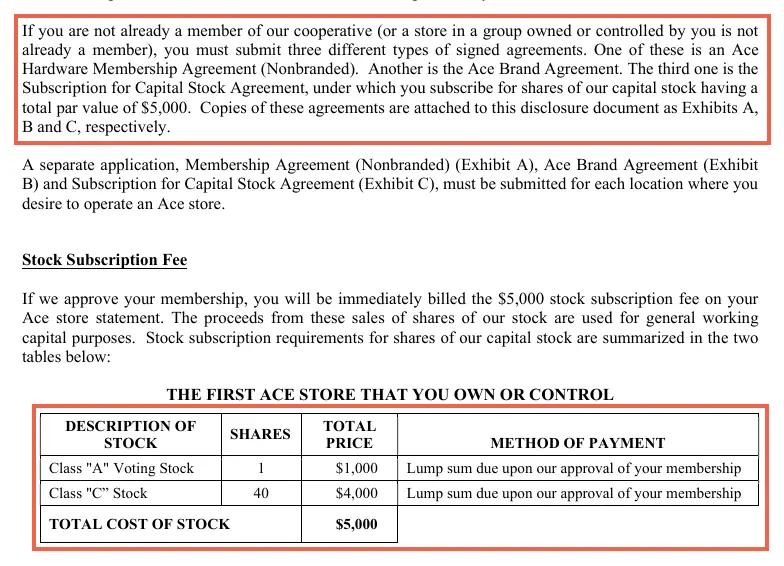
A new member signs three agreements for each store and buys $5,000 of Ace capital stock on top of the $5,000 affiliation fee, according to Item 5 of the 2026 FDD. The stock is the ownership stake: the first store’s single Class A share carries the vote, and every share is sold back to Ace at a set price when the membership ends, unless Ace accepts a transfer to a new member.
| What you sign or buy | First Ace store | Each additional store | Source |
|---|---|---|---|
| Membership Agreement (Nonbranded), Exhibit A | Required | Required | Items 1, 5 |
| Ace Brand Agreement, Exhibit B | Required to trade as Ace | Required to trade as Ace | Items 1, 5 |
| Subscription for Capital Stock Agreement, Exhibit C | Required | Required | Item 5 |
| Class A voting stock | 1 share, $1,000 | 0 shares, $0 | Item 5 |
| Class C stock | 40 shares, $4,000 | 50 shares, $5,000 | Item 5 |
| Affiliation fee | $5,000, non-refundable | $5,000, non-refundable | Item 5 |
| Repurchase price on exit | Class A at $1,000 par | Class C at the greater of $100 par or the Board’s last price | Item 5 |
Ace waives the $5,000 affiliation fee in four cases listed in Item 5: an owner converting a store supplied by another hardware wholesaler, a buyer of such a store who converts it, a change of ownership among family members of an existing Ace store, and veterans or active-duty service members in the Veterans’ Incentive Program, who file a DD 214 and must own at least 50% of an entity buyer. Other brands’ offers to veterans are compared in our research on veteran franchise discounts.
The shares carry restrictions. Item 5 says they “may not be promised, mortgaged, sold, assigned, or transferred without the prior consent of our Board of Directors,” and Item 10 note 1 gives Ace “a first lien upon, and a right of set-off against” all stock issued to a member to secure any debt owed to Ace.
Cooperative membership or franchise agreement: what changes for the owner?
Ace membership drops three things most franchise agreements contain: a royalty on sales, a fixed term and a post-term non-compete. It also withholds something buyers usually get, a protected area, and lets either side end the deal on 30 days’ notice. The table sets the 2026 Ace FDD beside medians from 259 Minnesota-filed FDDs issued in 2025 and 2026.
| Point | Ace membership (2026 FDD) | Typical franchise agreement (259 FDDs, 2025 to 2026) | Source |
|---|---|---|---|
| Ongoing royalty | No royalty line in the Item 6 fee table | Median 6% of sales across 239 FDDs with a percentage royalty | Ace Item 6; royalty rate study |
| Brand or ad fund | 2% of prior-year purchases, $6,270 minimum, $13,600 maximum | Median 2% of sales where the fund is a percentage (187 FDDs) | Ace Item 6 note 7; royalty rate study |
| Up-front payment to the brand | $5,000 affiliation fee plus $5,000 of stock that Ace buys back on exit | Median initial franchise fee $49,500 | Ace Item 5; royalty rate study |
| Length of term | “No fixed term is specified” | 65.6% set a 10-year initial term | Ace Item 17(a); agreement terms study |
| Termination without cause | Either side, on 30 days’ written notice, subject to state law | 4.2% let the franchisor terminate without cause | Ace Item 17(d), (e); agreement terms study |
| Non-compete after exit | None on membership termination; 1 year only under a Multi-Unit Store Development Agreement | 88.4% include a post-term non-compete | Ace Item 9(w); agreement terms study |
| Territory | “You will not receive an exclusive territory” | 81.1% promise some protected area | Ace Item 12; territory study |
| Margin on supplies | Net income on merchandise to members returned as patronage distributions | 77.2% report franchisor or affiliate revenue from required purchases | Ace Item 8; Minnesota CARDS sample of 259 FDDs |
The 30-day clause cuts both ways. A member can leave without cause, but Ace can also end the agreements without cause on the same notice unless state law requires more, and its list of causes includes “failure to meet the standard annual minimum purchase levels” (Item 17, note 3). Item 6 lists no transfer fee, and a sale of the store works through Ace’s consent to transfer the shares to an eligible buyer (Item 17(l)).
What does the 2026 FDD put on a new Ace store’s opening bill?
Item 7 of the 2026 Ace FDD estimates $611,928 to $2,018,550 to open a new store of 3,000 to 12,000 square feet in leased space, before any real estate purchase, construction, interest or debt service. Opening inventory is the largest line at $210,000 to $1,000,000, followed by working capital for the first 90 days at $90,578 to $205,000.
Opening inventory is the largest line in both estimates; all other lines (fees, stock, brand assessment, signage, supplies, insurance, training, prepaid) total $42,000 to $159,500. Source: 2026 Ace FDD, Item 7.
| Item 7 line | New store, leased | Conversion store | Paid to |
|---|---|---|---|
| Affiliation fee | $5,000 | Waived | Ace |
| Capital stock subscription | $5,000 | $5,000 | Ace |
| Initial brand assessment | $6,000 to $12,000 | $6,000 to $12,000 | Ace |
| Local Lift Max Assessment | $6,500 to $48,100 | $6,500 | Ace |
| Exterior signage | $10,000 to $30,000 | $10,000 to $30,000 | Ace or supplier |
| Leasehold improvements, store planning, decor and fixtures | $102,750 to $200,850 | $40,000 to $100,000 (decor and fixtures) | Ace or suppliers |
| Store set-up labor (new) or reset labor (conversion) | $48,000 to $160,000 | $45,000 to $240,000 | Ace or supplier |
| Equipment, including point of sale | $91,100 to $138,100 | $14,100 to $120,000 | Ace or supplier |
| Rent: first 3 months and deposit | $21,000 to $107,000 | Not listed | Landlord |
| Prepaid expenses | $3,000 to $15,000 | Not listed | Third parties |
| Opening inventory | $210,000 to $1,000,000 | $0 to $680,000 | Ace or suppliers |
| Initial or branded supplies | $3,000 to $7,500 | $3,000 to $7,500 | Ace or suppliers |
| Insurance | $10,000 to $40,000 | $0 to $40,000 | Ace Insurance or your agency |
| Training | $0 to $45,000 (New Investor Retail Training) | $10,000 to $45,000 (Conversion Retail Training) | Ace |
| Working capital, first 90 days | $90,578 to $205,000 | Not listed | Ace and third parties |
| Total | $611,928 to $2,018,550 | $139,600 to $1,286,000 |
Most of that money flows to Ace itself: the cover page says the total “includes up to $1,288,100 that must be paid to the franchisor or an affiliate,” because inventory, fixtures and signage are bought through the cooperative. Opening inventory is 49.5% of the high estimate ($1,000,000 of $2,018,550) and 34.3% of the low ($210,000 of $611,928). Item 7 note 1 assumes you buy through Ace’s vendors and join one of its new store incentive programs.
How much less does a conversion to Ace cost?
Converting an existing hardware store starts at $139,600, 22.8% of the new-store low of $611,928, because rent, prepaid expenses and 90 days of working capital drop out and existing stock can cover the inventory line ($0 to $680,000). The conversion total is $139,600 to $1,286,000 (Item 7, Table 2).
Reset labor can run higher than new-store labor, up to $240,000 against $160,000, an amount Item 7 says depends on “the size and scope of your project.” Conversion terms at other franchisors are compared in our conversion franchising research.
What is the free opening stock order, and when can Ace bill it back?
Under the New Investor A incentive in Item 10, Ace gives 6 months of deferred dating on up to 75% of the Opening Stock Order (OSO), capped at $525,000, then credits the recommended Discovery assortment products back: a first credit of 75% of the order (also capped at $525,000) 6 months after delivery and the rest at 12 months.
The order must be placed within six months of activation with at least 80% Discovery compliance by department. Branch A, for an existing member’s next store, covers up to 85% and $600,000 in one credit at 6 months.
Ace’s FAQ calls the credit “not a loan,” and the Item 10 table lists no APR and no loan fees for it. Note 3 adds the condition: Ace “reserves the right to bill a pro rata portion of the applicable incentive credit back” if the membership or brand agreement ends for any reason within the first five years of the store’s opening. Store Conversion incentive agreements go further and require repayment of 100% of the credits if the agreements end for any reason or the store leaves the Ace format within five years of the agreement (Item 10, note 10).
| When | What happens | Amount | Item |
|---|---|---|---|
| On approval | Three agreements signed; stock subscription billed | $5,000 | 5 |
| First statement after approval | Affiliation fee billed | $5,000 | 5 |
| 60 days after activation (Q1 to Q3) | First brand assessment billed | $6,000 ($12,000 from February if activated in Q4) | 6 |
| 20 to 180 days after signing | Store opens (FDD estimate); Ace’s FAQ says 6 to 12 months after approval | None | 11 |
| 6 months after OSO delivery | First incentive credit | 75% of the order, up to $525,000 | 10 |
| 12 months after OSO delivery | Second incentive credit | Rest of the eligible credit | 10 |
| After a full calendar year | Brand assessment moves to 2% of prior-year purchases; low volume charge can apply | $6,270 to $13,600; $100 per period | 6 |
| 5 years after opening | Pro rata billback window on termination closes | Pro rata share of credit | 10 |
How do store size and inventory rules move the Ace Hardware franchise cost?
Three rules scale with floor area. Item 7 prices store set-up labor at “$16 per sq. ft,” Item 16 requires basic hardware stock of at least $50 per square foot, and Ace’s FAQ calls a typical store 8,000 to 15,000 square feet, a band that runs past the 3,000 to 12,000 square feet that Item 7 is built on. The table multiplies the two per-foot rates by five store sizes.
| Store size | Set-up labor at $16 per sq ft (Item 7) | Basic hardware stock at $50 per sq ft (Item 16) | Where it sits |
|---|---|---|---|
| 3,000 sq ft | $48,000 | $150,000 | Item 7 low end; labor matches the $48,000 low |
| 8,000 sq ft | $128,000 | $400,000 | Low end of Ace’s typical size |
| 10,000 sq ft | $160,000 | $500,000 | Labor matches the Item 7 high of $160,000 |
| 12,000 sq ft | $192,000 | $600,000 | Item 7 size ceiling; labor $32,000 above the Item 7 high |
| 15,000 sq ft | $240,000 | $750,000 | Top of Ace’s typical size; outside Item 7 |
The arithmetic exposes two gaps to close before signing. The $160,000 labor high equals 10,000 square feet at $16, so a 12,000 square foot store at the same rate implies $192,000. Item 16 applies the $50 minimum to “basic hardware departments (Departments 1 through 5 and 7)” without saying which floor area counts, so ask Ace’s Market Development Manager whether it means the whole store or those departments; the column above is the whole-store reading.
Item 16 sets operating rules that shape staffing cost too: open from 8:00 a.m. to 7:00 p.m. Monday through Saturday, 66 hours a week, or at least 60 hours where no competitor sits within 5 miles, and carry 50% of Ace’s Category Management (Discovery) Programs. Ace’s FAQ sets the money floor at “$350,000 in Liquid Capital” and a “Net Worth of $700,000” and says “Ace does not provide any internal financing,” pointing first-time owners to SBA loans or a local bank.
What does Ace bill every year if there is no royalty?
Ace replaces a royalty with purchase-based charges and flat program fees listed in Item 6 of the 2026 FDD. A new store pays a flat $6,000 brand assessment in its first year, then 2% of the prior year’s purchases inside a $6,270 to $13,600 band, plus Core Retail Services, a Local Lift Max search assessment and a low volume charge when purchases fall short of the minimum.
| Charge | Amount in Item 6 | What the numbers work out to | Required? |
|---|---|---|---|
| Annual Brand Assessment | $6,000 flat in year one; then 2% of prior-year purchases, $6,270 minimum, $13,600 maximum | The floor applies below $313,500 of purchases and the cap above $680,000 | Yes |
| Core Retail Services | $323.25 a month per parent store, $134.75 per branch store, rising 2.5% a year | $3,879 a year for a parent store at the Item 6 rate | Yes |
| Local Lift Max Assessment | New stores start in the $6,500 tier; existing stores $4,500 to $48,100 | Billed in 26 installments a year | Yes |
| Low Volume Service Charge | $100 per bi-weekly period below $200,000 of annual purchases; $200 below $300,000 from January 1, 2027 | $2,600 a year now and $5,200 from 2027 across 26 statements | Only below the minimum |
| Point of sale maintenance | About $850 a month; $7.50 per payment device a month on Epicor | About $10,200 a year before device fees | Yes, a POS system is required |
| Business insurance | $10,000 to $40,000 a year; general liability with a $1 million combined single limit and $2 million aggregate, $1 million umbrella | From Ace Insurance Agency or a carrier with an AM Best rating of at least A- | Yes |
| Handling on purchases (Item 8) | About 10% on warehouse orders; 2.0% to 0.5% on drop ship; generally 6% on bulletin orders | Drop-ship rate reaches 0.5% above $815,000 of annual volume | On orders billed through Ace |
Two details in the filing deserve a direct question to Ace. Item 5 quotes Core Retail Services at $315.25 and $131.50 a month while the Item 6 fee table says $323.25 and $134.75, and Item 6 note 3 states that “Failure to meet our minimum purchase levels constitutes cause for termination of your Membership Agreement.” Late balances also carry a .77% charge per bi-weekly statement (.384% in Texas, .692% in Georgia).
Are most new Ace owners building, buying or converting?
Buying or converting. Item 20 of the 2026 FDD projects 154 new memberships during 2026: 79 for new owners of existing Ace stores, 50 for retailers converting from another hardware affiliation and 25 for new owners of new stores. Ace also expects 16 more company-owned stores, taking its subsidiary’s count to 284, with 65 signed stores not yet open at the end of 2025.
Ace projects 154 memberships for 2026; only 25 are new owners opening new stores. Source: 2026 Ace FDD, Item 20.
| Year | Franchised stores at start | Opened | Terminations | Reacquired by Ace | Franchised stores at end |
|---|---|---|---|---|---|
| 2023 | 4,645 | 190 | 75 | 1 | 4,759 |
| 2024 | 4,759 | 210 | 65 | 19 | 4,885 |
| 2025 | 4,885 | 173 | 71 | 5 | 4,982 |
Ace Retail Group, Inc., an Ace subsidiary, operated 268 company-owned stores at the end of 2025 (Item 1 and Item 20, Table 4; Table 1 prints 26, a typo), for 5,250 U.S. outlets in total, and Item 1 counts 420 licensed Ace Hardware stores outside the United States. Non-renewals were 0 in each year, consistent with memberships that carry no fixed term (Item 17(a)).
Existing Ace stores change hands owner to owner, not through Ace. A buyer applies for membership, Ace must consent to the transfer of the seller’s shares (Item 17(l)), and the buyer signs a new Membership Agreement (Nonbranded). How resale purchases are financed across brands is tracked in our franchise resale index.
Which published Ace figures are out of date?
Several widely read Ace guides still quote earlier filings or older requirements. The table sets six common claims beside the current primary source: the Ace FDD issued March 25, 2026 and amended June 5, 2026, and Ace’s ownership FAQ as accessed on November 2, 2026.
| What some guides say | What the primary source says | Source |
|---|---|---|
| Ace became a cooperative in 1973 (an explainer dated 2021) | “We became a retailer-owned cooperative in 1976.” | FDD Item 1 |
| $250,000 cash and $400,000 net worth (two directory-style guides) | $350,000 liquid capital and $700,000 net worth | Ace FAQ |
| $579,000 to $1.9 million to open (a 2024 cost article) | $611,928 to $2,018,550 for a new leased store | FDD Item 7 |
| $603,850 to $2,001,550 (a 2026 review built on the 2025 FDD) | $611,928 to $2,018,550 in the 2026 filing | FDD Item 7 |
| No ongoing fees | 2% brand assessment ($6,270 to $13,600), Core Retail Services at $323.25 a month, Local Lift Max | FDD Item 6 |
| The $5,000 fee is the whole entry cost | $5,000 affiliation fee plus $5,000 of capital stock | FDD Item 5 |
Ace’s own pages differ from its FDD in one place a buyer should reconcile. The FAQ says “Ace does not provide any internal financing,” while Item 10 note 2 says “We are the lender for all these financing programs”; the loan programs in Item 10 serve existing members, for example store improvement loans that need 3 years in business and 30% equity, so a first-time owner relies on incentive credits and outside lenders.
Which route into Ace fits your situation?
The route turns on whether you already run a hardware store, how your liquid capital compares with Ace’s $350,000 floor, how much you will buy through Ace each year and whether you can stay five years. Each row pairs a situation with the FDD section that settles it.
| If this is your situation | Then | Check in the 2026 FDD |
|---|---|---|
| You run an independent hardware store supplied by another wholesaler | Price the conversion path: $139,600 to $1,286,000, with the $5,000 affiliation fee waived | Item 5 waiver; Item 7, Table 2 |
| You hold less than $350,000 in liquid capital | You are below Ace’s stated floor; bring in an equity partner or look at a smaller model | Ace FAQ; Item 7 low of $611,928 |
| You expect under $300,000 of annual purchases through Ace from 2027 | Budget $5,200 a year in low volume charges and treat the shortfall as termination risk | Item 6, note 3; Item 17, note 3 |
| You might sell or close within five years | Model the pro rata billback of the New Investor credit, or 100% repayment under a Store Conversion agreement | Item 10, notes 3 and 10 |
| You want to buy an existing Ace store | Confirm Ace’s consent to the share transfer and how many years of incentive billback remain | Items 10, 17(l), 20 |
| You want to offer handyman or in-home services | Not under the Ace marks; that needs a separate Ace Handyman Services franchise | Items 1, 16 |
| You are a veteran or on active duty | Ask for the affiliation fee waiver with a DD 214; you must own at least 50% of an entity buyer | Item 5 |
| You need a protected trade area | Ace grants none; ask the Business Development Manager how it spaces stores in your market | Item 12; Ace FAQ |
This page is general information, not legal, financial or investment advice. Before signing, ask a franchise attorney to read the Membership Agreement (Nonbranded), the Ace Brand Agreement and the incentive agreement in Exhibit O, with three questions: what triggers the five-year billback, how the 30-day termination clause works under your state’s law, and which floor area the $50 per square foot inventory rule uses. How to read the rest of the filing is set out in our guide to the franchise disclosure document.
How we compiled this
We read the Ace Hardware Corporation FDD issued March 25, 2026 and amended June 5, 2026 (524 pages, Minnesota file 6071), Items 1 to 20, and checked key pages as rendered images. We added Ace’s ownership FAQ, the FTC rule at 16 CFR 436.1, 26 U.S.C. 1388 and three of our studies of 259 Minnesota-filed FDDs, all accessed in November 2026. We left out Item 19 figures, patronage distribution amounts and any store financial results, and used the separate Ace Handyman Services filing only through Item 1 of the Ace FDD.
Frequently asked questions
Is Ace Hardware a franchise?
Ace calls itself a retailer-owned cooperative, not a traditional franchise, yet it files a Franchise Disclosure Document because the Ace Brand Agreement meets the FTC test in 16 CFR 436.1(h): trademark, significant control and a required payment. A member who signs only the Membership Agreement (Nonbranded) buys from Ace without using the name, and Item 12 says that location “is not a franchise.”
How much does an Ace Hardware franchise cost?
Item 7 of the 2026 Ace FDD estimates $611,928 to $2,018,550 for a new leased store of 3,000 to 12,000 square feet and $139,600 to $1,286,000 to convert an existing hardware store. Neither figure includes buying land or a building. Ace’s FAQ also asks for $350,000 in liquid capital and a $700,000 net worth.
What is the Ace Hardware franchise fee?
The affiliation fee is $5,000 per new location and is non-refundable (Item 5). Separately, a first store buys $5,000 of Ace stock: 1 Class A voting share at $1,000 and 40 Class C shares at $4,000. Ace waives the affiliation fee for conversions from another wholesaler, family transfers and qualifying veterans.
How much does an Ace Hardware franchise owner make?
We do not publish earnings figures. Item 19 of the 2026 Ace FDD includes sales data by store format from a Retail Financial Report built on voluntarily reported store results. Owner pay turns on Items 6 and 7: inventory financed, rent, the purchase-based brand assessment, staffing for 66 opening hours a week and patronage tied to purchases. Our Item 19 study explains how to read it.
Is there an Ace Hardware franchise for sale?
Existing Ace stores are sold by their owners, and Item 20 projects that 79 of 154 new memberships in 2026 will go to new owners of existing Ace stores. The buyer applies for membership and Ace must consent to the transfer of the seller’s shares (Item 17(l)). Ask how many years remain on any incentive credit billback.
Does Ace Hardware have a handyman franchise?
Yes, through a separate company. Ace Handyman Franchising, Inc., an Ace subsidiary, had 383 Ace Handyman Services franchises at December 31, 2025 (Item 1 of the Ace Hardware FDD). Ace store members may not offer in-home services under the Ace marks (Item 16). Costs for that model are in our handyman franchise comparison.
How long does it take to open an Ace Hardware store?
Item 11 of the 2026 FDD estimates 20 to 180 days from signing the Membership Agreement and Brand Agreement to opening. Ace’s FAQ gives a longer planning view, 6 to 12 months after approval, because site search, permits, construction and inventory set-up come first. Item 11 lists real estate, financing, permits and construction as added delay factors for new businesses.
Sources
- Ace Hardware Franchise Disclosure Document, issued March 25, 2026, as amended June 5, 2026 (cover, Items 1, 5 to 17, 19, 20), Ace Hardware Corporation via Minnesota CARDS, document 36825-202606-04. Accessed November 2, 2026.
- Own an Ace: FAQs, Ace Hardware Corporation. Accessed November 2, 2026.
- 16 CFR 436.1, Definitions (FTC Franchise Rule), Legal Information Institute, Cornell Law School. Accessed November 2, 2026.
- 26 U.S.C. 1388, Definitions; special rules (patronage dividend), Legal Information Institute, Cornell Law School. Accessed November 2, 2026.
- Franchise registrations search, Minnesota Department of Commerce (CARDS), source of the 259 FDDs behind our royalty, agreement term and territory studies. Accessed November 2, 2026.