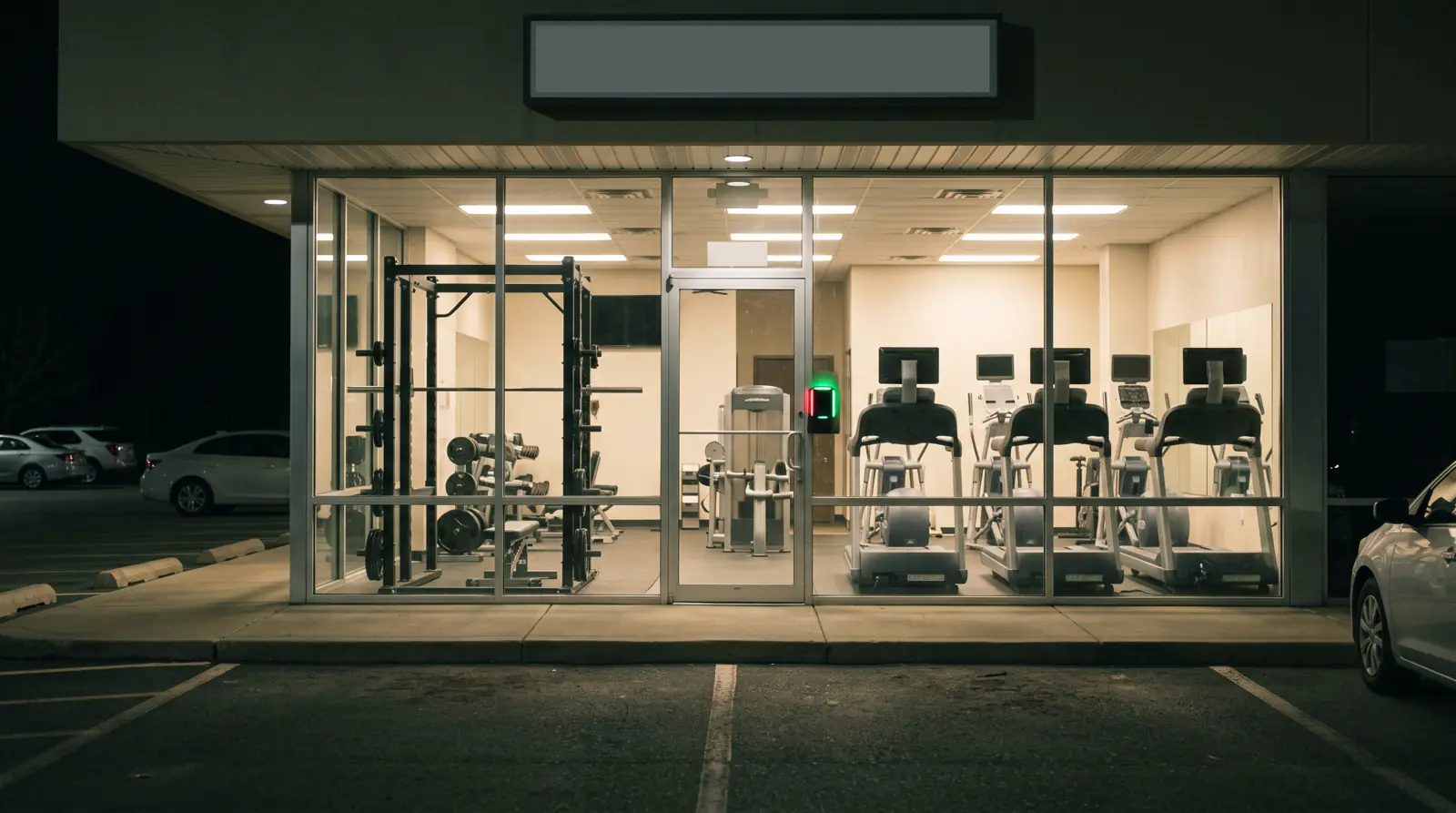
An Anytime Fitness franchise cost is $539,329 to $905,482 under the disclosure document amended September 14, 2026: leasehold work, gym equipment and the required access and security package make up most of it.
Key takeaways
- The Item 7 total for one start-up center is $539,329 to $905,482, and $91,357 to $111,462 of it is paid to the franchisor or an affiliate (Anytime Fitness Franchise Disclosure Document, issued March 31, 2026, as amended September 14, 2026, cover page and Item 7).
- Leasehold improvements run $170,280 to $417,300 for a 4,000 to 7,000 square foot “vanilla shell” space, priced at $19.08 per square foot base rent and $6.05 per square foot CAM (Item 7, Notes 1 and 4).
- The ProVision Technology System for door access, CCTV and tailgate detection costs $37,857 to $45,462 and must be bought from the franchisor’s affiliate (Items 5, 8 and 11).
- Three fixed fees total $2,541 a month at 2026 rates: $842 Monthly Fee, $900 advertising fee and $799 Base Technology Fee, and the tech fee may rise 10% a year, compounded (Item 6).
- The first term is 6 years; renewal costs $7,500 plus a remodel, and Item 6 suggests setting aside $1,000 a month for it (Items 6 and 17).
- In 2025, 72 franchised clubs left the system (39 terminations, 30 non-renewals, 3 ceased operations), 3.14% of the 2,290 open at the start of the year by our arithmetic (Item 20, Table 3).
What does the 2026 FDD say an Anytime Fitness franchise costs to build out?
The Item 7 table in the Anytime Fitness disclosure document issued March 31, 2026 and amended September 14, 2026 totals $539,329 to $905,482 for one start-up center. Leasehold improvements are the largest line at $170,280 to $417,300, then fitness equipment at $139,873 to $157,936 and the technology package at $37,857 to $45,462. Those three lines are 64.5% of the low total and 68.5% of the high total.
| Item 7 line | Low | High | Paid to | What the note adds |
|---|---|---|---|---|
| Initial franchise or development fee | $42,500 | $42,500 | Franchisor | Lump sum at signing (Note 2) |
| Travel and training | $1,500 | $2,425 | Vendors | Training in Woodbury, Minnesota is free; travel is not (Note 3) |
| Leasehold improvements | $170,280 | $417,300 | Third parties | Vanilla shell, standard tenant work only (Note 4) |
| 3 months’ rent plus security deposit | $33,500 | $58,700 | Landlord | One month’s rent as deposit (Note 4) |
| Construction management | $0 | $12,500 | Vendors | Optional today, may become mandatory (Note 4) |
| Architect and design | $12,825 | $26,075 | Architect | Designated architectural vendor (Note 5) |
| Fitness equipment | $139,873 | $157,936 | Vendors | Size and source move it (Note 6) |
| Technology equipment package | $37,857 | $45,462 | Affiliate (ProVision) | Access, security and club systems (Note 6) |
| Supplies | $3,500 | $3,800 | Vendors | Includes an AED of about $2,000 (Note 7) |
| Interior and exterior signs | $14,250 | $36,900 | Vendors | Local zoning moves it (Note 8) |
| Miscellaneous opening costs | $6,750 | $7,910 | Vendors | Utility setup, permits, legal and accounting (Note 9) |
| Pre-sale and grand opening advertising | $11,000 | $23,000 | Franchisor or vendors | Set by market tier (Note 10) |
| Insurance and bond | $2,900 | $3,450 | Vendors | Bond base rate $250 a year (Note 11) |
| Furniture and fixtures | $15,200 | $18,330 | Vendors | Before opening |
| Additional funds, 3 months | $47,394 | $49,194 | Franchisor, suppliers, utilities | Payroll for 1 trainer and 2 employees, no owner draw (Note 12) |
| Total | $539,329 | $905,482 | We re-added both columns; they match |
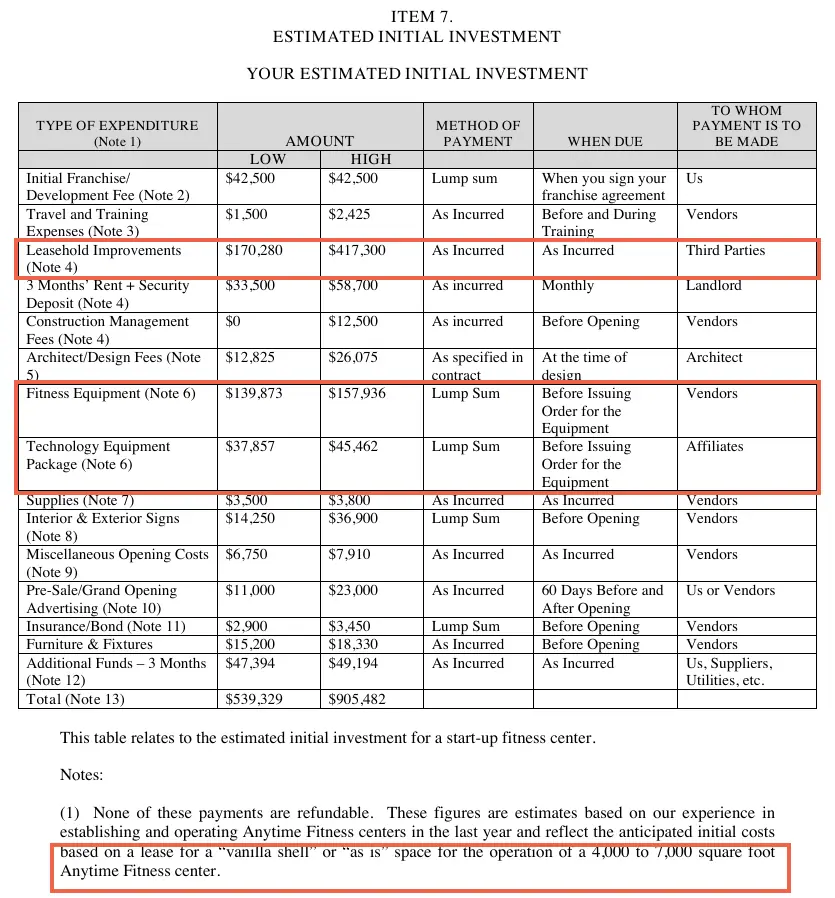
The additional funds line of $47,394 to $49,194 covers 3 months, which is the minimum period that 16 CFR 436.5(g) of the FTC Franchise Rule calls reasonable for that category. Note 12 says it includes uniforms, key fobs, the first 3 months of franchisor fees and payroll for one full-time personal trainer and 2 full-time employees, and it excludes any owner draw.
Leasehold improvements account for $247,020 of the $366,153 gap between the low and high Item 7 totals. Source: Anytime Fitness FDD issued March 31, 2026, as amended September 14, 2026, Item 7; accessed November 2, 2026.
The franchisor does not finance any part of the investment (Item 7, Note 13). If an SBA loan funds the build, Note 13 warns of SBA fees that may add 2.25% of the loan amount, plus closing costs, interest reserves and a construction contingency that the $905,482 ceiling does not include. Our guide to franchise costs explains how Items 5, 6 and 7 fit together across brands.
What size and condition of space does the Item 7 estimate assume?
Item 7 Note 1 prices a “vanilla shell” or “as is” lease of 4,000 to 7,000 square feet, and Note 4 assumes $19.08 per square foot base rent plus $6.05 per square foot CAM, the averages Anytime Fitness clubs paid in 2025. The shell must already have an office, bathrooms, studio space, concrete floors, demised exterior walls, HVAC, a roof and utilities stubbed to the premises.
| Input (Item 7, Notes 1 and 4) | 4,000 sq ft | 7,000 sq ft |
|---|---|---|
| Base rent plus CAM per sq ft per year | $25.13 | $25.13 |
| Annual rent plus CAM | $100,520 | $175,910 |
| Monthly rent plus CAM | $8,376.67 | $14,659.17 |
| 4 months (3 months plus a 1-month deposit) | $33,506.67 | $58,636.67 |
| Item 7 rent and deposit line | $33,500 | $58,700 |
| Leasehold line per sq ft, if low maps to 4,000 and high to 7,000 | $42.57 | $59.61 |
| 2025 average tenant improvement allowance at $27.23 per sq ft | $108,920 | $190,610 |
Our arithmetic rebuilds the rent and deposit line within $70 at both ends, so a larger or pricier space moves that line in a straight line: every extra 1,000 square feet at the Note 4 rates adds $8,376.67 to the 4-month figure. Note 4 also says most franchisees received a tenant improvement allowance in 2025, averaging $27.23 per square foot within a range of $0 to $75, but it does not say whether the $170,280 to $417,300 leasehold line is before or after that allowance. Ask the franchisor which.
The leasehold estimate leaves out structural modifications, site work, energy studies, surveys and exterior improvements, and it assumes the general contractor’s price already includes permit fees (Note 4). A second-generation retail box without demised walls or stubbed utilities is therefore outside the range. Item 5 adds that the franchisor supplies one Compliance Drawing free for a new center and charges $250 for each additional one, and the designated architect then prepares Construction Documents for $12,825 to $26,075 (Item 8).
Why does the access and security system have its own budget line?
Members can enter any Anytime Fitness center at any hour with a key fob or digital credential, so the franchisor requires one access, security and club technology package from its affiliate ProVision (PV Distribution LLC). Item 7 prices that package at $37,857 to $45,462, separate from the $139,873 to $157,936 fitness equipment line, and both are lump sums due before the equipment order goes in.
| Component or charge | Amount | Supplier | FDD item |
|---|---|---|---|
| ProVision Technology System (one time) | $37,857 to $45,462 | ProVision, mandatory | Items 5, 7, 11 |
| Door readers and key fobs | Inside the package | ProVision | Item 5 |
| Security and surveillance, CCTV | Inside the package | ProVision | Items 5, 11 |
| Tailgate entry detection | Inside the package | ProVision | Item 11 |
| Fitness scanning, sound system | Inside the package | ProVision | Items 5, 11 |
| Computers, iPads and networking (warranty: 12 months, core hardware) | Inside the package | ProVision | Item 11 |
| Base Technology Fee | $799 a month, up to 10% a year compounded | Franchisor or affiliate | Item 6, Note 7 |
| Access control software, security monitoring, email hosting (up to 5 addresses), cellular communications | Inside the fee | ProVision | Items 6, 11 |
| Club Management Software | Not priced in Item 6 | Designated vendor (required) | Items 8, 11 |
| Billing and payment processor | Processor’s own terms | Mandatory vendor that pays rebates to the franchisor | Item 8 |
| Support on other gear | $150 an hour (non-ProVision) | ProVision | Item 6, Note 7 |
| Tech inspection | $550 before renewal or transfer | ProVision | Item 6 |
One detail to raise before signing: Items 5 and 11 say taxes, shipping and installation are estimated at 63% of the technology package cost, while Item 7 Note 6 says 38%. The $37,857 to $45,462 range is identical in all three places, so the conflict is about how much of the package is hardware and how much is installation; a written ProVision quote that splits the two settles it.
Item 11 states there are “no limitations on the frequency and costs of hardware and software upgrades,” and the warranty covers core hardware only, for 12 months. Item 8 shows why the supplier list matters to the franchisor: required purchases produced $35,601,110 of its fiscal 2025 revenue, 22.96% of $155,027,601, while ProVision took in $29,369,478 from franchisee purchases and vendor rebates can reach 34%. Our study of franchise supplier rebates compares disclosures like these across systems.
For the gym floor itself, Item 10 names Geneva Capital as an equipment lessor on these terms:
- Up to $200,000 of equipment, security system and signage for a new location; up to $400,000, including construction, for Club Purple and Club Platinum members.
- Rates of 7% to 13% a year over 12 to 60 months, with up to 20% paid in advance and a security deposit of one month’s payment.
- A personal guaranty from every owner and each owner’s spouse.
Our research on franchise technology requirements sets the $799 tech fee next to other systems’ monthly software charges.
Who pays the full $42,500 fee, and who pays less?
A first-time buyer pays a $42,500 initial franchise fee in one lump sum when signing, and none of it is refundable (Item 5). Lower prices apply to veterans with an honorable discharge ($38,250), existing franchisees of Anytime Fitness, Orangetheory, The Bar Method or Waxing the City ($37,500), and multi-unit buyers, who prepay the whole Development Fee at signing. Fees collected in fiscal 2025 ranged from $22,500 to $42,500.
| Centers | New franchisee | Existing franchisee | Veteran | Veteran, existing | New franchisee, per center |
|---|---|---|---|---|---|
| 1 | $42,500 | $37,500 | $38,250 | $33,750 | $42,500 |
| 2 | $75,000 | $65,000 | $67,500 | $58,500 | $37,500 |
| 3 | $97,500 | $82,500 | $87,750 | $74,250 | $32,500 |
| 4 | $130,000 | $110,000 | $117,000 | $99,000 | $32,500 |
| 5 or more (each) | $27,500 | $25,000 | $27,000 | $22,500 | $27,500 |
The per-center column is our division of the Item 5 totals. The multi-unit discount comes with a penalty clause: under an Area Development Agreement, Item 6 charges $10,000 in liquidated damages for each center not developed by its deadline, and every later center is signed on the franchise agreement form in use at that time (Item 1). Existing owners in the Club Purple and Club Platinum programs pay $27,500 and $22,500 for a single additional center. Our report on veteran franchise discounts shows how the 10% veteran reduction here compares with other systems.
What leaves your account every month once the doors open?
Three fixed fees start in the first full month after opening: the $842 Monthly Fee, the $900 General Advertising and Marketing Fee and the $799 Base Technology Fee. Together they come to $2,541 a month, or $30,492 a year at 2026 rates, and the billing vendor deducts them from member dues before the balance reaches you (Item 6, Note 5).
| Item 6 fee | 2026 amount | How it can change |
|---|---|---|
| Monthly Fee (includes AF Coaching) | $842 a month | CPI adjustment each January; can be replaced on 30 days’ notice by up to 8% of Gross Revenue |
| General Advertising and Marketing Fee | $900 a month | 60 days’ notice; capped at the greater of $900 or 3% of Gross Revenue |
| Base Technology Fee | $799 a month | Up to 10% a year, compounded and cumulative |
| Local Marketing Spend | $600, $800 or $1,000 a month by market tier | Shortfalls can be collected and spent by the franchisor |
| Club Enhancement Program | $1,000 a month | Recommended set-aside for the renewal remodel; the franchisor may require it be paid in |
| Equipment Maintenance Assessment | $275 each January | Starts the January after 24 months open (Item 8) |
| Conference fee | $499 early, $749 at the event | Conference years only; capped at $1,500 |
| Continuing engagement credits | Up to $2,400 a year | $2.00 per credit short of 1,200 |
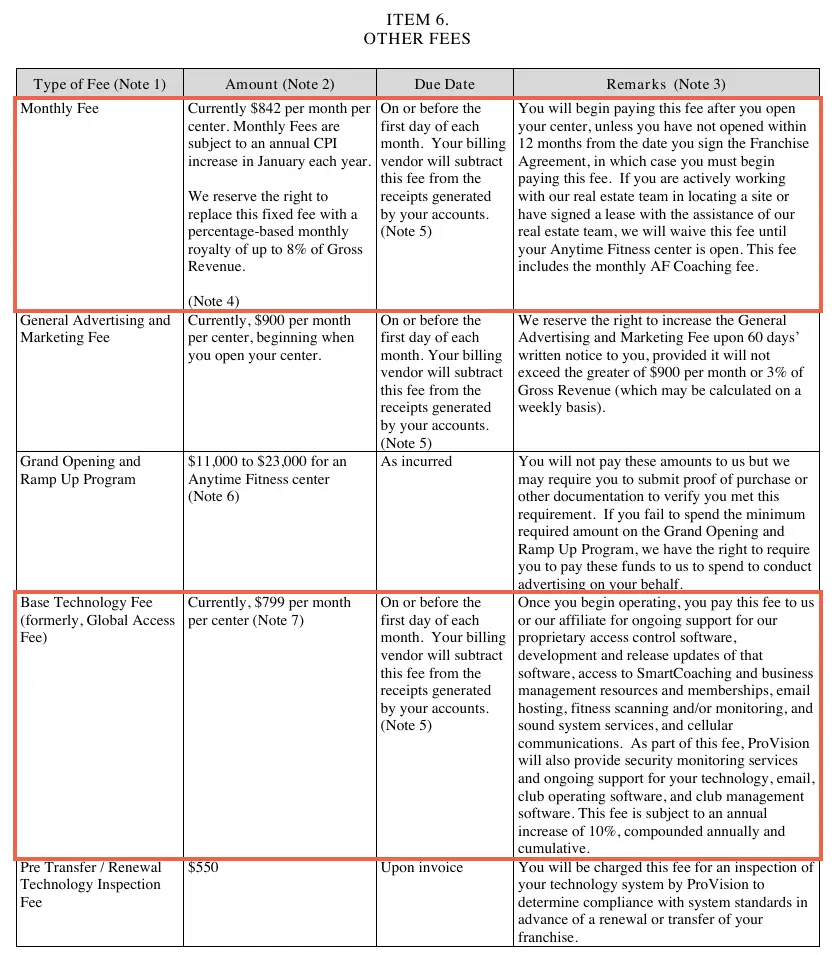
Adding the tier-based local marketing minimum takes the fixed monthly floor to $3,141 in a Tier 3 market and $3,541 in Tier 1, and funding the $1,000 Club Enhancement set-aside lifts it to $4,141 to $4,541. The franchise recruitment site lists a lower $647 monthly royalty for owners of 10 or more gyms; that tier does not appear in the Item 6 table, so ask for it in writing if it applies to you.
| Year of operation | Base Technology Fee per month if raised 10% each year | Annual cost |
|---|---|---|
| 1 | $799.00 | $9,588.00 |
| 2 | $878.90 | $10,546.80 |
| 3 | $966.79 | $11,601.48 |
| 4 | $1,063.47 | $12,761.63 |
| 5 | $1,169.82 | $14,037.79 |
| 6 | $1,286.80 | $15,441.57 |
| 6-year term | Flat at $799: $57,528 | $73,977.27 |
The table is our arithmetic at the maximum increase Note 7 permits, rounded to the cent; the franchisor may raise it by less or not at all, and Note 7 lets skipped increases be caught up later. Item 6 Note 4 is the larger long-run variable: the switch from a flat $842 to a royalty of up to 8% of Gross Revenue would tie the fee to member dues and to personal training, nutrition, recovery and retail sales.
Does the club really have to run 24 hours with no one at the desk?
System standards call for 24-hour access, but the franchise agreement lets the franchisor consent to shorter hours where state or local law requires a staff member on site whenever members are training. Items 1 and 15 also require every center to be staffed for a minimum number of hours per week; the FDD does not print that number, which sits in the operations manual.
- Staffing: a minimum of staffed hours each week, plus personal training and small or large group training delivered by you or qualified staff (Item 1). The franchisor may also require a telephone answering service for unstaffed hours.
- Safety gear: an AED of about $2,000, counted inside the $3,500 to $3,800 supplies line (Item 7, Note 7).
- Insurance: general liability of $1,000,000 per person and per occurrence and $3,000,000 in the aggregate (Item 8). Note 11 tells buyers to confirm before buying that insurance is available “given that you will not staff the premises all of the time.”
- Member prepayments: a health club surety bond from a designated vendor, at a negotiated base rate of $250 a year (Item 7, Note 11).
- Payroll: the 3-month additional funds line assumes no local law requires a full-time on-site staff member (Item 7, Note 12).
Minnesota, the franchisor’s home state, shows what a state health club law adds. Minnesota Statutes section 325G.27 requires each club to register with the attorney general for a $250 fee, renew for $150 every September 1, and carry a surety bond no smaller than its outstanding liabilities to members. Section 325G.26 voids membership contracts longer than 18 months from signing, which limits how far ahead a club can sell prepaid memberships.
When does each bill arrive between signing and renewal?
Most of the cash leaves in the 9 to 12 months between signing and opening, the typical span Item 11 gives. Three later costs are easy to miss: the $842 Monthly Fee can start at month 12 even if the club is not open, selective cardio replacement is expected in years 5 to 7, and renewal at the end of the 6-year term requires a remodel plus a $7,500 fee.
| When | Event | Cost or rule | FDD item |
|---|---|---|---|
| Month 0 | Sign, pay the $42,500 fee | Franchise Agreement signed | Item 5 |
| By month 6 | Lease expected | Rent and deposit line: $33,500 to $58,700 | Items 7, 11 |
| Opening minus 60 days | Grand opening spend starts | $11,000 to $23,000 by market tier | Item 6 |
| Months 9 to 12 | Typical opening | Monthly Fee, ad fee and Base Technology Fee begin | Items 6, 11 |
| Month 12 | Opening deadline; Monthly Fee starts if not open | Waived while working with the franchisor’s real estate team | Item 11 |
| Opening plus 60 days | Ramp-up spend ends | Local Marketing Spend of $600 to $1,000 a month follows | Item 6 |
| January after 24 months open | $275 equipment assessment | Then every January | Item 8 |
| Years 5 to 7 | Selective cardio replacement | Expected under current standards | Item 6, Note 14 |
| Year 6 | Term ends; $7,500 renewal fee and remodel | Renewal is for 5 years | Items 6, 17 |
| About year 10 | Strength equipment replacement | Expected under current standards | Item 6, Note 14 |
Missing the opening deadline is a default that lets the franchisor terminate and keep everything paid to it and its affiliates (Item 11). Renewal also requires signing the then-current agreement, which “may contain materially different terms,” and showing the right to stay in the premises for the 5-year renewal term (Item 17, row c). Our guide to reading a franchise disclosure document shows where each of these items sits.
How many clubs leave the system each year, and can you buy one already open?
The FDD publishes no failure rate. Item 20 shows that 72 franchised clubs left the system in 2025 through 39 terminations, 30 non-renewals and 3 that ceased operations, against 53 openings; that equals 3.14% of the 2,290 franchised clubs open at the start of the year, our arithmetic. Franchised clubs fell from 2,318 to 2,271 between the start of 2023 and the end of 2025.
| Year | Franchised at start | Opened | Terminations | Non-renewals | Ceased operations | At year end | Exits as % of start | Transfers to new owners |
|---|---|---|---|---|---|---|---|---|
| 2023 | 2,318 | 47 | 42 | 25 | 0 | 2,298 | 2.89% | 243 |
| 2024 | 2,298 | 46 | 33 | 21 | 0 | 2,290 | 2.35% | 207 |
| 2025 | 2,290 | 53 | 39 | 30 | 3 | 2,271 | 3.14% | 169 |
72 franchised clubs left the system in 2025, against 53 openings. Source: Anytime Fitness FDD issued March 31, 2026, as amended September 14, 2026, Item 20, Table 3; accessed November 2, 2026.
Item 20 does not say how many of the terminated or non-renewed clubs closed their doors and how many kept operating under another name, so the exit column is an upper bound on closures, not a count of them. Table 5 lists 154 franchise agreements signed but not yet open at December 31, 2025, and 38 projected franchised openings for 2026. Our franchise closure rate study sets exit counts like these against other systems.
Transfers outnumber exits in every year shown: 169 clubs changed hands in 2025. Buying an open club brings a $9,999 transfer fee owed by the seller, a $550 technology inspection and $4,000 for 2 to 6 days of required on-site relaunch training within 180 days of closing, and may face renovation or re-equipment requirements (Items 6 and 11). Our franchise transfer fee report compares that $9,999 charge with other brands.
Item 19 of the same FDD has three sections: historical revenue for centers using AF Coaching, centers using the Coaching Dashboard, and a revenue and expense statement built from company-owned centers. This site does not reproduce those figures; read Item 19 in the filing itself, and see our study of Item 19 disclosures for what such tables can and cannot show.
Which published cost figures no longer match the September 2026 filing?
Several cost pages that rank for this search still quote 2024 or 2025 numbers or attach the wrong name to a fee. Anytime Fitness filed a new disclosure document in Minnesota in April 2026 and an amended one in September 2026, so each claim below is checked against the amended version, issued March 31, 2026 and amended September 14, 2026.
| Topic | What some guides say | What the 2026 FDD says | Source |
|---|---|---|---|
| Total investment | $397,516 to $973,121 (a franchise data site using the 2024 FDD) | $539,329 to $905,482 | FDD Item 7 |
| Royalty | “$799 per month” | $799 is the Base Technology Fee; the Monthly Fee is $842 | FDD Item 6 |
| Marketing fee | $600 per month brand fund | $900 General Advertising and Marketing Fee | FDD Item 6 |
| Club size | 3,500 to 6,500 square feet (a consultant directory) | 4,000 to 7,000 square feet | FDD Item 7, Note 1; Item 11 |
| Failure rate | 3% in year one, 10% by year three (a lending site, no source given) | No rate published; 72 franchised exits in 2025 | FDD Item 20, Table 3 |
| Royalty type | A percentage of gross sales | Flat $842 today, with a right to switch to up to 8% of Gross Revenue | FDD Item 6, Note 4 |
The capital screen has not changed: the Anytime Fitness franchise requirements page lists a $380,000 minimum net worth and $225,000 in liquid capital for its ideal candidate, as of November 2026. Investment ranges for other gym systems filed in the same disclosure format are collected in our fitness franchise statistics report. A different gym format with a much larger box and multi-club development rules is covered in our Planet Fitness franchise cost breakdown.
Which line should you price first for your own site?
Price the leasehold first. Item 7 swings by $247,020 between the low and high leasehold estimates, more than the $119,133 gap across every other line combined, and that swing comes from your space’s size and condition. The market tier, set by population within 3 miles, then fixes your grand opening and monthly marketing minimums.
| If your situation is | Then budget or do this | FDD basis |
|---|---|---|
| More than 50,000 people within 3 miles (Tier 1) | $23,000 grand opening, then $1,000 a month local marketing | Item 6, Notes 6 and 15 |
| 25,000 to 49,999 people within 3 miles (Tier 2) | $16,000 grand opening, then $800 a month | Item 6, Notes 6 and 15 |
| Fewer than 25,000 people within 3 miles (Tier 3) | $11,000 grand opening, then $600 a month | Item 6, Notes 6 and 15 |
| Space lacks HVAC, demised walls or stubbed utilities | Get a contractor bid before signing a lease; structural and site work fall outside $417,300 | Item 7, Note 4 |
| Landlord offers no tenant improvement allowance | Ask whether the leasehold range assumed one; the 2025 average was $27.23 per sq ft | Item 7, Note 4 |
| Local law requires staff during all open hours | Request consent for shorter hours and budget payroll beyond 1 trainer and 2 employees | Franchise Agreement; Item 7, Note 12 |
| Honorably discharged veteran | Fee of $38,250 instead of $42,500 | Item 5 |
| Planning 2 clubs | $75,000 Development Fee at signing; $10,000 for each club not built on schedule | Items 5, 6 |
| Buying an open club | $9,999 transfer fee, $550 tech inspection, $4,000 relaunch training | Items 6, 11 |
| Leasing the equipment | Geneva Capital up to $200,000 at 7% to 13%, with owner and spouse guaranties | Item 10 |
This page summarizes public filings and is not legal, financial or investment advice. Before signing, ask a franchise attorney to read Items 6, 11 and 17 against the agreement, and ask an accountant to rebuild the rent and fee lines with your landlord’s real per-square-foot quote.
How we compiled this
In November 2026 we read the 491-page Anytime Fitness Franchisor LLC disclosure document issued March 31, 2026 and amended September 14, 2026 (Minnesota file 10062), 16 CFR 436.5, Minnesota Statutes sections 325G.26 and 325G.27, and the brand’s franchise requirements page: 5 primary documents. We re-added the Item 7 columns, rebuilt the rent line from Note 4 and did the fee and Item 20 arithmetic ourselves. Every Item 19 figure was left out under our site rule, and no third-party failure or profit estimate was used.
Frequently asked questions
Is Anytime Fitness a franchise?
Yes. Anytime Fitness Franchisor LLC, a Delaware company in Woodbury, Minnesota formed in 2021, franchises the clubs, and its predecessor began franchising in October 2002. At the end of 2025 the U.S. system had 2,271 franchised and 11 company-owned clubs, according to Item 20 of the FDD amended September 14, 2026. Purpose Brands has been the indirect parent since April 2, 2024.
How much does it cost to open an Anytime Fitness?
Item 7 of the 2026 FDD estimates $539,329 to $905,482 for one start-up center in a 4,000 to 7,000 square foot vanilla shell space. Leasehold work of $170,280 to $417,300 drives most of the spread. The estimate excludes structural work, site work, SBA loan fees and any owner draw during the first 3 months.
What is the Anytime Fitness franchise fee?
The standard initial franchise fee is $42,500, paid in full and nonrefundable at signing. Veterans with an honorable discharge pay $38,250, and existing franchisees of Anytime Fitness or its affiliated brands pay $37,500. A 2-club development deal costs $75,000 up front, according to Item 5 of the FDD issued March 31, 2026.
What is the Anytime Fitness franchise failure rate?
The FDD does not state one. Item 20 counts 39 terminations, 30 non-renewals and 3 clubs that ceased operations in 2025, a combined 72 exits or 3.14% of the 2,290 franchised clubs open on January 1, by our arithmetic. Item 20 does not separate closed clubs from those still operating outside the system.
Can you buy an Anytime Fitness franchise that is already open?
Yes. Item 20 records 169 transfers of franchised clubs to new owners in 2025. The buyer must be approved, a $9,999 transfer fee applies to an open club, ProVision charges $550 to inspect the technology, and new owners pay $4,000 for 2 to 6 days of required on-site relaunch training within 180 days of closing.
How much money can an Anytime Fitness owner earn?
This site does not publish earnings figures. Item 19 of the 2026 FDD contains historical revenue data for clubs using AF Coaching and the Coaching Dashboard, plus a statement built from company-owned clubs. Owner income depends on rent, payroll, the fixed fees in Item 6 and the build-out debt from Item 7, so compare Item 19 against those lines.
How much cash do you need to qualify for an Anytime Fitness franchise?
The brand’s franchise requirements page lists a minimum net worth of $380,000 and $225,000 in liquid capital for its ideal candidate, as of November 2026. Lenders and Geneva Capital, the equipment lessor named in Item 10, also require personal guaranties, and Geneva asks each owner’s spouse to sign one as well.
Sources
- Anytime Fitness Franchise Disclosure Document, issued March 31, 2026, as amended September 14, 2026, Anytime Fitness Franchisor LLC, Items 1, 5 to 8, 10 to 12, 15, 17, 19 and 20 and the Franchise Agreement, Minnesota Department of Commerce CARDS, accessed November 2, 2026.
- 16 CFR 436.5, Disclosure items (FTC Franchise Rule), Electronic Code of Federal Regulations, accessed November 2, 2026.
- A Consumer’s Guide to Buying a Franchise, Federal Trade Commission, accessed November 2, 2026.
- Minnesota Statutes section 325G.27, Registration requirements, surety bond requirement, alternative security, Office of the Revisor of Statutes, accessed November 2, 2026.
- Minnesota Statutes section 325G.26, Limitation on membership period, Office of the Revisor of Statutes, accessed November 2, 2026.
- What It Takes to Be an Anytime Fitness Franchisee, Anytime Fitness, accessed November 2, 2026.