A Dave’s Hot Chicken franchise is sold as an area development agreement for at least three restaurants: an $80,000 Development Fee at signing, then $616,800 to $4,121,900 per restaurant, depending on format (2026 FDD, Items 5 and 7).
Key takeaways
- Under the Dave’s Hot Chicken Franchise Disclosure Document, issued May 4, 2026, the franchisor offers “Area Development Franchises” for “a minimum of three” restaurants; single-unit deals are offered “in certain situations, such as” non-traditional restaurants and food trucks (Cover, Item 1).
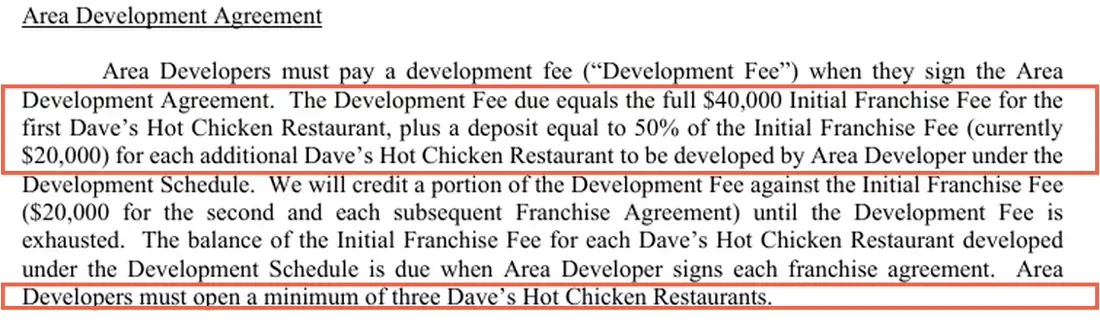
- The Development Fee is the full $40,000 fee for restaurant 1 plus a $20,000 deposit for each added restaurant, so the three-restaurant minimum costs $80,000 up front, non-refundable even if nothing opens (Item 5).
- Each open restaurant pays a 6% royalty, a 4% Creative Fund contribution that may rise to 5%, and a 1% local advertising minimum, all on weekly Gross Sales (Item 6).
- Franchised outlets rose from 233 to 348 in 2025, with 117 openings and 52 signed agreements not yet open at December 31, 2025 (Item 20).
- The company’s own franchise page asks for $2,500,000 in liquid assets, $5,000,000 in net worth and “5 or more restaurants”, a higher unit count than the FDD’s three (franchise.daveshotchicken.com, accessed November 3, 2026).
| Key number | Figure | Where it is printed |
|---|---|---|
| Minimum restaurants under an area development agreement | 3 | Cover; Items 1 and 5 |
| Development Fee, 3 restaurants | $80,000 | Item 7, Area Development Franchise table |
| Initial Franchise Fee per traditional restaurant | $40,000 | Item 5 |
| Item 7, freestanding restaurant | $823,800 to $4,121,900 | Item 7 |
| Item 7, in-line or endcap restaurant | $616,800 to $2,632,500 | Item 7 |
| Item 7, first restaurant under an ADA (incl. Development Fee) | $656,800 to $4,161,900 | Item 7 |
| Royalty plus Creative Fund plus local advertising | 6% + 4% + 1% of Gross Sales | Item 6 |
| Financial performance representation | None made | Item 19 |
Is Dave’s Hot Chicken a franchise you can buy one restaurant of?
Dave’s Hot Chicken is franchised, but the standard offer is a multi-unit commitment. The May 4, 2026 FDD says the franchisor “primarily” offers Area Development Franchises for a minimum of three restaurants and “may offer” single-restaurant franchises “in certain situations, such as non-traditional restaurants and branded food truck restaurants” (Cover). Item 1 adds that the franchisor itself owns no restaurants; its predecessor operates 10 in California.
The FDD defines three formats. Traditional Restaurants sit in stand-alone buildings or retail centers and typically run 2,000 to 3,000 square feet (Item 7, Note 3). Non-Traditional Restaurants sit inside a host venue such as an airport, stadium, college or casino, typically 1,000 to 1,800 square feet, and get no protected territory (Items 1 and 12). DHC Food Trucks are sold only to franchisees who already signed a franchise agreement and an area development agreement (Item 1).
Unless agreed otherwise, non-traditional restaurants and food trucks do not count toward the development schedule (Item 1). A buyer who wants a single airport unit is in a different negotiation from a buyer signing for a metro area. Every buyer must receive the FDD at least 14 calendar days before signing or paying, under 16 CFR 436.2(a); how to read the 23 Items is covered in our guide to the franchise disclosure document.
How is the area development fee for Dave’s Hot Chicken calculated?
The Development Fee equals the full $40,000 Initial Franchise Fee for restaurant 1 plus a deposit of 50% of that fee, currently $20,000, for each added restaurant in the schedule (Item 5, p.17). The franchisor credits $20,000 of the fee against each later franchise agreement and collects the other $20,000 when that agreement is signed. The fee is non-refundable “even if an Area Developer fails to open any” restaurant (Item 5, p.18).
| Restaurants committed | Development Fee at ADA signing | Balance due as later agreements are signed | Opening fees if you are not self-certified | Total paid in initial and opening fees |
|---|---|---|---|---|
| 3 (minimum) | $80,000 | 2 x $20,000 = $40,000 | 2 x $15,000 = $30,000 | $150,000 |
| 4 | $100,000 | 3 x $20,000 = $60,000 | $30,000 + $40,000 = $70,000 | $230,000 |
| 5 | $120,000 | 4 x $20,000 = $80,000 | $30,000 + 2 x $40,000 = $110,000 | $310,000 |
| 6 | $140,000 | 5 x $20,000 = $100,000 | $30,000 + 3 x $40,000 = $150,000 | $390,000 |
The table is our arithmetic from Item 5 and assumes today’s fees for every later agreement; Item 1 says each added restaurant is signed on the “then-current form” of franchise agreement, and Item 6, Note 1 lets fixed-dollar fees rise with the Consumer Price Index once per calendar year. In the fiscal year ended January 4, 2026, the franchisor collected Development Fees of $30,000 to $140,000 (Item 5). The $140,000 top matches the formula for six restaurants, though Item 5 does not say how many restaurants that agreement covered.
How does that compare with other development fees?
Against a 259-FDD sample, Dave’s Hot Chicken asks for a larger deposit share and a higher minimum. Our study of area development agreements in 259 FDDs found a median per-unit deposit of $18,000 across 54 filings, a median of 40% of the first unit’s fee, and a median minimum of 2 units. A publicly traded chicken franchisor discloses its own terms in its annual report.
| Term | Dave’s Hot Chicken (FDD May 4, 2026) | Wingstop (Form 10-K, FY2025) | 259-FDD study (2025 to 2026 filings) | Source |
|---|---|---|---|---|
| Development fee basis | $40,000 for restaurant 1 plus $20,000 per added restaurant | “$10,000 development fee per restaurant to-be-developed” | Per-unit deposit median $18,000 (54 FDDs) | FDD Item 5; Wingstop 10-K, Item 1; our study |
| Per-restaurant franchise fee | $40,000 | $20,000 | Deposit median 40% of first fee | Same |
| Refundable? | No | “not refundable” | Non-refundable in 94.4% | Same |
| Minimum units | 3 | Not stated in the 10-K | Median 2; 29 of 99 stating a minimum required 3 | Same |
| Royalty | 6% of Gross Sales | 6.0% of gross sales net of discounts | See our royalty study | FDD Item 6; 10-K |
| Brand or ad fund | 4%, may rise to 5%, plus 1% local | 5.5% Ad Fund | Not compared here | Same |
The cross-brand royalty spread sits in our franchise royalty rates report, and the full Wingstop fee ledger is in our Wingstop franchise cost breakdown. Listed alphabetically and not ranked.
What deadlines does the development schedule set?
The 2026 FDD prints the deadline rules but leaves the dates blank: Exhibit B of the Area Development Agreement is a form with “Development Period Ending” cells filled in per deal. The fixed rules are a 90-day site search for restaurant 1, opening within 12 months of each franchise agreement, early signing of later agreements and paid extensions capped at 12 months (Items 5, 11 and 17).
| Step | Deadline | Where it is printed |
|---|---|---|
| Sign the ADA and franchise agreement 1; pay the Development Fee | Same day; $80,000 for 3 restaurants | Item 5; Item 11 |
| Find an acceptable site for restaurant 1 | 90 days after signing | Item 11 |
| Submit the lease for review | Within 70 days of site acceptance (acceptance valid 70 days) | Item 11 |
| Sign the lease or purchase agreement | Earlier of 150 days after site acceptance or 14 days before construction | ADA section 2.2 |
| Open each restaurant | Within 12 months of its franchise agreement; typical 11 to 12 months | Item 11 |
| Sign franchise agreements 2 and 3 | Earlier of 7 days after site acceptance or 180 days before the period ends | Item 1; ADA section 2.2 |
| Request an extension | 90 days before the period ends; $5,000 per month; 12 months maximum | Item 5; ADA section 2.1.2 |
| ADA term | Typically 5 years or until the last agreement is signed; no renewal | Item 17 |
One timing line differs inside the document: Item 11 says area developers sign each later franchise agreement “within 60 days” of site acceptance, while Item 1 and ADA section 2.2 say 7 days. A buyer can ask franchise counsel which clause controls before signing. Across franchising, the typical gap from signing to opening is tracked in our report on how long it takes to open a franchise.
What happens if the schedule slips?
A missed development obligation is a default that “cannot be cured” under the Area Development Agreement (Item 17, row h). The franchisor may then end the remaining development rights or shrink the Development Area (ADA section 3.1). Open restaurants keep their franchise agreements “absent a breach of the Franchise Agreement itself” (Item 12).
Item 17 adds that certain ADA defaults are uncurable under the franchise agreement “in the case of a cross-default”, so ask counsel how the two agreements interact for your units. Extension fees run $5,000 per month per restaurant, prepaid and non-refundable (Item 5).
What does the Development Area protect?
During the ADA term, the franchisor will not open or license another Traditional Restaurant in your Development Area, which may be cities, counties or states (Item 12). The area is not exclusive: Non-Traditional Restaurants, food trucks, pre-existing restaurants and delivery channels can still compete. Each opened restaurant then gets its own Territory, generally a 0.5-mile radius in urban markets and at least 2 miles in suburban ones.
After the ADA expires, the franchisor may develop anywhere in the former area, subject only to each open restaurant’s Territory (Item 12). The franchisor also keeps grocery, catering, internet and delivery sales in your area without compensation, and you may be required to use its national third-party delivery contract (Item 12). How these terms compare across brands is in our franchise territory rights study.
Can a developer sell one restaurant later?
Usually not on its own. A developer with three or fewer restaurants must transfer all of them, and one with more than three must transfer at least 50%; unopened ADA development rights cannot be transferred (Item 6, Note 7). The transfer fee is 50% of the then-current initial fee per restaurant, and the seller signs a one-year non-compete covering 10 miles around every Dave’s Hot Chicken restaurant (Items 6 and 17).
What does a three-restaurant commitment add up to?
Item 7 prices one restaurant at a time, so the three-restaurant minimum needs arithmetic. Using the FDD’s own lines, three in-line restaurants at the low estimate total $1,880,400 and three freestanding restaurants at the high estimate total $12,365,700, before real estate purchases, tenant allowances or price changes on later agreements. The franchisor offers no financing (Item 10).
| Line | Low: in-line or endcap | High: freestanding | Basis |
|---|---|---|---|
| Development Fee at ADA signing | $80,000 | $80,000 | Item 5; Item 7 ADA table |
| Restaurant 1, Item 7 less the $40,000 fee already paid | $576,800 | $4,081,900 | Item 7 ADA table |
| Restaurant 2: $20,000 fee balance, Item 7 less $40,000, plus $15,000 opening fee at the low end | $611,800 | $4,101,900 | Items 5 and 7 |
| Restaurant 3: same as restaurant 2 | $611,800 | $4,101,900 | Items 5 and 7 |
| Three restaurants, our arithmetic | $1,880,400 | $12,365,700 | Sum of rows |
Three Item 7 notes move these totals. Construction runs $275,000 to $1,180,000 in-line and $475,000 to $2,315,900 freestanding, and franchisees “have reported tenant improvement allowances as high as $340,000” freestanding and $250,000 in-line, which the estimates exclude (Note 3). The estimates assume a leased existing building, not a ground-up build (Note 3). Additional funds cover only three months, $16,300 to $48,000, and exclude any owner salary (Note 13).
Item 7 ranges from $263,150 for a food truck to $4,161,900 for the first restaurant under an area development agreement. Dave’s Hot Chicken FDD issued May 4, 2026, accessed November 3, 2026.
Why is restaurant 4 more expensive to open than restaurant 2?
The New Restaurant Opening Fee steps up with count: $0 for restaurant 1, $15,000 each for restaurants 2 and 3, and $40,000 for each restaurant after the third (Item 5). It is waived once the developer runs its own certified trainer, certified restaurant managers, NRO Leader and certified training restaurant. Staffing also steps: six managers at the first restaurant in a new Development Area for 30 days, four at later ones (Item 15).
| Restaurant number | Initial fee cash | New Restaurant Opening Fee | Managers, first 30 days | Franchisor on-site opening team |
|---|---|---|---|---|
| 1 | $40,000 inside the Development Fee | $0 | 6 | Yes, up to 2 weeks |
| 2 | $20,000 deposit + $20,000 at signing | $15,000 | 4 | Yes, up to 2 weeks |
| 3 | $20,000 deposit + $20,000 at signing | $15,000 | 4 | Yes, up to 2 weeks |
| 4 and later | $20,000 deposit + $20,000 at signing | $40,000 | 4 | Yes, for the $40,000 fee unless self-certified |
Which fees come out of each restaurant’s weekly sales?
Each Dave’s Hot Chicken restaurant pays 6% of Gross Sales as royalty every Wednesday, plus a 4% Creative Fund contribution that the franchisor may raise to 5% on 30 days’ notice, plus a 1% local advertising minimum (Item 6). That is 11% of Gross Sales before rent, labor and food, or 12% if the fund rises. Fixed fees add $556 a month and a $170 to $500 weekly technology fee.
| Fee | Amount | When | Item |
|---|---|---|---|
| Continuing Royalty | 6% of Gross Sales | Weekly, Wednesday | Item 6 |
| Creative Fund Contribution | 4% of weekly Gross Sales, may rise to 5%; 1% at airport non-traditional sites | With royalty | Item 6 |
| Local advertising requirement | 1% of weekly Gross Sales; shortfall paid to the fund | Annual true-up | Item 6 |
| Advertising cooperative (none formed yet) | 0.5% to 2% of Gross Sales | If established | Item 6, Note 3 |
| Technology and Operations Fee | $170 to $500 per week; high end capped at +20% per calendar year | Weekly, Thursday | Item 6 |
| Food Safety Assessment, Mystery Shopper, Guest Response | $100 + $256 + $200 = $556 per month | Monthly or weekly | Item 6 |
| NRO Media Fee | $22,000 once (not airports) | Within 1 week of opening | Item 6 |
| Grand Opening Advertising | $10,000 to $12,000 | Within 1 week of opening | Item 6 |
| Annual conference | $500 to $1,500, due even if absent | 30 days after notice | Item 6 |
| Transfer fee; renewal fee | 50% of the then-current initial fee each | At transfer or renewal | Item 6 |
Item 6, Note 1 says earlier developers “may be paying lower fees in some categories” because the predecessor negotiated reduced royalties and fund contributions for some area developers, so an existing operator’s rates are not a guide to a new contract. Gross Sales counts third-party delivery orders at the time the customer is charged, and unapproved delivery-app discounts do not reduce it (Item 6, Note 2).
Who qualifies, according to the company and the FDD?
The two documents set different bars. The company’s franchise page asks for $2,500,000 in liquid assets, $5,000,000 in net worth, 5 or more restaurants and a current portfolio of 5 or more QSR or fast casual franchise units in the target market. The FDD sets a three-restaurant minimum and adds operating rules: an owner-operator with at least 10% equity, a Director of Operations and a 75% debt ceiling.
| Requirement | Company franchise page (accessed Nov 3, 2026) | FDD issued May 4, 2026 |
|---|---|---|
| Liquid assets | $2,500,000 | Not stated |
| Net worth | $5,000,000 | Not stated; a franchisee taking over a lease must have $1,000,000 net worth and 3 other units (Exhibit I-6) |
| Restaurants to develop | 5 or more (international: 30+) | Minimum of 3 (Items 1 and 5) |
| Current operating record | 5+ QSR or fast casual franchise units in the market | Operating Principal meets “educational, experience, financial” criteria in the manual (Item 15) |
| Fried chicken interests | No current ownership in a fried chicken concept | Non-compete covers Nashville hot chicken or 20%+ of sales from fried chicken (Item 17) |
| Debt limit | Not stated | Debt to capital employed no higher than 75% (Franchise Agreement section 20.1) |
| Guarantees | Not stated | Owners and their spouses sign the Continuing Guaranty (Item 15) |
The Operating Principal must devote 100% of working time to the business unless the franchisor agrees otherwise, and a developer with more than one restaurant needs a Director of Operations (Item 15). Ask the development team which page governs the unit count for your market, because the FDD is the document the 14-day rule attaches to.
What did the 2025 Roark deal change in the franchise documents?
On June 2, 2025, Dave’s Hot Chicken announced it “has chosen an investment from Roark”, the Atlanta firm with $40 billion in equity under management (company release via GlobeNewswire). The Associated Press reported a deal “valued at $1 billion” (AP, June 3, 2025). The FDD then shows a new franchisor entity, a securitization and Roark-fund control.
| Date | Event | Source |
|---|---|---|
| March 2019 | Predecessor Dave’s Hot Chicken Franchise Co. LLC begins offering franchises | FDD Item 1 |
| May 2025 | Predecessor acquires 5 franchised restaurants from the founders | FDD Item 1 |
| June 2, 2025 | Company announces Roark investment; expects more than 400 restaurants by year end and reports rights sold for more than 1,000 locations | Company release |
| July 1, 2025 | Dave’s Hot Chicken Franchise Co. SPV LLC organized in Delaware | FDD Item 1 |
| September 2025 | Securitization closes; all franchise and development agreements and trademarks move to the new franchisor | FDD Item 1 |
| September 26, 2025 | New franchisor begins offering franchises | FDD Item 1 |
| May 4, 2026 | Current FDD issued; audited statements cover the fiscal year ended January 4, 2026 | FDD Cover; Item 21 |
Three practical effects follow from Item 1. The predecessor now acts as manager and franchise sales agent under a Management Agreement, while the SPV franchisor stays responsible for every promised service. A separate affiliate, Dave’s Hot Chicken Supply Chain SPV LLC, runs the supply chain. Item 12 says other Roark-fund portfolio companies “may operate and/or franchise businesses that sell similar goods or services”. Item 3 lists only affiliate matters, none against the Dave’s Hot Chicken franchisor. Fund ownership across 259 franchisors is mapped in our private equity franchise ownership report.
How many Dave’s Hot Chicken restaurants opened in 2025?
Item 20 counts 117 franchised openings in 2025, taking franchised outlets from 233 to 348, and company-owned outlets from 5 to 10, for 358 in total at December 31, 2025. Two franchised outlets ceased operations for other reasons, 25 changed hands between franchisees, and 52 signed agreements had not opened. The franchisor projects 131 franchised openings in the following fiscal year (Item 20, Tables 1 to 5).
Franchised outlets grew from 157 to 348 between the ends of 2023 and 2025, with 117 openings in 2025. Dave’s Hot Chicken FDD issued May 4, 2026, Item 20, accessed November 3, 2026.
| Year | Franchised at start | Franchised opened | Ceased, other reasons | Franchised at end | Company-owned at end | Transfers |
|---|---|---|---|---|---|---|
| 2023 | 88 | 70 | 1 | 157 | 6 | 1 |
| 2024 | 157 | 77 | 1 | 233 | 5 | 5 |
| 2025 | 233 | 117 | 2 | 348 | 10 | 25 |
Two notes shape these counts. Item 20, Note 1 reclassifies 13 restaurants from company-owned to franchised, including 6 owned by an officer and 6 formerly owned by the founders; the affiliate reacquired those 6 in May 2025 and closed one. Item 20 also says franchisees “have signed confidentiality clauses” in the past three years, so some former owners may decline to talk. The 52-unit backlog compares with a median of 13 among the 126 development-agreement franchisors in our area development study; backlog patterns by system size are in our franchise development backlog research.
Which published Dave’s Hot Chicken figures disagree with the FDD?
Four figures in circulation do not match the May 4, 2026 FDD. The largest gap is the company’s own landing page, which lists a per-restaurant range topping out at $1,963,000 while Item 7 runs to $4,121,900 for a freestanding restaurant, and which asks for five restaurants against the FDD’s three. Other guides misstate the marketing fund and the start date of franchising.
| Figure in circulation | Where seen | What the May 4, 2026 FDD says |
|---|---|---|
| “$619,800 to $1,963,000 per Restaurant” | Company franchise page, accessed Nov 3, 2026 | $616,800 to $2,632,500 in-line; $823,800 to $4,121,900 freestanding (Item 7) |
| “Required to develop 5 or more restaurants” | Company franchise page | “a minimum of three” (Items 1 and 5) |
| Marketing fund of about 2% | A lender’s cost guide, updated July 2026 | Creative Fund 4%, may rise to 5%, plus 1% local (Item 6) |
| Initial investment of $615,800 to $1.8 million | A franchise trade article, July 2024 | $616,800 to $4,121,900 by format (Item 7) |
| Franchising since 2018 | A franchise directory listing | Predecessor offered franchises from March 2019 (Item 1) |
Does a Dave’s Hot Chicken development deal fit your situation?
The FDD and the company page point to one buyer profile: an existing multi-unit restaurant operator with capital for at least three restaurants, a management bench of six for the first opening, and no fried chicken holdings. The table maps common starting points to the FDD clause that decides them. This is general information, not legal, financial or investment advice.
| If your situation is | Then | Clause that decides it |
|---|---|---|
| You can fund one restaurant but not three | The standard ADA route does not fit; ask whether a non-traditional single site is available | Cover; Item 1 |
| Three in-line restaurants at the low estimate (about $1,880,400) exceed your capital plus borrowing | Size the plan to all three; a missed schedule is a non-curable ADA default | Items 7 and 17 |
| You hold any stake in a fried chicken restaurant | The company page excludes current fried chicken owners, and the non-compete bars them during the term | Item 17, row q; company page |
| Your group’s debt exceeds 75% of capital employed | Restructure first; the ratio is a franchise agreement covenant | Franchise Agreement section 20.1 |
| You may want to sell one restaurant within a few years | Plan to sell all of them, or at least half once past three | Item 6, Note 7 |
| You want an urban site | Expect a 0.5-mile Territory; suburban sites get at least 2 miles | Item 12 |
| You will need lender financing | Arrange it outside the system; the franchisor offers none | Item 10 |
| You want income figures before signing | Item 19 has none; build projections from Items 6 and 7 and franchisee calls | Item 19; Item 20 |
Item 19 states that the franchisor does “not make any financial performance representations”. What other franchisors publish in Item 19, and how to read it, is covered in our Item 19 research.
How we compiled this
We read the full 327-page Dave’s Hot Chicken FDD issued May 4, 2026 from the Minnesota CARDS registry, including the Franchise Agreement and Area Development Agreement exhibits, plus Wingstop’s FY2025 Form 10-K, the company’s franchise page and its June 2, 2025 release, all in November 2026. Totals marked as our arithmetic combine printed FDD lines. We excluded Item 19 data, franchisee names and every figure we could not open at its source.
Frequently asked questions
Is Dave's Hot Chicken a franchise?
Yes. Dave’s Hot Chicken Franchise Co. SPV LLC sells franchises under an FDD issued May 4, 2026, and owns no restaurants itself; its predecessor operates 10 in California (Item 1). Franchised outlets numbered 348 at December 31, 2025 (Item 20). The standard offer is an area development agreement for at least three restaurants, with single units mainly for non-traditional sites.
How much does a Dave's Hot Chicken franchise cost?
Item 7 of the May 4, 2026 FDD puts one restaurant at $616,800 to $2,632,500 in-line or endcap and $823,800 to $4,121,900 freestanding. The first restaurant under an area development agreement, including the $80,000 Development Fee, is $656,800 to $4,161,900. Three restaurants add up to about $1,880,400 to $12,365,700 by our arithmetic.
What are the Dave's Hot Chicken franchise requirements?
The company’s franchise page asks for $2,500,000 in liquid assets, $5,000,000 in net worth, 5 or more restaurants, and an existing portfolio of 5 or more QSR or fast casual units in the market, with no fried chicken holdings. The FDD sets a three-restaurant minimum, a 10% owner-operator and a 75% debt to capital ceiling.
Can I open just one Dave's Hot Chicken restaurant?
Usually not. The FDD says the franchisor primarily sells area development rights for a minimum of three restaurants and may offer a single franchise in certain situations, such as non-traditional venues and food trucks (Cover, Item 1). Food trucks are offered only to existing franchisees, and non-traditional sites receive no protected Territory (Items 1 and 12).
How much does a Dave's Hot Chicken franchise owner make a year?
The FDD does not say. Item 19 states the franchisor does not make financial performance representations. Owner income depends on sales less 11% to 12% for royalty, Creative Fund and local advertising (Item 6), then rent, labor, food and debt service on the build cost in Item 7. Item 20 and Exhibit G list franchisees you can call.
Does Dave's Hot Chicken offer financing?
No. Item 10 of the May 4, 2026 FDD says the franchisor does not offer direct or indirect financing and does not guarantee any note, lease or obligation. Buyers arrange bank or SBA loans themselves, and the franchise agreement caps the group’s debt to capital employed at 75% (section 20.1), which limits how much of the build can be borrowed.
How long does it take to open a Dave's Hot Chicken?
Item 11 estimates 11 to 12 months from signing a franchise agreement to opening a traditional or non-traditional restaurant, assuming a site is leased within one month, and 1 to 5 months from start of construction. Each restaurant must open within 12 months of its franchise agreement. Food trucks take 3 to 6 months and must open within 6.
Sources
- Dave’s Hot Chicken Franchise Co. SPV LLC, Franchise Disclosure Document, issued May 4, 2026, Minnesota Department of Commerce CARDS document 36528-202605-09. Accessed November 3, 2026.
- Dave’s Hot Chicken, franchising page. Accessed November 3, 2026.
- Dave’s Hot Chicken, “Dave’s Hot Chicken Entering Next Phase of Growth & Innovation with Roark”, GlobeNewswire, June 2, 2025 (syndicated copy). Accessed November 3, 2026.
- The Associated Press, “Dave’s Hot Chicken sold to Subway owner Roark Capital in a $1 billion deal”, June 3, 2025 (WBNG). Accessed November 3, 2026.
- Wingstop Inc., Form 10-K for the fiscal year ended December 27, 2025, SEC EDGAR. Accessed November 3, 2026.
- 16 CFR 436.2, FTC Franchise Rule, Legal Information Institute. Accessed November 3, 2026.
- Franchise Consultants and Brokers, Area Development Agreement Franchise Terms: What 259 FDDs Require, updated October 17, 2026.