An ice cream franchise in the four current FDDs we read costs $179,564 to $680,775 to open (Item 7), and the production model, scooped tubs, slab-mixed batches or machine-made frozen yogurt, sets most of the equipment bill.
Key takeaways
- Standard-shop Item 7 totals run from $179,564 to $515,490 at Menchie’s (FDD amended October 5, 2026) up to $390,675 to $680,775 at Cold Stone Creamery (FDD issued March 27, 2026).
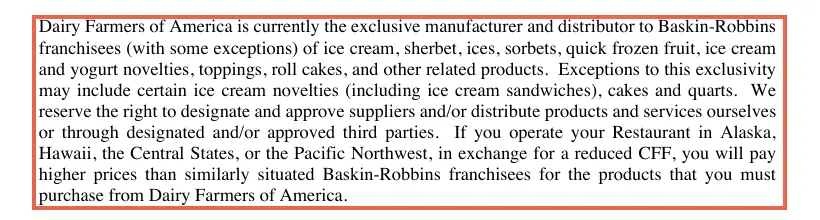
- Baskin-Robbins franchisees buy their ice cream from one maker: Item 8 names Dairy Farmers of America as exclusive manufacturer and distributor, with a 5% to 45% rebate to the franchisor (FDD issued March 26, 2026).
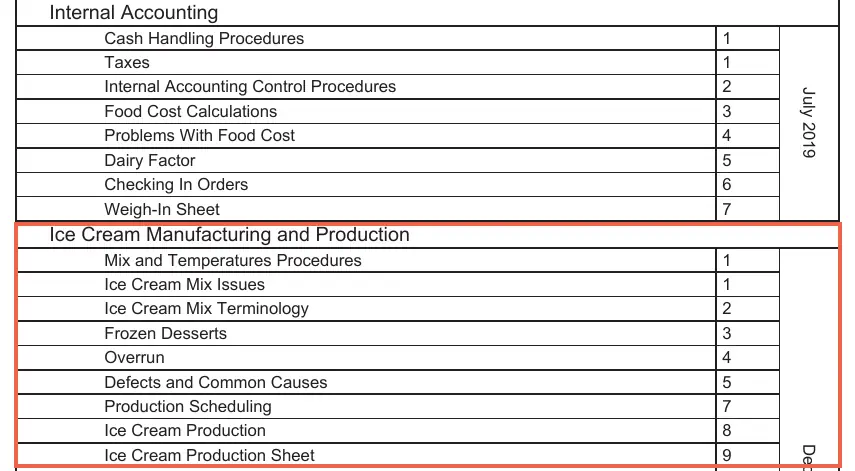
- Marble Slab Creamery shops freeze their own product: the manual index in its FDD amended February 10, 2026 lists a Batch Freezer chapter and an Ice Cream Manufacturing and Production section.
- U.S. plants made 45,151 thousand gallons of regular ice cream mix in July 2025 against 31,672 thousand in December, a 1.43 ratio (USDA NASS Dairy Products 2025 Summary).
- Federal law defines ice cream as a pasteurized mix frozen while stirred, with at least 10 percent milkfat and 4.5 pounds per gallon (21 CFR 135.110).
| Key number | Value | Where it is printed |
|---|---|---|
| Lowest standard-shop Item 7 low end | $179,564 (Menchie’s) | Menchie’s FDD, Item 7 |
| Highest standard-shop Item 7 high end | $680,775 (Cold Stone Creamery, traditional) | Cold Stone FDD, Item 7 (coded) |
| Highest initial franchise fee of the four | $53,900 (Menchie’s, one store) | Menchie’s FDD, Item 5 |
| Share of purchases under franchisor specifications | “more than 95%” (Baskin-Robbins) | Baskin-Robbins FDD, Item 8 |
| Peak month vs December, regular ice cream mix, 2025 | 1.43 times (July) | USDA NASS, Dairy Products 2025 Summary, p. 16 to 17 |
| Minimum milkfat for anything sold as ice cream | 10 percent | 21 CFR 135.110(a)(2) |
Scoop, slab or swirl: which production model does each franchise sell you?
Three production models sit behind the four filings. Baskin-Robbins shops scoop finished product that Dairy Farmers of America manufactures and distributes (Item 8). Marble Slab Creamery shops turn a liquid mix into ice cream in a batch freezer, then fold in toppings on a chilled slab. Menchie’s shops run frozen yogurt machines bought from a required supplier (Item 7, note 5).
The model decides what a franchisee owns, who it depends on and which inspector visits. A dipping shop’s critical assets are its freezer cabinets and a single delivery relationship. A batch-freezing shop adds a production line, recipes and a dairy cost metric: the Marble Slab manual index lists a “Dairy Factor” page beside “Food Cost Calculations” and a production section whose index runs to page 37. Cold Stone Creamery is the fourth filing; our coded copy records its fees and Item 7 lines but not its production method, so read its Items 8 and 11 before placing it in a column.
| Production model | Example in this set | What arrives at the back door | Machine that makes or holds the product | Item 7 equipment line | Source |
|---|---|---|---|---|---|
| Scoop finished tubs | Baskin-Robbins | Finished product shipped by DFA (Dairy Farmers of America makes the ice cream) | Dipping cabinet in the shop | Equipment, fixtures and signs: $115,000 to $185,000 | Baskin-Robbins FDD, Items 7 and 8 |
| Freeze the mix in the shop | Marble Slab Creamery | Pasteurized liquid mix arrives at the shop | Batch freezer (manual p. 8), then chilled slab mix-ins on a marble or granite slab | Furniture, fixtures, equipment and decor: $121,000 to $150,000 | Marble Slab FDD, Item 7, manual index |
| Machine-made frozen yogurt | Menchie’s | Frozen yogurt mix | Frozen yogurt machines from required supplier, then dispense and serve | Furniture, fixtures and equipment: $63,000 to $172,140 | Menchie’s FDD, Item 7, note 5 |
Every model ends with the same step on the diagram, scoop and serve or dispense and serve, but the steps before it change the staffing plan. Marble Slab’s 560-page manual (Item 11) gives production its own chapters on “Overrun”, “Ice Cream Mix Issues” and an “Ice Cream Production Sheet”, which signals daily batch work that a dipping shop does not schedule.
How big is the freezer bill inside Item 7?
Across the four filings, the equipment line takes 29.5% to 37.4% of the Item 7 total. The share is our arithmetic: each brand’s equipment line divided by its own Item 7 total, at the low end and the high end. Baskin-Robbins counts signs in the same line, Marble Slab adds decor, and Menchie’s prices its low end on used equipment.
| Brand (A to Z) | Equipment line as printed | Line, low to high | Item 7 total, low to high | Share at low end | Share at high end |
|---|---|---|---|---|---|
| Baskin-Robbins | Equipment, Fixtures and Signs | $115,000 to $185,000 | $307,400 to $626,700 | 115,000 / 307,400 = 37.4% | 185,000 / 626,700 = 29.5% |
| Cold Stone Creamery (coded) | Furniture, fixtures and equipment group | $135,000 to $233,000 | $390,675 to $680,775 | 135,000 / 390,675 = 34.6% | 233,000 / 680,775 = 34.2% |
| Marble Slab Creamery (Traditional) | Furniture, fixtures, equipment and decor | $121,000 to $150,000 | $354,500 to $476,650 | 121,000 / 354,500 = 34.1% | 150,000 / 476,650 = 31.5% |
| Menchie’s (single store) | Furniture, Fixtures, and Equipment | $63,000 to $172,140 | $179,564 to $515,490 | 63,000 / 179,564 = 35.1% | 172,140 / 515,490 = 33.4% |
Two footnotes move these numbers. Baskin-Robbins adds an estimated 10% for tax and delivery to its equipment range (Item 7, note 2), and its Standard (Margin) incentive pays a $31,000 credit straight to the equipment vendor, or $50,000 with a drive-thru (note 12). Menchie’s says its low-end figures are for used furniture, fixtures and equipment and its high end for new (note 5), so the $109,140 gap inside that line is mostly a new-versus-used choice.
Marble Slab’s note 6 lists display cases, counters, work tables, ovens, refrigerators and beverage dispensers bought from a supplier approved by GFG Management. Item 8 adds that the franchisor designates the kitchen equipment supplier, the smallwares provider and the signage manufacturer. When you price a lease, ask for the electrical and floor-load specifications of the freezer package before signing, because Item 7 of Baskin-Robbins excludes electrical supply circuits and final connections from its sign estimate (note 2).
Dairy Farmers of America, GAC Supply and a required machine vendor: the Item 8 supply chain
Item 8 of the FTC Franchise Rule, 16 CFR 436.5(h) makes every franchisor state its revenue from required purchases and the share of a franchisee’s buying that is restricted. In these filings the restricted share runs from about 70% of ongoing costs at Menchie’s to “more than 95%” at Baskin-Robbins, and the money flows to three different places.
| Brand (A to Z) | Who makes or ships the frozen product | Restricted share of purchases | Franchisor revenue from franchisee purchases | Rebates or supplier payments | Source |
|---|---|---|---|---|---|
| Baskin-Robbins | Dairy Farmers of America, exclusive manufacturer and distributor of ice cream, sherbet, ices and sorbets, with exceptions for some novelties, cakes and quarts | More than 95% of purchases to establish and operate | $12,600,000, or 25.0% of about $50,600,000 total revenue (2025); affiliates $3,100,000 | 5% to 45% of your purchases from Dairy Farmers of America | Baskin-Robbins FDD, Item 8 |
| Marble Slab Creamery | Designated and approved suppliers; branded paper, sodas and products used to prepare certain menu items from the approved supplier | About 95% to establish and 95% to operate | $0 of $6,673,000 (fiscal 2024); affiliate GAC Supply $32,852,000 from all franchisees’ required purchases, including affiliate brands | Supplier rebates “based on the volume of purchases”; 15% referral fee on an optional payroll service | Marble Slab FDD, Item 8 |
| Menchie’s | Frozen yogurt machines from a required supplier; trademarked merchandise, uniforms and cabinets from the franchisor | About 90% to begin operations and 70% of ongoing costs | $3,146,863, or 15.3% of $20,611,182 (2025) | 0.8% to 18% of franchisees’ purchases from various suppliers | Menchie’s FDD, Items 7 and 8 |
The Baskin-Robbins filing also shows how a product markup can stand in for a royalty. In Alaska, Hawaii, the Central States and the Pacific Northwest, the Continuing Franchise Fee drops from 5.9% of Gross Sales to 0.5% or 1.0% (Item 6), and in exchange the franchisee “will pay higher prices” for Dairy Farmers of America products (Item 8). Compare the delivered price per tub in those regions, not the royalty line alone.
Switching suppliers is slow in all three systems. Baskin-Robbins charges $1,000 to $10,000 for supplier testing and treats silence after 180 days as a refusal. Marble Slab caps its review cost at $5,000 and charges $500 per day for unapproved products. Menchie’s says it typically answers in 30 days and adds $250 per day in liquidated damages for unauthorized menu items (Item 6). Our franchise supplier rebate study across coded FDDs shows where the 5% to 45% Baskin-Robbins range sits against other systems.
How seasonal is frozen dessert demand month by month?
USDA plant data put a number on the summer peak. In 2025, U.S. plants made 45,151 thousand gallons of regular ice cream mix in July and 31,672 thousand in December, and May through August produced 37.4% of the year’s 473,470 thousand gallons. Low-fat soft ice cream, the closest series to soft serve, peaked in June at 18,284 thousand gallons.
Regular ice cream mix output peaked at 45,151 thousand gallons in July 2025 and fell to 31,672 thousand in December. USDA NASS Dairy Products 2025 Summary, April 2026, accessed November 3, 2026.
| Month (2025) | Ice cream, regular, mix (1,000 gallons) | Ice cream, lowfat, soft (1,000 gallons) |
|---|---|---|
| January | 37,305 | 11,715 |
| February | 35,842 | 13,037 |
| March | 39,399 | 16,033 |
| April | 42,046 | 17,095 |
| May | 43,575 | 17,361 |
| June | 44,204 | 18,284 |
| July | 45,151 | 18,117 |
| August | 44,224 | 16,164 |
| September | 39,107 | 13,574 |
| October | 39,251 | 12,349 |
| November | 31,694 | 11,105 |
| December | 31,672 | 10,232 |
| Year | 473,470 | 175,066 |
These are factory volumes from the NASS Dairy Products 2025 Summary, April 2026, pages 15 to 17, not shop sales. Factories also build stock ahead of demand. Read the curve as a floor on seasonality: the soft-serve series swings harder, with June output 1.79 times December’s, and November through February made 28.8% of the year’s regular mix.
The franchisors say the same thing in Item 1. Marble Slab writes that sales “are affected by seasonal changes, especially in areas that experience cold, inclement winters.” Menchie’s writes that “sales of frozen desserts generally increase in warmer weather, your sales may be seasonal.”
Can a franchised scoop shop close for the winter?
Not without the franchisor’s consent in any of the three agreements we read. Baskin-Robbins section 7.A(1), Marble Slab section 5.13 and Menchie’s section VI.H each tie opening days and hours to the franchisor’s manual. At Menchie’s, three consecutive closed days without written consent count as voluntary abandonment, and Item 17(h) lists closing the Store among defaults that cannot be cured.
| Brand (A to Z) | Clause | What it requires | Seasonal wording in the FDD |
|---|---|---|---|
| Baskin-Robbins | Franchise Agreement 7.A(1) | Open “for the days and hours we periodically prescribe”; hours may vary by restaurant based on economic factors and market | Item 7, note 9: sales “typically lower in the winter months” |
| Marble Slab Creamery | Franchise Agreement 5.13 | Open for the hours and days the Manual specifies; manual has a “Minimum Hours of Operation” page | Item 1: “cold, inclement winters” |
| Menchie’s | Franchise Agreement VI.H; Item 17 | Days and times set in the Operations Manual; 3 consecutive closed days without consent is abandonment | Item 1: “your sales may be seasonal”; stores serve the public “throughout the year” |
The cash cushion the rule requires is short against a long winter. Item 7 must show Additional Funds for an initial period that is “at least three months or a reasonable period for the industry” under 16 CFR 436.5(g). The four filings print $0 to $30,000 (Baskin-Robbins), $20,000 (Cold Stone Creamery), $8,000 to $12,000 (Marble Slab Traditional) and $6,000 to $36,000 (Menchie’s, including payroll), each for 3 months.
Opening date matters for that reason. Cold Stone’s coded terms give a typical 4 to 12 months from signing to opening and require the shop to open within 18 months (Franchise Agreement 3.1), with the site approved within 9 months. A September signing on a 7-month build puts the first three open months in April, May and June, the rising side of the NASS curve. Our study of Item 11 opening timelines compares those windows with other food systems.
| Milestone | Timing | Brand and clause |
|---|---|---|
| Sign franchise agreement | Month 0 | All four |
| Site selected and approved | Month 9 | Cold Stone Creamery (coded from Franchise Agreement) |
| Typical opening | 4 to 12 months after signing or first payment | Cold Stone Creamery, Item 11 (coded) |
| Must be open | Month 18 | Cold Stone Creamery, Franchise Agreement 3.1 (coded) |
| Site deadline missed | $5,000 buys a 60-day extension | Marble Slab Creamery, Item 6 |
| First 3 open months | Item 7 Additional Funds window | 16 CFR 436.5(g); Baskin-Robbins Item 7, note 9 on cold weather openings |
Which federal and state dairy rules reach the mix and the freezer?
Federal law governs what may be called ice cream and how its mix is heated; states decide who needs a dairy license to freeze it. Under 21 CFR 135.3 a pasteurized mix is held at 155 °F for 30 minutes or 175 °F for 25 seconds. A shop that freezes a mix bought already pasteurized usually sits under a lighter state license than a plant that makes mix.
| Rule | What it says | Who it reaches |
|---|---|---|
| 21 CFR 135.110(a)(1) | Ice cream is “produced by freezing, while stirring, a pasteurized mix” | Anything labeled or sold as ice cream |
| 21 CFR 135.110(a)(2) | At least 10 percent milkfat, 10 percent nonfat milk solids, 1.6 pounds total solids and 4.5 pounds per gallon; frozen custard needs 1.4 percent egg yolk solids | Recipes and overrun in a batch-freezing shop |
| 21 CFR 135.3 | Pasteurized mix: 155 °F for 30 minutes or 175 °F for 25 seconds | Whoever pasteurizes the mix |
| 21 CFR 1240.61 | Milk products in final package form shipped across state lines must be pasteurized; fat of 10 percent or more or added sweeteners adds 5 °F to the listed temperatures | Mix and packaged product moving between states |
| Vermont Frozen Dessert License, 6 V.S.A. Chapter 155 | License required “for all those who make and sell ice cream”; with an already pasteurized base mix, “the only license needed is a Frozen Dessert License” | Vermont scoop, creemee and soft-serve shops |
| Ga. Comp. R. and Regs. 40-2-8-.01 | (1) a Department of Agriculture permit-license to offer frozen dessert or mix for sale; (3)(c) retail shops that freeze and package approved mixes skip the Dairy Manufacturing Plant License when licensed by the State Department of Human Resources | Georgia frozen dessert retailers |
One FDD statement deserves a second look. Menchie’s Item 1 says “We know of no trade or license regulations which specifically affect the frozen yogurt industry.” Vermont’s frozen dessert page lists frozen yogurt among the products its license covers, and Georgia’s rule reaches any frozen dessert mix, so ask your state agriculture department, not only the county health office, before you sign a lease. This page is general information, not legal, financial or investment advice.
Ice cream franchise costs in four filings, A to Z
The four standard-shop Item 7 totals overlap between $390,675 and $476,650 and spread from $179,564 to $680,775 at the edges. Initial franchise fees run $25,000 to $53,900. Each figure below is quoted from the brand’s own FDD with its issue date; Cold Stone Creamery comes from our coded dataset of the March 27, 2026 filing.
Item 7 totals for a standard shop range from $179,564 (Menchie’s low end) to $680,775 (Cold Stone Creamery high end), per each brand’s current FDD, Minnesota CARDS, accessed November 3, 2026.
| Brand (A to Z) | Initial fee (Item 5) | Item 7 total, standard shop | Other formats in Item 7 | Typical space | Source |
|---|---|---|---|---|---|
| Baskin-Robbins | $25,000; Combo Restaurant $10,000 plus the Dunkin’ fee | $307,400 to $626,700 | Gas station and SDO fees prorated by term (a 10-year term pays $12,500 or $6,250) | Not stated in Item 7 | FDD issued March 26, 2026, Items 5 and 7 |
| Cold Stone Creamery | $27,000 first traditional; $15,000 later units; $10,000 to $20,000 non-traditional | $390,675 to $680,775 | Non-traditional table also filed | 1,200 sq ft vanilla shell basis | FDD issued March 27, 2026 (coded) |
| Marble Slab Creamery | $25,000; Satellite $15,000 | $354,500 to $476,650 (Traditional) | Non-Traditional $251,500 to $393,150; Satellite $172,850 to $253,811; Great American Cookies co-brand $496,185 to $654,635 | 1,600 to 1,800 sq ft, 20-foot front | FDD amended February 10, 2026, Items 5 and 7 |
| Menchie’s | $53,900; two stores $99,900 | $179,564 to $515,490 | Two-store total $352,228 to $1,028,080 | About 900 to 1,700 sq ft | FDD amended October 5, 2026, Items 5 and 7 |
Real estate drives the high ends. Baskin-Robbins prices real estate development at $123,000 to $269,400 and warns that government impact fees “can be $87,000 or more in some markets”, outside the range (note 4). Menchie’s leasehold line runs $35,000 to $201,440, and Marble Slab’s Traditional leasehold line runs $155,000 to $201,000. The Item 7 initial investment report sets these against more than 250 coded filings.
Four figures that changed since earlier write-ups
- A 2018 list article, never updated, gives Baskin-Robbins as $93,550 to $401,800; the March 26, 2026 Item 7 prints $307,400 to $626,700.
- A ranking page updated in September 2026 gives Cold Stone Creamery as $310,375 to $602,775; the March 27, 2026 filing prints $390,675 to $680,775.
- The same page gives Menchie’s as $165,110 to $424,571; the October 5, 2026 amendment prints $179,564 to $515,490.
- Directory snippets still show a $40,000 Menchie’s fee; Item 5 now reads $53,900.
What leaves the till each week once the doors open?
All four charge a royalty near 6% of sales, but the advertising fund ranges from 2% to 5% and the fixed fees differ. Menchie’s sets a weekly floor of $125 on its royalty. Baskin-Robbins charges the highest combined percentage in standard territories, 5.9% plus 5.0%, and the lowest in its product-markup regions.
| Brand (A to Z) | Royalty | Advertising | Technology and other fixed fees | Source |
|---|---|---|---|---|
| Baskin-Robbins | 5.9% of Gross Sales; 0.5% in Hawaii and the Central States Territory; 1.0% in Alaska, Idaho, Montana, Oregon and Washington | 5.0% of Gross Sales; 3.5% in Alaska and Hawaii; 2.5% in the Central States and at SDOs | Continuing Training Fee $300 per year; POS maintenance and user fees | Item 6 |
| Cold Stone Creamery | 6% of Gross Sales | 3%, up to 4% | Data fees up to $75 per month; POS help desk up to $60 per month; 11% fee on gift card redemptions | Item 6 (coded) |
| Marble Slab Creamery | 6% of total net sales | 2% National Advertising Fund (may rise to 4%) plus 2% local spend | Brand Technology System Support $840 to $1,500 per year, optional services up to $3,250 | Item 6 |
| Menchie’s | Greater of $125 or 6% of Gross Sales, weekly | 2% of Gross Sales | Technology Fee $80 per month; renewal 10% of the then-current fee or $5,000 | Item 6 |
Two internal inconsistencies are worth raising with the franchisor before signing. Menchie’s Item 6 table says the Technology Fee may rise by up to 25% a year, while its note 2 says up to 5%. Marble Slab’s cover page prints $176,185 to $264,635 for its Round Table Pizza co-brand while the Item 7 table totals $176,185 to $263,635. Our royalty rate dataset for 2026 FDDs lists the same fee fields for other food brands.
Item 19 and Item 20: where the sales tables sit and how many shops each system counts
All four filings include an Item 19 financial performance representation, and this page does not repeat its figures. Baskin-Robbins covers 814 franchised restaurants for 2025, Marble Slab covers 195 of 249 restaurants for 2024 with food and labor cost tables, and Menchie’s reports franchisee Gross Sales tables. Item 20 shows flat or shrinking counts.
| Brand (A to Z) | Franchised U.S. outlets, latest year-end (Item 20) | Change in latest year | What Item 19 contains |
|---|---|---|---|
| Baskin-Robbins | 967 at end of 2025, plus 1,219 Dunkin’ and Baskin-Robbins combos (Item 1) | 976 to 967 (net -9) | 2025 data for 814 restaurants, in quartiles |
| Cold Stone Creamery | 1,052 (fiscal 2025, coded) | Not coded | Present (coded) |
| Marble Slab Creamery | 249 at end of 2024 | 248 to 249 (net +1) | Net sales, food cost and labor cost tables, 2024 |
| Menchie’s | 295 at end of 2025, plus 1 company-owned | 295 to 295 (net 0) | Gross Sales tables from franchisee reports |
Read the Item 19 exclusions as closely as the tables. Baskin-Robbins leaves out the 41 restaurants that closed in 2025 and all 1,219 combos. Marble Slab leaves out 34 restaurants not open all year, 132 international locations and 20 that did not report. Our Item 19 research report explains how to rebuild a sample from those notes, and the guide to reading an FDD lists which items to request first.
Matching a production model to your market: a decision table
Pick the production model before the brand. Use climate, capital and staffing first, then compare Items 6 to 8 inside the model that fits. The thresholds below come straight from the four filings and the NASS curve; they are screens for questions to ask, not a ranking of the brands.
| If your situation is | Then look at | Why, with the number |
|---|---|---|
| Cold-winter market and less than $30,000 of reserve beyond Item 7 | A format with a combo or co-brand partner, or plan a spring opening | November to February made 28.8% of 2025 regular mix; Baskin-Robbins says cold-weather openings may need more working capital |
| All-in budget under about $260,000 | Menchie’s low end, a Marble Slab Satellite or Non-Traditional unit | Lowest printed totals: $172,850 (Satellite), $179,564 (Menchie’s), $251,500 (Non-Traditional) |
| You want no in-shop production | The dipping model | Dairy Farmers of America makes and ships Baskin-Robbins product (Item 8) |
| You want to control recipes and overrun on site | The batch-freezer model | Marble Slab manual: Batch Freezer, Overrun and Ice Cream Mix chapters; state frozen dessert license likely |
| Site is in Alaska, Hawaii, the Pacific Northwest or the Central States | Baskin-Robbins delivered product prices, not only royalties | Royalty drops to 0.5% or 1.0% in exchange for higher DFA prices |
| You plan to change suppliers later | Item 8 approval terms | Testing $1,000 to $10,000 (Baskin-Robbins); review cap $5,000 (Marble Slab); about 30 days (Menchie’s) |
For a dessert concept paired with a meal menu, our Culver’s franchise cost breakdown covers a frozen custard brand built around burgers, and the Dunkin’ franchise cost page covers the coffee side of the 1,219 Baskin-Robbins combos. Broader options sit in our franchise ideas guide.
How we compiled this
On November 3, 2026 we opened three Clean FDDs on file with the Minnesota Department of Commerce (CARDS), Baskin-Robbins, Marble Slab Creamery and Menchie’s, and took Cold Stone Creamery from our coded dataset of its March 27, 2026 filing; Handel’s had no Clean FDD in CARDS. The brands are examples, not a ranking. We read Items 1, 5 to 8, 11, 17, 19 and 20, the federal texts through the eCFR, USDA NASS plant data and two state frozen dessert sources, and excluded Item 19 figures and franchisee names.
Frequently asked questions
How much does it cost to open an ice cream franchise?
In the four current FDDs we read, a standard shop’s Item 7 total runs $179,564 to $515,490 at Menchie’s, $307,400 to $626,700 at Baskin-Robbins, $354,500 to $476,650 at a Marble Slab Creamery Traditional Restaurant and $390,675 to $680,775 at Cold Stone Creamery. Kiosks and satellites cost less: Marble Slab prints $172,850 to $253,811 for a Satellite.
Do ice cream franchises make the ice cream in the store?
It depends on the brand’s production model, printed in Items 7, 8 and 11. Baskin-Robbins franchisees scoop product made and distributed by Dairy Farmers of America. Marble Slab Creamery’s manual has Batch Freezer and Ice Cream Manufacturing chapters, so its shops freeze mix on site. Menchie’s shops buy frozen yogurt machines from a required supplier.
Are ice cream franchises profitable?
This site does not publish earnings figures. Item 19 of each brand’s FDD is where sales data sits: Baskin-Robbins covers 814 franchised restaurants for 2025, Marble Slab covers 195 of 249 restaurants for 2024 with food and labor cost tables, and Menchie’s reports franchisee Gross Sales. Read the exclusions, then compare them with your Item 6 fees and Item 7 costs.
How seasonal is an ice cream franchise?
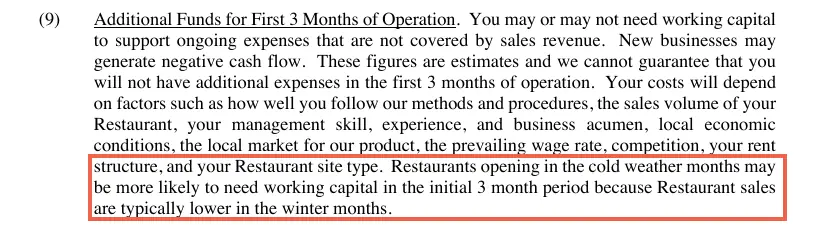
USDA data show U.S. plants made 45,151 thousand gallons of regular ice cream mix in July 2025 and 31,672 thousand in December, and November through February produced 28.8% of the year’s total. Baskin-Robbins’ Item 7 note 9 adds that restaurants opening in cold weather months may need more working capital because winter sales are typically lower.
Can I close my ice cream franchise during the winter?
Only with the franchisor’s consent under the three agreements we read. Baskin-Robbins section 7.A(1), Marble Slab section 5.13 and Menchie’s section VI.H tie opening days and hours to the manual. At Menchie’s, three consecutive closed days without written consent count as abandonment, and Item 17(h) lists closing the Store among the defaults that cannot be cured.
Do I need a dairy license to run a soft-serve or frozen yogurt franchise?
Often yes, at the state level. Vermont requires a Frozen Dessert License for anyone who makes and sells ice cream, frozen yogurt or custard, and Georgia rule 40-2-8-.01 requires a Department of Agriculture permit-license to sell frozen dessert or mix. Federal rule 21 CFR 135.3 sets mix pasteurization at 155 degrees for 30 minutes or 175 degrees for 25 seconds.
Sources
- Baskin-Robbins Franchising LLC, Baskin-Robbins Franchise Disclosure Document, issued March 26, 2026, Items 1, 5 to 8, 19 and 20 and Franchise Agreement 7.A, Minnesota CARDS document 35663-202603-13 (accessed November 3, 2026).
- Kahala Franchising, L.L.C., Cold Stone Creamery Franchise Disclosure Document, issued March 27, 2026, Items 5 to 7, 11, 19 and 20 as coded in our research datasets, Minnesota CARDS document 35603-202603-14 (accessed November 3, 2026).
- Marble Slab Franchising, LLC, Marble Slab Creamery Franchise Disclosure Document, issued April 30, 2025 as amended February 10, 2026, Items 1, 5 to 8, 11, 19 and 20, manual index and Franchise Agreement 5.13, Minnesota CARDS document 35450-202603-04 (accessed November 3, 2026).
- Menchie’s Group, Inc., Menchie’s Franchise Disclosure Document, issued April 10, 2026, as amended October 5, 2026, Items 1, 5 to 8, 17, 19 and 20 and Franchise Agreement VI.H, Minnesota CARDS document 37422-202610-03 (accessed November 3, 2026).
- 21 CFR 135.110, Ice cream and frozen custard, eCFR (accessed November 3, 2026).
- 21 CFR 135.3, Definitions, eCFR (accessed November 3, 2026).
- 21 CFR 1240.61, Mandatory pasteurization for all milk and milk products in final package form, eCFR (accessed November 3, 2026).
- 16 CFR 436.5, Disclosure items (FTC Franchise Rule), eCFR (accessed November 3, 2026).
- USDA National Agricultural Statistics Service, Dairy Products 2025 Summary, April 2026, pages 15 to 17 (accessed November 3, 2026).
- Vermont Agency of Agriculture, Food and Markets, Frozen Dessert Licenses (accessed November 3, 2026).
- Georgia Department of Agriculture rules, Chapter 40-2-8, Ice Cream, Frozen Desserts and Related Products (accessed November 3, 2026).