A Pizza Hut franchise cost runs $670,000 to $2,130,000 before land in the October 2026 filing, and Pizza Hut is screening Traditional candidates for verified capital and plans of 5 or more restaurants.
Key takeaways
- The Pizza Hut Franchise Disclosure Document, issued March 25, 2026, as amended October 8, 2026 (cover page and Item 7) prices a new Inline/Endcap Delco at $670,000 to $960,000 and a Restaurant-Based Delivery or Delivery Based Restaurant at $846,000 to $2,130,000, excluding real property.
- Neither the FDD nor franchise.pizzahut.com prints a minimum net worth; Pizza Hut’s online Interest Inquiry asks for liquid capital and net worth it “will look to verify” and says its development team wants candidates for “5+ locations” (accessed November 2, 2026).
- Item 15 requires each restaurant to have an approved Qualified Operator holding at least 10% of the franchisee’s equity, and every owner of 10% or more signs a personal guaranty.
- On top of the 6.0% Monthly Service Fee and 4.75% System Advertising Fund, Items 6 and 11 add a $2,950 yearly Restaurant Technology Fee, a $0.41 Digital Innovation Fee per digital transaction and $5,500 to $8,000 a year in vendor technology services.
- Item 1 states that funds managed by LongRange Capital acquired Pizza Hut from YUM! Brands, Inc. on September 1, 2026; Item 20 shows franchised U.S. restaurants fell from 5,214 to 4,956 in 2025, with 275 more closures through August 18, 2026.
| Key number | Figure | Where it is printed |
|---|---|---|
| Initial franchise fee, per restaurant | $25,000, due at signing, not refundable | FDD Item 5 |
| Total initial investment, four formats | $670,000 to $2,130,000 (land excluded) | FDD cover page, Item 7 |
| Monthly Service Fee / System Advertising Fund | 6.0% (6.5% in certain cases) / 4.75% of Gross Sales | FDD Item 6 |
| Restaurant Technology Fee | $2,950 per year | FDD Items 6 and 11 |
| Protected Radius | 500 yards; no exclusive territory | FDD Item 12 |
| Initial term / renewals | 10 years from opening / two 5-year renewals | FDD Item 17 |
| Franchised U.S. restaurants, end of 2025 | 4,956 | FDD Item 20, Table 1 |
What does Pizza Hut screen for before it sells a Traditional franchise?
Pizza Hut screens on four things before it sells a Traditional restaurant: verified liquid capital and net worth, operating experience or an operating partner, appetite for 5 or more locations, and an approved Qualified Operator who owns at least 10% of the franchisee. None of these comes with a published dollar minimum in the October 2026 FDD; the franchisor’s own questionnaire and Item 15 set the bar.
The first gate is the Pizza Hut Interest Inquiry form embedded on franchise.pizzahut.com/join-us/. For a Traditional restaurant it asks how much liquid capital you have, defined as “unencumbered cash”, and your approximate net worth, with the note that “Pizza Hut will look to verify this information in future conversations.” One question reads: “The traditional Pizza Hut development team is currently looking for franchise candidates interested in opening 5+ locations,” with answer choices of 5, 6-10, 11-15, 16-20 and 20+.
| Screen | What Pizza Hut asks or requires | Source |
|---|---|---|
| Liquid capital | Self-reported “unencumbered cash”, verified later; no minimum printed | Interest Inquiry, accessed Nov 2, 2026 |
| Net worth | Self-reported, verified later; no minimum printed | Interest Inquiry; FDD has no net worth item |
| Unit count | Development team “currently looking for” candidates for 5+ locations | Interest Inquiry |
| Operations experience | Direct experience, a trusted operating partner, or a plan to hire one | Interest Inquiry answer choices |
| Background review | Background checks and interviews, generally 10 to 12 weeks | franchise.pizzahut.com FAQ |
| Qualified Operator | Approved by Pizza Hut, at least 10% equity, completes First Slice training | FDD Item 15 |
| Personal guaranty | Every owner with a 10% or greater interest | FDD Item 15 |
| Business entity | The franchisee is a corporation, LLC, partnership or other entity | FDD Item 1 |
The Qualified Operator rule is what makes a passive purchase hard. Item 15 says owner participation is recommended rather than required, but each restaurant still needs one or more approved Qualified Operators who “actively manage and participate” and hold at least a 10% equity interest. If that person dies, becomes disabled or leaves, a successor must be named within 30 days. The guaranty reaches every 10% owner, a pattern our research on franchise personal guarantees tracks across 259 FDDs.
- Submit the Interest Inquiry: liquid capital, net worth, operations experience, partners and preferred network size of 5 to 20+ restaurants.
- Pass background checks and interviews, which the franchise FAQ says generally take 10 to 12 weeks.
- Have Pizza Hut approve a Qualified Operator with at least 10% equity.
- Sign the Location Franchise Agreement and pay the $25,000 fee, which is not refundable (Item 5).
- Complete First Slice training, 6 to 12 weeks, finishing 3 to 4 weeks before opening (Item 11).
- Open the first restaurant no later than 6 months after the Effective Date; Pizza Hut has up to 30 days to accept a completed site registration form (Item 11).
How do the four Item 7 formats add up, line by line?
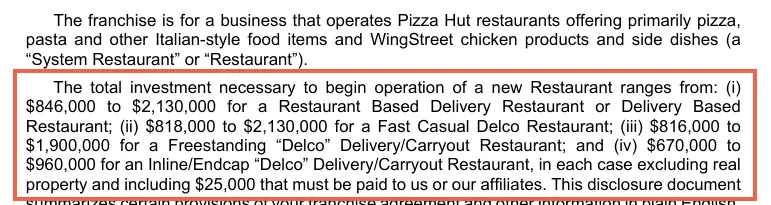
Item 7 of the October 2026 FDD prints four totals: $846,000 to $2,130,000 for a Restaurant-Based Delivery (RBD) or Delivery Based Restaurant (DBR), $818,000 to $2,130,000 for a Fast Casual Delco (FCD), $816,000 to $1,900,000 for a Freestanding Delco and $670,000 to $960,000 for an Inline/Endcap Delco. Each includes the $25,000 fee and 3 months of additional funds, and none includes land.
| Item 7 line | RBD or DBR | FCD | Freestanding Delco | Inline/Endcap Delco |
|---|---|---|---|---|
| Initial franchise fee | $25,000 | $25,000 | $25,000 | $25,000 |
| Equipment | $150,000 to $300,000 | $125,000 to $225,000 | $125,000 to $269,500 | $125,000 to $200,000 |
| Opening inventory | $4,000 to $8,000 | $4,000 to $8,000 | $4,000 to $8,000 | $4,000 to $8,000 |
| Smallwares | $15,000 to $50,000 | $12,000 to $25,000 | $10,000 to $18,000 | $10,000 to $18,000 |
| Building and site improvements | $619,000 to $1,651,500 | $619,000 to $1,751,500 | $619,000 to $1,489,200 | $473,000 to $618,700 |
| Land or leasehold interest | Varies | Varies | Varies | Varies |
| Computer System | $15,000 to $30,000 | $15,000 to $30,000 | $15,000 to $30,000 | $15,000 to $30,000 |
| Computer System training | $0 to $1,500 | $0 to $1,500 | $0 to $1,500 | $0 to $1,500 |
| Additional funds (3 months) | $5,000 to $21,500 | $5,000 to $21,500 | $5,000 to $21,500 | $5,000 to $21,500 |
| Miscellaneous | $10,000 to $22,000 | $10,000 to $22,000 | $10,000 to $22,000 | $10,000 to $22,000 |
| Opening advertising (recommended) | $0 to $16,500 | $0 to $16,500 | $0 to $10,300 | $0 to $10,300 |
| Start-up “Other” | $3,000 to $4,000 | $3,000 to $4,000 | $3,000 to $5,000 | $3,000 to $5,000 |
| Total | $846,000 to $2,130,000 | $818,000 to $2,130,000 | $816,000 to $1,900,000 | $670,000 to $960,000 |
We added every line in all four tables and each column matches the printed total to the dollar. Two items sit outside every total: land, which Item 7 lists as “Varies”, and delivery vehicles, which note 10 says “typically” belong to drivers personally. The recommended opening campaign runs 18 weeks for DBR and FCD restaurants and 6 to 8 weeks for a Delco, per note 7.
An Inline/Endcap Delco tops out at $960,000; the three larger formats run to $1,900,000 or $2,130,000 before land. Source: Pizza Hut FDD amended October 8, 2026, Item 7.
The cheapest format, the Inline/Endcap Delco, is carryout and delivery only, sits in 1,200 to 1,600 square feet and comes with a leasehold rather than land. The RBD is the traditional dine-in restaurant with delivery added, at 2,000 to 4,000 square feet. For how Item 7 is built and what it leaves out, see our guide to the franchise disclosure document.
Why can two Pizza Huts differ by $1.28 million before land?
Building and site improvements explain most of the spread. In the RBD or DBR table that one line runs $619,000 to $1,651,500, which is 77.5% of the $2,130,000 high total and accounts for $1,032,500 of the $1,284,000 gap between low and high. Square footage, seat count and whether you build or convert a shell drive that line.
| What moves the cost | Low end | High end | Dollar effect in Item 7 |
|---|---|---|---|
| Building and site, RBD or DBR | $619,000 | $1,651,500 | $1,032,500 of a $1,284,000 spread |
| Building and site, FCD | $619,000 | $1,751,500 | $1,132,500 of a $1,312,000 spread |
| Building and site, Inline/Endcap Delco | $473,000 | $618,700 | $145,700 of a $290,000 spread |
| Square feet (note 3) | 1,200 to 1,600 Delco | 2,000 to 4,000 RBD | Moves the format choice itself |
| Equipment, RBD vs Inline Delco | $125,000 | $300,000 | Up to $175,000 |
| Smallwares, RBD vs Delco | $10,000 | $50,000 | Up to $40,000 |
| Land | Not estimated | Added on top of every total | |
Building and site is a smaller share in the Inline/Endcap table, 64.4% of the $960,000 high, because the landlord owns the shell. Items 1 and 8 name an affiliate, Pizza Hut of America, LLC, that leases some restaurant sites to franchisees and booked about $3,878,053 of such lease revenue in 2025, so a few locations come with a franchisor lease rather than a third-party one.
What technology charges ride on top of the 6% Monthly Service Fee?
The percentage fees in Item 6 are a 6.0% Monthly Service Fee (6.5% in certain cases) and a 4.75% System Advertising Fund, a combined 10.75% of Gross Sales. Fixed technology costs come on top: a $2,950 Restaurant Technology Fee, $5,500 to $8,000 a year for required vendor services and $1,000 to 3,500 a year in equipment maintenance, per Items 6 and 11.
| Recurring charge | Amount in the FDD | Paid to | Item |
|---|---|---|---|
| Monthly Service Fee | 6.0% of Gross Sales (6.5% in certain cases), by the 20th of the next month | Pizza Hut, LLC | 6 |
| System Advertising Fund | 4.75% of Gross Sales; IPHFHA dues credited dollar for dollar | Fund, via IPHFHA | 6, 11 |
| Digital Innovation Fee | $0.41 per digital or automated-channel transaction; last raised January 1, 2024 | Pizza Hut or affiliates incl. Digico | 6 |
| Restaurant Technology Fee | $2,950 per year in 12 monthly bills | Pizza Hut Connect, LLC | 6, 11 |
| Dragontail fee | $240 installation plus $75 per month; collection temporarily suspended | Pizza Hut Connect, Dragontail | 6, 11 |
| Third-party technology services | $5,500 to $8,000 per year (telecom, broadband, network, card processing) | Approved vendors | 11 |
| Computer System maintenance | $1,000 to 3,500 per year (Pizza Hut’s cost in its own units) | Maintenance vendor | 11 |
| Dinova orders | 9.5% royalty on Dinova orders over $20; opt out by email | Passed through to Dinova | 6, 11 |
| Purchasing Co-op stock | $10 membership share plus $400 per traditional restaurant | Pizza Hut National Purchasing Coop | 8 |
The fixed technology lines can be added without assuming any sales level. The worked table below uses only the dollar amounts Items 6 and 11 print; the Digital Innovation Fee is left out because it depends on transaction count.
| Yearly fixed technology cost per restaurant | Low | High |
|---|---|---|
| Restaurant Technology Fee | $2,950 | $2,950 |
| Third-party technology services | $5,500 | $8,000 |
| Computer System maintenance | $1,000 | $3,500 |
| Subtotal while Dragontail is suspended | $9,450 | $14,450 |
| Dragontail if collection resumes ($75 x 12) | $900 | $900 |
| Subtotal with Dragontail | $10,350 | $15,350 |
Item 6 note 3 lets the Digital Innovation Fee, Restaurant Technology Fee and Dragontail fee rise after fiscal 2026, either with approval of the IPHFHA Appointed Technology Governance Committee or by the CPI-U inflation rate. Item 8 shows where the money went in 2025: Pizza Hut Connect, LLC received about $68,019,036 from franchisees, of which $31,116,608 went to PH Digico LLC for spending directed by the Digital Investment Committee. Our study of franchise technology requirements compares these charges across 259 systems.
Which insurance limits reflect the delivery model?
Item 8 sets business automobile liability at $5,000,000 combined single limit per occurrence, not subject to an aggregate, alongside commercial general liability of $3,000,000 per occurrence and $6,000,000 aggregate, employer’s liability of at least $1,000,000 and 12 months of business interruption cover. Carriers must be A.M. Best rated at least “A”.
Required purchases from approved suppliers run about 30% to 45% of opening costs and 30% to 50% of operating costs, also per Item 8, with McLane Foodservice as principal distributor.
How often can Pizza Hut make you remodel, rebuild or relocate?
Section 5.06 of the Location Franchise Agreement lets Pizza Hut direct Minor Remodels, Major Remodels, Rebuilds and Relocations, but sets floors: no Minor or Major Remodel within 5 years of construction or the last upgrade, and no Rebuild or Relocation within 10 years of the last one. A transfer or renewal can pull an upgrade forward, and new equipment or technology standards can arrive at any time.
| Obligation | What the agreement says | Section or Item |
|---|---|---|
| Remodel Schedule | Initial schedule in Appendix B; changes to timing or scope need mutual written agreement | LFA 5.06A |
| Minor or Major Remodel | Not required less than 5 years after construction or the last remodel, rebuild or relocation | LFA 5.06B(i) |
| Rebuild or Relocation | Not required less than 10 years after the last rebuild or relocation | LFA 5.06B(ii) |
| New Brand Standards | New equipment, smallwares and technology “at any time and with any frequency” | LFA 5.06C |
| Technology upgrades | Successor POS, back-of-house and kitchen systems at franchisee expense | Item 11 |
| Renewal | Must be current on “asset upgrade obligations”; fee $12,500, may rise to $25,000 | Items 6, 17 |
| Transfer | Buyer signs the current agreement, which may include rebuild, relocation and remodeling obligations; fee $2,500 plus $250 per restaurant | Items 6, 17 |
| Relocation | A new initial franchise fee (currently $25,000) if the replacement does not open within 12 months of closing | Items 6, 12 |
The FDD does not estimate what a Minor Remodel, Major Remodel or Rebuild costs; those are built to “then-current published specifications” that the franchisee does not see until the Remodel Schedule is set. Ask for the Appendix B schedule for any restaurant you are buying, because Item 17 makes a current upgrade record a condition of the 2 renewal terms of 5 years each. After exit, an 18-month non-compete covers a 25-mile radius of any Pizza Hut.
Who sells you the franchise now that LongRange Capital owns Pizza Hut?
The franchisor is still Pizza Hut, LLC of Plano, Texas, but Item 1 of the October 8, 2026 amendment states that on September 1, 2026, investment funds managed and majority owned by LongRange Capital acquired the Pizza Hut brand and franchise system, including Pizza Hut, LLC, from YUM! Brands, Inc. through a chain of holding companies based in Stamford, Connecticut.
- Ownership chain in Item 1: Pizza Hut, LLC is owned by Pizza Hut Guarantor, LLC, which is owned by Pizza Hut US Holdco, LLC, which sits under American Pie BidCo, LLC and the Toppings entities controlled by LongRange Capital funds.
- Item 21 attaches consolidated financial statements of PH Guarantor, LLC and Subsidiary for the fiscal year ended December 29, 2025, plus a guaranty, in Exhibit I.
- Supply terms in the amended Item 8 still name Restaurant Supply Chain Solutions as exclusive purchasing agent and McLane Foodservice as principal distributor, and the Pepsi beverage agreement runs through December 31, 2036.
- The franchising homepage, accessed November 2, 2026, still describes “Our parent company Yum! Brands, Inc.”, which the amended FDD no longer supports.
Read Item 21 and the guaranty in Exhibit I with the new owner in mind, since the audited statements predate the September 2026 closing. Our report on private equity franchise ownership covers what changes for a franchisee when a fund buys the franchisor; two questions worth putting to Pizza Hut in writing are whether the post-2026 technology fee increases in Item 6 note 3 are planned and whether Remodel Schedules will be reset.
How many U.S. Pizza Hut restaurants opened, closed or changed hands?
Item 20 shows a shrinking franchised base: 5,302 franchised U.S. restaurants at the start of 2023 and 4,956 at the end of 2025, a fall of 346. In 2025 alone, 55 opened, 259 ceased operations and 54 were reacquired by Pizza Hut, and a footnote adds that 275 more franchised restaurants ceased operations from December 30, 2025, through August 18, 2026.
| Item 20 measure | 2023 | 2024 | 2025 |
|---|---|---|---|
| Franchised restaurants at year end | 5,300 | 5,214 | 4,956 |
| Opened (incl. relocations and units bought from Pizza Hut) | 155 | 89 | 55 |
| Ceased operations, other reasons | 157 | 159 | 259 |
| Reacquired by franchisor | 0 | 16 | 54 |
| Terminations and non-renewals | 0 | 0 | 0 |
| Transfers between franchisees | 147 | 37 | 189 |
| Company-owned restaurants at year end | 7 | 23 | 75 |
In 2025, 55 franchised Pizza Huts opened and 259 ceased operations; 54 more were reacquired by the franchisor. Source: Pizza Hut FDD amended October 8, 2026, Item 20, Table 3.
The 54 reacquisitions in 2025 were 30 in North Carolina, 18 in Louisiana and 6 in South Carolina, per Tables 3 and 4. Transfers were concentrated in Georgia (50), Illinois (29), North Carolina (24) and Wisconsin (23). Table 5 projects 33 new franchised openings in fiscal 2026 and lists 0 signed-but-unopened agreements. Item 6 also charges 24 times the average Monthly Service Fee if a restaurant closes without consent.
What does Pizza Hut’s Item 19 cover, and what does it leave out?
Pizza Hut does publish an Item 19. It reports average and median Gross Sales for mature franchised Dine-In/Red Roof, RBD and Delco restaurants open at least one year, for fiscal 2025 and 2024, and the share of units above the average. This site does not republish those figures; read them in Item 19 of the filing.
The exclusions matter for a buyer: Item 19 leaves out DBR and FCD restaurants, carryout-only and seasonal units, and Pizza Hut Express licenses, so two of the four formats priced in Item 7 have no sales history in the document. Gross Sales in Item 19 is also a top-line figure, before the 10.75% in fees, food, labor and rent. Our review of Item 19 in 259 FDDs shows how many report only sales, without cost or profit lines.
Which Pizza Hut cost claims online no longer match the filing?
Several widely read guides and Pizza Hut’s own franchising pages print figures that differ from the October 2026 FDD. The most common errors are an old $367,000 low end, a $700,000 net worth and $350,000 liquidity rule that neither the FDD nor the franchisor’s site states, and the Non-Traditional 10% fee attached to Traditional restaurants.
| Claim seen online | What the primary source says | Source |
|---|---|---|
| A finance guide updated October 2026: total investment from $367,000 | Lowest current Traditional total is $670,000 (Inline/Endcap Delco) | FDD Oct 2026, cover and Item 7 |
| Pizza Hut’s franchising pages: $579,000 to $2,053,500 Traditional | $670,000 to $2,130,000 across four formats | FDD Oct 2026, Item 7 |
| Several guides: $700,000 net worth and $350,000 liquid capital required | No dollar minimum in the FDD or on franchise.pizzahut.com; the Interest Inquiry asks and verifies | FDD Items 1 to 23; Interest Inquiry |
| Search summaries: 10% royalty including advertising | 10% is the Non-Traditional license fee; Traditional is 6.0% plus 4.75% | License Disclosure Document Item 6; FDD Item 6 |
| Pizza Hut’s FAQ: training is 8 to 12 weeks | First Slice runs 6 to 12 weeks depending on experience | FDD Item 11 |
| Pizza Hut’s homepage: parent company is Yum! Brands | LongRange Capital funds acquired Pizza Hut on September 1, 2026 | FDD Item 1 |
| A 2024 guide: one investment range for all formats | Four separate Item 7 tables with different building lines | FDD Oct 2026, Item 7 |
Ground-up, resale or Express license: which Pizza Hut route fits your capital?
The route depends on how many restaurants you can fund and who will run them. Pizza Hut’s questionnaire targets 5 or more Traditional restaurants, so a single ground-up unit is the hardest fit; buying existing restaurants, building a multi-unit network or taking a Pizza Hut Express license under the separate Non-Traditional document are the realistic paths.
| If your situation is | Then the closest Pizza Hut route is | Numbers to check first |
|---|---|---|
| You can fund 5 or more restaurants and have restaurant operators | Traditional development, ground-up or mixed with acquisitions | Item 7 per format x unit count; 6-month opening deadline for unit 1, 12 months after site approval for later units |
| You want cash flow from day one and can pass Item 15 | Buy existing restaurants from a franchisee | $2,500 plus $250 per restaurant transfer fee; Pizza Hut’s right of first refusal; Appendix B Remodel Schedule |
| You plan to own but not operate | Only with a Qualified Operator holding 10% or more | Item 15 approval; 30-day successor rule; personal guaranty by 10% owners |
| You already run a convenience store, campus, airport or venue | Pizza Hut Express Non-Traditional license | $55,800 to $304,000 by format; license fee $5,000 to $20,000; 10% Monthly Service Fee |
| You need SBA financing | Traditional or Express, both on the SBA Franchise Directory | SBA codes S1313 (Traditional) and S7600 (Non-Traditional); Item 10: no franchisor financing |
| You have under $670,000 and no operating partner | Neither Traditional format is priced within reach | Lowest Item 7 total is $670,000 before land |
The resale path is active: Item 20 counts 189 franchisee-to-franchisee transfers in 2025, and buyers sign Pizza Hut’s then-current agreement. Our franchise resale index shows how often SBA loans fund a change of ownership. The SBA listing, recertified July 22, 2026, appears in our SBA Franchise Directory tracker. Taco Bell shared Pizza Hut’s parent until September 2026; its format split is on the Taco Bell franchise cost page. This page is not legal, financial or investment advice.
How we compiled this
We read 10 primary documents on November 2, 2026: Pizza Hut’s Traditional FDD and Non-Traditional License Disclosure Document (both amended October 8, 2026, from Minnesota CARDS), six franchise.pizzahut.com pages, the Interest Inquiry form and the SBA Franchise Directory of September 29, 2026. We re-added every Item 7 column. We excluded Item 19 sales figures, owner-income estimates and questionnaire answer bands we could not confirm on screen.
Frequently asked questions
How much does a Pizza Hut franchise cost?
Item 7 of the Pizza Hut FDD issued March 25, 2026 and amended October 8, 2026 puts a new restaurant at $670,000 to $960,000 for an Inline/Endcap Delco, $816,000 to $1,900,000 for a Freestanding Delco, $818,000 to $2,130,000 for a Fast Casual Delco and $846,000 to $2,130,000 for an RBD or DBR. Every range excludes land and includes the $25,000 fee.
What net worth do you need for a Pizza Hut franchise?
The current FDD and franchise.pizzahut.com print no minimum net worth or liquidity figure. Pizza Hut’s Interest Inquiry asks Traditional candidates for liquid capital, defined as unencumbered cash, and approximate net worth, and says Pizza Hut will verify both. The same form says the development team wants candidates for 5 or more locations, so lenders and Pizza Hut will size capital to a multi-unit plan.
Is Pizza Hut a franchise?
Yes. Pizza Hut, LLC has franchised U.S. restaurants since 1959, per Item 1 of its FDD, and Item 20 counts 4,956 franchised and 75 company-owned U.S. restaurants at the end of fiscal 2025. Since September 1, 2026, the franchisor has been owned by funds managed by LongRange Capital rather than YUM! Brands, Inc.
What is the Pizza Hut franchise fee?
Item 5 sets the initial franchise fee at $25,000 per System Restaurant, paid in full when you sign the Location Franchise Agreement and not refundable under any circumstances. Pizza Hut may raise it each year in line with the CPI-U. The fee covers the Initial Training Program for one Qualified Operator; extra trainees cost $500 per person per week under Item 6.
How much does a Pizza Hut franchise owner make?
Pizza Hut owner income and Item 19 numbers are left off this page by editorial rule. Income depends on Gross Sales less the 6.0% Monthly Service Fee, 4.75% advertising contribution, about $9,450 to $14,450 a year in fixed technology costs, food bought largely through the RSCS co-op, labor, rent and debt on the Item 7 investment. Item 19 of the FDD reports sales for mature RBD and Delco units.
Can I buy an existing Pizza Hut restaurant?
Yes, if you pass the same Item 15 and transfer conditions as a new franchisee. Item 20 counts 189 transfers between franchisees in 2025. The transfer fee is $2,500 plus $250 per restaurant, Pizza Hut holds a right of first refusal, and the buyer signs the current agreement, which may carry rebuild, relocation and remodeling obligations under Item 17.
Does Pizza Hut offer financing or SBA eligibility?
Item 10 states that Pizza Hut and its affiliates offer no direct or indirect financing and do not guarantee franchisee loans or leases. Pizza Hut appears on the SBA Franchise Directory dated September 29, 2026, under code S1313 for Traditional restaurants, recertified July 22, 2026, and code S7600 for the Non-Traditional Master License Agreement.
Sources
- Pizza Hut, LLC, Franchise Disclosure Document (Pizza Hut Traditional), issued March 25, 2026, as amended October 8, 2026, Minnesota Department of Commerce CARDS, accessed November 2, 2026.
- Pizza Hut, LLC, Non-Traditional License Disclosure Document, issued March 25, 2026, as amended October 8, 2026, Minnesota Department of Commerce CARDS, accessed November 2, 2026.
- Pizza Hut Franchise, FAQs, Pizza Hut, LLC, accessed November 2, 2026.
- Pizza Hut Franchise, Traditional opportunities and Restaurants, Pizza Hut, LLC, accessed November 2, 2026.
- Pizza Hut Franchise, homepage, Pizza Hut, LLC, accessed November 2, 2026.
- Pizza Hut Franchise, Join us (Pizza Hut Interest Inquiry form), Pizza Hut, LLC, accessed November 2, 2026.
- SBA Franchise Directory, effective September 29, 2026, U.S. Small Business Administration, accessed November 2, 2026.