A self storage franchise is sold by few brands: in November 2026 the filings list Storage Authority at $298,000 to $9,800,000 and the UNITS container business at $518,000 to $1,269,400, while the largest storage companies manage owners’ sites under contract.
Key takeaways
- Storage Authority’s FDD issued March 13, 2025 prints an Item 7 total of $6,948,000 to $9,800,000 for a new facility and $298,000 to $660,000 to convert an existing one, excluding the facility purchase (Storage Authority FDD, Item 7).
- The same FDD’s Item 20 Table 1 shows franchised outlets falling from 2 at the start of 2022 to 0 at the end of 2024, with 2 company-owned outlets each year (Storage Authority FDD, Item 20).
- UNITS charges a $55,500 initial fee for a territory of 300,000 people plus $18,500 per additional 100,000, up to $222,000 for 1,200,000 people (UNITS FDD issued June 26, 2026, Item 5).
- At December 31, 2025, Extra Space Storage managed 1,856 stores for third parties, CubeSmart 862 and Public Storage 362, each under management agreements rather than franchise agreements (Extra Space 10-K; CubeSmart 10-K; Public Storage 10-K).
- Census County Business Patterns counted 18,564 establishments with paid employees in NAICS 531130, lessors of miniwarehouses and self-storage units, across the 50 states and DC in 2023 (Census CBP 2023).
Can you buy a self storage franchise from a national brand?
Yes, but the choice is narrow. Two franchisors whose current disclosure documents we could open sell storage outlets: Storage Authority, LLC, a Florida company that has offered franchises since 2015 for indoor, outdoor and RV storage facilities, and UNITS Franchising Group, Inc., whose franchisees deliver portable containers and keep them in a warehouse. Both disclose under the FTC Franchise Rule, 16 CFR 436.1(h), which defines a franchise by three elements: the trademark, significant control or assistance, and a required payment.
On November 8, 2026 a search of Minnesota’s CARDS franchise registration database returned a June 26, 2026 UNITS filing but no Clean FDD rows for Storage Authority or Zippy Shell, and a search on the word “Storage” returned only a closet-system franchisor. Storage Authority’s 2025 document was read from a public PDF copy of the filing. Brands that do not register in Minnesota can still sell in other states, so a missing row is a prompt to request the current FDD, not proof that a brand stopped selling.
The two offers sit in different industries. Storage Authority’s outlet is real estate: Item 1 describes indoor or outdoor storage, including RV or other vehicle storage, built new or converted. UNITS sells a moving and delivery operation in which the containers come in four sizes, 8′ x 8′ x 20′, 16′, 12′ and 4′ long, according to Item 7 Note 4 of its 2026 FDD, with a minimum order of 12 containers.
Why do Public Storage, Extra Space and CubeSmart manage stores for owners instead of franchising them?
Their annual reports describe third-party management, not franchising. In a management agreement the owner keeps the land and building, the REIT operates the store under its brand, and the owner pays a monthly fee. Extra Space Storage’s 10-K for 2025 states that its management services agreements cover “leasing and operating the property and providing accounting, marketing, banking, maintenance and other services” for “monthly management fees, which are based on a percentage of revenues collected” (Extra Space Storage 10-K, filed February 20, 2026).
None of the three 10-Ks prints the percentage. CubeSmart writes that its agreements provide fee income “based on a percentage of revenues at the managed stores” and reimbursement of payroll and other store expenses (CubeSmart 10-K, Note 14). Public Storage lists the program’s purposes as management fees, scale and promoting its brand, and states that borrowers in its bridge lending program must use its third-party management program (Public Storage 10-K, filed February 12, 2026). The rate is therefore something an owner negotiates with each manager and should obtain in writing.
| Route | Who holds the site | Who runs the store | How the brand is paid | Count at last year-end | Source |
|---|---|---|---|---|---|
| Storage Authority franchise | Franchisee buys land and builds, or converts | Franchisee | $69,000 fee; 6% of Gross Revenues or $1,950 a month, whichever is greater | 0 franchised, 2 company-owned (end of 2024) | FDD Items 5, 6, 20 |
| UNITS container franchise | Franchisee leases a warehouse of at least 10,000 square feet | Franchisee | $55,500 to $222,000 fee; royalty of 4%, then 6%, then 8% of Gross Sales | 67 franchised, 2 company-owned (end of 2025) | FDD Items 5, 6, 7, 20 |
| Extra Space Storage management | Third-party owner | Extra Space Storage | Monthly fee, percentage of revenues (rate not printed) | 1,856 stores managed for third parties | 10-K, Item 2 |
| CubeSmart management | Third-party owner | CubeSmart | Percentage of revenues plus expense reimbursement | 862 stores managed for third parties, in 39 states | 10-K, Item 1 |
| Public Storage management | Third-party owner | Public Storage | Management fees (rate not printed) | 362 facilities managed, 84 more under contract | 10-K, Item 1 |
| U-Haul independent dealer | Dealer’s own business site | Dealer, as U-Haul’s rental agent | U-Haul pays the dealer a commission on gross revenues | Over 23,000 independent dealers | U-Haul Holding 10-K, FY2026 |
Scale explains part of the split. Extra Space Storage reported 4,281 stores owned or managed in 43 states and DC at December 31, 2025, of which 1,856 were managed for third parties, up from 1,575 a year earlier. For residential rentals the comparable question, who must hold a license when you manage property for others, is covered on our property management franchise page.
What does the build, the conversion or the container fleet cost under Item 7?
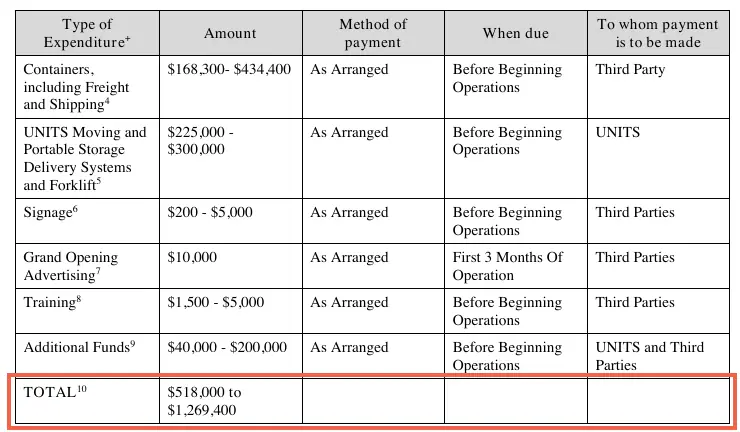
Land and the building decide the total. In Storage Authority’s new-construction table, land acquisition runs $800,000 to $2,000,000 and design, testing, market study, Phase 1 environmental, site development and buildings run $5,700,000 to $7,100,000, against a $69,000 franchise fee. UNITS has no land line; its largest items are containers at $168,300 to $434,400 and the delivery systems and forklift at $225,000 to $300,000, paid to UNITS. Item 7 is the estimated initial investment table every franchise disclosure document must carry.
| Item 7 line | Storage Authority new build | Storage Authority conversion | UNITS container business |
|---|---|---|---|
| Initial franchise fee | $69,000 | $69,000 | $55,500 to $222,000 |
| Land or real estate | $800,000 to $2,000,000 (land) | Not included (facility purchase excluded) | $10,000 to $75,000 (3 months rent and deposit) |
| Building, site work or refurbishing | $5,700,000 to $7,100,000 | $85,000 to $280,000 | None listed |
| Containers, trucks and forklift | None listed | None listed | $393,300 to $734,400 (two lines combined) |
| Signage | $80,000 to $150,000 | $75,000 to $150,000 | $200 to $5,000 |
| Permits, insurance, deposits, professional fees | $50,000 to $100,000 | $20,000 to $40,000 | Not a separate line |
| Working capital | $225,000 to $315,000 for 18 months | $30,000 to $60,000 for 3 months | $40,000 to $200,000 for 3 months |
| Total printed in Item 7 | $6,948,000 to $9,800,000 | $298,000 to $660,000 | $518,000 to $1,269,400 |
| Source | Storage Authority FDD, Item 7, pp. 7 to 10 | same, existing facility table | UNITS FDD, Item 7, pp. 10 to 12 |
A new Storage Authority facility is estimated at $6,948,000 to $9,800,000, a conversion at $298,000 to $660,000 and a UNITS container business at $518,000 to $1,269,400. FDD Item 7 tables, accessed November 8, 2026.
Storage Authority’s cover page prints the new-facility total as “6,953,000 to $9,800,000”, while its Item 7 table totals $6,948,000 at the low end, a $5,000 difference inside the same document. Note 3 says the high amount assumes a typical 60,000 phase 1 gross square foot, single story metal building, and excludes later expansion, off-site work, fill, environmental remediation and soil replacement. Note 7 excludes property tax and loan interest and principal, which on a $6,948,000 project are lender questions rather than franchisor ones.
The UNITS range follows the container count. Note 4 of its Item 7 bases the low figure on an initial purchase of 50 containers and the high figure on 120, excluding tariffs, which pass through to the buyer. Note 2 requires a warehouse of at least 10,000 square feet, which UNITS may waive in a Micro Territory of under 300,000 people if the franchisee has enclosed, locked outdoor space.
For a new Storage Authority facility, the payments arrive in a fixed order. The fee is due at signing, the territory is fixed only once a site is agreed, and the 12-year term starts at the Certificate of Occupancy under Item 17. Financing for a build of this size is usually arranged before land closes; our franchise financing guide explains how SBA and conventional loans treat franchise fees and real estate.
- Sign the franchise agreement and pay the $69,000 initial franchise fee (Item 5).
- Receive a non-exclusive Search Area to look for a site (Item 12).
- Agree a site; the exclusive territory becomes a 3 mile radius, or 5 miles where 3 miles holds fewer than 10,000 people (Item 12).
- Pay the $3,000 Website and Management Software Set Up Fee 90 days before opening (Item 5).
- Obtain the Certificate of Occupancy; the 12-year term starts (Item 17).
- From the first month with income, pay 6% or $1,950 royalty and 2.5% or $400 marketing, sales, technology and website fee (Item 6).
- Hold $225,000 to $315,000 of working capital for the first 18 months, the period Item 7 Note 6 uses for a new facility.
- At the end of year 12, renew for successive 10-year terms (Item 17).
Royalty floors and population-priced territories: the arithmetic
Each FDD sets its fees differently. Storage Authority charges a percentage with a monthly minimum, so a facility in lease-up pays the floor, while UNITS ramps its percentage over the first year and prices its franchise fee by the population inside the territory. Our study of franchise royalty rates across 259 FDDs shows where 6% and 8% sit against other sectors.
| Recurring fee | Storage Authority (2025 FDD) | UNITS (2026 FDD) | Source |
|---|---|---|---|
| Royalty | 6% of Gross Revenues or $1,950 per month, whichever is greater | 4% of Gross Sales for months 1 to 6, 6% for months 7 to 12, 8% after | Item 6 |
| Marketing or brand fund | 2.5% of Gross Revenues or $400 per month, whichever is greater | Brand Fund 2% of Gross Sales | Item 6 |
| Local advertising | Not listed as a separate fee | $3,000 to $4,500 per month | Item 6 |
| Software | $100 a month inside the marketing fee; SiteLink required; kiosk software $150 to $275 a month | $250 to $800 per month | Item 6 |
| Transfer | $20,000 transfer and training fee | $25,000, plus at least $30,000 if UNITS brokers or refers the buyer | Item 6 |
| Revenue excluded from the fee base | Truck rentals booked and accounted separately | Refunds, sales taxes, customer allowances | Item 6 notes |
| Worked arithmetic | Inputs from the FDD | Result |
|---|---|---|
| Storage Authority yearly royalty floor | $1,950 x 12 months | $23,400 |
| Storage Authority yearly marketing floor | $400 x 12 months | $4,800 |
| Combined yearly minimum before percentages apply | $23,400 + $4,800 | $28,200 |
| Monthly Gross Revenues at which 6% equals the $1,950 floor | $1,950 / 0.06 | $32,500 |
| UNITS fee, territory of 300,000 people or fewer | $55,500 base | $55,500 |
| UNITS fee, territory of 600,000 people | $55,500 + 3 x $18,500 | $111,000 |
| UNITS fee, territory of 1,200,000 people | $55,500 + 9 x $18,500 | $222,000 (matches Item 5 maximum) |
The Storage Authority floors start in “the first month that you have income”, per Item 6, with the $1,950 pro-rated in that month, so a new building in lease-up pays $1,950 until monthly Gross Revenues pass $32,500. Territory size works differently at the two brands: Storage Authority draws a radius, UNITS counts people with Maptitude software. Our research on franchise territory rights compares radius, population and ZIP-code territories across filings.
How many franchised storage outlets were open at the last year-end?
Very few for fixed-site storage. Storage Authority’s Item 20 Table 1 lists 2 franchised outlets at the start of 2022, 1 at the end of 2022 and 2023, and 0 at the end of 2024; Table 3 records one New Jersey outlet that ceased operations for other reasons in 2024. The 2 company-owned outlets, in Connecticut per Table 4, are facilities run by the co-founder’s entities under license. UNITS ended 2025 with 67 franchised and 2 company-owned outlets (UNITS FDD, Item 20 Table 1).
| Brand and outlet type | Start of first year | End of year 1 | End of year 2 | End of year 3 | Source |
|---|---|---|---|---|---|
| Storage Authority franchised (2022 to 2024) | 2 | 1 | 1 | 0 | Item 20 Table 1 |
| Storage Authority company-owned (2022 to 2024) | 2 | 2 | 2 | 2 | Item 20 Table 1 |
| UNITS franchised (2023 to 2025) | 61 | 72 | 71 | 67 | Item 20 Table 1 |
| UNITS company-owned (2023 to 2025) | 2 | 3 | 4 | 2 | Item 20 Table 1 |
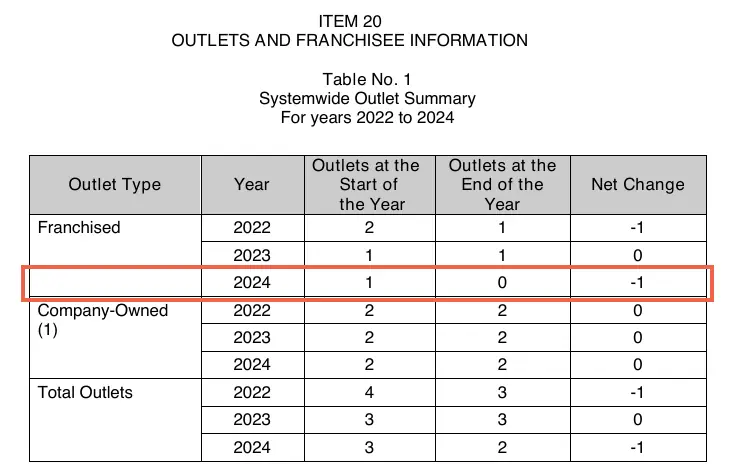
Item 20 counts outlets open for business, so agreements signed for sites still being built do not appear in Table 1. A 2019 trade-press column written by Storage Authority’s president put the system at 31 franchises; the 2025 filing is the dated record to compare against, and Exhibit D lists current and former franchisees to call. Storage Authority’s Item 19 makes no financial performance representation, while UNITS’s Item 19 contains historical Gross Sales for certain franchisee markets for 2023 to 2025; our Item 19 research explains how to read that kind of disclosure.
Does a build over $1,469,600 change the FTC disclosure duty?
It can. Under 16 CFR 436.8(a)(5)(i), the Franchise Rule does not apply when the buyer’s initial investment, excluding unimproved land and any financing from the franchisor, is at least $1,469,600 and the buyer signs an acknowledgment of the exemption. Storage Authority’s new-build Item 7 minus the land line still comes to $6,148,000 at the low end, above that threshold.
The exemption is optional for the seller and conditional for the buyer; Storage Authority still issues an FDD for both models. A second exemption, 436.8(a)(5)(ii), covers a franchisee entity in business for at least five years with net worth of at least $7,348,000. State registration laws have their own exemptions, so ask a franchise attorney two things before signing: whether any exemption is being relied on, and whether your state’s registration statute still requires delivery. The rule itself is summarized on our FTC Franchise Rule page.
Which states hold the most self-storage establishments?
Texas, California and Florida. County Business Patterns 2023 counts 2,304 establishments in Texas, 2,247 in California and 1,581 in Florida under NAICS 531130, out of 18,564 across the 50 states and DC, with 48,382 employees in the pay period including March 12. CBP covers only establishments “with paid employees” (Census CBP methodology), so unstaffed, kiosk-run facilities with no payroll are not in these counts.
Texas had 2,304 self-storage establishments with paid employees in 2023, California 2,247 and Florida 1,581, of 18,564 nationwide. Census County Business Patterns 2023, NAICS 531130, accessed November 8, 2026.
Ownership is spread across legal forms. Of the establishments with a reported legal form of organization in the 2023 state file, 7,988 were C-corporations, 6,439 partnerships, 3,118 S-corporations and 966 sole proprietorships, which fits a business held in property partnerships and REIT subsidiaries. The full state table follows; Item 12 radius or population terms only mean something once the local count is known.
| State | Establishments, NAICS 531130 (2023) | Paid employees, week of March 12, 2023 |
|---|---|---|
| Texas | 2,304 | 5,463 |
| California | 2,247 | 6,617 |
| Florida | 1,581 | 4,547 |
| Georgia | 705 | 1,839 |
| New York | 702 | 2,177 |
| North Carolina | 645 | 1,682 |
| Illinois | 572 | 1,476 |
| Washington | 535 | 1,472 |
| Arizona | 530 | 1,436 |
| Virginia | 511 | 1,126 |
| Colorado | 489 | 1,517 |
| Ohio | 468 | 1,131 |
| New Jersey | 454 | 1,131 |
| Tennessee | 444 | 1,032 |
| Pennsylvania | 415 | 925 |
| Indiana | 350 | 820 |
| Oregon | 332 | 880 |
| Massachusetts | 330 | 795 |
| Alabama | 328 | 964 |
| Louisiana | 322 | 1,030 |
| South Carolina | 320 | 695 |
| Maryland | 314 | 727 |
| Michigan | 312 | 725 |
| Nevada | 286 | 803 |
| Missouri | 285 | 606 |
| Oklahoma | 276 | 561 |
| Utah | 205 | 497 |
| New Mexico | 189 | 401 |
| Kentucky | 188 | 420 |
| Minnesota | 176 | 523 |
| Arkansas | 168 | 414 |
| Idaho | 166 | 377 |
| Connecticut | 164 | 369 |
| Wisconsin | 143 | 319 |
| Mississippi | 142 | 351 |
| Kansas | 124 | 318 |
| New Hampshire | 104 | 305 |
| Montana | 89 | 185 |
| Iowa | 82 | 219 |
| Maine | 72 | 182 |
| Nebraska | 72 | 198 |
| Hawaii | 64 | 194 |
| Delaware | 56 | 170 |
| Wyoming | 54 | 105 |
| Rhode Island | 50 | 138 |
| South Dakota | 48 | 93 |
| Alaska | 45 | 159 |
| West Virginia | 42 | 87 |
| Vermont | 25 | 68 |
| North Dakota | 20 | 71 |
| District of Columbia | 19 | 42 |
| Total, 50 states and DC | 18,564 | 48,382 |
Storage figures in circulation compared with the filings
Several ranking pages for this query print fees and totals that differ from the documents. The corrections below compare what a top-ranking guide states with the figure printed in the current filing; the filings are linked in the table.
| What a ranking guide says | What the primary document prints | Source |
|---|---|---|
| A software vendor’s guide, updated August 2026: Storage Authority fee $60,000 to $80,000, total $2M to $5M+ | $69,000 initial fee; $6,948,000 to $9,800,000 new build, $298,000 to $660,000 conversion | Storage Authority FDD, Items 5 and 7 |
| The same guide: UNITS fee $60,000 to $80,000, total $600K to $1.5M | $55,500 to $222,000 fee; $518,000 to $1,269,400 total | UNITS FDD, Items 5 and 7 |
| The same guide: Storage Authority marketing fund 1% to 2% | 2.5% of Gross Revenues or $400 per month, whichever is greater | Storage Authority FDD, Item 6 |
| A small-business listicle, 2024: Storage Authority franchise fee $39,000 | $69,000 initial fee, plus $3,000 set-up fee | Storage Authority FDD, Item 5 |
| The same listicle: CubeSmart and Extra Space Storage listed with franchise fees and investment ranges | Both 10-Ks describe management agreements paid as a percentage of revenues | CubeSmart 10-K; Extra Space 10-K |
| A 2025 vendor blog: Storage Authority total $500,000 to $4,000,000 | $298,000 to $660,000 conversion; $6,948,000 to $9,800,000 new build | Storage Authority FDD, Item 7 |
Choosing among franchise, management contract, dealer agreement and going independent
Start from what you already hold: land, an operating facility, a warehouse lease or another storefront. The table maps each position to the route whose documents fit it, with the threshold that applies. Converting an existing business to a brand is a pattern our conversion franchising research tracks across sectors. Nothing in this comparison is legal, tax or investment advice for a particular storage site or contract.
| If your position is | Route to price first | Threshold or document to check |
|---|---|---|
| You can fund land plus a building of about $6.9 million or more | Storage Authority new construction, or an independent build with a management contract | Item 7 total $6,948,000 to $9,800,000; ask lenders whether a management agreement is required, as Public Storage requires for its bridge loans |
| You own an operating facility and want a national name | Storage Authority conversion or a REIT management agreement | Conversion total $298,000 to $660,000, excluding the facility; management fee is a percentage of revenues, rate set in the contract |
| You want the real estate but not the daily operation | Third-party management agreement | Fee basis, expense reimbursement and termination terms in the management agreement |
| You have $518,000 to $1,269,400 and no land | UNITS container franchise | Warehouse of at least 10,000 square feet; fee $55,500 to $222,000 by population |
| You run another site-based business with spare lot space | U-Haul independent dealer | Commission on gross revenues from U-Haul rentals; no franchise fee is described in the 10-K |
| Your investment, excluding unimproved land, is $1,469,600 or more | Any franchise route | Whether the seller relies on 16 CFR 436.8(a)(5)(i) and asks you to sign an acknowledgment |
| You want full control of rates and software | Independent facility | State self-storage lien and notice laws named in Item 1 of both FDDs still apply |
How we compiled this
We read two franchise disclosure documents (Storage Authority, issued March 13, 2025, and UNITS, issued June 26, 2026), four Form 10-K filings on SEC EDGAR (Public Storage, Extra Space Storage, CubeSmart and U-Haul Holding Co.), the 2026 annual edition of 16 CFR 436.1 and 436.8, and the Census Bureau’s County Business Patterns 2023 state file, all accessed in November 2026. We left out every Item 19 figure, every franchisee name from Item 20 exhibits, and REIT revenue figures.
Frequently asked questions
Is owning a self storage franchise profitable?
Neither filing answers that with a number you can apply to your site. Storage Authority’s Item 19 makes no financial performance representation; UNITS’s Item 19 reports historical Gross Sales for certain franchisee markets. Owner results turn on occupancy and rates, debt service, which Storage Authority’s Item 7 Note 7 excludes, and fees such as the 6% or $1,950 monthly royalty. Read Item 19 and call former owners listed in Item 20.
How much does it cost to open a storage unit franchise?
Storage Authority’s 2025 FDD prints $6,948,000 to $9,800,000 for a new facility, including $800,000 to $2,000,000 for land, and $298,000 to $660,000 to convert an existing facility, excluding its purchase. The UNITS portable container franchise prints $518,000 to $1,269,400 in its June 2026 FDD, with no land line because franchisees lease a warehouse.
Does Public Storage sell franchises?
Its 10-K for 2025 describes a third-party management program, not franchising: at December 31, 2025 Public Storage managed 362 facilities for other owners and was under contract to manage 84 more. Extra Space Storage (1,856 managed stores) and CubeSmart (862) describe the same model, paid as a percentage of revenues (Public Storage 10-K).
Is a U-Haul dealership a franchise?
U-Haul Holding Co. describes its over 23,000 independent dealers as rental agents who receive equipment from the company and are paid a commission based on gross revenues from U-Haul rentals. Whether a specific dealer contract meets the FTC franchise definition depends on its terms, chiefly whether the dealer pays U-Haul $735 or more in required payments by the end of its first six months.
Which storage franchise uses portable containers?
UNITS Moving and Portable Storage. Its June 26, 2026 FDD describes delivery, warehouse storage and transport of modular containers in four sizes, an initial order of 50 to 120 containers in the Item 7 estimate, delivery systems bought from UNITS for $225,000 to $300,000, and a royalty that steps from 4% to 6% to 8% of Gross Sales during the first year.
Can I convert my existing storage facility into a franchise?
Storage Authority offers a conversion model: its 2025 Item 7 estimates $298,000 to $660,000, including the $69,000 fee and $85,000 to $280,000 for refurbishing and rebranding, with an exclusive 3 mile radius territory. The alternative is a management agreement with a REIT, where you keep ownership and pay a percentage of revenues.
Sources
- Storage Authority, LLC Franchise Disclosure Document, issued March 13, 2025, public PDF copy of the filing, accessed November 8, 2026.
- UNITS Franchising Group, Inc. Franchise Disclosure Document, issued June 26, 2026, Minnesota CARDS document 36949-202606-17, accessed November 8, 2026.
- Public Storage, Form 10-K for 2025, SEC EDGAR, accessed November 8, 2026.
- Extra Space Storage Inc., Form 10-K for 2025, SEC EDGAR, accessed November 8, 2026.
- CubeSmart, Form 10-K for 2025, SEC EDGAR, accessed November 8, 2026.
- U-Haul Holding Company, Form 10-K for fiscal 2026, SEC EDGAR, accessed November 8, 2026.
- U.S. Census Bureau, County Business Patterns 2023, state file, and CBP methodology page, accessed November 8, 2026.
- 16 CFR 436.1 and 16 CFR 436.8, Code of Federal Regulations, 2026 annual edition, govinfo, accessed November 8, 2026.
- Minnesota Department of Commerce, CARDS franchise registrations search, accessed November 8, 2026.