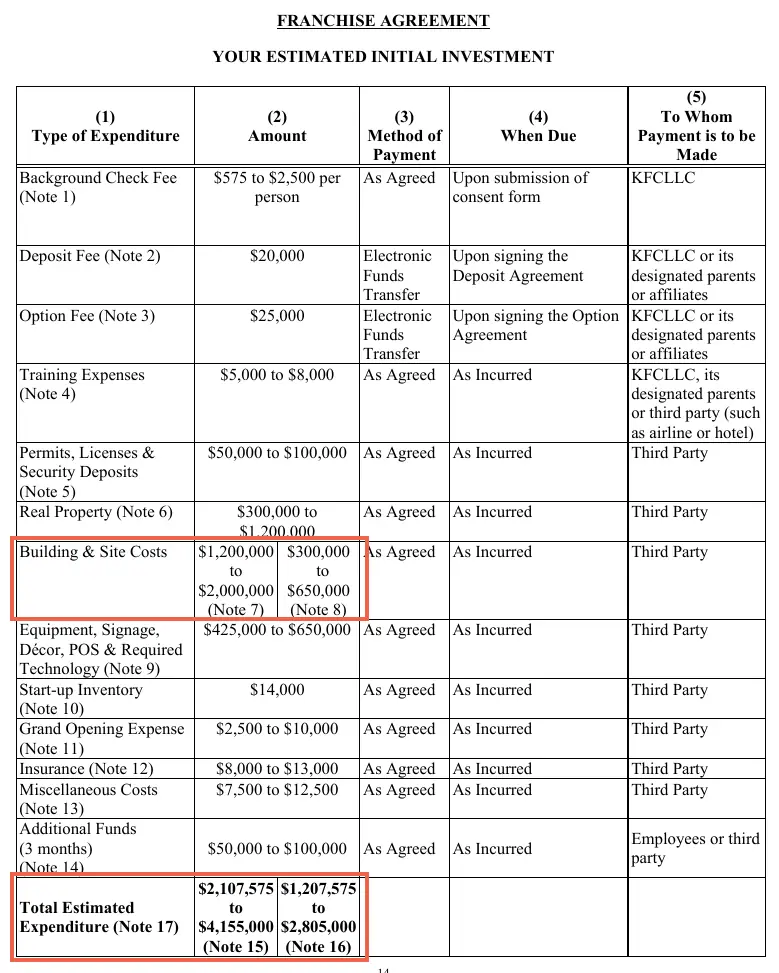
A KFC franchise cost runs $2,107,575 to $4,155,000 for a newly built U.S. restaurant, per Item 7 of the KFC FDD issued March 25, 2026. Remodeling, reopening or converting a building runs $1,207,575 to $2,805,000.
Key takeaways
- The $45,000 initial franchise fee is paid in two parts: a $20,000 Deposit Fee with the site application and a $25,000 Option Fee once the site is accepted (KFC FDD 2026, Item 5).
- Real property is budgeted at $300,000 to $1,200,000 in both Item 7 columns, so a remodel still assumes you buy land; only the building line drops, from $1,200,000 to $2,000,000 down to $300,000 to $650,000.
- Under the Comeback Agreement signed September 30, 2025, the National Co-Op advertising rate is 5.8% of Gross Revenue until March 31, 2027, then 4.5% through 2028 and 2% from January 1, 2029 (Item 6, Note 4).
- Royalty on a new restaurant is 5% for most buyers and 4% for Legacy Franchisees, with a $1,440 monthly minimum; resales carry the seller’s rate of up to 5.25%.
- Franchised U.S. restaurants fell from 3,558 to 3,404 during 2025, with 9 openings against 155 terminations (Item 20, Tables 1 and 3).
- Yum! Brands counts 33,897 KFC units worldwide at the end of 2025, 90% of them outside the U.S. (Yum! Brands 2025 Form 10-K).
| Figure | 2026 filing | Where printed |
|---|---|---|
| New build total | $2,107,575 to $4,155,000 | Item 7, Note 15 |
| Remodel, reopen or convert total | $1,207,575 to $2,805,000 | Item 7, Note 16 |
| Non-Traditional license total | $318,075 to $2,258,500 | Non-Traditional LDD, Item 7 |
| Paid to KFC US, LLC before opening | $48,575 to $50,500 | Cover page |
| Royalty | 4% to 5.25%, minimum $1,440 a month | Item 6, Note 2 |
| National Co-Op advertising | 5.8% until March 31, 2027 | Item 6, Note 4 |
| Franchise term | 20 years | Item 17 |
| Signing to opening | about 6 to 24 months | Item 11 |
What does each line of KFC’s 2026 Item 7 add up to?
KFC’s Item 7 prints thirteen lines for a Traditional Outlet and two totals: $2,107,575 to $4,155,000 for a ground-up build and $1,207,575 to $2,805,000 for a remodel, reopening or conversion. Building and site work is the swing line at $1,200,000 to $2,000,000 new, and every other line is identical in both columns. We re-added both columns and each total matches the printed figure.
| Item 7 line | New build | Remodel, reopen or convert | Non-Traditional | Source |
|---|---|---|---|---|
| Background check (per person) | $575 to $2,500 | $575 to $2,500 | $575 to $2,500 | Item 7, Note 1 |
| Deposit Fee | $20,000 | $20,000 | n/a | Item 5 |
| Option Fee | $25,000 | $25,000 | n/a | Item 5 |
| Initial License Fee | n/a | n/a | $22,500 | LDD Item 5 |
| Training expenses | $5,000 to $8,000 | $5,000 to $8,000 | $5,000 to $8,000 | Item 7, Note 4 |
| Permits, licenses, deposits | $50,000 to $100,000 | $50,000 to $100,000 | $7,500 to $10,000 | Item 7, Note 5 |
| Real property | $300,000 to $1,200,000 | $300,000 to $1,200,000 | $50,000 to $375,000 | Item 7, Note 6 |
| Building and site, or leasehold work | $1,200,000 to $2,000,000 | $300,000 to $650,000 | $75,000 to $1,200,000 | Item 7, Notes 7 and 8 |
| Equipment, signage, decor, POS, technology | $425,000 to $650,000 | $425,000 to $650,000 | $100,000 to $550,000 | Item 7, Note 9 |
| Start-up inventory | $14,000 | $14,000 | $12,000 to $15,000 | Item 7, Note 10 |
| Grand opening | $2,500 to $10,000 | $2,500 to $10,000 | $5,000 to $15,000 | Item 7, Note 11 |
| Insurance (annual premium) | $8,000 to $13,000 | $8,000 to $13,000 | $8,000 to $13,000 | Item 7, Note 12 |
| Miscellaneous | $7,500 to $12,500 | $7,500 to $12,500 | $7,500 to $12,500 | Item 7, Note 13 |
| Additional funds, 3 months | $50,000 to $100,000 | $50,000 to $100,000 | $25,000 to $35,000 | Item 7, Note 14 |
| Total as printed | $2,107,575 to $4,155,000 | $1,207,575 to $2,805,000 | $318,075 to $2,258,500 | Item 7 |
The three-month additional funds line follows the federal Franchise Rule, which asks for an “initial period” of at least three months or a period reasonable for the industry (16 CFR 436.5(g)). KFC’s Note 17 adds that the estimates exclude any finance charge, interest or debt service, so loan costs sit outside these totals.
Building and site work ($1,200,000 to $2,000,000) and land ($300,000 to $1,200,000) make up most of a new KFC’s Item 7 high estimate of $4,155,000. KFC FDD, March 25, 2026.
| Worked check | Arithmetic from the filing | Result |
|---|---|---|
| Paid to KFC, low | $575 background + $20,000 deposit + $25,000 option + $3,000 training | $48,575 |
| Paid to KFC, high | $2,500 background + $20,000 + $25,000 + $3,000 | $50,500 |
| New build minus remodel, low | $2,107,575 minus $1,207,575 | $900,000 (the building line gap) |
| New build minus remodel, high | $4,155,000 minus $2,805,000 | $1,350,000 ($2,000,000 minus $650,000) |
| Land share of the remodel total | $300,000 of $1,207,575; $1,200,000 of $2,805,000 | 24.8% low; 42.8% high |
| Development Fee | 3 to 12 Outlets times $45,000 | $135,000 to $540,000 |
Why does a KFC remodel still budget up to $1.2 million for land?
Note 6 of Item 7 says KFC’s real property estimates “are for purchased sites”, and the same $300,000 to $1,200,000 sits in the remodel column. A buyer who leases the lot, or takes over a closed building on a ground lease, may land below the printed $1,207,575 low end, though the lease then shows up as rent and security deposits instead.
The site assumptions are concrete. KFC describes average approved lots as about 175 feet wide and 200 feet deep and prices site work for a 21,000 to 43,500 square foot pad (Notes 6 and 7). Remodel figures assume a 1,700 to 3,000 square foot building, and the new-build numbers rest on the RS Means national average city cost index, so KFC tells buyers to adjust for the local index (Note 7).
Remodel duties continue after opening. Non-Legacy buyers sign the 5/15 Amendment, which requires a 10-year upgrade with refurbishment in years 5 and 15 of the 20-year term. Legacy Franchisees, those in the system as of August 1, 2008, owe a 10-year remodel capped at $175,000, adjusted for inflation (Item 1). Operators who rebuild or relocate by December 31, 2026 can sign a Rebuild/Relocate Addendum for a new 20-year term at twice the current renewal fee, which Item 6 lists at $9,600.
Which part of the $45,000 comes back if a site falls through?
KFC collects the $45,000 fee before a franchise agreement is signed, and refunds are narrow. If KFC rejects the proposed site, the $20,000 Deposit Fee comes back minus any $6,000 Impact Study Fee, after you sign a general release; if a bona fide zoning or building restriction kills the project, $22,500 of the $25,000 Option Fee comes back (Item 5).
- Pay the background check fee of $575 to $2,500 per person who signs the Franchise Agreement or Guaranty; some non-U.S. citizens have paid as much as $3,700 (Item 7, Note 1).
- Sign the Deposit Agreement, pay $20,000 and submit the site. The closest or second-closest existing franchisee may request an Impact Study; KFC accepts the site if projected impact is under 10%, or under 5% if that restaurant opened within the prior 18 months (Item 11).
- Sign the Option Agreement and Franchise Agreement, pay the $25,000 Option Fee and submit Site Plans, which KFC typically answers within 30 days (Item 11).
- Complete training: a 1 to 1.5 day immersion in Plano or online, a 1-week restaurant orientation and 5 weeks of key operator training; the fee is $3,000 per person at a company Outlet (Items 5 and 11).
- Build and open, which KFC estimates at about 6 to 24 months from signing (Item 11).
Multi-unit buyers pay differently. A Development Agreement for 3 to 12 Outlets replaces the per-store fee with a Development Fee of $45,000 per committed Outlet, paid in yearly installments due September 30 before each development year, with no refund and no territorial exclusivity (Item 5 and Item 1). Our area development agreement research compares how other franchisors schedule those installments.
How high do KFC’s percentage fees run while the Comeback Agreement lasts?
A new non-Legacy KFC pays a 5% royalty plus a 5.8% National Co-Op contribution, 10.8% of Gross Revenue, until March 31, 2027, when the co-op rate is scheduled to fall to 4.5% (Item 6, Notes 2 and 4). Digital orders add a 3.1% Digital Fee on that channel, and fixed monthly charges add $297.39 for technology and $180 for the One System Fund.
| Recurring fee | Amount in the 2026 filing | Due | Source |
|---|---|---|---|
| Royalty | 4% (Legacy) or 5% on a new Outlet; resales 4% to 5.25%; minimum $1,440 a month | Monthly, by the 20th | Item 6, Note 2 |
| National Co-Op advertising | 5.8% to March 31, 2027; 4.5% through December 31, 2028; 2% from January 1, 2029 | Monthly, by the 20th | Item 6, Note 4 |
| Digital Fee | 3.1% of Gross Revenue from digital orders, fixed through 2026 | Monthly | Item 6 |
| Technology Fee | $297.39 per Outlet per month; up to $450.63 expected; cap $3,000 | Monthly | Item 6, Note 7 |
| One System Fund | $180 per Outlet per month plus tax and shipping | Monthly | Item 6 |
| Transfer to a new franchisee | $9,600 first Outlet, $4,800 each additional | At transfer | Item 6 |
| Late royalty | 1.5% per month | On demand | Item 6 |
The Comeback Agreement among KFC US, LLC, the KFC National Council and Advertising Cooperative and the Association of Kentucky Fried Chicken Franchisees raised the co-op rate from October 1, 2025 (Item 1). Existing franchisees could sign a Brand Contribution Option Amendment, a permanent 0.25% royalty increase in exchange for KFC funding part of their higher advertising bill. That is why a resale can carry 5.25%, and a buyer who closes such a restaurant before the amendment’s 10th anniversary may owe KFC the unamortized contribution (Item 6, Note 8).
The Digital Fee only applies if you use digital ordering, but Item 6 states that about 90% of franchisees participate. Our advertising fund research shows where a 5.8% contribution falls among other filings.
What does a KFC Non-Traditional license cost instead?
A KFC Non-Traditional Outlet inside an airport, university, stadium or travel plaza costs $318,075 to $2,258,500, per Item 7 of KFC’s separate Non-Traditional License Disclosure Document issued March 20, 2026. The initial license fee is $22,500, and the ongoing Licensing Fee is 9.5% of Gross Revenues under a 10-year license term (KFC Non-Traditional LDD 2026, Items 5, 6 and 17).
Space is the constraint. KFC estimates college and university sites need at least 500 to 900 square feet and airport or mall sites at least 880 square feet, excluding dining area (LDD Item 7, Note 3). Item 1 of the Traditional FDD counts 29 Non-Traditional Outlets as of December 29, 2025, against 3,404 franchised Traditional ones.
Does KFC publish a net worth or liquidity minimum?
No net worth or liquid-asset minimum for franchisees appears in the March 25, 2026 KFC FDD. Item 1 instead says KFC is “seeking franchisees with multi-unit operational experience” and weighs a candidate’s financial and business capacity to support growth, any record of development in KFC or another quick-service system, and willingness to sign development agreements for 3 to 12 Outlets.
Many cost guides repeat a net worth and liquidity figure attributed to KFC’s franchising website. That page loads its text by script, and neither our direct request nor the November 4, 2025 Wayback Machine capture returned any requirement text, so this page does not repeat a number. Ask KFC’s franchise development team to state the current threshold in writing, and check it against your lender’s terms, since Item 10 says KFC offers no financing of any kind. Our franchise financing guide covers how buyers usually fund a multi-million-dollar build.
The only net worth figure in the filing is KFC’s own: its financial statements say it must hold at least $15 million of net worth to qualify for a large franchisor exemption under certain registration laws, and it reported $52.9 million at December 29, 2025 (Item 21, Exhibit J). This page is general information, not legal, financial or investment advice.
Where do KFC’s U.S. restaurants sit inside Yum! Brands?
KFC US, LLC is the U.S. franchisor, KFC Corporation manages the system under a management agreement, and Yum! Brands, Inc. is the ultimate parent (Item 1). Yum’s 2025 Form 10-K reports 33,897 KFC Division units at year end, up from 31,981 in 2024, with 90% outside the U.S. and 99% run by franchisees. The U.S. system moved the other way.
| KFC U.S. outlets (Item 20) | 2023 | 2024 | 2025 |
|---|---|---|---|
| Franchised, start of year | 3,842 | 3,715 | 3,558 |
| Opened | 30 | 28 | 9 |
| Terminations | 156 | 151 | 155 |
| Reacquired by franchisor | 1 | 34 | 7 |
| Franchised, end of year | 3,715 | 3,558 | 3,404 |
| Company-owned, end of year | 46 | 79 | 86 |
| Transfers between owners | 34 | 168 | 30 |
Franchised KFC outlets in the U.S. fell from 3,842 to 3,404 between the start of 2023 and the end of 2025; 2025 saw 9 openings and 155 terminations. Item 20, KFC FDD, March 25, 2026.
Table 5 of Item 20 projects 25 new franchised Outlets in 12 states during 2026, led by 6 in New York and 4 in Georgia, plus 1 company Outlet in Texas, with zero signed-but-unopened agreements at December 29, 2025. The same parent files separate FDDs for its other brands; the Taco Bell franchise cost breakdown and the Pizza Hut franchise cost formats use the same Item 7 approach. For a chicken competitor outside Yum, see the Popeyes franchise cost filing, and our public franchisor unit growth report sets Yum’s openings beside other listed chains.
Item 19 of the KFC filing does contain a financial performance representation: a Kalibrate Forecast Tool comparison of projected and actual annual Net Sales for 2,227 single-brand drive-thru Outlets open at least one year. This site does not reprint those figures; read Item 19 of the current FDD, and our Item 19 research explains how forecast-based disclosures differ from historical averages.
Which KFC cost figures online predate the March 2026 filing?
Several ranking guides still print 2025 or 2024 filing figures, and some fee rates changed within the year. Each row below sets a claim from a top-ranking page, described without naming it, against the March 25, 2026 KFC FDD.
| Claim in circulation | What the 2026 filing prints | Source |
|---|---|---|
| New build $1,852,825 to $3,771,550 (guides updated March 2025 and January 2026) | $2,107,575 to $4,155,000 | Item 7 |
| Remodel or conversion $1,052,825 to $2,521,550 | $1,207,575 to $2,805,000 | Item 7 |
| National Co-Op 4.5%, or “about 5%” | 5.8% until March 31, 2027 | Item 6, Note 4 |
| Digital fee 3.5% | 3.1% through end of 2026 | Item 6 |
| Royalty 4% to 5% | 4% to 5.25% (resales) | Item 6, Note 2 |
| Non-Traditional $302,825 to $1,434,000 | $318,075 to $2,258,500 | LDD Item 7 |
| 3,761 U.S. units | 3,490 at December 29, 2025 | Item 20, Table 1 |
| Fixed net worth and liquidity minimums | No franchisee minimum printed | Items 1 and 5 |
Build, remodel or license: which KFC entry matches your capital?
The route follows two inputs: how much capital you can commit, counting land, and whether you control a building or a captive venue. Use the thresholds below, which come straight from the 2026 filings, and confirm the site economics with Item 19 and the franchisees listed in Exhibit K before you pay the $20,000 deposit.
| If your situation is | Then the matching route is | Key 2026 figure |
|---|---|---|
| Capital below $318,075 | No KFC format fits; that is the lowest Item 7 low end | LDD Item 7 |
| Space in an airport, campus or stadium of 500 to 900+ sq ft | Non-Traditional license, 10-year term | $318,075 to $2,258,500; 9.5% Licensing Fee |
| A closed KFC or other restaurant building you can buy | Remodel, reopen or convert column | $1,207,575 to $2,805,000 |
| Land plus ground-up construction budget | New build, 20-year term | $2,107,575 to $4,155,000 |
| A plan for 3 to 12 restaurants | Development Agreement | $135,000 to $540,000 Development Fee |
| Buying an existing KFC | Transfer; check the seller’s royalty and any Brand Contribution Option Amendment | $9,600 first-Outlet transfer fee; royalty up to 5.25% |
| An existing operator planning to rebuild | Rebuild/Relocate Addendum if finished by December 31, 2026 | New 20-year term; fee twice the $9,600 renewal fee |
Protection is limited whichever route you pick: Item 12 grants no exclusive territory, only a Protected Territory of the smaller of a 1.5-mile radius or the area where 30,000 people live. Our territory rights research compares that radius with other restaurant filings.
How we compiled this
We read two KFC US, LLC disclosure documents from Minnesota’s CARDS database, the Traditional FDD issued March 25, 2026 and the Non-Traditional LDD issued March 20, 2026, retyped every Item 7 line into a CSV and re-added all six totals. Unit counts come from Item 20 and from Yum! Brands’ 2025 Form 10-K on SEC EDGAR. Item 19 figures were left out under this site’s no-earnings rule; everything was accessed November 8, 2026.
Frequently asked questions
How much does it cost to open a KFC franchise?
KFC’s FDD issued March 25, 2026 puts a newly built U.S. restaurant at $2,107,575 to $4,155,000 and a remodeled, reopened or converted one at $1,207,575 to $2,805,000 (Item 7). Both totals include land bought at $300,000 to $1,200,000 and three months of additional funds. A Non-Traditional license in a captive venue runs $318,075 to $2,258,500.
What is the KFC franchise fee?
The initial franchise fee is $45,000, paid as a $20,000 Deposit Fee when you apply for a site and a $25,000 Option Fee when KFC accepts it (Item 5). Add $3,000 per person for training at a company restaurant and a $575 to $2,500 background check per signer. Non-Traditional licenses charge $22,500 instead.
What are the requirements to own a KFC franchise?
The 2026 FDD prints no net worth or liquidity minimum for franchisees. Item 1 says KFC is seeking operators with multi-unit restaurant experience who can sign development agreements for 3 to 12 Outlets, and it weighs financial and business capacity. Each signer passes a background check, the site must clear KFC’s review and any Impact Study, and training runs about 6 weeks.
How much do KFC franchise owners make?
This site does not publish earnings figures. Owner income depends on a restaurant’s sales against fixed and percentage costs: a 5% royalty and 5.8% co-op contribution on a new Outlet, monthly technology and One System Fund charges, rent or debt on a build of up to $4,155,000, food and labor. Item 19 of the current KFC FDD holds the company’s own sales representation.
Can an individual open a single KFC restaurant?
The Franchise Agreement grants one Outlet at one approved site, so a single-unit deal exists on paper. Item 1, however, says KFC is seeking franchisees with multi-unit operational experience and offers Development Agreements for 3 to 12 Outlets, and Item 20 projects only 25 new franchised U.S. Outlets for 2026. Buying an existing restaurant through a transfer is the other entry route.
How much does a KFC franchise cost in India?
The U.S. FDD does not answer that. Item 1 states that its figures exclude international operations, which other Yum! Brands affiliates franchise, and Yum’s 2025 Form 10-K says 90% of the 33,897 KFC Division units sit outside the U.S. Costs, fees and eligibility in India come from the KFC affiliate or master franchisee for that market, not from this filing.
Does KFC offer financing for a new restaurant?
No. Item 10 of the March 25, 2026 FDD says KFC US, LLC offers no direct or indirect financing for the initial investment or continuing operation, and neither KFC nor its affiliates guarantee a note or lease. Note 17 of Item 7 adds that its $2,107,575 to $4,155,000 estimate excludes interest and debt service, so loan costs come on top.
Sources
- KFC US, LLC Franchise Disclosure Document (KFC Traditional), issued March 25, 2026, cover page and Items 1, 5, 6, 7, 10, 11, 12, 17, 19, 20 and 21. Minnesota Department of Commerce CARDS, document 35571-202603-05. Accessed November 8, 2026.
- KFC US, LLC Non-Traditional License Disclosure Document, issued March 20, 2026, Items 5, 6, 7 and 17. Minnesota CARDS, document 35546-202603-05. Accessed November 8, 2026.
- Yum! Brands, Inc. Form 10-K for fiscal 2025, Items 1, 2 and 7 (KFC Division unit counts). SEC EDGAR. Accessed November 8, 2026.
- 16 CFR 436.5, Franchise Rule disclosure items, paragraphs (g) and (s). Legal Information Institute, Cornell Law School. Accessed November 8, 2026.