A Baskin Robbins franchise costs $307,400 to $626,700 to open, with a $25,000 standard fee, under the FDD issued March 26, 2026. Gas station, non-traditional and Dunkin’ Combo units pay different fees.
Key takeaways
- The initial franchise fee is $25,000 for a standard restaurant, $10,000 plus Dunkin’s own fee for a Combo, and a term-prorated fee for gas station ($12,500 on 10 years) and SDO units ($6,250 on 10 years), per Item 5 of the Baskin-Robbins Franchise Disclosure Document issued March 26, 2026.
- The weekly royalty is 5.9% of Gross Sales in most of the US, 1.0% in Alaska, Idaho, Montana, Oregon and Washington, and 0.5% in Hawaii and the Central States Territory, where Item 8 says product prices run higher instead.
- Standalone Baskin-Robbins restaurants fell from 1,001 to 967 over 2023 to 2025, while Dunkin’ and Baskin-Robbins Combos fell from 1,269 to 1,219 in 2025 alone (Item 20).
- Royalty and opening incentives require a signed agreement on or before March 31, 2027 and exclude SDO and Combo units (Items 5 and 6).
- The Baskin-Robbins franchising page asks for $100,000 in liquid assets and $200,000 net worth, and Item 10 states the franchisor offers no financing.
Five contracts under one brand: what does each Baskin-Robbins format charge up front?
Baskin-Robbins Franchising LLC sells one brand through five contract shapes, and Item 5 prices each one differently. A standard restaurant pays $25,000, a gas station or convenience store unit pays the standard fee prorated by term, an SDO venue pays half of that, and a Combo pays $10,000 to Baskin-Robbins plus the Dunkin’ fee. Multi-Brand sites also pay the partner brand.
The fee is only part of the opening cheque. Item 5 also sets a minimum marketing start-up spend that moves with format: $6,000 for a standard or gas station unit, $10,000 for a Combo, and $3,000 for an SDO. The full matrix is in the file baskin-robbins-fees-by-format.csv.
| Format | Initial fee to Baskin-Robbins | Marketing start-up minimum | Advertising fee (CAF) | Renewal | Source |
|---|---|---|---|---|---|
| Standard (standalone) restaurant | $25,000 | $6,000 | 5.0% of Gross Sales | 20-year term, 10-year renewal | Baskin-Robbins FDD, Items 5, 6, 17 |
| Gas station or convenience store | $25,000 prorated by term; $12,500 on a 10-year term | $6,000 | No separate rate listed in Item 6 | Per Franchise Agreement | Items 5, 6 |
| SDO (airport, hospital, campus, stadium and similar) | 50% of $25,000, prorated; $6,250 on a 10-year term | $3,000 | 2.5% of Gross Sales | No renewal rights | Items 5, 6, 17 |
| Combo with Dunkin’ | $10,000 plus the Dunkin’ fee | $10,000 | Not stated separately for Combos | 20-year term, 10-year renewal | Items 5, 6, 17 |
| Multi-Brand Location | Fee for the restaurant type, plus every partner fee | Per restaurant type | Per restaurant type | Tied to the partner agreement too | Items 1, 5, 17 |
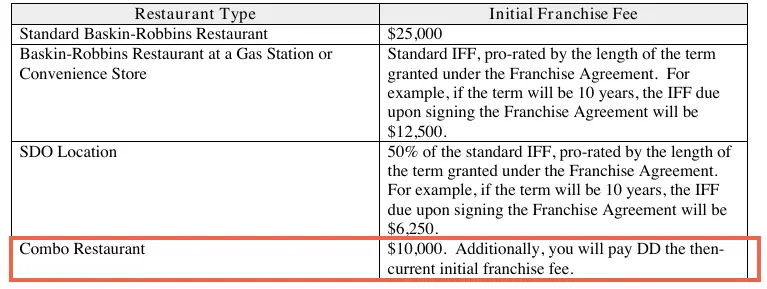
The Dunkin’ half of a Combo has its own price list. The Dunkin’ FDD issued March 26, 2026 sets the standard Dunkin’ fee by market type, from $90,000 in Type 1 areas such as Boston to $40,000 in Type 6 areas, so a Combo’s combined fee depends on the Dunkin’ market type. Our Dunkin’ cost breakdown by format lists those market types.
Item 1 names the Multi-Brand partners: Arby’s, Buffalo Wild Wings, BWW GO, Jimmy John’s and Sonic. Nine Baskin-Robbins restaurants operated at Multi-Brand Locations at the end of 2025, and Item 20 lists Jimmy John’s pairings opened in 2024 and 2025 in Minnesota, New Jersey, New York, Ohio and Washington.
- Standalone and gas station units sign the Franchise Agreement (Exhibit C-1).
- SDO venues sign the Franchise Agreement plus the Non-Traditional Rider (Exhibit C-3).
- Combo operators sign the Combo Franchise Agreement (Exhibit C-2) and receive a separate Dunkin’ FDD.
- Multi-Brand operators sign the Multi-Brand Addendum (Exhibit C-5) plus each partner brand’s agreement.
- Two or more restaurants require a Development Agreement (D-1) or Combo Development Agreement (D-2), with 25% of each fee due at signing.
Which states pay 5.9% royalty, and which pay 0.5% or 1.0%?
Item 6 sets the Continuing Franchise Fee at 5.9% of Gross Sales across most of the US, but at 1.0% in Alaska, Idaho, Montana, Oregon and Washington and 0.5% in Hawaii and the Central States Territory. The trade-off is in Item 8: restaurants in those areas pay higher prices for required products in exchange for the reduced royalty.
The Central States Territory is not whole states. Item 5 defines it as certain designated areas in Arkansas, Georgia, Kansas, Mississippi, Missouri, Nebraska, Oklahoma and Tennessee, so an applicant in Memphis or Wichita should ask which side of the line the site sits on before reading any fee table.
| Area | Royalty (CFF) | Advertising (CAF) | Weekly total | Source |
|---|---|---|---|---|
| Standard (Royalty) Territory: rest of the US | 5.9% | 5.0% | 10.9% | Baskin-Robbins FDD, Item 6 notes 2, 3 |
| Idaho, Montana, Oregon, Washington | 1.0% | 5.0% | 6.0% | Item 6 |
| Alaska | 1.0% | 3.5% | 4.5% | Item 6 |
| Hawaii | 0.5% | 3.5% | 4.0% | Item 6 |
| Central States Territory | 0.5% | 2.5% | 3.0% | Item 6 |
| SDO in a standard area | 5.9% | 2.5% | 8.4% | Item 6 |
Royalty plus advertising runs from 3.0% of Gross Sales in the Central States Territory to 10.9% in standard areas, before incentives. Baskin-Robbins FDD issued March 26, 2026, Item 6.
Both fees are paid weekly, on or before Thursday for the seven-day period ending the Saturday twelve days earlier (Item 6). The Center training subscription adds $300 per restaurant a year, and late payments carry 1.5% a month or the legal maximum. For how 5.9% sits against other systems, see the franchise royalty rates report.
Where are new Baskin-Robbins units being signed for 2026?
Item 20 Table 5 counts 37 Baskin-Robbins franchise agreements signed but not yet open at December 28, 2025, and projects 52 new franchised openings in the next fiscal year. Texas leads with 10 signed and 7 projected, and the Combo table projects 26 openings with none signed. The official franchising page lists four standalone building formats.
| State | Signed, not open (Dec 28, 2025) | Projected openings, next fiscal year | Outlets at end of 2025 |
|---|---|---|---|
| Texas | 10 | 7 | 101 |
| California | 5 | 5 | 395 |
| Florida | 3 | 3 | 7 |
| New York | 3 | 3 | 8 |
| Minnesota | 0 | 4 | 2 |
| North Carolina | 0 | 4 | 3 |
| Virginia | 0 | 3 | 13 |
| Total: 24 states and DC in Table 5 | 37 | 52 | 967 (all states) |
The state file baskin-robbins-item20-states-2025.csv carries all 41 states with outlets plus DC: 2025 openings, terminations, non-renewals, closures, year-end count, Table 5 figures, and the Item 5 fee territory each falls in. Table 5 is the franchisor’s projection, not a list of open territories, and Item 12 grants no exclusive territory under a single Franchise Agreement; the franchise territory rights report compares that clause across filings.
| Building format | Size | Site note | Source |
|---|---|---|---|
| Freestanding | 1,610 sq ft | Drive-thru and patio; minimum 25,000 Average Daily Traffic | Baskin-Robbins franchising page, Nov 2026 |
| Endcap | 1,645 sq ft | Mixed-use with drive-thru | Same |
| Inline | 1,006 sq ft | Storefronts, malls | Same |
| Small Format | 1,070 sq ft | Fits a 1/2 acre lot (22,000 sq ft) | Same |
| Non-traditional kiosk | 150 to 350 sq ft | Inspire Brands program range, all brands | Inspire non-traditional page, Nov 2026 |
How is the $307,400 to $626,700 built, and what sits beyond it?
Item 7 prints one table for a new restaurant, and real estate development is the widest line at $123,000 to $269,400. The low end assumes a build-to-suit lease where the landlord funds most construction; the high end assumes leasehold improvements inside a landlord’s building. Note 11 says a Combo costs about the same plus extra equipment, with the Dunkin’ portion priced in the Dunkin’ FDD.
| Item 7 line | Low | High | What moves it (Item 7 note) |
|---|---|---|---|
| Initial Franchise Fee | $25,000 | $25,000 | Standard unit only; formats in Item 5 |
| Real Estate Development | $123,000 | $269,400 | Build-to-suit vs leasehold improvements (note 1) |
| Equipment, Fixtures and Signs | $115,000 | $185,000 | Includes about 10% tax and delivery (note 2) |
| Restaurant Technology System | $15,000 | $29,500 | 1 to 2 POS; drive-thru gear excluded (note 3) |
| Licenses, Permits, Fees and Deposits | $7,000 | $20,000 | Impact fees excluded (note 4) |
| Opening Inventory | $5,000 | $8,000 | Storage capacity and season (note 5) |
| Miscellaneous Opening Costs | $9,500 | $28,000 | Pre-opening payroll, deposits (note 6) |
| Uniforms | $400 | $800 | |
| Insurance | $3,500 | $10,000 | $2,000,000 per occurrence general liability (note 7) |
| Travel and Living While Training | $1,000 | $15,000 | One person, 4 weeks (note 8) |
| Marketing Start-Up Fee | $3,000 | $6,000 | Format and incentives (Item 5) |
| Additional Funds, first 3 months | $0 | $30,000 | Winter openings may need more (note 9) |
| Total | $307,400 | $626,700 | Baskin-Robbins FDD, Item 7 |
We added the twelve lines ourselves, and both printed totals match. The arithmetic below separates the payments the cover page says go to the franchisor or an affiliate ($28,300 to $36,650) from the costs Item 7 leaves out.
| Calculation | Inputs | Result | Source |
|---|---|---|---|
| Low total check | 25,000 + 123,000 + 115,000 + 15,000 + 7,000 + 5,000 + 9,500 + 400 + 3,500 + 1,000 + 3,000 + 0 | $307,400 | Item 7 |
| High total check | 25,000 + 269,400 + 185,000 + 29,500 + 20,000 + 8,000 + 28,000 + 800 + 10,000 + 15,000 + 6,000 + 30,000 | $626,700 | Item 7 |
| Gas station fee, 10-year term | $25,000 x 10 / 20 years | $12,500 | Item 5 example |
| SDO fee, 10-year term | $25,000 x 50% x 10 / 20 years | $6,250 | Item 5 example |
| Combo: Baskin-Robbins fee, The Center fee and marketing minimum | $10,000 fee + $300 The Center + $10,000 marketing minimum | $20,300, plus the Dunkin’ fee | Item 5 |
| Development Agreement deposit, 3 standard units | 3 x $25,000 x 25% | $18,750 at signing | Item 5 |
Four costs sit outside the range. Buying land can add $100,000 to $1,200,000 or more, a freestanding building on leased land $200,000 to $300,000 more, and government impact fees “can be $87,000 or more in some markets” (Item 7 notes 1 and 4). A pre-lease feasibility study runs $1,000 to $3,000. None of this is legal or financial advice; an accountant can test these lines against a specific site.
What do the incentives that expire March 31, 2027 change?
Two incentive programs cut the weekly fees for new standard restaurants signed by March 31, 2027. The Standard (Royalty) program starts the royalty at 1.9% and steps it up one point a year to 5.9% in Year 5, with a 2.5% advertising fee through Year 3 and a $12,500 royalty credit. The Standard (Margin) program, for the low-royalty states, pays equipment credits instead.
| Program | What it gives | Who qualifies | Source |
|---|---|---|---|
| Standard (Royalty) | CFF 1.9%, 2.9%, 3.9%, 4.9%, then 5.9% from Year 5; CAF 2.5% through Year 3; $12,500 CFF credit; marketing spend cut to $3,000 with $3,000 from the franchisor | New or reopened standard unit in the Standard (Royalty) Territory | Baskin-Robbins FDD, Items 5, 6 |
| Standard (Margin) | $12,500 CFF credit; equipment credit of $31,000, or $50,000 with a drive-thru; reduced CAF (1.3% Central States, 1.8% Alaska and Hawaii, 2.5% Pacific Northwest, through Year 3) | New unit in Alaska, Hawaii, Idaho, Montana, Oregon, Washington or the Central States Territory | Items 5, 6, 7 note 12 |
| Early Opening | 0% royalty from opening to the required opening date, up to 6 months | Royalty or Margin participants who open early | Item 6 note 2 |
| VetFran | $10,000 royalty credit per restaurant, up to $100,000; combinable with the above | Honorably discharged veterans new to the system | Item 6 note 2 |
All four programs share the same exclusions: no renewals, no relocations outside the relocation programs, no transfers, no SDO units and no Combos. Each also requires development costs submitted within 120 days of opening. Veterans comparing several brands can use our franchise opportunities for veterans guide, which sets VetFran credits side by side.
Why did the Combo count drop by 50 in 2025 while standalones lost 9?
Item 20 reports standalone and Combo restaurants in separate tables. Standalone units went from 1,001 at the start of 2023 to 967 at the end of 2025. Combos rose to 1,283 in 2023, then fell to 1,269 and 1,219, with 54 ceasing operations and 12 opening in 2025. A Combo counts as closed when either brand closes, per the Combo notes.
Standalone units lost 34 over three years; Combos lost 50 in 2025 alone. Baskin-Robbins FDD issued March 26, 2026, Item 20.
| Year | Standalone end of year | Standalone opened / exits | Combo end of year | Combo opened / exits | Source |
|---|---|---|---|---|---|
| 2023 | 978 | 21 / 44 | 1,283 | 52 / 21 | Baskin-Robbins FDD, Item 20 |
| 2024 | 976 | 33 / 35 | 1,269 | 31 / 45 | Item 20 |
| 2025 | 967 | 32 / 41 | 1,219 | 12 / 62 | Item 20 |
Exits here are terminations, non-renewals and other cessations added together. The rows do not reconcile exactly, because Item 20 notes 2 and 3 move a restaurant between tables when a Dunkin’ is added or removed. Colorado accounts for 11 of the 12 standalone terminations in 2025, falling from 25 to 14 outlets, and California held 395 standalones at year end. Resales are steady: 50 standalone and 65 Combo transfers in 2025, which matters to anyone weighing an existing unit through a franchise for sale listing.
What must an owner bring: capital, training hours and months to open?
The franchising page asks for $100,000 in liquid assets and $200,000 net worth. Item 11 puts the typical gap between signing and opening at 8 to 15 months, and the 13-day training program combines 27 to 37 online hours with 70 to 90 on-the-job hours. Item 10 says Baskin-Robbins offers no direct or indirect financing.
| Requirement | Figure | Source |
|---|---|---|
| Liquid assets / net worth | $100,000 / $200,000 | Baskin-Robbins franchising page |
| Training fee | $3,000 per person; first 2 included in the fee | Baskin-Robbins FDD, Item 5 |
| Training length | 13 days; 8 to 10 classes a year | Item 11 |
| Signing to opening | 8 to 15 months | Item 11 |
| Insurance minimums | $2,000,000 general liability; $1,000,000 employment practices | Item 7 note 7 |
| Required purchases | More than 95% from approved sources; Dairy Farmers of America supplies the ice cream | Item 8 |
| Term / post-term non-compete | 20 years / 24 months | Item 17 |
Owners of an entity franchisee each sign a personal guaranty (Item 1), and transfers cost $7,500 for a standalone and $20,000 for a Combo (Item 6). The franchise transfer fees report compares those charges with other systems.
Which Baskin-Robbins numbers in circulation no longer match the filing?
Several top-ranking pages still print figures that the March 26, 2026 filing has replaced. We describe them by type and date only, and set each against the current item number so a reader can check the PDF directly.
| What a top-ranking page says | What the 2026 FDD says | Source |
|---|---|---|
| A deep dive updated January 2026: total $307,400 to $622,600, real estate $123,000 to $267,000, insurance $3,500 to $8,300 | $307,400 to $626,700; $123,000 to $269,400; $3,500 to $10,000 | Baskin-Robbins FDD, Item 7 |
| The same deep dive: over 2,400 US shops | 2,186 franchised US restaurants at December 28, 2025, Combos included | Item 1 |
| A directory listing updated 2022: a $1500 training fee | $3,000 per person beyond the first 2 attendees | Item 5 |
| The same listing: veterans get the first fee waived | VetFran gives a $10,000 royalty credit per restaurant, up to $100,000 | Item 6 note 2 |
Matching a site and budget to a Baskin-Robbins format
The choice usually follows the site you can get. A grocery-anchored pad with 25,000 cars a day points to a freestanding drive-thru, a travel center points to the gas station agreement, and an existing Dunkin’ points to a Combo. The thresholds below come from Items 5, 6, 7 and 17 and the franchising page.
| If your situation is | Format to price first | Threshold or rule |
|---|---|---|
| Pad site with 25,000+ Average Daily Traffic and room for a drive-thru | Freestanding standard unit | 1,610 sq ft; Margin equipment credit $50,000 with drive-thru |
| Fuel or convenience host, term under 20 years | Gas station Franchise Agreement | Fee prorated: $12,500 on 10 years |
| Airport, hospital, campus or stadium concession | SDO with Non-Traditional Rider | $6,250 on 10 years; CAF 2.5%; no renewal; no incentives |
| You already run a Dunkin’ | Combo or adding Baskin-Robbins | $10,000 fee; $10,000 marketing minimum; no Royalty or VetFran incentives |
| Site in Oregon, Washington, Idaho, Montana, Alaska or Hawaii | Standard unit under Margin terms | CFF 1.0% or 0.5% with higher product prices (Item 8) |
| Plan for 2 or more units | Development Agreement | 25% of each fee at signing; Development Area protection while compliant (Item 12) |
| Liquid assets under $100,000 | None of the new-build formats | Below the franchising page minimum |
A gas station operator weighing several food brands can compare host-site terms in our gas station franchise guide. Anyone reading the filing for the first time can start with our guide to the 23 FDD items, which the FTC Franchise Rule (16 CFR Parts 436 and 437) requires.
For a side-by-side view of dipping, batch-freezer and soft-serve systems, see the ice cream franchise comparison of four filings.
How we compiled this
We read the 2026 Baskin-Robbins FDD (Minnesota CARDS document 35663-202603-13) in full for Items 1, 5 to 12, 17, 19 and 20, took the Dunkin’ fee schedule from the March 26, 2026 Dunkin’ FDD, and checked format sizes and capital minimums on the franchising pages in November 2026. We recomputed the Item 7 totals and parsed every state row of Item 20 into the two CSV files. Item 19 sales figures are excluded under our site policy.
Frequently asked questions
How much does it cost to open a Baskin-Robbins franchise?
Item 7 of the Baskin-Robbins FDD issued March 26, 2026 estimates $307,400 to $626,700 for a new restaurant, including the $25,000 fee and up to $30,000 of working capital. Land, a freestanding building on leased land and impact fees of $87,000 or more in some markets sit outside that range, per Item 7 notes 1 and 4.
What is the Baskin-Robbins franchise fee?
Item 5 sets $25,000 for a standard restaurant. A gas station or convenience store unit pays $25,000 prorated by term, $12,500 on a 10-year term; an SDO venue pays half of that, $6,250 on 10 years; and a Combo pays $10,000 plus the Dunkin’ fee. The franchisor reports 2025 fees paid of $0 to $25,000.
How much do Baskin-Robbins franchise owners make?
We do not publish earnings figures. Item 19 of the 2026 FDD contains historical 2025 sales data for 814 franchised restaurants and excludes all 1,219 Combos. Owner income then depends on the weekly 5.9% royalty and 5.0% advertising fee in Item 6, rent, labor and the Item 7 build cost, so read Item 19 with an accountant.
What are the requirements to own a Baskin-Robbins franchise?
The Baskin-Robbins franchising page asks for $100,000 in liquid assets and $200,000 net worth. Item 11 requires the 13-day training program, Item 7 note 7 sets $2,000,000 general liability coverage, and Item 1 makes every owner of an entity franchisee sign a personal guaranty. The franchisor offers no financing (Item 10).
Is a Baskin-Robbins and Dunkin' combo cheaper to open?
Not by default. Item 7 note 11 says a Combo costs about the same to build as a Baskin-Robbins restaurant plus extra equipment, and the Dunkin’ portion is priced in the Dunkin’ FDD. The Baskin-Robbins fee drops to $10,000, but the Dunkin’ fee of $40,000 to $90,000 is added, and Combos are excluded from the 2026 incentives.
Can you open a Baskin-Robbins in a gas station or airport?
Yes. Item 5 prices a gas station or convenience store unit at the $25,000 fee prorated by term, and an airport, hospital, campus or other SDO venue at 50% of that, prorated. SDO units pay a 2.5% advertising fee, sign the Non-Traditional Rider, have no renewal rights under Item 17 and cannot use the 2026 incentives.
Is the Baskin-Robbins franchise system growing or shrinking?
Item 20 of the 2026 FDD shows standalone restaurants down from 1,001 to 967 between the start of 2023 and the end of 2025, and Combos down from 1,269 to 1,219 during 2025. Table 5 projects 52 standalone and 26 Combo openings in the next fiscal year, with 37 standalone agreements signed but not open.
Sources
- Baskin-Robbins Franchising LLC, Franchise Disclosure Document, issued March 26, 2026, Minnesota Department of Commerce CARDS, accessed November 10, 2026.
- Dunkin’ Donuts Franchising LLC, Franchise Disclosure Document, issued March 26, 2026, Item 5, Minnesota CARDS, accessed October 20, 2026.
- Baskin-Robbins franchising page, Inspire Brands, accessed November 10, 2026.
- Non-Traditional franchising page, Inspire Brands, accessed November 10, 2026.
- Franchise Rule, Federal Trade Commission, accessed November 10, 2026.